Ivan Bailey Decorative Objects

to
1
1
1
1
1
1
1
1
Height
to
Width
to
1
1
1
1
1,556
693
503
502
Creator: Ivan Bailey
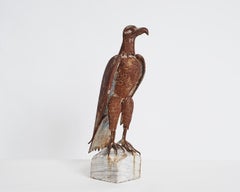
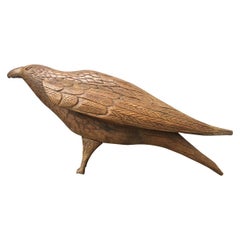
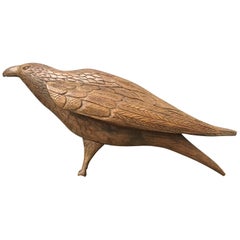
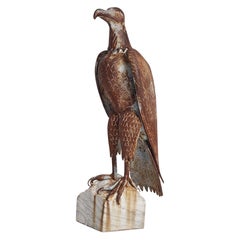
Ivan Bailey, Sculpture of a Resting Eagle, Steel & Granite, US, 20th Century

Ivan Bailey, Sculpture of a Resting Eagle, Steel & Granite, US, 20th Century

By Ivan Bailey

Located in New York, NY

Ivan Bailey, a native of Georgia, trained as a blacksmith. He went on to perform countless commissions, both public and private, in the fine arts, not limited to the Olympic Torch mo...

Category

Late 20th Century American Ivan Bailey Decorative Objects

Materials

Bronze

Related Items
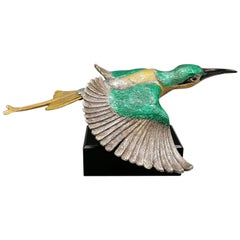
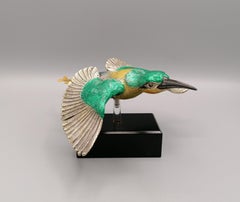
20th Century Italian Sculpture of a Bee Eater

20th Century Italian Sculpture of a Bee Eater

$213Sale Price|20% Off

H 6.3 in W 8.67 in D 6.3 in

20th Century Italian Sculpture of a Bee Eater

By Argenteria Etruria

Located in VALENZA, IT

Resin sculpture depicting the Bee-Eater covered in pure 999 silver. Made by the Etruria silver factory in Florence at the end of the 20th century. The finish is hand-enameled in gree...

Category

1990s Italian Other Ivan Bailey Decorative Objects

Materials

Silver Leaf

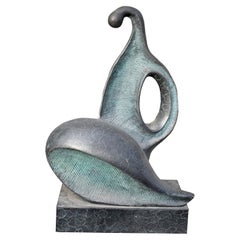
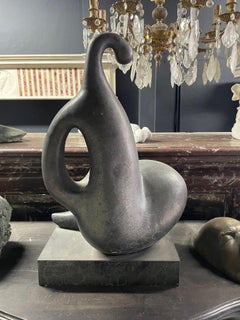
20th Century Abstract Bronze Sculpture

20th Century Abstract Bronze Sculpture

$2,138Sale Price|20% Off

H 23.63 in W 17.72 in D 9.06 in

20th Century Abstract Bronze Sculpture

Located in Bagshot, GB

A fantastic piece of abstract art in the form of a bronze sculpture. With sharp casting in the form of a shell motif and figurine and with a great verdi gris patina.

Category

Mid-20th Century European Mid-Century Modern Ivan Bailey Decorative Objects

Materials

Bronze

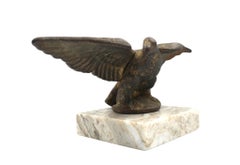
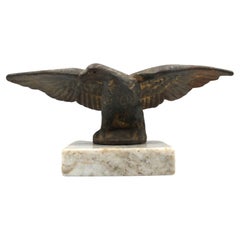
Vintage Cast-Iron Eagle Sculpture, Early 20th Century

Vintage Cast-Iron Eagle Sculpture, Early 20th Century

Located in Colorado Springs, CO

This is a cast-iron figural eagle doorstop, circa early 20th century. The eagle is depicted with wings spread wide, perched and mounted to a square marble base. The eagle retains traces of its original gilt surface and is embossed with “F.O.E.” at its midsection, possibly referring to the Fraternal Order of Eagles.   The eagle is both the national bird and the national animal of the United States. The eagle motif has been widely used throughout American history, most notably as part of our Great Seal. The founders of the United States were fond of comparing their new republic with the Roman Republic, in which eagle imagery, usually the golden eagle, was prominent. On June 20, 1782, the Continental Congress adopted the design for the Great Seal of the United States...

Category

Early 20th Century American Federal Ivan Bailey Decorative Objects

Materials

Marble, Iron

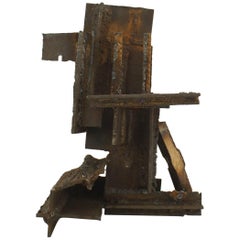
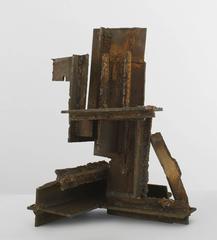
Mid-Century Modern Brutalist Steel Sculpture, USA, 20th Century

Mid-Century Modern Brutalist Steel Sculpture, USA, 20th Century

Located in Queens, NY

American Mid-Century Modern Brutalist sculpture of tortured and burnt welded steel.

Category

Mid-20th Century American Brutalist Ivan Bailey Decorative Objects

Materials

Steel

Vintage Bronze Eagle with Fish Sculpture, after Edward Chope, Late 20th Century

Vintage Bronze Eagle with Fish Sculpture, after Edward Chope, Late 20th Century

Located in Colorado Springs, CO

This is a bronze eagle on a marble base, after Edward Chope, circa late 20th century. The bronze sculpture depicts a majestic bald eagle with its wings fully spread open, soaring ove...

Category

Late 20th Century Ivan Bailey Decorative Objects

Materials

Bronze

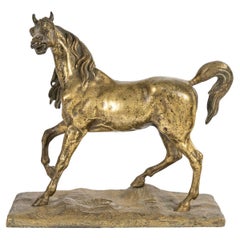
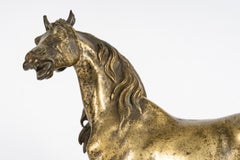
Bronze Sculpture of a Horse, 20th Century.

Bronze Sculpture of a Horse, 20th Century.

$1,893

H 8.27 in W 8.67 in D 3.55 in

Bronze Sculpture of a Horse, 20th Century.

Located in Saint-Ouen, FR

Bronze sculpture of a horse, 20th century. Early 20th century bronze sculpture of a horse. Dimensions : H: 21cm, W: 22cm, D: 9cm Contact us before ordering to confirm product avail...

Category

20th Century French Art Nouveau Ivan Bailey Decorative Objects

Materials

Bronze

Early 20th Century Bronze Sculpture of Elephants

Early 20th Century Bronze Sculpture of Elephants

$1,657

H 7.88 in W 16.54 in D 6.3 in

Early 20th Century Bronze Sculpture of Elephants

By Antonio Amorgasti 1

Located in Antwerp, BE

Early 20th century bronze sculpture of two elephants with a patinated bronzed finish. The base signed Ant.Amorgasti, 1924. Antonio Amorgasti,(18...

Category

1920s Belgian Art Deco Vintage Ivan Bailey Decorative Objects

Materials

Bronze

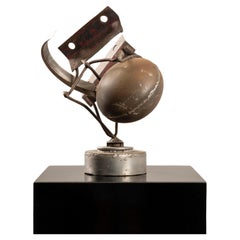
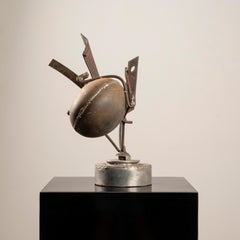
Claude Viseux, Abstract Sculpture, Late 20th Century, Steel

Claude Viseux, Abstract Sculpture, Late 20th Century, Steel

$1,799Sale Price|20% Off

H 21.26 in Dm 15.75 in

Claude Viseux, Abstract Sculpture, Late 20th Century, Steel

By Claude Viseux

Located in SAINT-SEVER, FR

Claude Viseux est un peintre, sculpteur et graveur aquafortiste et lithographe français né le 3 juillet 1927 à Champagne-sur-Oise et mort le 9 novembre 2008 à Anglet. 'est dans les années 1959-1960 que la sculpture de Claude Viseux, qualifiée de « protéiforme, onirique, fantastique » — ami de Max Ernst, Man Ray, Francis Ponge et Henri Michaux, il ne désavoue pas une parenté avec le Surréalisme9 — se substitue à la peinture, ses premières réalisations étant les objets trouvés en bord de mer qu'il pétrifie dans la cire10 d'une part, les empreintes de pierres et d'algues coulées en bronze d'autre part. En 1960, il signe le Manifeste des 121 titré « Déclaration sur le droit à l’insoumission dans la guerre d’Algérie ». En 1961, ses expérimentations s'orientent vers les corps organiques, notamment avec sa série Ostéales constituée d'assemblages d'os fossilisés qu'il patine ou au contraire décape, qu'il visse, scie, assemble et plastifie. Les Concrétudes ou Coulées directes qui suivent en 1961-1962 sont obtenues à partir de coulées de métal en fusion dans le sable, générant des reliefs qu'il soude sur des plaques d'acier. Il va cependant adopter rapidement l'acier inoxydable — qu'il est avec Pol Bury parmi les premiers à employer en sculpture — comme matériau de prédilection. « Il assemble divers rebus industriels — tuyaux, écrous, boulons, cuves… — pour créer des sculptures à mi-chemin du mécanique et du biologique » restitue ainsi Sophie Serra11. Claude Viseux, qui fréquente alors Jean Tinguely, Piotr Kowalski, Michel Guino, Takis et César, confirme : « Ma récupération de l'élément industriel s'élargit vers les aciers spéciaux, avec un essai de vocabulaire formel : des barres, des profilés, des sphères, des rotules, des fonds de cuves, des chambres à combustion de Boeing, des tubulures, des soupapes de navire »9. « L'artiste entre au cœur de la réalité industrielle, prospecte dans les chaînes de montage de Renault et rôde dans les terrains vaques autour des usines », restitue donc l'encyclopédie Les Muses : « il récupère ferrailles, pièces détachées, débris de voitures, vieux châssis, toute une série d'éléments devenus inutiles. Ils les assemblent, tels quels, sans les modifier. Des créatures agressives ou pathétiques vont surgir de ce combat physique et dialectique que l'artiste livre avec la matière et entrer dans le domaine d'une poétique étrange, surnaturelle5 ». Dans les années 1967-1970, Les « structures actives » en acier inoxydable procèdent ainsi de la production industrielle de série. Elles se répartissent en familles de formes combinatoires composées par addition, soustraction, multiplication, division. Il confirme : « le monde industriel est ma nature, mon bouillon de culture, où je cherche des corps, des familles de corps, des genres, des espèces, dans un aller-retour de l'artificiel au naturel pour confondre les règnes, pour en inventer d'autres selon une géométrie organique qui féconde les différents types de structures, qui aménage la forme concernée par la forme à venir »9. En 1968, Claude Viseux s'installe à la villa Baudran à Arcueil, atelier qu'il conservera jusqu'en 1992. Si des corps imaginaires naissent ainsi des pièces mécaniques que Claude Viseux emprunte à l'automobile, à l'avion et au bateau, en 1972, « la symétrie de ces formes pures en inox », constate Lydia Harambourg, « l'amène à s'interroger sur la notion d'équilibre instable »12. Ses Instables sont de la sorte exposés à la Biennale de Venise en 1972 où, rappelle encore Lydia Harambourg, une salle entière est consacrée « aux dessins qui reprennent son vocabulaire mécanique identitaire de sphères, toupies, hélices, anneaux, astrolabes et balanciers »12. Les Instables sont de même, en 1973, présentés à la galerie Le Point cardinal à Paris où Claude Viseux avait déjà exposé en 1968 avec Henri Michaux et Joaquin Ferrer...

Category

1960s French Vintage Ivan Bailey Decorative Objects
Materials

Stainless Steel

Resting Dancer Bronze Statue of a Lady Resting. French mid 20th Century

Resting Dancer Bronze Statue of a Lady Resting. French mid 20th Century

Located in Amsterdam, Noord Holland

Lovely Bronze Statue Condition Condition is Perfect: Size 27.5cm Period 20th century

Category

20th Century French Ivan Bailey Decorative Objects
Materials

Bronze

Ivan Bailey decorative objects for sale on 1stDibs.

Ivan Bailey decorative objects are available for sale on 1stDibs. These distinctive items are frequently made of metal and are designed with extraordinary care. There are many options to choose from in our collection of Ivan Bailey decorative objects, although gold editions of this piece are particularly popular. If you’re looking for additional options, many customers also consider decorative objects by Larry Mohr, Irving Harper, and Silas Seandel. Prices for Ivan Bailey decorative objects can differ depending upon size, time period and other attributes — on 1stDibs, these items begin at $6,000 and can go as high as $6,000, while a piece like these, on average, fetch $6,000.