James Peter Quinn Art

Australian, 1869-1951

James Peter Quinn was born on 4 December 1869 at 60 Bourke Street, Melbourne. He was the third son of John Quinn, a restaurant-keeper born in Antigua, West Indies and his English wife Ann née Long. Little is known of Quinn's childhood and early education, both parents died when he was young. His guardians apprenticed him to an engraver, but he undertook part-time studies at the school of design, National Gallery of Victoria, under Frederick McCubbin in 1887–89 and at the school of painting under George Folingsby and Lindsay Bernard Hall in 1890–93. Awarded several student prizes, he won the gallery's traveling scholarship in 1893. Quinn went to London in 1894, but quickly left for Paris, where he studied at the Académie Julian, Académie des Beaux-Arts under Jean-Paul Laurens and with Colarossi and Delécluse. He returned to London about 1902 and married fellow art-student Blanche Louise Guernier there on 29th September. By 1904, he had exhibited with the Royal Academy of Arts and went on to establish a reputation as a highly successful portrait painter. His finest and most sensitive work was produced before 1910. His family was the subject of many paintings, including Mère et Fils, awarded an honorable mention at the Old Salon, Paris, in 1912. Quinn also painted many self-portraits. His many commissioned works included portraits of Joseph Chamberlain, the Duchess of York and later, the Duke of Windsor. In 1918–19, he was an official war artist with the Australian Imperial Force in France and exhibited war paintings at the Grafton Galleries, London. In 1919, with George Coates, he was an official artist to the Canadian War Records. He was a council-member of the London Portrait Society and a member of the Royal Society of Portrait Painters and the Royal Institute of Oil Painters, exhibiting regularly with them and the Royal Academy and in Paris with the Old and New salons. Quinn's sudden return to Australia in December 1935, alone, followed the death of his gifted artist-son René. He held exhibitions at the Fine Art Society's Gallery, Melbourne, in 1936 and the Royal South Australian Society of Arts Gallery next year. Quinn ostensibly returned as an acclaimed artist, was invited to rejoin the Victorian Artists' Society he had joined first in 1888 and was its president (but for one year) in 1937–50. Yet a coolness existed. Though he had little in common with the modernist painters of the period, his commitment to a tolerant brotherhood of artists found no allies among the aggressive conservative old guard. In 1937, he clashed publicly with (Sir) Robert Menzies who in opening a V.A.S. exhibition denigrated modern art. Despite the affection felt for him by many artists and students, Quinn was somewhat isolated. He continued to exhibit, winning the Crouch Prize, Ballarat Fine Art Gallery, in 1941. In the mid-1940s, he taught briefly at the National Gallery school. A lover of good food, wine and conversation, Quinn delighted in mixing with all classes. Frequenting the haunts of journalists, writers and the more Bohemian fringe, he was easily recognizable with his bow tie, grey curly hair and a cigarette dangling from the corner of his mouth. Survived by one son, he died of cancer on 18th February 1951 at Prahran and was buried in St Kilda cemetery. His war portraits are held by the Australian War Memorial, Canberra and he is represented in most Australian public collections and major galleries throughout the world.

to
2
2
Overall Width
to
Overall Height
to
2
2
1
2
2
2
2
10,491
2,809
2,500
1,414
2
2
Artist: James Peter Quinn
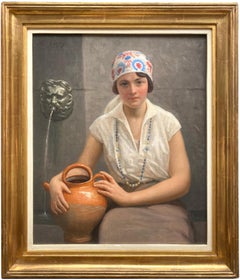
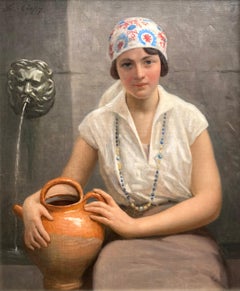
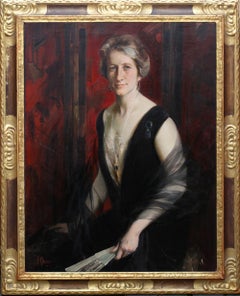
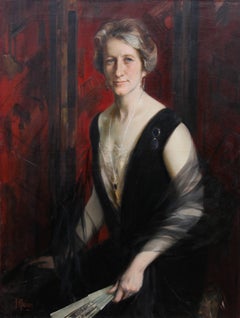
Portrait of Violet Ann Gilbert - British 1920s art oil painting exh Paris Salon

Portrait of Violet Ann Gilbert - British 1920s art oil painting exh Paris Salon

By James Peter Quinn

Located in Hagley, England

A stunning portrait oil painting of Violet Ann Gilbert which was painted by James Peter Quinn in 1929 and was exhibited at The Paris Salon of that year. A beautiful portrait of a young woman from the nineteen twenties. In excellent condition and framed in the original period frame. This is a fine painting by a noted listed artist and a great example of an early 20th century portrait painting. Signed lower left. Provenance. Exhibited at the Paris Salon 1929, labels verso. Condition. Oil on canvas in excellent condition, image size 40 inches by 30 inches. Housed in its original gallery frame, framed size is 47 by 37 inches. Excellent condition. James Peter Quinn (1869-1951) was born on 4 December 1869 at 60 Bourke Street, Melbourne, third son of John Quinn, restaurant-keeper born in Antigua, West Indies, and his English wife Ann, née Long. Little is known of Quinn's childhood and early education; both parents died when he was young. His guardians apprenticed him to an engraver, but he undertook part-time studies at the school of design, National Gallery of Victoria, under Frederick McCubbin in 1887-89, and at the school of painting under George Folingsby and Bernard Hall in 1890-93. Awarded several student prizes, he won the gallery's travelling scholarship in 1893. Quinn went to London in 1894 but quickly left for Paris where he studied at the Académie Julian, at the Académie des Beaux-Arts under Jean Paul Laurens, and with Colarossi and Delécluse. He returned to London about 1902 and married fellow art-student Blanche Louise Guernier there on 29 September. By 1904 he had exhibited with the Royal Academy of Arts and went on to establish a reputation as a highly successful portrait painter. His finest and most sensitive work was produced before 1910. His family were the subjects of many paintings, including 'Mère et Fils', awarded an honourable mention at the Old Salon, Paris, in 1912. He also painted many self-portraits. His many commissioned works included portraits of Joseph Chamberlain, the Duchess of York and, later, the Duke of Windsor. In 1918-19 he was an official war artist with the Australian Imperial Force in France, and exhibited war paintings at the Grafton Galleries, London. In 1919, with George Coates, he was an official artist to the Canadian War Records. He was a council-member of the London Portrait Society, and a member of the Royal Society of Portrait Painters and the Royal Institute of Oil Painters, exhibiting regularly with them and the Royal Academy, and in Paris with the Old and New salons. Quinn's sudden return to Australia in December 1935, alone, followed the death of his gifted artist-son René. He held exhibitions at the Fine Art Society's Gallery, Melbourne, in 1936 and the Royal South Australian Society of Arts Gallery the next year. Quinn ostensibly returned as an acclaimed artist, was invited to rejoin the Victorian Artists' Society he had joined first in 1888, and was its president (but for one year) in 1937-50. Yet a coolness existed. Though he had little in common with the modernist painters of the period, his commitment to a tolerant brotherhood of artists found no allies among the aggressively conservative old guard. In 1937 he clashed publicly with (Sir) Robert Menzies who in opening a V.A.S. exhibition denigrated modern art. In spite of the affection felt for him by many artists and students, Quinn was somewhat isolated. He continued to exhibit, winning the Crouch prize, Ballarat Fine Art Gallery, in 1941. In the mid-1940s he taught briefly at the National Gallery school. A lover of good food, wine and conversation, Quinn delighted in mixing with all classes. Frequenting the haunts of journalists, writers and the more Bohemian fringe, he was easily recognizable with his bow tie, grey curly hair and cigarette dangling from the corner of his mouth. Survived by one son, he died of cancer on 18 February 1951 at Prahran and was buried in St Kilda cemetery. His war portraits are held by the Australian War...

Category

1920s Art Deco James Peter Quinn Art

Materials

Oil

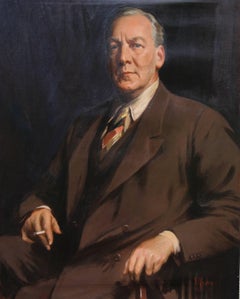
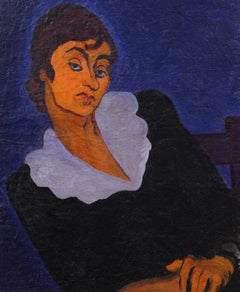
Portrait John Gilbert - Australian 20's exhibited art male portrait oil painting

Portrait John Gilbert - Australian 20's exhibited art male portrait oil painting

By James Peter Quinn

Located in Hagley, England

A stunning portrait of Mr John Gilbert. This original oil on canvas was painted by James Peter Quinn in 1929 and was exhibited at The Paris Salon of that year. A fine portrait, it is in excellent condition and framed in the original period frame. This is a fine painting by a noted Australian listed artist. Signed right. Provenance. Exhibited at the Paris salon 1929. Condition. Oil on canvas in very good condition, image size 40 inches by 30 inches. Housed in its original gallery frame, 47 by 37 inches framed. Excellent condition. James Peter Quinn (1869-1951) was born on 4 December 1869 at 60 Bourke Street, Melbourne. He was the third son of John Quinn, restaurant-keeper born in Antigua, West Indies, and his English wife Ann, née Long. Little is known of Quinn's childhood and early education; both parents died when he was young. His guardians apprenticed him to an engraver, but he undertook part-time studies at the school of design, National Gallery of Victoria, under Frederick McCubbin in 1887-89, and at the school of painting under George Folingsby and Bernard Hall in 1890-93. Awarded several student prizes, he won the gallery's travelling scholarship in 1893. Quinn went to London in 1894 but quickly left for Paris where he studied at the Académie Julian, at the Académie des Beaux-Arts under Jean Paul Laurens, and with Colarossi and Delécluse. He returned to London about 1902 and married fellow art-student Blanche Louise Guernier there on 29 September. By 1904 he had exhibited with the Royal Academy of Arts and went on to establish a reputation as a highly successful portrait painter. His finest and most sensitive work was produced before 1910. His family were the subjects of many paintings, including 'Mère et Fils', awarded an honourable mention at the Old Salon, Paris, in 1912. He also painted many self-portraits. His many commissioned works included portraits of Joseph Chamberlain, the Duchess of York and, later, the Duke of Windsor. In 1918-19 he was an official war artist with the Australian Imperial Force in France, and exhibited war paintings at the Grafton Galleries, London. In 1919, with George Coates he was an official artist to the Canadian War Records. He was a council-member of the London Portrait Society, and a member of the Royal Society of Portrait Painters and the Royal Institute of Oil Painters, exhibiting regularly with them and the Royal Academy, and in Paris with the Old and New salons. Quinn's sudden return to Australia in December 1935, alone, followed the death of his gifted artist-son René. He held exhibitions at the Fine Art Society's Gallery, Melbourne, in 1936 and the Royal South Australian Society of Arts Gallery next year. Quinn ostensibly returned as an acclaimed artist, was invited to rejoin the Victorian Artists' Society he had joined first in 1888, and was its president (but for one year) in 1937-50. Yet a coolness existed. Though he had little in common with the modernist painters of the period, his commitment to a tolerant brotherhood of artists found no allies among the aggressively conservative old guard. In 1937 he clashed publicly with (Sir) Robert Menzies who in opening a V.A.S. exhibition denigrated modern art. In spite of the affection felt for him by many artists and students, Quinn was somewhat isolated. He continued to exhibit, winning the Crouch prize, Ballarat Fine Art Gallery, in 1941. In the mid-1940s he taught briefly at the National Gallery school. A lover of good food, wine and conversation, Quinn delighted in mixing with all classes. Frequenting the haunts of journalists, writers and the more Bohemian fringe, he was easily recognizable with his bow tie, grey curly hair and cigarette dangling from the corner of his mouth. Survived by one son, he died of cancer on 18 February 1951 at Prahran and was buried in St Kilda cemetery. His war portraits are held by the Australian War...

Category

1920s Realist James Peter Quinn Art

Materials

Oil

Related Items
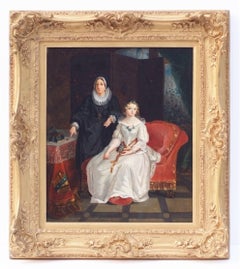
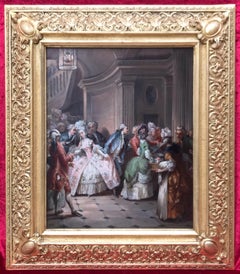
Painting 19th century  French School Genre Scene Interior Portrait

Painting 19th century French School Genre Scene Interior Portrait

Located in Saint-Ouen, FR

French School 19th century Close to François Xavier FABRE (1766-1837) The Princess and The Chaperone Oil on canvas One can read on the reverse "Fabre Fecit" and the name and address of the canvas dealer shop...

Category

1850s Academic James Peter Quinn Art

Materials

Oil

Gerberas - Contemporary Figurative Oil Painting, Realistic Little Girl Portrait

Gerberas - Contemporary Figurative Oil Painting, Realistic Little Girl Portrait

By Kamil Lisek

Located in Salzburg, AT

KAMIL LISEK (born in 1980) Studied under the guidance of prof. Maciej Świeszewski at the faculty of painting at the Academy of Fine Arts in Gdansk. He graduated with distinction obta...

Category

2010s Realist James Peter Quinn Art

Materials

Canvas, Oil, Linen

Antique European Signed Impressionist Large Framed Woman Portrait Oil Painting

Antique European Signed Impressionist Large Framed Woman Portrait Oil Painting

Located in Buffalo, NY

Antique European impressionist oil painting. Oil on canvas. Signed. Framed. Provenance from a Sag Harbor, NY collection. Handsomely framed in period giltwood molding. Excellent cond...

Category

1890s Impressionist James Peter Quinn Art

Materials

Oil, Canvas

“Portrait of a North African Man, 1872” Orientalist Portrait Black Model 19th C.

“Portrait of a North African Man, 1872” Orientalist Portrait Black Model 19th C.

Located in Yardley, PA

“Portrait of a North African Man, 1872” by August Holmberg (1851-1911) This striking oil painting by the German painter, August Holmberg, depicts a richly detailed and intimate port...

Category

1870s Realist James Peter Quinn Art

Materials

Oil, Paper, Canvas

Signed Oil on Canvas Painting of Gentleman, Circa 2000, 90x60 cm

Signed Oil on Canvas Painting of Gentleman, Circa 2000, 90x60 cm

By Fernando Botero

Located in Sitges, Barcelona

Title: Gentleman in Interior (After Fernando Botero) Artist: Sanz (Spanish painter, active late 20th – early 21st century) Year: circa 2000 Medium: Oil on canvas Dimensions (unfr...

Category

Early 2000s Contemporary James Peter Quinn Art

Materials

Oil

''Mother and Child in Zeeland' by Julien Celos (1884 – Antwerp – 1953)

''Mother and Child in Zeeland' by Julien Celos (1884 – Antwerp – 1953)

Located in Knokke, BE

Julien Celos 1884 – Antwerp – 1953 Belgian Painter 'Mother and Child in Zeeland' Signature: signed lower middle left 'Julien Célos' Medium: oil on canvas Dimensions: image size 64 x 52 cm; frame size 84 x 73 cm Biography: Julien Célos (Antwerp, 30 September 1884 – 8 September 1953) was a Belgian painter and etcher, born to a French father, celebrated for his poetic views of Flemish towns and his remarkable colour prints. He trained at the Royal Academy of Fine Arts in Antwerp under Franz Courtens and also benefited from the teaching of Albert Baertsoen, whose influence is evident in his taste for urban atmospheres, misty canals and subtle tonalities. Working at a time when luminism shaped much Belgian painting, Célos adopted certain aspects of its research into light and atmospheric effects while maintaining a distinctive, calm and lyrical sensibility. The greater part of his output was devoted to rural landscapes and the towns of Belgian Flanders—Bruges, Mechelen, Ghent and Antwerp—as well as Zeeland in the Netherlands and various regions of France. Bruges and Mechelen occupied a privileged place in his iconography: beguinages, narrow alleys, silent quays and ancient squares became the motifs of an intimate and timeless painting. He also travelled in Brittany and spent several months in Tunisia on a study trip. Alongside his painting, Julien Célos developed an important body of graphic work, notably colour etchings published by prestigious firms such as Georges Petit in Paris, Dietrich in Brussels and Caspers in Berlin. In both technique and subject matter, his work is comparable to that of artists such as Emmanuel Viérin. Highly active in Belgian artistic circles, he was a member of the Antwerp artists’ association Als Ik Kan, founded in 1883 and active until 1952, as well as of the committee of La Gravure Originale Belge. Even before the First World War, Julien Célos enjoyed notable critical recognition. In 1907 he took part in the Exposition Générale des Beaux-Arts in Brussels, presenting oils, etchings, pastels and drawings, including En ville morte, Automne and L’Église à Veere. The following year he received an honourable mention at the Salon des Artistes Français. In 1914 he again exhibited in Brussels and at the Cercle Artistique et Littéraire, where the press praised the poetry of his urban views and the excellence of his colour etchings. Like many Belgian artists, he lived in exile in England and the Netherlands during the First World War. This period was marked by intense exhibition activity: in 1915 he participated in a major exhibition in Brighton devoted to the new Belgian painting, alongside James Ensor, Félicien Rops, Emile Claus, Albert Baertsoen and Théo van Rysselberghe, where he was described as “one of the finest artists in interpreting the picturesque character of small Flemish towns.” That same year his works were shown at the Royal Institute in London and in a solo exhibition of forty-five pieces at the Goupil Gallery. In 1917 he exhibited in Amsterdam with Alfred Van Neste...

Category

Early 20th Century Impressionist James Peter Quinn Art

Materials

Canvas, Oil

‘Oriental Girls - Mediants à Tanger’ by Jean François Portaels (1818 - 1895)

‘Oriental Girls - Mediants à Tanger’ by Jean François Portaels (1818 - 1895)

Located in Knokke, BE

Jean François Portaels 1818 - Brussels - 1895 Belgian Painter ‘Oriental Girls - Mediants à Tanger, Maroc’ Signature: signed lower right ‘J. Portaels’ Medium: oil on canvas Dimensions: image size 40,5 x 28,5 cm, frame size 67,5 x 56 cm Biography: Jean François Portaels, also known as Jan Portaels, was a versatile Belgian painter born on April 3, 1818, in Vilvoorde and passed away on February 8, 1895, in Schaerbeek. He was celebrated for his genre scenes, biblical stories, landscapes, portraits, and Orientalist subjects. As a teacher and director of the Academy of Fine Arts of Ghent and the Académie Royale des Beaux-Arts in Brussels, Portaels significantly impacted Belgian art, becoming a pivotal figure in the Belgian Orientalist school. His works were known for their 'everyday elegance and feminine grace,' and he played a crucial role in influencing the next generation of Belgian artists, including notable figures like Théo van Rysselberghe. Portaels was the son of a wealthy brewer who also served as Vilvoorde's mayor. Showing an early passion for drawing, he was sent to the Académie Royale des Beaux-Arts in Brussels in 1836, where he studied under François-Joseph Navez, a former student of Jacques-Louis David. Navez invited him to his studio, which was renowned at the time, allowing Portaels to refine his skills alongside other talented students like Charles de Groux and Joseph Stallaert. In 1841, Portaels moved to Paris, enrolling at the Ecole des Beaux-Arts and studying under Paul Delaroche. He became influenced by the emerging Orientalist movement, which was gaining traction in Paris. In 1842, he won the Grand Prix de Rome, which funded his travels across Italy and other regions, including Morocco, Algeria, Egypt, Lebanon, Judea, Spain, Hungary, and Norway. These journeys profoundly influenced his artistic vision, particularly his Orientalist works. Upon his return to Belgium in 1847, Portaels was appointed Director of the academy in Ghent. In 1849, he married Marie Hélène Navez, the daughter of his first teacher. Despite being offered the directorship of the Brussels Academy, he initially declined, opting to preserve his independence. He later accepted a teaching position at the Academy and eventually became its director in 1878, succeeding Eugène Simonis. Portaels was known for his broad range of artistic talents, including history painting, portraiture, and genre art. He was particularly recognised for his Orientalist depictions, often portraying the 'Oriental woman' with distinctive features like arched eyebrows and almond-shaped eyes. His style, marked by charm and elegance, distinguished him from the dominant artistic movements of Classicism and Romanticism. He was a pioneer in monumental art in Belgium, working with Jean Baptiste van Eycken to introduce fresco techniques like water glass painting...

Category

Late 19th Century Impressionist James Peter Quinn Art

Materials

Oil, Canvas

“A Mulatto Girl, 1879” Portrait Young Mixed Race Girl British 19th Century Oil

“A Mulatto Girl, 1879” Portrait Young Mixed Race Girl British 19th Century Oil

Located in Yardley, PA

“A Mulatto Girl, 1879” by Walter Scott Boyd (British, c. 1860-c. 1950) The identity of this young girl is presently unknown; however, the title of the work reveals some information ...

Category

1870s Realist James Peter Quinn Art

Materials

Canvas, Oil

1930's French Post Impressionist Signed Portrait Lady Artists Studio Interior

1930's French Post Impressionist Signed Portrait Lady Artists Studio Interior

By Antique French

Located in Cirencester, Gloucestershire

The Artists Model by Fernand LABAT (French, circa 1930's) signed lower right oil on canvas, unframed canvas: 20 x 24 inches Provenance: private collection, France Condition: the ca...

Category

Mid-20th Century French School James Peter Quinn Art

Materials

Oil

Previously Available Items
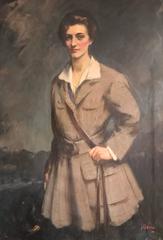
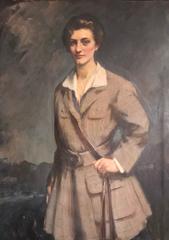
1920's Society Portrait Scottish Sporting Lady

1920's Society Portrait Scottish Sporting Lady

By James Peter Quinn

Located in Cirencester, Gloucestershire

"The Sporting Lady" by James Peter Quinn (Australian 1869-1951) signed lower right oil painting on canvas canvas: 131cm x 90cm Provenance: private collection, England Very fine original painting by the well listed Australian portrait artist, James Peter Quinn (1869-1951). The painting is signed to the lower right corner and has the artists London address verso. The painting depicts this three-quarter length portrait of a young 'society lady', standing with her black labrador beside her. The work has a sporting theme to it, with the lady dressed in a hunting jacket with a slight Scottish flavour to it and suggestion of a tartan in there too. She is likely depicted standing on a grouse moor...

Category

Early 20th Century Impressionist James Peter Quinn Art

Materials

Oil

James Peter Quinn art for sale on 1stDibs.

Find a wide variety of authentic James Peter Quinn art available for sale on 1stDibs. You can also browse by medium to find art by James Peter Quinn in oil paint, paint and more. Much of the original work by this artist or collective was created during the 1920s and is mostly associated with the Art Deco style. Not every interior allows for large James Peter Quinn art, so small editions measuring 37 inches across are available. Customers who are interested in this artist might also find the work of Robert Gemmell Hutchison, Goyo Dominguez, and Bruce Cohen. James Peter Quinn art prices can differ depending upon medium, time period and other attributes. On 1stDibs, the price for these items starts at $8,919 and tops out at $22,934, while the average work can sell for $15,927.

Artists Similar to James Peter Quinn