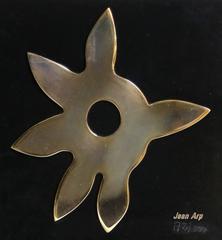
By Jean Arp
Located in Surfside, FL
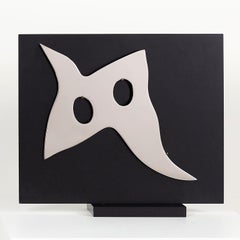
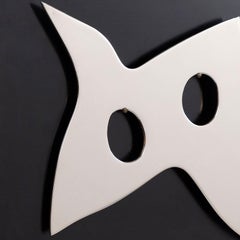
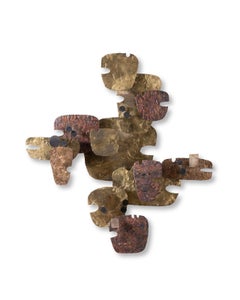
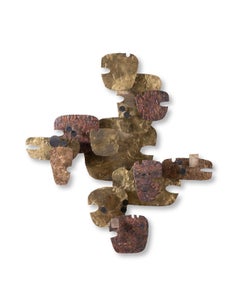
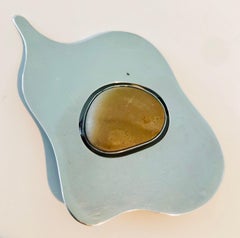
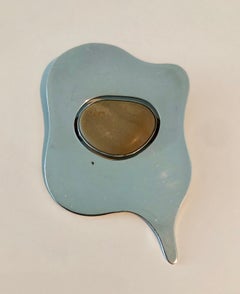
Sterling silver pendant or brooch (it is designed to be worn either way) biomorphic, abstract form set with a buff colored river pebble. Designed by Jean Hans Arp and fabricated by Johanaan Peter of the Ein Hod artists village (founded by Dada artist Marcel Janco) from the limited edition of 100.
Hallmark: stamped on the reverse: PETER EIN-HOD, MADE IN ISRAEL, ST925 DESIGN BY Arp, 55/100
Jean Arp or Hans Arp (16 September 1886 – 7 June 1966) was a German-French sculptor, painter, poet, and abstract artist in other media such as torn and collage pasted paper.
Arp was born in Strasbourg, the son of a French mother and a German father, during the period following the Franco-Prussian War when the area was known as Alsace-Lorraine (Elsass-Lothringen in German) after France had ceded it to Germany in 1871. Following the return of Alsace to France at the end of World War I, French law determined that his name become "Jean". Arp would continue referring to himself as "Hans" when he spoke German.
In 1904, after leaving the École des Arts et Métiers in Strasbourg, he went to Paris where he published his poetry for the first time. From 1905 to 1907, Arp studied at the Kunstschule in Weimar, Germany, and in 1908 went back to Paris, where he attended the Académie Julian. Arp was a founder-member of the Moderne Bund in Lucerne, participating in their exhibitions from 1911 to 1913.
In 1912, he went to Munich, called on Wassily Kandinsky, the influential Russian painter and art theorist, was encouraged by him in his researches and exhibited with the Der Blaue Reiter group. Later that year, he took part in a major exhibition in Zürich, along with Henri Matisse, Robert Delaunay and Kandinsky. In Berlin in 1913, he was taken up by Herwarth Walden, the dealer and magazine editor who was at that time one of the most powerful figures in the European avant-garde.
In 1915, he moved to Switzerland to take advantage of Swiss neutrality.
In 1916, Hugo Ball opened the Cabaret Voltaire, which was to become the center of Dada activities in Zurich for a group that included Arp, Marcel Janco, Tristan Tzara, and others. In 1920, as Hans Arp, along with Max Ernst and the social activist Alfred Grünwald, he set up the Cologne Dada group. However, in 1925, his work also appeared in the first exhibition of the surrealist group at the Galérie Pierre in Paris.
In 1926, Arp moved to the Paris suburb of Meudon. In 1931, he broke with the Surrealist movement to found Abstraction-Création, working with the Paris-based group Abstraction-Création and the periodical, Transition. Beginning in the 1930s, the artist expanded his efforts from collage and bas-relief to include bronze and stone sculptures. He produced several small works made of multiple elements that the viewer could pick up, separate, and rearrange into new configurations.
Throughout the 1930s and until the end of his life, he wrote and published essays and poetry. In 1942, he fled from his home in Meudon to escape German occupation and lived in Zürich until the war ended.
Arp visited New York City in 1949 for a solo exhibition at the Buchholz Gallery. In 1950, he was invited to execute a relief for the Harvard University Graduate Center in Cambridge, Massachusetts and would also be commissioned to do a mural at the UNESCO building in Paris.
In 1958, a retrospective of Arp's work was held at the Museum of Modern Art in New York City, followed by an exhibition at the Musée National d'Art Moderne, Paris, France, in 1962. Organized by the Minneapolis Institute of Arts and the Wurttembergischer Kunstverein of Stuttgart, a 150-piece exhibition titled "The Universe of Jean Arp" concluded an international six-city tour at the San Francisco Museum of Modern Art in 1986.
The Musée d'art moderne et contemporain of Strasbourg houses many of his paintings and sculptures.
Arp's career was distinguished with many awards including the Grand Prize for sculpture at the 1954 Venice Biennale, a sculpture prizes at the 1964 Pittsburgh International, the 1963 Grand Prix National des Arts, the 1964 Carnegie Prize, the 1965 Goethe Prize from the University of Hamburg, and then the Order of Merit with a Star of the German Republic.
Arp and his first wife, the artist Sophie Taeuber-Arp, became French nationals in 1926. In the 1930s, they bought a piece of land in Clamart and built a house at the edge of a forest. Influenced by the Bauhaus, Le Corbusier and Charlotte Perriand, Taeuber designed it. She died in Zürich in 1943. After living in Zürich, Arp was to make Meudon his primary residence again in 1946. Arp married the collector Marguerite Hagenbach (1902–1994), his long-time companion, in 1959. He died in 1966, in Basel, Switzerland.
The worlds of fashion, design, and art have long overlapped. The Surrealists were particularly keen on blurring the lines separating the creative fields, as a number of Surrealist artists dabbled in fashion and design, creating functional and wearable art. For example, Elsa Schiaparelli daring clothing designs were developed in collaboration with Salvador Dali and Jean Cocteau, and several other prominent Surrealist artists contributed to the fashion industry of their day. This is from the period of the wearable art movement when artists like Alexander Calder, Ibram Lassaw and Clare Falkenstein amongst many others were turning to jewelry as an expressive medium for their art.
Exhibited: International Exhibition of Modern Jewellery 1890-1961, The Worshipful Company of Goldsmiths, London 1961 (no. 21, another example); International Ausstellung Schmuck, Jewellery, Bijoux, Hessischer Landesmuseum in Darmstadt, Darmstadt 1964 (no. 2, another example); Jewelry by Contemporary Painters and Sculptors, Museum of Modern Art, New York 1967 (no. 3, another example); Private Passion. Artists Jewelry of the 20th Century, Stedelijk Museum 's-Hertogenbosch 2009 (no. 25 from the edition)
Literature: Jewelry by Contemporary Painters and Sculptors. R.S. Neu. 1967. #3.Martine Newby Haspeslagh, Sculpture to Wear. Jewellery by Post-War Painters and Sculptors, Didier Ltd...
Category
1960s Dada Jean Arp Sculptures