Jean-Baptiste-Camille Corot Paintings

French, 1796-1875
Corot was a French landscape and portrait painter as well as a printmaker who is considered a great master of landscape painting in the 19th century. A pivotal figure in landscape painting, his vast output (over 3,000 paintings) simultaneously references the Neo-Classical tradition and anticipates the plein-air innovations of Impressionism. In the spring of 1829, Corot came to Barbizon to paint in the Forest of Fontainebleau, he had first painted in the forest at Chailly in 1822. He returned to Barbizon in the autumn of 1830 and in the summer of 1831, where he made drawings and oil studies, from which he made a painting intended for the Salon of 1830. The Barbizon school of painters were part of an art movement towards Realism in art, which arose in the context of the dominant Romantic Movement of the time. The Barbizon school was active roughly from 1830 through 1870.
to
1
Overall Width
to
Overall Height
to
1
1
1
1
1
13
792
753
753
663
1
Artist: Jean-Baptiste-Camille Corot
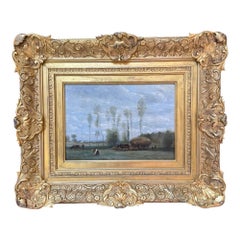
Jean-Baptiste-Camille Corot (French, 1796–1875) – Landscape with Figures and Cat

Jean-Baptiste-Camille Corot (French, 1796–1875) – Landscape with Figures and Cat

By Jean-Baptiste-Camille Corot

Located in Jacksonville, FL

A charming 19th-century oil on canvas by renowned French artist Jean-Baptiste-Camille Corot, depicting a peaceful pastoral landscape. The composition features grazing cattle, a hay w...

Category

19th Century American Realist Jean-Baptiste-Camille Corot Paintings

Materials

Oil

Related Items
"Summer Pier Fishing" American Scene Social Realism WPA Mid-20th Century Modern

"Summer Pier Fishing" American Scene Social Realism WPA Mid-20th Century Modern

By Syd Browne

Located in New York, NY

"Summer Pier Fishing" American Scene Social Realism WPA Mid-20th Century Modern Syd J. Browne (1907-1991) "Summer Pier Fishing" 22 x 30 inches Oil on canvas. c. 1930s Signed lower r...

Category

1930s American Realist Jean-Baptiste-Camille Corot Paintings

Materials

Canvas, Oil

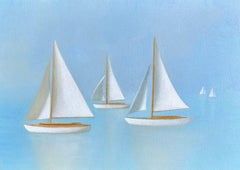
Sailboat Study No. 1

Sailboat Study No. 1

Located in Fairfield, CT

Born in Spokane, WA (1986), Tamalin Soleil Baumgarten paints quiet landscape scenes with a tonal, melancholic realism. She received her MFA from New York Academy of Art in 2015 and h...

Category

2010s American Realist Jean-Baptiste-Camille Corot Paintings

Materials

Oil, Panel

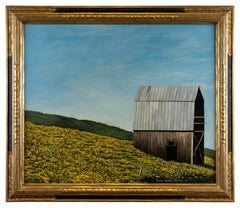
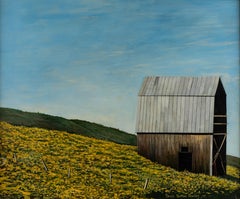
Barn, New Hampshire
Barn, New Hampshire

Barn, New Hampshire

Located in Sheffield, MA

Bruce Barton Penney American, born 1929 Barn on a Hill Oil on board 25 by 30 in, w/ frame 30 ¼ by 35 in Signed lower right, dated 64 Born Laconia, New Hampshire. Addresses: Kennebu...

Category

Mid-20th Century American Realist Jean-Baptiste-Camille Corot Paintings

Materials

Oil, Board

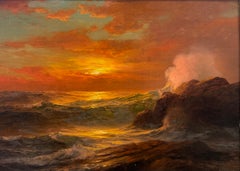
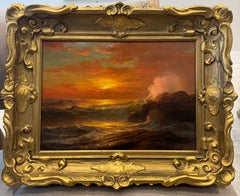
Red Sky
Red Sky

Warren W. SheppardRed Sky, 1910

$9,775

H 11 in W 14 in

Red Sky

By Warren W. Sheppard

Located in Greenville, DE

Spectacular example of Warren Sheppard's work, from what most consider his best period. Sunset (possibly, sunrise) executed with strong orange/red palette, and rock formations, maki...

Category

1910s American Realist Jean-Baptiste-Camille Corot Paintings

Materials

Canvas, Oil

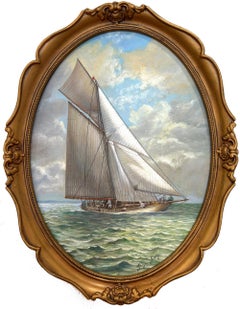
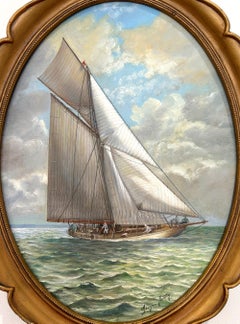
"Gaff Yacht on the Atlantic" American Oval Realist Oil Painting Miniature Detail

"Gaff Yacht on the Atlantic" American Oval Realist Oil Painting Miniature Detail

By Georgina Nemethy

Located in New York, NY

A Fine depiction of an Gaff Yachts in the open ocean. For this wonderful depiction of 19th Century sailing ships, Nemethy uses a Fine technique which depicts the figures on the boat ...

Category

Early 2000s American Realist Jean-Baptiste-Camille Corot Paintings

Materials

Canvas, Oil

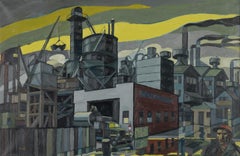
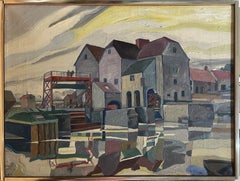
"Colonial Sand and Stone Company, New York, " Industrial WPA Scene, Precisionist

"Colonial Sand and Stone Company, New York, " Industrial WPA Scene, Precisionist

By William Sharp

Located in New York, NY

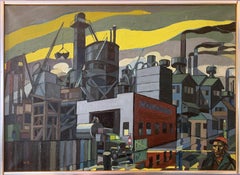
William Sharp (1900 - 1961) Factory on the River Oil on canvas 20 1/2 x 28 1/2 inches Initialed lower left: WS Provenance: Estate of the artist Private Collection, New York Swann Auction Galleries, American Art, June 13, 2019, Lot 178 Private Collection, New York Colonial Sand and Stone Co., founded by Generoso Pope, was once the country’s largest sand and gravel business, providing the concrete for much of New York City’s skyline, including the Empire State Building, Rockefeller Center, Radio City Music Hall, airports and subways. William Sharp was born on June 13, 1900, in Lemberg, Austria, where he attended college and the Academy for Arts and Industry. He later studied in Kraków, Poland, and in Berlin and Munich, Germany. Sharp began his career as a designer of stained-glass windows and as a painter of murals. He served in the German army during World War I. After the war he became a newspaper artist in Berlin and a well-known etcher. Sharp drew political cartoons that were bitterly critical of the growing Nazi movement. As the influence of National Socialism intensified, he began to contribute drawings, under a pseudonym, to publications that were hostile to Hitler. After Hitler assumed power, Sharp was confronted with these drawings and told that he would be sent to a concentration camp. However, in 1934, he escaped to the United States. His first newspaper assignment in America was making courtroom sketches for The New York Mirror...

Category

Mid-20th Century American Realist Jean-Baptiste-Camille Corot Paintings

Materials

Canvas, Paint, Oil

"Surrealist Violin" Photorealist Oil on Canvas Painting of Violin and Notes

"Surrealist Violin" Photorealist Oil on Canvas Painting of Violin and Notes

Located in New York, NY

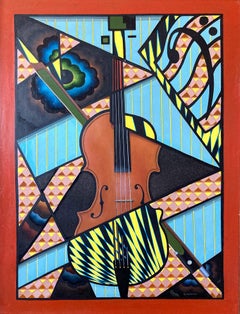
A surrealistic Nemethy from a brand new series which fuzes photorealism with surrealism in a most interesting current style. With the finest details, Nemethy creates an atmosphere th...

Category

2010s American Realist Jean-Baptiste-Camille Corot Paintings

Materials

Canvas, Oil

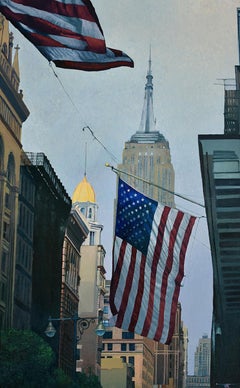
Idols e Flags

Idols e Flags

By David Leonard

Located in Fairfield, CT

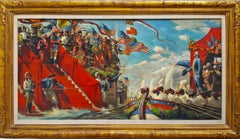
The primary subjects of my paintings are 21st century man's working monuments, which represent our culture's dedication to production and consumption. The essence of our way of life ...

Category

21st Century and Contemporary American Realist Jean-Baptiste-Camille Corot Paintings

Materials

Canvas, Oil

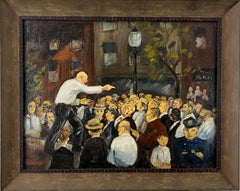
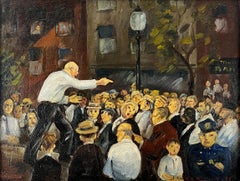
Communist Rally, Cleveland Public Square - Depression Era American Oil Painting

Communist Rally, Cleveland Public Square - Depression Era American Oil Painting

By Clyde Singer

Located in Marco Island, FL

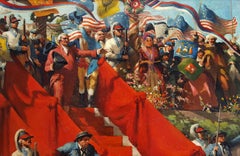
Painted during America's Great Depression (1929-1939), when Americans were looking for change and new ideas to navigate societal struggles. The young boy is looking away and uninterested in the passionate speaker. Also in the foreground is the police officer, who is there to keep the peace. This image was included in the exhibition and book titled Clyde Singer's America, Fig. 80. Oil Painting on board with conservation backing. Presented in a custom frame. The following is excerpted from an article by Elizabeth McClelland, published in "Little Bits of History, Clyde Singer, American Scene Painter" in TIMELINE, December 1966, a publication of the Ohio Historical Society. Born in Malvern, Ohio, forty miles south of Akron, Clyde Singer became known for his regionalist paintings in oil and watercolor of people at carnivals, standing in bars, on windy street corners, celebrating holidays, or looking at pictures in a gallery. Many of his works are small, ones he calls his "bread and butter...

Category

1930s American Realist Jean-Baptiste-Camille Corot Paintings

Materials

Oil, Board

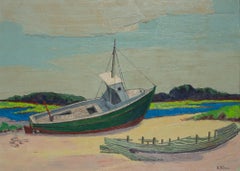
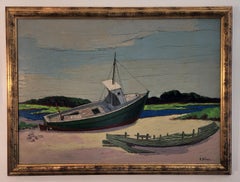
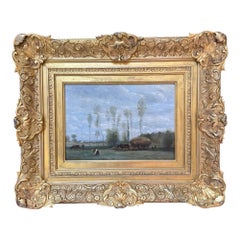
"Low Tide at Noon, Wellfleet, Massachusetts, " Ernest Fiene, WPA, Boat on Beach

"Low Tide at Noon, Wellfleet, Massachusetts, " Ernest Fiene, WPA, Boat on Beach

By Ernest Fiene

Located in New York, NY

Ernest Fiene (1894 - 1965) Low Tide at Noon, Wellfleet, Massachusetts Oil on canvas 26 x 36 inches Signed lower right Ernest Fiene was born in Elberfeld, Germany in 1894. As a teenager, Fiene immigrated to the United States in 1912. He studied art at the National Academy of Design in New York City from 1914 to 1918, taking day classes with Thomas Maynard and evening classes with Leon Kroll. Fiene continued his studies at the Beaux-Arts Institute of Design in Paris from 1916 to 1918, adding classes in printmaking at the Art Students League in 1923. Fiene began his career as an artist in 1919 with his first exhibition of watercolors at the MacDowell Club arranged by his mentor Robert Henri. In 1923 the Whitney Studio Club mounted a large exhibition of his works. The following year he had an exhibition at the New Gallery in New York, which completely sold out all fifty-two works, including paintings, watercolors, drawings, and etchings. With the proceeds of sales from the New Gallery exhibition, Ernest Fiene and his younger brother Paul, a sculptor, built studios in Woodstock, New York in 1925. In the early Twenties Ernest Fiene painted mostly landscapes of Woodstock and both the Ramapo and Hudson River Valleys. He was the subject of the first monograph for the Younger Artists Series in 1922. Published in Woodstock, the series went on to include Alexander Brook, Peggy Bacon, and Yasuo Kuniyoshi. The book reproduced 1 illustration in color and another 27 reproductions in black and white. Around 1925 Fiene became fascinated with the intensity, excitement, and opportunities for color harmonies New York City offered as a subject. His paintings shifted to urban and industrial themes with architecture, industry, and transportation becoming his subjects. By 1926 Fiene had attracted the dealer Frank K.M. Rehn, who gave him a one-man exhibition that year, which travelled to the Boston Arts Club. C.W. Kraushaar Galleries gave Fiene a one-man exhibition of urban, landscape, portrait, and still life paintings in 1927. Julianna Force, the director of the Whitney Studio Club and first director of the Whitney Museum of American Art, included two of Fiene's paintings in a fall exhibition in 1928. The Whitney Studio Club showed Fiene's paintings in a two-man exhibition with Glenn O. Coleman that year and acquired three of Fiene's paintings. Also in 1928 Fiene became affiliated with Edith Halpert's Downtown Gallery where he had an exhibition of 20 lithographs in the spring. Fiene sold his house in Woodstock in 1928 to spend more of his time in New York City. With so many successful exhibitions, Fiene returned to Paris in 1928-29 where he rented Jules Pascin's studio and studied at the Académie de la Grande Chaumière. In France, Fiene painted both landscape and urban subjects developed from ideas influenced by Cubist geometry and the use of flat areas of broad color. Upon returning to New York in 1930, Fiene used this new approach to continue to paint New York skyscraper and waterfront subjects, as well as to begin a series of paintings on changing old New York based on the excavations for Radio City Music Hall and the construction of the Empire State Building. Frank K.M. Rehn Galleries exhibited this series, titled "Changing Old New York," in 1931. Fiene also has solo exhibitions at Rehn Galleries in 1930 and 1932. Fiene's oil paintings are exhibited at the Chicago Arts Club in 1930 as well. Fiene was included in the Museum of Modern Art's exhibition Painting and Sculpture by Living Americans in December of 1931. Visiting New York, Henri Matisse saw the exhibition and called Fiene's Razing Buildings, West 49th Street the finest painting he had seen in New York. Fiene had two mural studies from his Mechanical Progress series exhibited at the Museum of Modern Art's exhibition Murals by American Painters and Photographers in 1932. Fiene sent View from my Window which depicts Fiene working on a lithograph stone while looking out his window to the newly completed Empire State Building to the Carnegie International in 1931. In 1932 Fiene participated in the first Biennial of American Painting at the Whitney Museum and his prints were included in exhibitions at the Downtown Gallery and the Wehye Gallery. In the same year, Fiene was awarded a Guggenheim fellowship to further study mural painting in Florence, Italy. On his return from Italy in 1933 Fiene re-engaged himself in New York City life and won several public and private mural projects. Fiene resumed his active exhibition schedule, participating in two group exhibitions at the Whitney Museum and a one-man exhibition of recent paintings at the Downtown Gallery in January 1934. In 1933 he purchased a farm in Southbury, Connecticut, which added Connecticut scenes to his landscape subjects. This was also the year Fiene began to spend summers on Monhegan Island, Maine, where he painted seascapes, harbor scenes, and still lifes. Fiene's landscape paintings attracted numerous commissions as part of the American Scene movement. From 1935-36 Fiene took an extended sketching trip through the urban, industrial, and farming areas of Pennsylvania and West Virginia. Most of the twenty-four Pennsylvania urban and rural paintings from this trip were featured in an exhibition held at the First National Bank in Pittsburgh in October of 1937 by the Pittsburgh Commission for Industrial Expansion. Fiene said of these works that he formed rhythm, opportunity for space and color, and integrity in the Pennsylvania mill and furnace paintings. Fiene received the silver medal for one of the Pittsburgh paintings...

Category

Mid-20th Century American Realist Jean-Baptiste-Camille Corot Paintings
Materials

Canvas, Oil

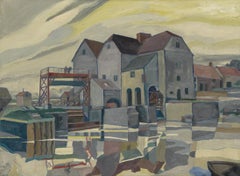
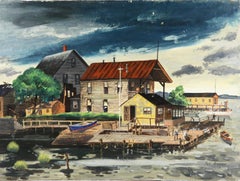
"Factory on the River" Modernist and Precisionist WPA Industrial New York Scene

"Factory on the River" Modernist and Precisionist WPA Industrial New York Scene

By William Sharp

Located in New York, NY

William Sharp (1900 - 1961) Factory on the River Oil on canvas 17 1/2 x 23 1/4 inches Initialed lower right: WS Provenance: Estate of the artist Private Collection, New York Swann Auction Galleries, American Art, June 13, 2019, Lot 178 William Sharp was born on June 13, 1900, in Lemberg, Austria, where he attended college and the Academy for Arts and Industry. He later studied in Kraków, Poland, and in Berlin and Munich, Germany. Sharp began his career as a designer of stained-glass windows and as a painter of murals. He served in the German army during World War I. After the war he became a newspaper artist in Berlin and a well-known etcher. Sharp drew political cartoons that were bitterly critical of the growing Nazi movement. As the influence of National Socialism intensified, he began to contribute drawings, under a pseudonym, to publications that were hostile to Hitler. After Hitler assumed power, Sharp was confronted with these drawings and told that he would be sent to a concentration camp. However, in 1934, he escaped to the United States. His first newspaper assignment in America was making courtroom sketches for The New York Mirror...

Category

Mid-20th Century American Realist Jean-Baptiste-Camille Corot Paintings
Materials

Canvas, Paint, Oil

Previously Available Items
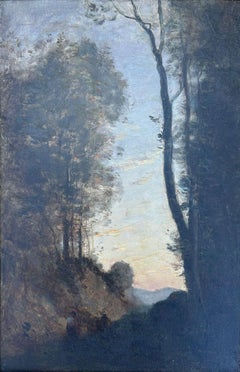
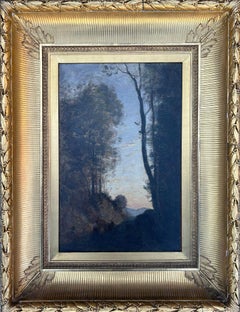
"Soir dans une gorge Boisee" Jean-Baptiste-Camille Corot, Plein-Air Landscape

"Soir dans une gorge Boisee" Jean-Baptiste-Camille Corot, Plein-Air Landscape

By Jean-Baptiste-Camille Corot

Located in New York, NY

Jean-Baptiste-Camille Corot Soir dans une gorge Boisee, 1850-55 Signed lower right Oil on board 13 1/2 x 9 inches Provenance: Dutilleux, Paul Tesse, etc. Quincy Adams Shaw Pauline S...

Category

1850s Impressionist Jean-Baptiste-Camille Corot Paintings
Materials

Oil, Panel

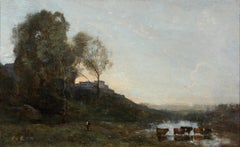
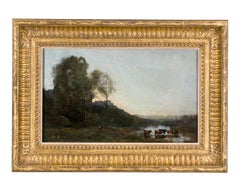
Le Gué aux Cinq Vaches (The Ford with Five Cows)

Le Gué aux Cinq Vaches (The Ford with Five Cows)

By Jean-Baptiste-Camille Corot

Located in New Orleans, LA

This ethereal landscape with its luminous atmosphere and light-drenched palette is a quintessential plein air masterpiece by the renowned French painter Jean-Baptiste-Camille Corot. Regarded by many as the first Impressionist, Corot's paintings served as the inspiration for an entire generation of artists. This example, entitled Le Gué aux Cinq Vaches (The Ford with Five Cows), offers a tranquil scene rendered in his mature style, composed at the apogee of his career after he abandoned the crisp brushwork and classical lines of his predecessors. Rather, the feathery brushstrokes and softened atmosphere of this charming tableau reveals the genius of this legendary artist and portends the revolutionary style of the Impressionists to come. Corot’s work occupies a space between old and new, traditional and modern, in the realm of 19th-century art history. Though he never broke with the traditionalists and academics who remained loyal to the Salon, his works possessed a unique individuality that set his oeuvre apart from other landscape artists of his age. As Etienne Moreau-Nelaton once said, he was “ the last of the classical landscapists and the first of the Impressionists.” His brushstrokes, bold and solid yet feathery and light, transformed the neoclassical landscape and altered plein air painting forever. Corot received a classical education in Rouen before embarking upon an apprenticeship in the family textile trade. The painting was his true passion and he soon devoted his entire life to perfecting his skill. Corot studied first with Achille Etna Michallon and Jean-Victor Bertin, both pupils of the leading historical landscape painter Pierre-Henri de Valenciennes. He visited the countryside of Rome and produced plein air studies, capturing the area’s natural beauty and classical antiquity. His fresh, starkly lit renditions reflect the debate of the day that sought to reconcile classically inspired idealizations with closely observed depictions of light and climate. He debuted at the Paris Salon in 1827, and continued to display there his entire life. As a result, many of these paintings were purchased by the state for provincial museums and by important collectors such as Emperor Napoleon III. For his enduring contribution to the arts, Corot was made a Knight of the Legion of Honor in 1846 and an Officer in 1867. At the Munich International Exposition of 1869, he was made a Knight of the Order of St. Michael. As seen in this extraordinary example, Corot’s work reveals a deep understanding of the French landscape. The dramatic distribution of light and shadow recalls the romantic compositions of Delacroix, while the overwhelming presence of nature pays homage to the influence of the great Barbizon artists. Quintessentially French, Corot’s oeuvre was profoundly influential both upon his contemporaries and later generations of artists. Today, Corot's paintings of idyllic landscapes are in high demand on the art market, with both museums and private collectors competing for his works. This important work is featured on pp. 188-189 of L'Oeuvre de Corot: catalogue raisonné et illustré, Paris 1905, Vol. III, by A. Robaut, with a drawing by Robaut, no. 1756. Circa 1865 Canvas: 9 3/4" high x 15 1/2" wide Frame: 14" high x 19 1/2" wide Provenance: Georges Petit, Paris, 1880, inv. no.6.624 (label on the reverse) Bernheim Jeune, Paris, inv. no.3522 (label on the reverse) Private collection, France Private collection, London M.S. Rau Antiques...

Category

19th Century Academic Jean-Baptiste-Camille Corot Paintings
Materials

Canvas, Oil

Jean-baptiste-camille Corot paintings for sale on 1stDibs.

Find a wide variety of authentic Jean-Baptiste-Camille Corot paintings available for sale on 1stDibs. You can also browse by medium to find art by Jean-Baptiste-Camille Corot in oil paint, paint, canvas and more. Much of the original work by this artist or collective was created during the 19th century and is mostly associated with the Impressionist style. Not every interior allows for large Jean-Baptiste-Camille Corot paintings, so small editions measuring 16 inches across are available. Customers who are interested in this artist might also find the work of Henri Le Sidaner, Jean-Baptiste-Antoine Guillemet, and Emile Godchaux. Jean-Baptiste-Camille Corot paintings prices can differ depending upon medium, time period and other attributes. On 1stDibs, the price for these items starts at $335,351 and tops out at $499,296, while the average work can sell for $417,323.