Jean Berque Art

to
1
Overall Width
to
Overall Height
to
1
1
1
1
1
1
1
1
1
1
1
10,495
2,810
2,500
1,412
1
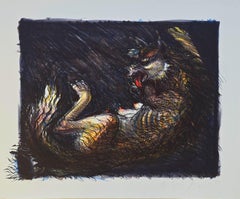
Artist: Jean Berque
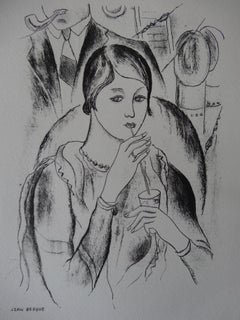
Kate : Drinking Woman - Stone lithograph, 1930

Kate : Drinking Woman - Stone lithograph, 1930

By Jean Berque

Located in Paris, IDF

Jean BERQUE Kate : Drinking Woman, 1930 Original stone lithograph Printed signature in the plate On Arches vellum 28 x 22 cm (c. 11 x 9 inch) Excellent condition

Category

1930s Modern Jean Berque Art

Materials

Lithograph

Related Items
Morningside Park and St. Luke's Hospital

Morningside Park and St. Luke's Hospital

By Charles Frederick William Mielatz

Located in Middletown, NY

A bucolic late 19th century image of upper Manhattan. New York: 1898. Lithograph on tissue-thin Japon paper with a deckle edge, 14 1/8 x 10 inches (357 x 252 mm), the full sheet. Tit...

Category

Late 19th Century American Modern Jean Berque Art

Materials

Lithograph, Handmade Paper

Fracas at Calamity's Place, Warrington Colescott

Fracas at Calamity's Place, Warrington Colescott

By Warrington Colescott

Located in Fairfield, CT

Artist: Warrington Colescott (1921-2018) Title: Fracas at Calamity's Place Year: 1969 Edition: 35/40, plus proofs Medium: Lithograph on paper Inscription: Signed & numbered in pencil...

Category

1960s American Modern Jean Berque Art

Materials

Lithograph

Cowboys and Indians, Warrington Colescott

Cowboys and Indians, Warrington Colescott

By Warrington Colescott

Located in Fairfield, CT

Artist: Warrington Colescott (1921-2018) Title: Cowboys and Indians Year: 1969 Edition: 24/75, plus proofs Medium: Lithograph on paper Inscription: Signed & numbered in pencil Size: ...

Category

1960s American Modern Jean Berque Art

Materials

Lithograph

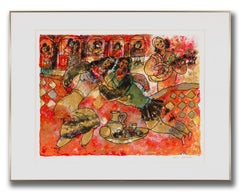
Théo Tobiasse "Les Siècles Coulent Entre Nos Rêves" Signed Color Lithograph

Théo Tobiasse "Les Siècles Coulent Entre Nos Rêves" Signed Color Lithograph

By Théo Tobiasse

Located in Miami, FL

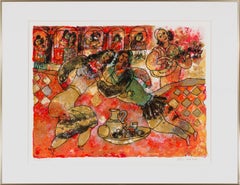
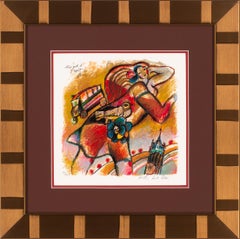
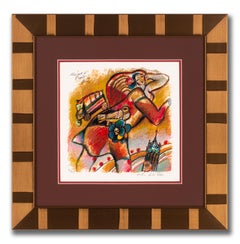
THÉO TOBIASSE (1927–2012) – “LES SIÈCLES COULENT ENTRE NOS RÊVES” Lithograph on Arches Paper ⚜ Hand Signed and Numbered ⚜ Gilt Wood Frame A LUMINOUS MEDITATION ON MEMORY, INTIMACY, AND THE PASSAGE OF TIME From the acclaimed suite Un Chant d’Exil et de Lumière (A Song of Exile and Light), this richly saturated lithograph is one image from a series of six distinct compositions published in 1997 by Klim Art Publisher, Toronto, and printed by master lithographer Pierre Chave at his celebrated atelier in Saint-Paul-de-Vence. The multi-color lithographic process, employing up to twenty-three separate color passes, produces the extraordinary depth and chromatic intensity visible across the entire composition. Two figures sit together at a table, each holding a glass of wine. A samovar and two lit candles anchor the still life at center, surrounded by scattered fruit and a bowl bearing an olive branch. A vibrant rainbow canopy arcs across the upper portion of the image, while a dove takes flight at upper right. Behind the couple hangs a decorative tablet adorned with flowering branches and scrolled columns. The title, inscribed in the artist’s hand within the composition, translates as “The centuries flow between our dreams,” a poetic distillation of the suite’s overarching contemplation of generational memory passing through shared moments of intimacy. What initially reads as a warm, intimate gathering reveals itself as a layered reflection on heritage, belonging, and the rituals that connect one generation to the next. The samovar recalls Tobiasse’s Eastern European childhood, while the olive branch and candles carry associations of renewal and hope. The dove and rainbow reinforce themes of peace and covenant that recur throughout Tobiasse’s oeuvre. Rendered on heavy Arches paper with deckled edges, the print retains a tactile, handmade quality that complements its emotional warmth. Presented in a crosshatch gilt wood frame the work suits interiors that embrace color and narrative, from a Mediterranean-inspired living space to a collector’s library or a gallery wall dedicated to the School of Paris tradition. WHY COLLECT THIS WORK? ✓ Suite Provenance – One of six distinct compositions from Tobiasse’s acclaimed Un Chant d’Exil et de Lumière series, published in 1997 ✓ Master Printed – Produced by Pierre Chave in Saint-Paul-de-Vence using up to twenty-three color passes ✓ Hand Signed and Numbered – Pencil signed lower right, numbered 87/199 ✓ Rich Symbolic Composition – Dove, rainbow, samovar, olive branch, and candle layered with personal and cultural meaning ✓ Gilt Wood Frame – Crosshatch gilt finish, ready to display ARTWORK DETAILS: ▸ Title: Les Siècles Coulent Entre Nos Rêves (The Centuries Flow Between Our Dreams) ▸ Suite: Un Chant d’Exil et de Lumière (A Song of Exile and Light) ▸ Artist: Théo Tobiasse (1927–2012) ▸ Medium: Lithograph on Arches Paper with Deckled Edges ▸ Year of Creation: 1997 ▸ Signature: Hand Signed Lower Right in Pencil ▸ Edition: 87/199 ▸ Publisher: Klim Art Publisher, Toronto, Canada ▸ Printer: Pierre Chave, Saint-Paul-de-Vence, France ▸ Provenance: Michael Hittleman Gallery, Los Angeles ▸ Country of Origin: France ▸ Dimensions: — ◼︎ Image Area: 30.5 x 22 inches — ◼︎ Paper Size: 36 x 27.25 inches — ◻︎ Frame Size: 44 x 35 x 0.875 inches ▸ Condition: Excellent, commensurate with age ▸ Framing: Crosshatch Gilt Wood Frame, ready to display INCLUDED DOCUMENTATION: ✓ Certificate of Authenticity ✓ Artist Biography Document THE ARTIST: Théo Tobiasse (born Tobias Eidesas, 1927, Jaffa, Israel; died 2012...

Category

1990s Modern Jean Berque Art

Materials

Lithograph

Guillaume Corneille  1948 Aquatinte / eau forte

Guillaume Corneille 1948 Aquatinte / eau forte

By Corneille

Located in Saint-Didier, Provence-Alpes-Côte d'Azur

Guillaume Corneille 1948 Aquatinte/ eau forte Proof of artist Signed, dated and noted PA (artist’s proof) from the artist’s hand to the crayoN Print run 125 copy Laid paper with wate...

Category

1980s Modern Jean Berque Art

Materials

Lithograph

Le Christ a l'Horloge, Paris (Christ in the Clock)

Le Christ a l'Horloge, Paris (Christ in the Clock)

By Marc Chagall

Located in Missouri, MO

Marc Chagall "Le Christ a l'Horloge, Paris" (Christ in the Clock) 1957 (M. 196) Color Lithograph on Arches Wove Paper Signed in Pencil "Marc Chagall" Lower Right Initialed "H.C." (Hors Commerce) Lower Left, aside from numbered edition of 90 *Floated in Gold Frame with Linen Matting, UV Plexiglass Sheet Size: 18 3/4 x 14 3/4 inches (47.5 cm x 38 cm) Image Size: 9 3/4 x 8 1/2 inches Framed Size: 28.5 x 24.25 inches Marc Chagall was a man of keen intelligence, a shrewd observer of the contemporary scene, with a great sympathy for human suffering. He was born on July 7, 1887 in Vitebsk, Russia; his original name was Moishe Shagal (Segal), but when he became a foremost member of the Ecole de Paris, he adopted French citizenship and the French spelling of his name. Vitebsk was a good-sized Russian town of over 60,000, not a shtetl. His father supported a wife and eight children as a worker in a herring-pickling plant. Sheltered by the Jewish commandment against graven images, the young Chagall never saw so much as a drawing until, one day, he watched a schoolmate copying a magazine illustration. He was ridiculed for his astonishment, but he began copying and improvising from magazines. Both Chagall's parents reluctantly agreed to let him study with Yehuda Pen, a Jewish artist in Vitebsk. Later, in 1906, they allowed their son to study in St. Petersburg, where he was exposed to Russian Iconography and folk art. At that time, Jews could leave the Pale only for business and employment and were required to carry a permit. Chagall, who was in St. Petersburg without a permit, was imprisoned briefly. His first wife, Bella Rosenfeld, was a product of a rich cultivated and intellectual group of Jews in Vitebsk. Chagall was made commissar for the arts for the area, charged with directing its cultural life and establishing an art school. Russian folklore, peasant life and landscapes persisted in his work all his life. In 1910 a rich patron, a lawyer named Vinaver, staked him to a crucial trip to Paris, where young artists were revolutionizing art. He also sent him a handsome allowance of 125 francs (in those days about $24) each month. Chagall rejected cubism, fauvism and futurism, but remained in Paris. He found a studio near Montparnasse in a famous twelve-sided wooden structure divided into wedge-shaped rooms. Chaim Soutine, a fellow Russian Jew, and Modigliani lived on the same floor. To Chagall's astonishment, he found himself heralded as one of the fathers of surrealism. In 1923, a delegation of Max Ernst, Paul Eluard and Gala (later Salvador Dali's wife) actually knelt before Chagall, begging him to join their ranks. He refused. To understand Chagall's work, it is necessary to know that he was born a Hasidic Jew, heir to mysticism and a world of the spirit, steeped in Jewish lore and reared in the Yiddish language. The Hasidim had a special feeling for animals, which they tried not to overburden. In the mysterious world of Kabbala and fantastic ancient legends of Chagall's youth, the imaginary was as important as the real. His extraordinary use of color also grew out of his dream world; he did not use color realistically, but for emotional effect and to serve the needs of his design. Most of his favorite themes, though superficially light and trivial, mask dark and somber thoughts. The circus he views as a mirror of life; the crucifixion as a tragic theme, used as a parallel to the historic Jewish condition, but he is perhaps best known for the rapturous lovers he painted all his life. His love of music is a theme that runs through his paintings. After a brief period in Berlin, Chagall, Bella and their young daughter, Ida, moved to Paris and in 1937 they assumed French citizenship. When France fell, Chagall accepted an invitation from the Museum of Modern Art to immigrate to the United States. He was arrested and imprisoned in Marseilles for a short time, but was still able to immigrate with his family. The Nazi onslaught caught Chagall in Vichy, France, preoccupied with his work. He was loath to leave; his friend Varian Fry rescued him from a police roundup of Jews in Marseille, and packed him, his family and 3500 lbs. of his art works on board a transatlantic ship. The day before he arrived in New York City, June 23, 1941, the Nazis attacked Russia. The United States provided a wartime haven and a climate of liberty for Chagall. In America he spent the war years designing large backdrops for the Ballet. Bella died suddenly in the United States of a viral infection in September 1944 while summering in upstate New York. He rushed her to a hospital in the Adirondacks, where, hampered by his fragmentary English, they were turned away with the excuse that the hour was too late. The next day she died. He waited for three years after the war before returning to France. With him went a slender married English girl, Virginia Haggard MacNeil; Chagall fell in love with her and they had a son, David. After seven years she ran off with an indigent photographer. It was an immense blow to Chagall's ego, but soon after, he met Valentine Brodsky, a Russian divorcee designing millinery in London (he called her Fava). She cared for him during the days of his immense fame and glory. They returned to France, to a home and studio in rustic Vence. Chagall loved the country and every day walked through the orchards, terraces, etc. before he went to work. Chagall died on March 28, 1985 in the south of France. His heirs negotiated an arrangement with the French state allowing them to pay most of their inheritance taxes in works of art. The heirs owed about $30 million to the French government; roughly $23 million of that amount was deemed payable in artworks. Chagall's daughter, Ida and his widow approved the arrangement. Written and submitted by Jean Ershler Schatz, artist and researcher from Laguna Woods, California. Sources: Hannah Grad Goodman in Homage to Chagall in Hadassah Magazine, June 1985 Jack Kroll in Newsweek, April 8, 1985 Andrea Jolles in National Jewish Monthly Magazine, May 1985 Michael Gibson...

Category

1950s Modern Jean Berque Art

Materials

Lithograph

Ancient View of Granada - Original Lithograph - 19th Century

Ancient View of Granada - Original Lithograph - 19th Century

Located in Roma, IT

Ancient View of Granada is an original lithograph on paper realized by an anonymous artist in The 19th Century. Original lithograph on paper. Titled on the lower center. Good conditions. An impressive landscape...

Category

19th Century Modern Jean Berque Art

Materials

Lithograph

Original Nantua son Lac vintage French travel poster

Original Nantua son Lac vintage French travel poster

Located in Spokane, WA

Original, smaller format size, NANTUA SON LAC. Archival linen-backed original lithograph, excellent condition, ready to ship or frame. Grade A. This poster promotes mini-golf, v...

Category

1950s American Modern Jean Berque Art

Materials

Lithograph

Guillaume corneille "La femme et l’oiseau" Silkscreen printing

Guillaume corneille "La femme et l’oiseau" Silkscreen printing

By Corneille

Located in Saint-Didier, Provence-Alpes-Côte d'Azur

William the crow The woman and the bird Silkscreen printing Circa 1078 Edition of 100 copies Numbered, dated and signed in pencil by the artist. 70 x 50 cms Perfect condition 790...

Category

1970s Modern Jean Berque Art

Materials

Lithograph

Iwo Jima Memorial, Felix de Weldon

Felix de Weldon Iwo Jima Memorial, Felix de Weldon, 2001

$2,400Sale Price|20% Off

H 30 in Dm 44 in

Iwo Jima Memorial, Felix de Weldon

By Felix de Weldon

Located in Fairfield, CT

Artist: Felix de Weldon (1907-2003) Title: Iwo Jima Memorial Year: 2001 Edition: 2/150, plus proofs Medium: Lithograph with graphite ink on BFK Rives cream color paper Inscription: S...

Category

Early 2000s American Modern Jean Berque Art

Materials

Ink, Graphite, Lithograph

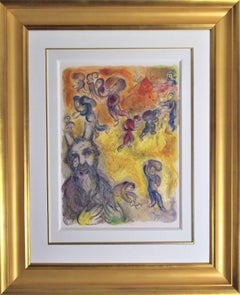
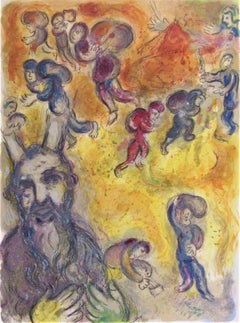
Marc Chagall - The Bible - Original Lithograph

Marc Chagall - The Bible - Original Lithograph

By Marc Chagall

Located in Collonge Bellerive, Geneve, CH

Marc Chagall, Original Lithograph depicting an instant of the Bible. Technique: Original lithograph in colours Year: 1956 Sizes: 35,5 x 26 cm / 14" x 10.2" (sheet) Published by: Édit...

Category

1950s Modern Jean Berque Art

Materials

Lithograph

Previously Available Items
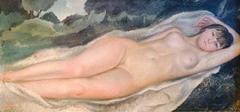
NU ALLONGE

NU ALLONGE

By Jean Berque

Located in Los Angeles, CA

JEAN BERQUE "NU ALLONGE" OIL ON CANVAS, SIGNED FRANCE, DATED 1927 25 X 53 INCHES Jean Berque 1896-1954 Berque was born 31 January 1896, in Rheims; died 27 April 1954, in Paris. Painter, illustrator, decorative artist. Nudes, landscapes, still-lifes. Jean Berque left his native Rheims for Paris in 1916, enrolling at the Académie Ranson, where he was a pupil of Félix Vallotton, Maurice Denis and Paul Sérusier. He was called up for military service, but sent home from the front for health reasons in 1917. Berque travelled widely in Morocco, Italy, Spain and southern France, where he met André Dunoyer de Segonzac, Colette and Lise Deharme and (in Collioure) Aristide Maillol. In 1925, he painted a Road to Calvary for the church of St-Nicaise in Rheims. Later in his career, he produced stage designs for Marivaux's On ne badine pas avec l'amour, at the Comédie Française. He was made a Chevalier of the Légion d'Honneur in 1953. His work has featured in a number of group exhibitions, including the Premier Group show at Galerie Druet, Paris in 1924. Other Paris shows included regular exhibitions at Galerie Bernheim, the Salon d'Automne from 1924-1928, and the Tuileries from 1927-1934. In 1931, he exhibited 51 canvases and drawings, and two illustrated books at Galerie Renaissance. A retrospective of his work as an illustrator was held at Rheims city library in 1992. Berque's favourite subjects included the landscapes of the Midi, and the countryside around Toulon. His nudes often attracted comment: a cover for the review Crapouillot (January 1927) featuring a photograph of one of his figures was banned from Paris news-stands. Berque illustrated a large number of books: Rabindranath Tagore's Lyrics (1925), Au Maroc (1927) and Le Cœur Sentimental (1934) by Abel Bonnard; André Maurois' Kate (1930); Paul Claudel's Connaissance de l'Est (1930); a French edition of Goethe's Prologue in Heaven (Prolog im Himmel) (1932); Paul Verlaine's Les Amies-filles (1932); The Song of Solomon (1933); the Return of the Prodigal Son. Gospel According to St Luke (1933); Pierre de Ronsard's Poems (1934), Amours de Marie (1942) and Livret de Folastries (1947); Lucretius's On the Nature of Things (De rerum natura) (1934); Anna de Noailles' Les Jardins. Poèmes; Denise Boas's The Sound of Silence (Le bruit du silence) (1935); Pierre Louys' Les Chansons Secrètes de Bilitis (1935), Les Chansons de Bilitis (1946), Trois Filles de leur Mère (c. 1950) and Aphrodite. Mœurs Antiques (1951); Baudelaire's Poems (1935); Gospel Accounts of the Road to Calvary (Le Chemin de Croix selon les Évangiles) (1936); André Mary's Tristan (1937); Denise Boas's Fabulettes (1937) and You Can't Help Your Nature or The Brunette and the Blonde (Tu dépends de ta nature ou la brune et la blonde) (1937); Joachim du Bellay's Œuvres Poétiques. Sonnets de l'Olive (1938); the Apocalypse According to St John (1938); Shelley's Twelve Poems (1939); Colette's Le Blé en Herbe (1946); Paul Jean Toulet's Mon amie...

Category

1920s Art Deco Jean Berque Art
Materials

Canvas, Oil

Jean Berque art for sale on 1stDibs.

Find a wide variety of authentic Jean Berque art available for sale on 1stDibs. You can also browse by medium to find art by Jean Berque in lithograph and more. Much of the original work by this artist or collective was created during the 1930s and is mostly associated with the modern style. Not every interior allows for large Jean Berque art, so small editions measuring 9 inches across are available. Customers who are interested in this artist might also find the work of Eugene Corneau, Giselle Halff, and Paul Conte. Jean Berque art prices can differ depending upon medium, time period and other attributes. On 1stDibs, the price for these items starts at $216 and tops out at $216, while the average work can sell for $216.

Artists Similar to Jean Berque