Jean Crotti Art

1878-1958

Jean Crotti was born in Bulle, Switzerland. His first formal art education occurred within the walls of the Munich School of Decorative of Art in 1898, before he moved to Paris in 1901 in order to attend the famed Académie Julian. His tutelage at the Académie did not last, and he abandoned his studies there in 1902. The reasoning for this departure was largely due to Crotti becoming disenfranchised by the rigors of painting within a controlled academic environment. The period that followed was largely dominated by Crotti painting in isolation, and his output was characterized by its Primitivist and Fauvist aesthetics.

In 1907, Crotti started exhibiting his works regularly within major public exhibitions, such as the Salon des Indépendants and the Salon d’Automne. After these initial dalliances with Primitivism and Fauvism, Crotti became influenced by Cubism and Orphism in 1912. This shift toward Orphism brought Crotti into close proximity with the Section d’Or, which was comprised of notable figures such as Marcel Duchamp, his brothers Raymond Duchamp-Villon and Jacques Villon (Gaston Duchamp), Francis Picabia, Robert and Sonia Delaunay and Guillaume Apollinaire.

Crotti, alongside his wife Yvonne Chastel, fled Europe for New York in 1914 — much like a great many of his fellow artists — in order to escape the cauldron of the Great War that began to consume Europe. It was soon after this migration to America that he met Suzanne Duchamp, the sister of Marcel, Raymond and Jacques Villon Duchamp. During this period in New York, he shared a studio space with Marcel Duchamp and Picabia, which had the effect of deepening the relationships between the three that had been established in Paris. The group also produced the highly influential avant-garde publication “291” during this period. It was not long after this move to New York that Crotti’s aesthetic shifted yet again, this time toward Dadaism. This can largely be attributed to his sharing of studio space with the two aforementioned artists and the War that was ravishing the world. These new works were exhibited within New York’s Gallery Bourgeois and the Montross Gallery. It was around this time that Crotti created Les forces mécaniques de l'amour en mouvement (1916), which is considered to be one of the earliest Dadaist works using found objects.

In 1916, Crotti returned to Paris, and shortly after his return to Europe, he divorced his wife for one Suzanne Duchamp. The pair married in 1919 and remained together until his death. This marriage proved to be extremely fruitful artistically, with the pair starting a two-person artistic movement that they called Tabu. This movement was largely characterised by its similarities to Dadaism — differing only slightly in that Crotti added a quasi-religious element to Tabu, in which he attempted to explore notions of the metaphysical and the subconscious, ideas that came to inspire the Surrealists.

In 1921, Dadaism had well and truly arrived within Paris. Crotti featured extensively within the Dadaists’ exhibitions and publications during this time until their flame was extinguished. He also contributed to Tristan Tzara’s unrealized dream of Dadaglobe. In the 1930s, Crotti went on to develop a new technique for creating art that he dubbed it “gemmail.” The process involved creating post-Cubist compositions from shards of glass that were intended to be illuminated from behind. Crotti never remained stagnant throughout his career, and his oeuvre shows that he toyed with many styles throughout his life. This lack of signature style largely contributed to Crotti’s resilience to being comfortably placed in a specific niche within the history of art and thus has made him an artist of extreme interest.

After Crotti’s death, his heirs donated a great swathe of his personal collection of letters to the Smithsonian Institute’s Archives of American Art in Washington, D.C. This collection contains correspondence between Crotti and numerous champions of the avant-garde, such as Francis Picabia, Jean Cocteau, Henri Matisse, Raoul Dufy and Pablo Picasso. Crotti’s works can be found hanging in many prominent public and private collections, such as Tate Modern, London; the Museum of Modern Art, New York; and the Metropolitan Museum of Art, New York. His works have also been a part of notable exhibitions such as “Tabu Dada: Jean Crotti and Suzanne Duchamp, 1915–1922,” Philadelphia Museum of Art (1983–84).

(Biography provided by Stern Pissarro Gallery)
to
1
Overall Width
to
Overall Height
to
1
1
1
1
1
1
1
1
1
1
1
1
1
10,917
2,844
2,494
1,424
1
Artist: Jean Crotti
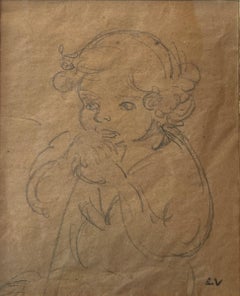
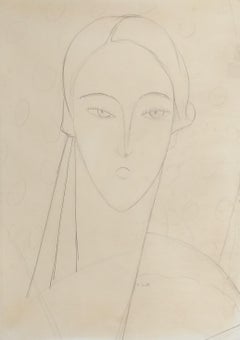
Jeune fille aux cheveux roulés - Drawing on Paper Modern art, 1920

Jeune fille aux cheveux roulés - Drawing on Paper Modern art, 1920

By Jean Crotti

Located in New York, NY

Jean Crotti Jeune fille aux cheveux roulés (Girl with rolled-up hair), ca. 1920 Pencil on paper 17 9/10 × 12 3/5 in 45.5 × 32 cm Unsigned Condition: Excellent condition.

Category

1920s Post-Impressionist Jean Crotti Art

Materials

Laid Paper, Pencil

Related Items
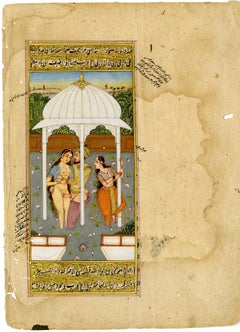
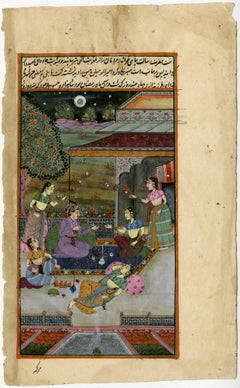
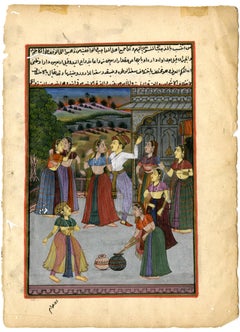
Mughal School, 18th century – Emperor Jahangir in his harem in flagrante delicto

Mughal School, 18th century – Emperor Jahangir in his harem in flagrante delicto

Located in Middletown, NY

An illuminated page from a book likely in reference to palace life during Emperor Jahangir's reign over the Mughal Empire. Circa 1750. Gouache and ink with gold heightening on cre...

Category

18th Century Rajput Jean Crotti Art

Materials

Gold

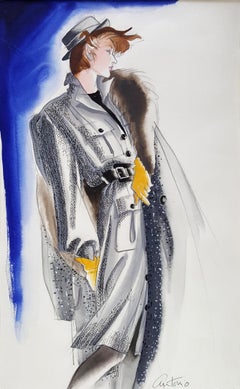
Vogue Magazine, Elegant Fashion Illustration for Adel Simpson

Vogue Magazine, Elegant Fashion Illustration for Adel Simpson

By Antonio Lopez

Located in Miami, FL

Vogue USA, Fashion Illustration. Meticulously drawn in a descriptive and yet creative way. Antonio's full mastery of his art is on full display. Signed lower right. The work is arch...

Category

1980s Post-Impressionist Jean Crotti Art

Materials

Watercolor, Gouache, Pencil

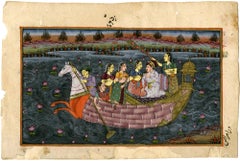
Mughal School, 18th century Emperor Jangahir on a pleasure boat with his harem a

Mughal School, 18th century Emperor Jangahir on a pleasure boat with his harem a

Located in Middletown, NY

Emperor Jahangir depicted with his harem attendees aboard a pleasure cruise, the water filled with lotus blossoms; symbols of paradise itself. Circa 1750. Gouache and ink with gold ...

Category

18th Century Rajput Jean Crotti Art

Materials

Gold

Raja Mahan Singh Mirpuri – Rajasthani School, 19th century

Raja Mahan Singh Mirpuri – Rajasthani School, 19th century

Located in Middletown, NY

Ink and gouache with yellow heightening on fibrous, brown laid paper with a Jaipur Court Fee tax stamp in blue ink, 13 1/2 x 8 3/4 inches (343 x 222 mm). Toning, handling creases and...

Category

19th Century Rajput Jean Crotti Art

Materials

Gold

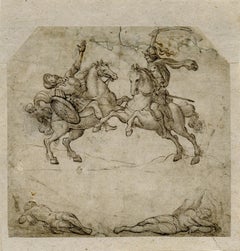
Mythological combat scene with Roman soldiers on horseback.

Mythological combat scene with Roman soldiers on horseback.

By Virgil Solis

Located in Middletown, NY

Pen and brownish black ink on grayish-cream laid paper, 6 1/2 x 8 inches (165 x 175 mm), irregular hexagonal sheet with margins. Some archival repairs along the top sheet edge, scatt...

Category

16th Century Old Masters Jean Crotti Art

Materials

Ink, Laid Paper, Pen

"Young Girl (Jenue Fille)" Louis Valtat, French Drawing

"Young Girl (Jenue Fille)" Louis Valtat, French Drawing

By Louis Valtat

Located in New York, NY

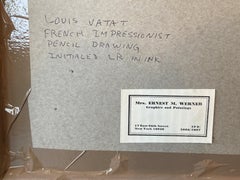
Louis Valtat Young Girl Stamped with initials lower right Pencil on brown paper Sight 7 x 6 inches Provenance: Mrs. Ernest M. Werner, New York Private Collection, Rhode Island Loui...

Category

Early 20th Century Fauvist Jean Crotti Art

Materials

Paper, Pencil

Mughal School, 17th century – Emperor Jahangir reclining in his harem

Mughal School, 17th century – Emperor Jahangir reclining in his harem

Located in Middletown, NY

An illuminated page from a book likely in reference to palace life during Emperor Jahangir's reign over the Mughal Empire. Circa 1690. Gouache and ink with gold heightening on light...

Category

18th Century Rajput Jean Crotti Art

Materials

Gold

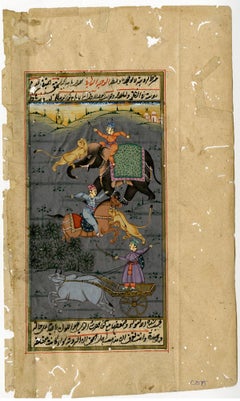
Mughal School, 17th century Tiger Hunt near the Jahangir Maha, Agra

Mughal School, 17th century Tiger Hunt near the Jahangir Maha, Agra

Located in Middletown, NY

An illuminated page from a book likely in reference to palace life during Emperor Jahangir's reign over the Mughal Empire. c 1690. Gouache and ink with heightening in gold on light ...

Category

17th Century Rajput Jean Crotti Art

Materials

Gold

The Loving Couple Drawing, Carbon Pencil on Paper, 1919

The Loving Couple Drawing, Carbon Pencil on Paper, 1919

By Charles Angrand

Located in Paris, Île-de-France

Circle of Charles Angrand (1854-1926) The Loving Couple Pencil and stump on paper, 30 x 22 cm Dated "10.4.19" lower left. Trace of a dedication Otherwise unsigned. Provenance: Pr...

Category

1910s Post-Impressionist Jean Crotti Art

Materials

Conté, Carbon Pencil

Mughal School, 18th century – Emperor Jahangir dancing with his harem attendees

Mughal School, 18th century – Emperor Jahangir dancing with his harem attendees

Located in Middletown, NY

A joyful scene of lighthearted merriment in the palace of Jangahir Mahal Agra Circa 1750. Gouache and ink with gold heightening on light weight cream laid paper, 8 1/4 x 6 inches (2...

Category

18th Century Rajput Jean Crotti Art

Materials

Gold

French School, Late 18th Century (circa 1775-1795) - Allegory Of Mourning

French School, Late 18th Century (circa 1775-1795) - Allegory Of Mourning

Located in Paris, Île-de-France

French School, late 18th century (circa 1775–1795) Allegory of Mourning (or Fallen Fortune) Pen and brown ink, grey ink, wash, watercolor, and white gouache highlights on laid paper...

Category

Late 18th Century Rococo Jean Crotti Art

Materials

Ink, Watercolor, Gouache, Laid Paper

Previously Available Items
Arlequin
Arlequin

Jean CrottiArlequin, 1928

Sold

H 17.5 in W 12.5 in

Arlequin

By Jean Crotti

Located in Los Angeles, CA

Crotti was born on 1878 in Bulle near Fribourg in the western, French-speaking section of Switzerland. Crotti’s works were exhibited at the Salon d’Automne and the Salon des Indépendants from 1907-1923. He was also included in the 1925 Exposition Internationale at l’Art d’Aujourd’hui in Paris, and the “International Exhibition of Modern Art” at the Brooklyn Museum organized by the Société Anonyme in 1926-1927. His solo exhibitions since the 1920’s included the Galerie de France of Paris in 1942, the Museo Caccia of Lugano in 1955, the Cordier and Ekstrom Gallery of New York in 1970, the Kunstmuseum Winterthur in 1972, and the Gimpel Fils Gallery of London in 1974 and Hanover in 1974. His early arts education was in Germany and France. He studied at the School of Decorative Arts in Munich and the Académie Julian in Paris. He left school in 1902 in order to detach himself and become independent as an artist. His earliest paintings, from 1900-1908, are quiet domestic scenes reminiscent of Bonnard and Vuillard. His work begins to show the influence of Orphism and Cubism in 1911. To escape from wartime Paris Crotti and his wife, Yvonne, moved to New York City. An article in the New York Tribune, “French Artists Spur on American Art,” (Oct. 24, 1915) interviewed a number of artists, including Marcel Duchamp, Francis Picabia, Albert and Juliette Gleizes, and Jean Crotti...

Category

1920s Cubist Jean Crotti Art

Materials

Paper

Jean Crotti art for sale on 1stDibs.

Find a wide variety of authentic Jean Crotti art available for sale on 1stDibs.

Artists Similar to Jean Crotti