By Robert Indiana
Located in Detroit, MI
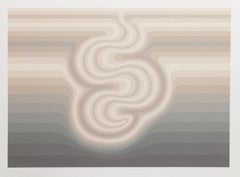
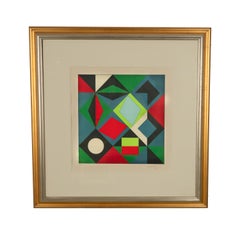
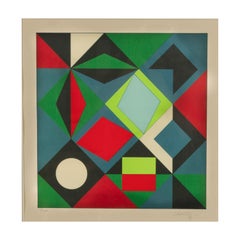
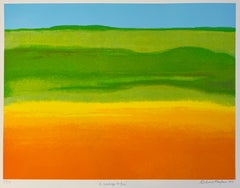
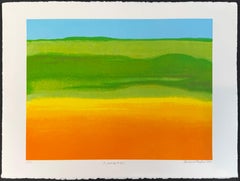
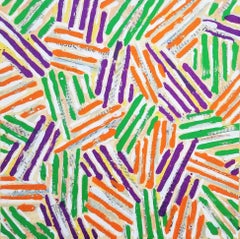
"Indianapolis Museum of Art Inaugural Exhibitions", 25 October 1970, is an eye popping large bold colorful geometric abstract silk screen. It is signed on the lower right.
Robert Indiana, one of the preeminent figures in American art since the 1960s, played a central role in the development of assemblage art, hard-edge painting, Pop art, Neo-Dada, American Modernism and Modern Art. A self-proclaimed “American painter of signs,” Indiana created a highly original body of work that explores American identity, personal history, and the power of abstraction and language, establishing an important legacy that resonates in the work of many contemporary artists such as Andy Warhol, Keith Haring, Roy Lectenstein, David Hockney, Romero Britto, Richard Hamilton and Robert Rauschenberg who make the written word a central element of their oeuvre.
Robert Indiana was born Robert Clark in New Castle, Indiana on September 13, 1928. Adopted as an infant, he spent his childhood moving frequently throughout his namesake state. At 14 he moved to Indianapolis in order to attend Arsenal Technical High School, known for its strong arts curriculum. After graduating he spent three years in the U.S. Air Force and then studied at the Art Institute of Chicago, the Skowhegan School of Sculpture and Painting in Maine, and the Edinburgh College of Art in Scotland.
In 1956, two years after moving to New York, Indiana met Ellsworth Kelly, and upon his recommendation took up residence in Coenties Slip, where a community of artists that would come to include Kelly, Agnes Martin, James Rosenquist, and Jack Youngerman had studios. Indiana, like some of his fellow artists, scavenged the area’s abandoned warehouses for materials, creating sculptural assemblages from old wooden beams, rusted metal wheels, and other remnants of the shipping trade that had thrived in Coenties Slip. The discovery of 19th century brass stencils led to the incorporation of brightly colored numbers and short emotionally charged words onto these sculptures as well as canvases, and became the basis of his new painterly vocabulary.
Although acknowledged as a leader of Pop, Indiana distinguished himself from his Pop peers by addressing important social and political issues and incorporating profound historical and literary references into his works. In 1964 Indiana accepted Philip Johnson’s invitation to design a new work for the New York State Pavilion at the New York World’s Fair, creating a 20-foot EAT sign...
Category
1970s American Modern Jeannette Bedwell Art
MaterialsPaper, Ink, Screen