By Emilio Grau Sala
Located in Madrid, ES
EMILIO GRAU SALA
Spanish, 1911 - 1975
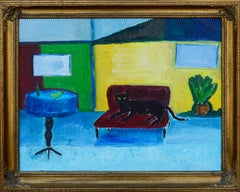
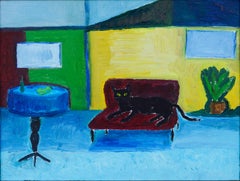
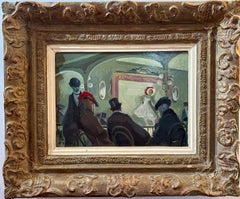
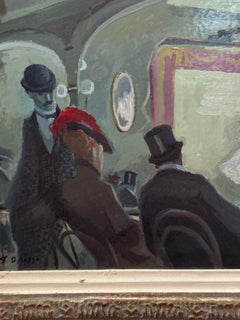
INTERIEUR AUX FLEURS JAUNES
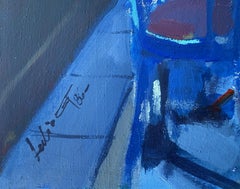
signed "Grau Sala" (lower left)
signed again, located, dated and titled "Grau Sala, Paris 61, Interieur aux fleurs jaunes" (on the reverse)
oil on canvas
15 x 18-1/4 inches (38 x 46 cm.)
framed: 23-1/2 x 26-1/2 (59.5 x 67 cm.)
PROVENANCE
Private Parisian Collection
Interieur aux fleurs jaunes
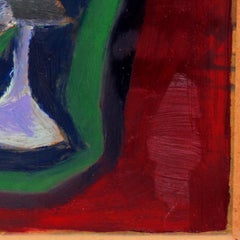
This interior with two female figures where also the plans made in different colors are drawing the composition.
The abundant pictorial material distributed in geometric portions, gives life to the tablecloth and mother and daughter figures, in black and white colors of the jacket, while the black line takes care of the environments so as not to separate them.
The fruit bowl and flowers give a cheerful touch with their pastel tones.
Emilio Grau Sala came from a family of artists. He was born in Barcelona in 1911 and his father, a good cartoonist, had been one of the promoters of the "Salon des Humanistes" and made his exhibitions normally in "Sala Parés", Barcelona.
His first works were exhibited at the Salon des Independents. In the years 1930-33 he had painted under the influence of Cubism, especially that of Torres García. It is from that time a painting of the port of Barcelona, geometric and structural, which completely anticipated what would later be his work. His personality began fully painting watercolors and oils with a certain fantasy character, with a point of decorative instinct and themes full of naivety and grace. Romantic interiors, paddocks, port scenes, sailors, etc.
Grau Sala was essentially a Mediterranean painter, son of post-impressionism and enriched with French painting of the last fifty years. Mediterranean because his work has the color and light of that land.
He understood and assimilated impressionist painting very well, and for that reason he was never subject to the modules of a formulist realism, nor the sexigencias of the forms.
In Paris he found the best environment to give us a fruitful and intense work, because he could use the expressive potential of French art to enrich it.
All this made him a very esteemed artist everywhere where his work was known. He was also very often required to illustrate books and publications in Paris. Also his posters were very successful.
He painted a large number of subjects, but perhaps the theme of horse racing is where you can see in a very clear way the joyful and optimistic life that was lived at that time. In this fabric there is an explosion of juicy and vivid colors full of ingenuity and simplicity in its composition. Only a teacher could turn the complicated into something simple and beautiful. Before this work we feel a deep emotion, the emotion of before starting a horse race. Joy and nervousness at the same time. Especially since it is a direct emotion. There are no intermediaries between our eyes and what the work intends to tell us. This is precisely what seduces and catches us of this painting.
His works can be found in the Museums of the Villa de Paris, L'Ile de France Museum, at the Château de Sceaux, Honfleur Museum, La Rochelle Museum, Barcelona Museum...
Category
1960s Fauvist Jonathan Taylor Art