Jonny Gaston Figurative Paintings

to
2
2
Overall Width
to
Overall Height
to
2
1
2
2
1
1
2
2
3
511
313
280
231
2
2
Artist: Jonny Gaston
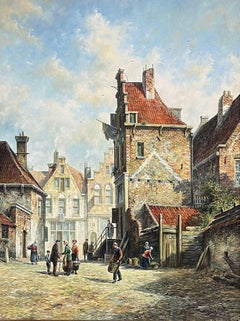
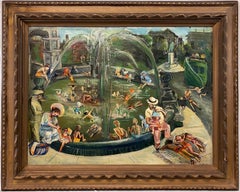
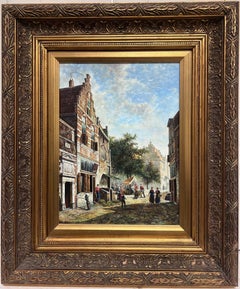
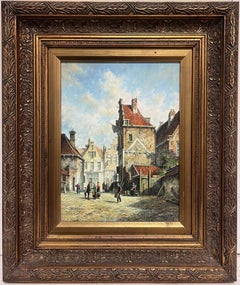
Classical Dutch Street Scene Signed Oil Painting Gilt Framed

Classical Dutch Street Scene Signed Oil Painting Gilt Framed

By Jonny Gaston

Located in Cirencester, Gloucestershire

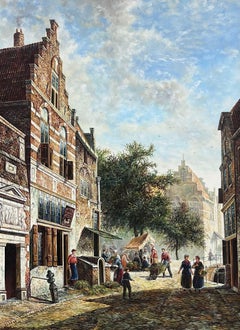
The Dutch Street by Jony Gaston (British 20th century) signed oil on board, framed framed: 25.5 x 22 inches board: 18 x 14 inches provenance: private collection, UK condition: very g...

Category

20th Century Dutch School Jonny Gaston Figurative Paintings

Materials

Oil

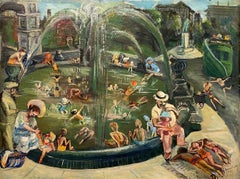
Classical Dutch Old City Street Scene Figures Old Buildings Signed & Framed Oil

Classical Dutch Old City Street Scene Figures Old Buildings Signed & Framed Oil

By Jonny Gaston

Located in Cirencester, Gloucestershire

The Old Dutch City by Jonny Gaston, British 20th century signed oil on board, framed framed: 25.5 x 22 inches board: 18 x 14 inches provenance: private collection, UK condition: very...

Category

20th Century Modern Jonny Gaston Figurative Paintings

Materials

Oil

Related Items
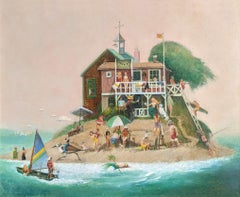
Walking Home, Contemporary Figurative Cityscape Painting, Landscape Park Art

Walking Home, Contemporary Figurative Cityscape Painting, Landscape Park Art

Located in Deddington, GB

Walking Home [2023] original Oil on Canvas Image size: H:8.5 cm x W:10 cm Complete Size of Unframed Work: H:46 cm x W:55 cm x D:1.5cm Frame Size: H:60 cm x W:79 cm x D:5cm Sold Fram...

Category

2010s Modern Jonny Gaston Figurative Paintings

Materials

Canvas, Oil

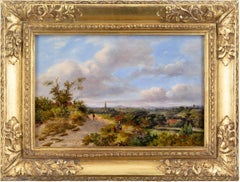
Mid-19th-Century Oil Painting On Panel, Figures On Rural Track, Town Beyond

Mid-19th-Century Oil Painting On Panel, Figures On Rural Track, Town Beyond

Located in Cheltenham, GB

US buyers pay no import tariffs on this item. This charming mid-19th-century oil painting by Dutch artist Johannes Philippus Galjaard (1812-1867) depicts several figures on a rural ...

Category

1850s Dutch School Jonny Gaston Figurative Paintings

Materials

Oil, Wood Panel

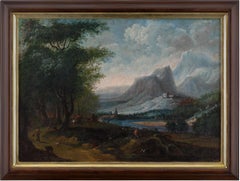
Mid-17th-Century Dutch School, Mountainous Landscape With Wood, River & Figures

Mid-17th-Century Dutch School, Mountainous Landscape With Wood, River & Figures

Located in Cheltenham, GB

This mid-17th-century Dutch landscape painting, executed in oil on canvas, depicts travellers moving through a broad river valley beneath dramatic mountainous peaks. Set within an ex...

Category

1660s Dutch School Jonny Gaston Figurative Paintings

Materials

Oil, Canvas

1930's Modernist Oil Painting Paris Rooftops Hazel Guggenheim Mckinley Fauvist

1930's Modernist Oil Painting Paris Rooftops Hazel Guggenheim Mckinley Fauvist

By Hazel Guggenheim McKinley

Located in Surfside, FL

Hazel Guggenheim King-Farlow McKinley (American, London, New Orleans, 1903-1995), "Paris Rooftops" c. 1930 Oil paint on wood panel Attributed, dated and titled verso (I am not sure in whose hand not signed by the artist herself). Dimensions H.- 18 in., W.- 15 in., Framed- H.- 26 1/2 in., W.- 23 in. Provenance: From an estate New Orleans, Louisiana. Hazel Guggenheim King-Farlow McKinley (born Barbara Hazel Guggenheim; April 30, 1903 – June 10, 1995) was an American painter, art collector, and art benefactor. Hazel Guggenheim was born in New York City to Benjamin Guggenheim and Fleurette (Seligman) Guggenheim. The marriage united two wealthy German-Jewish families. Born into the well-known Guggenheim family, a niece of Solomon Guggenheim who founded the Guggenheim Museum, she grew up in New York, alongside her sisters Benita Guggenheim and Marguerite Peggy Guggenheim who would become the influential gallery proprietor, art collector, museum founder, and midwife to the Abstract Expressionism art movement. Her father Benjamin gave up much of his financial interest in the family's mining business to start his own business in Paris. With his business failing, in 1912 he set out to return to the United States in time for McKinley's ninth birthday on the Titanic. Following the shipwreck, he drowned aged 46; his body was not recovered. McKinley inherited $450,000. She later inherited money on the deaths of her mother, and of her older sister, Benita, who died in childbirth. The loss of her father haunted McKinley for the rest of her life, and in 1969 she recorded "In Memoriam, Titanic Lifeboat Blues." McKinley began painting as a teenager and was a prolific artist throughout her life. When she fled New York for Paris at age 19 she studied at the Sorbonne and became part of 1920's bohemian Paris, France, where she was taught by key modernism artists of the time. Her primary mediums were ink, water color, tempera, and crayon. Some of her work is hand signed and some is not. In 1928 her sister Peggy moved to London and mar­ried the British writer John Holmes. In 1931, McKinley married the Englishman Denys King-Farlow. They settled in Sussex, UK, and had two children, John King-Farlow, who became a philosopher and poet, and Barbara Benita King-Farlow, who became an artist in her own right. In 1938 Peggy opened Guggenheim Jeune, a London gallery of mod­ern art, starring Wassily Kandinsky, Henry Moore, Salvador dali, Constantin Brancusi, Max Ernst, Pablo Pic­asso and Jean Miro with whom they socialized. Whilst living in the south of England with Denys King-Farlow in the 1930s, McKinley was influenced by a group of avant-garde artists, and had her first solo exhibition in London in April 1937 at the Coolings Gallery. She received instruction from British artists Rowland Suddaby, Raymond Coxon, and Edna Ginesi, becoming associated with the London Group and the Euston Road School. She painted primarily in watercolor. Her work included still-life, portraits, townscapes and landscapes. Although her first work was done in a "slightly plain palette," her later work in the 1930s brightened, sometimes falling within the realm of fauvism. "Under the influence of the Surrealist artists, Hazel's paintings after the 1930's became freer, though her work was far more whimsical and humorous than many artists more closely associated with the surrealism movement." In 1939 McKinley fled Europe due to the impending war and returned to the US, living mostly in California. She took brief art lessons from her sister Peggy's one-time husband Max Ernst and much later attended several summer schools taught by muralist and renowned teacher Xavier Gonzalez. In her life in the United States and abroad, McKinley met many prominent artists of the Paris, London, and New York art scenes including Jackson Pollock. McKinley continued to paint, and ran a small gallery of her own in the late 1950s and early 1960s in West Cornwall, Connecticut. One show at her gallery featured the works of British and Irish painters including Rowland Suddaby, Frank Beteson, Tom Nisbett, and Patrick Swift. McKinley showed two of her own works in the same exhibit, a watercolor painted at Positano, Italy and one painted at the Tuileries, Paris. Another featured work was a surrealistic water color portrait of McKinley by London artist Mervyn Peake. McKinley exhibited her work both in Europe and the United States throughout her long career, mostly at smaller venues. An incomplete listing of her exhibits and museum acquisitions of her work include: Berkshire Museum, the Galerie Raymond Duncan in Paris, Stendahl Galleries, the Jake Zeitlin Gallery, the Montgomery Museum of Fine Art, the Artists' Own Gallery in London, the Manchester City Art Gallery, and Santa Fe Art Museum. McKinley's work was only once included in a show by her sister Peggy. In 1943 McKinley was selected to exhibit a painting in Peggy's infamous show Exhibition by 31 Women in her New York gallery Art of This Century. The exhibition was radical at the time for being one of the first all-woman exhibitions, as well as showing only abstract or Surrealist works. The Exhibition by 31 Women was conceived by Peggy Guggenheim in collaboration with Marcel Duchamp, who is usually credited with suggesting the idea. The participating artists were selected by a jury that included André Breton, Max Ernst Duchamp, and Guggenheim. Advice was sought from Alfred H. Barr Jr., first director of the Museum of Modern Art in New York, who provided Guggenheim with five names, of which three were included in the exhibition, Suzy Frelinghuysen, Irene Rice Pereira, and Esphyr Slobodkina. Those already known to Guggenheim through their partners included Xenia Cage, wife of the composer John Cage, Frida Kahlo, wife of Diego Rivera, who was noted for his frescoes, Sophie Taeuber-Arp, wife of the sculptor, Hans Jean Arp, and Jacqueline Lamba, ex-wife of the surrealist André Breton. Guggenheim’s sister, Hazel Guggenheim McKinley and her daughter, Pegeen Vail Guggenheim exhibited. Also in the exhibition was the burlesque dancer, Gypsy Rose Lee, another friend of Guggenheim, who was possibly included more to help publicise the event than for her artistic skills. Other artists were friends of Guggenheim or of Max Ernst. One, Dorothea Tanning, was Ernst's lover, leading Guggenheim to say: "I realized that I should have only had thirty women in the show". Only one artist is known to have refused the invitation to submit works, Georgia O'Keeffe, who reportedly responded that she wished to be identified as a painter, and not singled out because of her gender. In the late 1950s, McKinley moved back to Europe for a while, before returning to the United States in 1969. She lived in New Orleans until her death in 1995. On her death, her only living son, John King-Farlow, wrote a poem in his mother's honor, entitled "Eulogy For My Mother (Hazel Guggenheim McKinley, Artist)." A short obituary distributed by the Associated Press noted she was a member of the illustrious New York Guggenheim family, that she was determined to make a name for herself as an artist, that her art works were shown in museums in the United States and Europe, and were in the collections of such celebrities as Greer Garson, Benny Goodman, and Jason Robards. In 1998 after her death, one of her paintings was exhibited in Peggy Guggenheim's Venice home museum the Palazzo Venier dei Leoni. Guggenheim’s work in various media and her connections to influential artists and collectors provide glimpses into the complex tapestry of the art world in the first half of the 20th century. In her later life she settled in New Orleans, where she continued painting, exhibiting, and studying art into her eighties at Newcomb College, New Orleans. She was part of a regional art scene that included Ida Kohlmeyer, George Rodrigue, Noel Rockmore and Hunt Slonem. Towards the end of her life while confined to bed, her last works were colored pen drawings and sketches. McKinley collected major contemporary artworks and she donated many of these works to public institutions. She donated over 15 works to Wakefield Art Gallery, UK, in the 1930s, and in 1938 presented the painting Cossacks...

Category

1930s Modern Jonny Gaston Figurative Paintings

Materials

Oil, Panel

18th c Dutch Triptych Oil Painting with Woman & Dogs, Boats, & Interior Scene

18th c Dutch Triptych Oil Painting with Woman & Dogs, Boats, & Interior Scene

Located in Milford, NH

A finely detailed Dutch School triptych oil on canvas, featuring a woman with dogs, boats, and an interior scene, unsigned, and framed in a custom giltwood frame. The painting probab...

Category

18th Century Dutch School Jonny Gaston Figurative Paintings

Materials

Canvas, Oil

"Woodstock Landscape" Albert Heckman, American Modernist, Atmospheric Valley

"Woodstock Landscape" Albert Heckman, American Modernist, Atmospheric Valley

By Albert Heckman

Located in New York, NY

Albert Heckman Woodstock Landscape Oil on board 10 x 8 inches Albert Heckman was born in Meadville, Western Pennsylvania, 1893. He went to New York City to try his hand at the art ...

Category

1940s American Modern Jonny Gaston Figurative Paintings

Materials

Oil, Board

Sailboat Seascape
Sailboat Seascape

Sailboat Seascape

Located in Soquel, CA

Beautifully rendered seascape of a sailboat full of small figures out at sea on glassy water with colorful reflections by Jacquelyn Kammerer (American, b-1944). Signed "J. Krammerer"...

Category

Late 20th Century American Impressionist Jonny Gaston Figurative Paintings
Materials

Canvas, Oil

"Concert" Early 20th Century WPA Modernism American City Landscape Scene Ashcan

"Concert" Early 20th Century WPA Modernism American City Landscape Scene Ashcan

By Michael Loew

Located in New York, NY

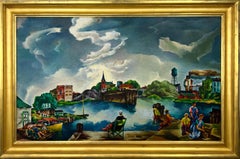
"Concert" Early 20th Century WPA Modernism American City Landscape Scene Ashcan The size of the canvas 28 3/4 x 43 1/4 inches. The painting comes directly from the artist's estate. It is signed lower right as well as signed, titled and dated verso. We have available more than two dozen paintings and works on paper from the 1930s - 80s that come directly from the Loew estate. BIO Michael Loew (1907 – 1985) was the son of a New York City baker. After high school, he was an apprentice to a stained-glass maker, and from 1926-1929, he studied at the Art Students League. In 1929, he traveled to Paris, North Africa, Germany, and Italy with a group of artists. When he returned to New York City in 1931, the Great Depression hit Loew unexpectedly, and for the next two years he paid his apartment rent with his paintings. In 1935, he found work with the WPA where he painted murals and partnered up with longtime friend Willem de Kooning in 1939 on a mural for the Hall of Pharmacy at the New York World’s Fair. Their friendship lasted for the rest of their lives. In the mid-30’s he painted in Mexico and the Yucatán documenting the construction of a U.S. Naval airbase on Tinian Island. It was from this airbase that the Enola...

Category

1920s American Modern Jonny Gaston Figurative Paintings

Materials

Canvas, Oil

Autumn Landscape in Sunlight - Indian Summer -

Autumn Landscape in Sunlight - Indian Summer -

Located in Berlin, DE

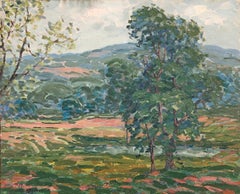
Frederick Vezin (1859 Torresdale Philadelphia - 1933 Düsseldorf), Autumn Landscape in the Sunlight, oil on canvas, mounted on cardboard, 32 x 41 cm (inside measurement), 44 x 51 cm (frame), signed and dates lower right "F. Vezin. [19]05". - Cardboard slightly curved, small inconspicuous retouch at the centre of the upper edge of the picture. About the artwork Although the painting appears to be a sketch, Frederick Vezin considered it to be a finished work of art, as evidenced by his signature on the lower right. And it is precisely this sketchy quality that leads to an understanding of the painting, which was certainly created in the landscape itself: the natural phenomena were to be depicted artistically at the moment of their observation. This is not done by meticulously sketching nature, but - and here Vezin follows the teaching of French Impressionism - by illustrating nature in its visual fullness. The artist's eye is, as it were, immersed in the visuality of nature, which is made visible by his hand. The painting is therefore not a reflection of the landscape, but its artistic intensification. This intensification also includes the fact that the foreground of the painting - corresponding to the field of vision - eludes a detail-oriented close-up view. Instead, the spatula-like application of paint, the vertical structure of which corresponds to the structure of the floral growth, has the effect of making nature tangible in its colourful substance. At the same time, the foreground, which remains indeterminate in its concrete objectivity, creates an atmospheric space that connects with the actual protagonist of the picture, the group of trees, which flares up in shades of red and brown. Here, too, the leaves are more speckled than clearly outlined. It is precisely this 'sketchiness' that opens up a visual experience that makes the landscape accessible in its visual fullness, thus revealing its essence. In addition to this abundance, the landscape is presented as a structure of order in that the composition of the picture makes the composition of the landscape visible. For example, the group of trees forms a distinct dark green shadow, which is repeated in the shadows cast by the trees behind it. A patterned diagonal axis is created in the picture, which is composed in this way by the landscape itself. Strictly speaking, this is a cultivated landscape: a fence at the bottom and a low stone wall at the top, running from left to right, are two elements that also have a strong compositional effect. And on the top of the hill, a stone house is embedded in the landscape as the brightest surface in the picture. Nature and culture here form a harmonious synthesis, giving the painting an Arcadian touch. In order to give the landscape as much space as possible, the horizon line is raised, but the design of the sky is also crucial. The clouds, combined with the shapes of the trees, create a bright blue sky. To the European eye, such a sky is reminiscent of a summer landscape. Accordingly, within the seasonal cycle, the blue sky is reserved for summer, and French Impressionism is also primarily an ode to summer. In Vezin's painting, however, the brilliant blue sky stands above an autumnal landscape, some of the trees even defoliated. It can therefore be assumed that the painting was made not in Europe but in the United States, and that it illustrates the proverbial Indian summer, making Frederick Vezin a pioneer of American landscape painting. About the artist Frederick Vezin was the son of a French immigrant to the United States and a German-born mother. This predestined him to promote artistic exchange between the old and new worlds. Having spent part of his schooling in Germany, in 1876, at the age of 20, he enrolled at the Düsseldorf Academy of Art, where he studied with Peter Janssen the Elder, Eduard von Gebhardt and Wilhelm Sohn, among others. He graduated in 1883, settled in Munich and returned to Düsseldorf in 1895, where he lived until his death in 1933. A native of the United States, he travelled to the country frequently and became a popular portrait and society painter. His artistic talent, however, was most evident in his landscape paintings. Trained in French Impressionism, he developed a virtuoso use of colour and a free brushwork that remained tied to the landscape motif, opening up the landscape itself in a new way. Frederick Vezin turned his attention primarily to the landscape of his homeland, becoming a pioneer of modern American landscape...

Category

Early 1900s Impressionist Jonny Gaston Figurative Paintings
Materials

Oil, Cardboard

Feeding the Ducks: by Evert Pieters. Late 19th Century Dutch School Oil Painting

Feeding the Ducks: by Evert Pieters. Late 19th Century Dutch School Oil Painting

By Evert Pieters

Located in St. Albans, GB

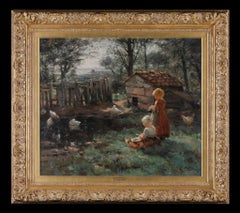
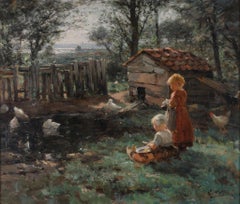
This painting is in excellent condition having been behind glass until recently. The colours are preserved and the canvas is blemish free. Artwork Size: 30 x 36" (76 x 91cm) Artwor...

Category

Late 19th Century Dutch School Jonny Gaston Figurative Paintings

Materials

Oil

By the River, Italian, Rural Scene, Trees, Orchard, Genre Painting

By the River, Italian, Rural Scene, Trees, Orchard, Genre Painting

By Alessandro Milesi

Located in Wiscasset, ME

Alessandro Milesi was a Venetian genre painter. He studied under Napoleone Nani at the Venice Academy of Fine Arts from 1869 to 1874 and exhibited extensively in Italy after a succes...

Category

Early 20th Century Impressionist Jonny Gaston Figurative Paintings
Materials

Canvas, Oil

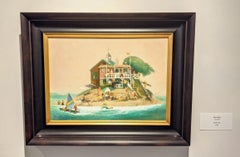
"Star Spangled Stern" a folded sail casts a shadow on the American flag

"Star Spangled Stern" a folded sail casts a shadow on the American flag

By Michel Brosseau

Located in Edgartown, MA

Michel Brosseau was born in Nantes and has lived in Bordeaux for many years. Both cities are on the Atlantic coast of France and have rich maritime histories, highlighted by prospero...

Category

2010s Contemporary Jonny Gaston Figurative Paintings
Materials

Linen, Raw Linen, Oil

Jonny Gaston figurative paintings for sale on 1stDibs.

Find a wide variety of authentic Jonny Gaston figurative paintings available for sale on 1stDibs. You can also browse by medium to find art by Jonny Gaston in oil paint, paint and more. Much of the original work by this artist or collective was created during the 20th century and is mostly associated with the modern style. Not every interior allows for large Jonny Gaston figurative paintings, so small editions measuring 22 inches across are available. Jonny Gaston figurative paintings prices can differ depending upon medium, time period and other attributes. On 1stDibs, the price for these items starts at $1,093 and tops out at $1,311, while the average work can sell for $1,311.