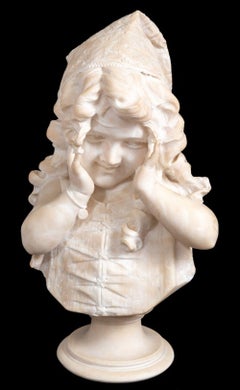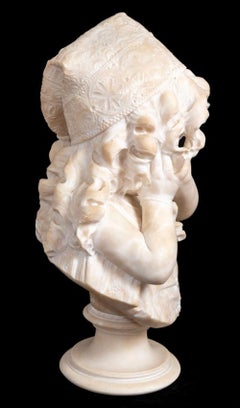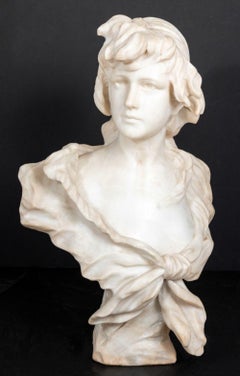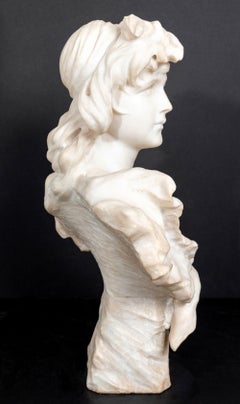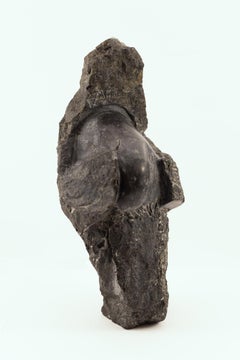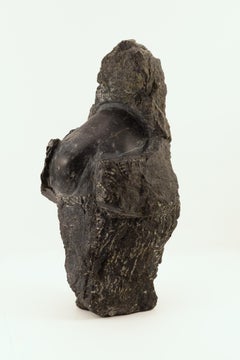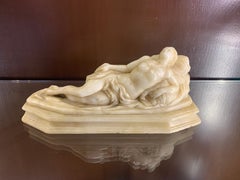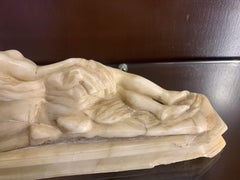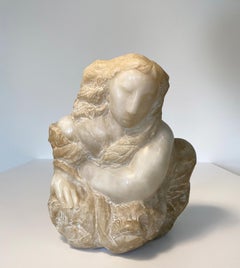
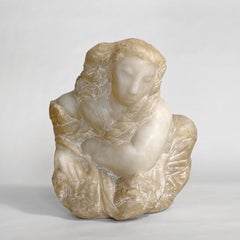
Ecstacy, marble of a woman
By Jose de Creeft
Located in New York, NY
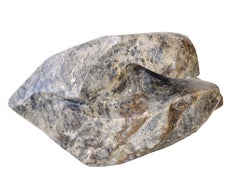
This romantic and lovely Alabaster marble is classic Jose De Creeft who was a world recognized stone sculptor carver. He has a remarkable career and story. And this work is what he is best known to do. Female form that has face and form emerging from rougher hewn areas of the stone. This was a technique that Rodin used as well and was popular around the turn of the century. Size is attractive as it can go on a well balanced table or a pedestal of easy size! Provenance: The Hannelore and Rudolph Schulhof Collection, New York* *Ecstasy was originally a part of the Schulhof Collection, founded by the couple Hannelore and Rudolph Schulhof and begun a few years into their marriage in the 1950s. The established collection is known for exceptional Postwar works including pieces by Johns, Rothko, and Twombly, to name a few. As Hannelore Schulhof stated in 2011, “Art is almost like a religion. It is what I believe in… it is what gives my life dimension beyond the material world.” Signed: J. De Creeft in the rear The stylized, placid face of Ecstasy, as well as the contrast between smooth and rough-hewn stone, are typical of de Creeft’s hand and instantly recognizable. Its natural alabaster inclusions and the generally fragmentized feel of the piece are both essential to its aesthetic and classic de Creeft. The Guadalajara-born sculptor studied alongside Rodin at the Académie Julian starting in 1905 and would eventually become Alexander Calder’s tutor in direct carving. Ecstasy was undoubtedly inspired by a wide variety of influences that had a profound effect on his work, including his early employment at the young age of six earning pennies by carrying stones to aid the construction of Gaudí’s Sagrada Familia, and an inspiring encounter with Inuit sculptors in Madrid’s El Retiro Park during the nascency of his career. Towards the mid-20th century, de Creeft was working within a group of Spanish expatriate artists in New York, including Vicente and Dalí. 1956, the year he carved Ecstasy—using the method of direct carving of which he was a firm proponent—marked the year he gained representation at the Contemporary Galleries in New York City. He would exhibit biannually there until 1966. In the 1950s de Creeft received numerous public commissions, including an eight-foot granite Poetess for the city of Philadelphia in 1951 and his famous 16-foot Alice in Wonderland climbing sculpture...
1950s Post-Modern José de Creeft Art
Alabaster