Joseph Hecht Art

French, 1891-1951

Polish artist Joseph Hecht went to live in neutral Norway at the outbreak of World War I. Immediately following the armistice, Hecht traveled to Italy; and two years later to Paris, where he maintained a studio until his death. Hecht became a member of the Salon d'Automne, thereby gaining an entrée into the Parisian art world and the opportunity to exhibit his work regularly. At his Paris studio, he taught burin-engraving, the classic copper-engraving technique, to many artists including British surrealist painter and printmaker Stanley William Hayter. In 1926 Hecht published his first suite of six prints, l'Arche de Noë, which included a preface by the French symbolist Gustave Kahn and was exhibited in December that year at the Paris gallery Le nouvel essor. Hecht’s future collaborator, mystical poet and critic André Suarès wrote a laudatory catalog article. The imagery that Hecht had developed found renewed vigor in 1928 when Suarès and Hecht collaborated on the folio, Atlas. In 1927 Hecht’s support of Hayter's printmaking explorations led to the founding of the printmaking cooperative Atelier 17, which was to become perhaps the most influential printmaking studio of the 20th century, and which endures to this day in Paris as Atelier Contrepoint. The collaborative atmosphere and experimental techniques developed at Atelier 17 influenced numerous artists including Pablo Picasso, Marc Chagall, Alberto Giacometti and Joan Miró. In 1929, Hecht also became a founding member of another group, La Jeune Gravure Contemporaine, which staged annual group shows and was influential in maintaining a vibrant interest in printmaking. Between 1926–38, Hecht's engravings were published in various collections and his work was widely exhibited, gaining him critical acclaim. Hecht won two gold medals at the 1937 Paris World's Fair.

to
3
3
2
2
1
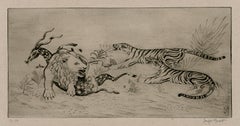
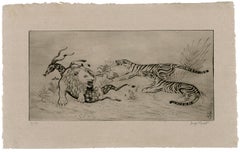
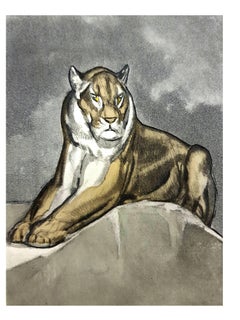
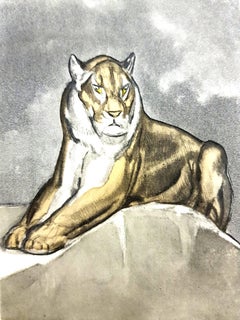
Lion Défendant sa Proie (Lion Defending Its Prey) — Atelier 17

Lion Défendant sa Proie (Lion Defending Its Prey) — Atelier 17

By Joseph Hecht

Located in Myrtle Beach, SC

Joseph Hecht, 'Lion Défendant sa Proie (Lion Defending Its Prey)', engraving, 1931, edition 50, Tonneau-Ryckelynck & Plumart 215. Signed and numbered '18/50' in pencil. A fine impres...

Category

1930s Modern Joseph Hecht Art

Materials

Engraving

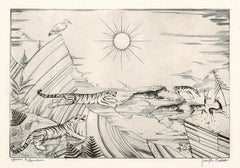
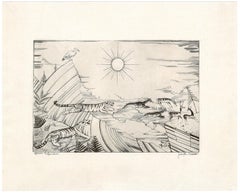
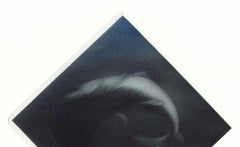
Asie (Asia) from the series Atlas — Atelier 17

Asie (Asia) from the series Atlas — Atelier 17

By Joseph Hecht

Located in Myrtle Beach, SC

Joseph Hecht, 'Asie (Asia) from the series Atlas', engraving, 1928, edition c. 50, Tonneau-Ryckelynck & Plumart 162. Signed and annotated 'epreuve definitive' (final proof) in pencil...

Category

1930s Modern Joseph Hecht Art

Materials

Engraving

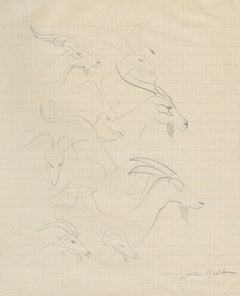
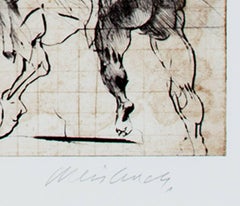
Page de Croquis: Tetes de Antilops

Page de Croquis: Tetes de Antilops

By Joseph Hecht

Located in Fairlawn, OH

Signed in pencil lower right recto Provenance: Elizabeth Carroll Shearer (1924-2014), Chesterland, Ohio, former President and Trustee of the Print Club of Cleveland which is an affiliate of the Cleveland Museum of Art. Her collectors mark of initials and a Sealyham Terrier...

Category

Early 20th Century Joseph Hecht Art

Materials

Graphite

Related Items
Snail in a Bowl (Artist Proof inscribed to Fritz Eichenberg)

Snail in a Bowl (Artist Proof inscribed to Fritz Eichenberg)

Located in New Orleans, LA

Leonard Merchant's mezzotint, "Snail in Cup" is inscribed for fellow artist, Fritz Eichenberg. While a student at the Central School for Arts and Crafts in London, a young Leonard Marchant found an engraving rocker in a cupboard and proceeded to turn himself into a master of the painstaking art of mezzotinting. Marchant, who has died in Shrewsbury aged 70, grew up in Simonstown, the Royal Navy's enclave in South Africa. Though his first job was as a parliamentary messenger, he taught himself to paint and, aged 19, was given a one-man show in Cape Town. Fired by this success, he left for England to study painting and, he claimed, to escape the stifling home atmosphere created by his Catholic mother and aunts. (His father was killed in the second world war.) Without contacts in London, he phoned Jacob Epstein, whose recommendation resulted in a grant to study briefly at the Central School. It was later, when studying full-time at the Central, that he saw the mezzotints of the Japanese master, Yozo Hamaguchi, in a London gallery. He was hooked. Creating a mezzotint is tedious in the extreme. The copper plate must first be prepared with a "rocker" which roughens the surface. A plate may be "rocked" 30 or 40 times. The rough texture is then reduced with a burnisher and a scraper, allowing the print a range of tones from velvety black through the greys to white. Marchant's plates could be months in the making. But the technical demands were the least of his worries. In its 18th- and 19th-century heyday, mezzotint was solely a reproductive medium, for copying masters such as Reynolds and Turner. The development of photography rendered it unfashionable, and by the 1960s the technique, known as la manière anglaise, was a bygone medium. Marchant, by now a teacher in printmaking at the Central, began to create original mezzotints with a colleague, Radavan Kraguly. A perfectionist, he seemed to revel in the straitjacket procedure. Perhaps it was the metaphor of bringing darkness out of light that appealed to this straight-talking, sometimes sombre, man, who would suddenly relax and light up like a gleaming hue on one of his prints. His work was of squares and triangles with the occasional cat, black and ominous, and carefully arranged still lifes, featuring plants, a seed pod, a pot he might have bought at auction to celebrate the sale of a print. There were one-man shows, notably at the Bankside Gallery. He sold well at the Royal Academy summer exhibition, was a Florence Biennale prizewinner, spent a fellowship year at the British School in Rome, and was elected a Fellow of the Royal Society of Painter-Printmakers. But making mezzotints was not a paying job. Marchant and his South African wife...

Category

1980s Modern Joseph Hecht Art

Materials

Mezzotint

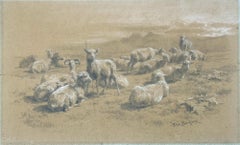
Highlands Sheep; A finished study from the Highlands Series

Highlands Sheep; A finished study from the Highlands Series

By Rosa Bonheur

Located in Middletown, NY

A finished primary study for Bonheur's major oil paintings of the late 1850s, capturing the quiet, unadorned dignity of animals in their native environment. Circa 1855. Graphite and...

Category

Mid-19th Century French School Joseph Hecht Art

Materials

Handmade Paper, Graphite, Crayon

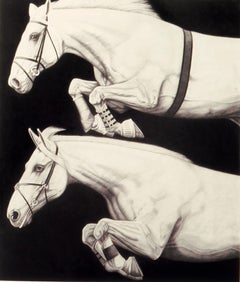
Puissance, Horse Drawing, Charcoal and graphite on Fabriano paper, white frame

Puissance, Horse Drawing, Charcoal and graphite on Fabriano paper, white frame

By Patsy McArthur

Located in Dallas, TX

Puissance is a beautiful and unique charcoal drawing on paper of a dynamic horse. The Fabriano paper is a high quality watercolor grade set in a custom white wood frame, all archival...

Category

2010s Realist Joseph Hecht Art

Materials

Charcoal, Archival Paper, Graphite

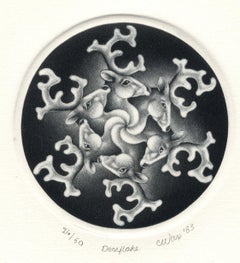
Deerflake (The artist's first work celebrating the Solstice / deer as snowflake)

Deerflake (The artist's first work celebrating the Solstice / deer as snowflake)

By Carol Wax

Located in New Orleans, LA

Carol Wax describes her circular images as "most often quasi abstract works that refer to ancient islamic designs using the shapes and attributes of animals, in this case the deer. T...

Category

Late 20th Century American Modern Joseph Hecht Art

Materials

Mezzotint

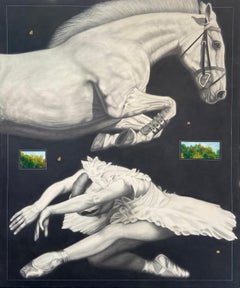
#4, 2007
#4, 2007

Joseph Piccillo#4, 2007

$18,000

H 72 in W 60 in

#4, 2007

By Joseph Piccillo

Located in Fairfield, CT

Represented by George Billis Gallery, NYC & LA -- Joseph Piccillo's large-scale canvases contrast masculine and feminine qualities, carefully balancing strength and power beside grac...

Category

Early 2000s Realist Joseph Hecht Art

Materials

Canvas, Graphite

Beast of Burden

Beast of Burden

By Michael Kotasek

Located in Sag Harbor, NY

Awards 2013 Loring W. Coleman Award for Watercolor/ Allied Artists of America, 100th Annual Exhibition at the National Arts Club 2011 Mary Bryan Memorial Medal / Allied Artis...

Category

21st Century and Contemporary American Realist Joseph Hecht Art

Materials

Graphite

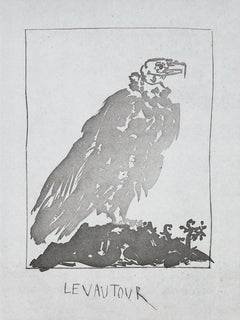
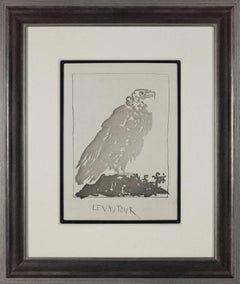
The Vulture. 1942 (Histoire Naturelle - Textes de Buffon, B.341)

The Vulture. 1942 (Histoire Naturelle - Textes de Buffon, B.341)

By Pablo Picasso

Located in Greenwich, CT

The Vulture is an aquatint and drypoint print on chine from one of the deluxe copies of Picasso's 1942 Histoire Naturelle - Textes de Buffon series. The image size is 10.6 x 8 inches, unsigned as issued, and framed in a contemporary silver and gray moulding. One of about 36 prints that exist with Picasso's remarqued title in French, from the edition of 262 (there were 226 portfolios, some with additional sets on varying papers). Catalogue - Cramer #37 The exceptional etchings from Picasso’s Histoire Naturelle – Textes de Buffon are a masterful combination of sugar-lift aquatint and drypoint, showcasing a full range of gray tonalities. The etchings of animals, birds and insects are considered some of the most beautiful and most unusual examples of Picasso’s graphic work. Roger Lacourière, Picasso’s master printer, pulled the prints for each etching between 1939-1942. It was Lacourière who taught Picasso the sugar-lift aquatint technique which allowed him to mimic the effect of brushstrokes in these etched images. Picasso first explored the technique in his plates for the Vollard Suite, but it was in the creation of the Buffon images that he fully realized its stunning, painterly potential. For the edition, 226 portfolios were produced with the first thirty-six counting as deluxe compilations. These rare deluxe sets were on diverse papers (chine, japon or vergé ancien) and each included a complete additional suite showing Picasso’s title remarques along the bottom. As such, the remarqued versions of the prints are quite rare with just thirty-six of each produced for the edition (with the exception of The Wolf which is never remarqued – the image always fills the entire etching plate). These prints are based on the writings of French naturalist Georges-Louis Leclerc, Comte de Buffon, who extensively documented the natural world in his monumental work Histoire Naturelle. Picasso’s association with the project to illustrate parts of the Buffon came during a tumultuous time in European history – the prelude to, and early years of, World War II. As the continent was ravaged, Picasso lived through the disaster in Paris, which the Germans occupied in 1940. These prints could be seen as a political statement – Picasso channeling his artistic expression into a form of resistance art...

Category

20th Century Modern Joseph Hecht Art

Materials

Drypoint, Aquatint
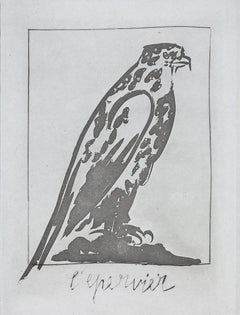
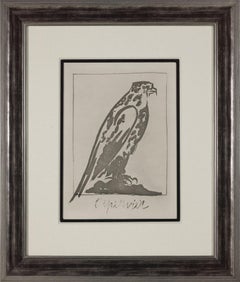
The Sparrow Hawk, 1942 (Histoire Naturelle - Textes de Buffon, B.342)

The Sparrow Hawk, 1942 (Histoire Naturelle - Textes de Buffon, B.342)

By Pablo Picasso

Located in Greenwich, CT

The Sparrow Hawk is an aquatint and drypoint print on chine from one of the deluxe copies of Picasso's 1942 Histoire Naturelle - Textes de Buffon series. The image size is 10.5 x 8 inches, unsigned as issued, and framed in a contemporary silver and gray moulding. One of about 36 prints that exist with Picasso's remarqued title in French, from the edition of 262 (there were 226 portfolios, some with additional sets on varying papers). Catalogue - Cramer #37 The exceptional etchings from Picasso’s Histoire Naturelle – Textes de Buffon are a masterful combination of sugar-lift aquatint and drypoint, showcasing a full range of gray tonalities. The etchings of animals, birds and insects are considered some of the most beautiful and most unusual examples of Picasso’s graphic work. Roger Lacourière, Picasso’s master printer, pulled the prints for each etching between 1939-1942. It was Lacourière who taught Picasso the sugar-lift aquatint technique which allowed him to mimic the effect of brushstrokes in these etched images. Picasso first explored the technique in his plates for the Vollard Suite, but it was in the creation of the Buffon images that he fully realized its stunning, painterly potential. For the edition, 226 portfolios were produced with the first thirty-six counting as deluxe compilations. These rare deluxe sets were on diverse papers (chine, japon or vergé ancien) and each included a complete additional suite showing Picasso’s title remarques along the bottom. As such, the remarqued versions of the prints are quite rare with just thirty-six of each produced for the edition (with the exception of The Wolf which is never remarqued – the image always fills the entire etching plate). These prints are based on the writings of French naturalist Georges-Louis Leclerc, Comte de Buffon, who extensively documented the natural world in his monumental work Histoire Naturelle. Picasso’s association with the project to illustrate parts of the Buffon came during a tumultuous time in European history – the prelude to, and early years of, World War II. As the continent was ravaged, Picasso lived through the disaster in Paris, which the Germans occupied in 1940. These prints could be seen as a political statement – Picasso channeling his artistic expression into a form of resistance art...

Category

20th Century Modern Joseph Hecht Art

Materials

Drypoint, Aquatint
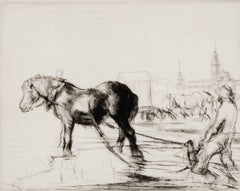
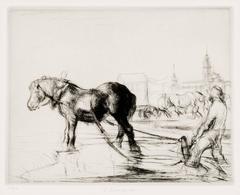
Ostend Horse
Ostend Horse

Edmund BlampiedOstend Horse, 1926-27

$750

H 20 in W 16 in D 2 in

Ostend Horse

By Edmund Blampied

Located in Plano, TX

Ostend Horse. 1926-27. Drypoint. Appleby 125. 7 x 815/16 (sheet 9 1/8x 12 1/5). Proof B, apart from the edition 100. A rich impression with tonal wiping and drypoint burr, printed on...

Category

1920s Modern Joseph Hecht Art

Materials

Drypoint, Etching

Through the Storm.
Through the Storm.

Edmund BlampiedThrough the Storm., 1923

$750

H 20 in W 16 in D 2 in

Through the Storm.

By Edmund Blampied

Located in Plano, TX

Appleby 97. 4 x 6 15/16 (sheet 8 1/8 x 10 3/8). Edition 100. A rich impression with drypoint burr and carefully wiped plate tone, printed on 'FJ Head' paper, on the full sheet with ...

Category

1920s Modern Joseph Hecht Art

Materials

Drypoint, Etching

"Requiem of Regret" (2024) By Brian Serway, Original Graphite Drawing

"Requiem of Regret" (2024) By Brian Serway, Original Graphite Drawing

Located in Denver, CO

"Requiem of Regret" (2024) by Brian Serway is an original handmade drawing made with water soluble graphite on board. This piece depicts a wolf standing on a rock peak looking out ov...

Category

2010s Realist Joseph Hecht Art

Materials

Board, Graphite

Strange Animals
Strange Animals

Ray H. FrenchStrange Animals, 1947

$1,500

H 9.75 in W 14 in

Strange Animals

By Ray H. French

Located in Fairlawn, OH

Strange Animals Engraving, 1949 Signed, dated, and titled in pencil by the artist The composition was created at the Univerisity of Iowa while the artist was enrolled in the famous M...

Category

1940s American Modern Joseph Hecht Art

Materials

Engraving

Joseph Hecht art for sale on 1stDibs.

Find a wide variety of authentic Joseph Hecht art available for sale on 1stDibs. You can also browse by medium to find art by Joseph Hecht in engraving, graphite, pencil and more. Much of the original work by this artist or collective was created during the 20th century and is mostly associated with the modern style. Not every interior allows for large Joseph Hecht art, so small editions measuring 9 inches across are available. Customers who are interested in this artist might also find the work of Robert De Launay, Roger Soubie, and Eugène Delâtre. Joseph Hecht art prices can differ depending upon medium, time period and other attributes. On 1stDibs, the price for these items starts at $400 and tops out at $2,400, while the average work can sell for $2,400.

Artists Similar to Joseph Hecht