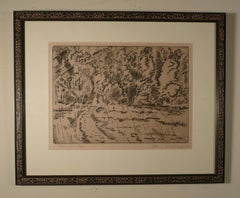
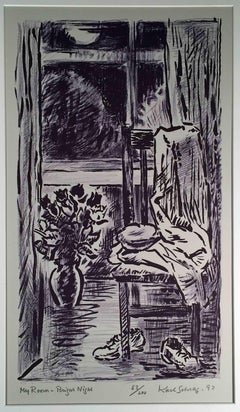
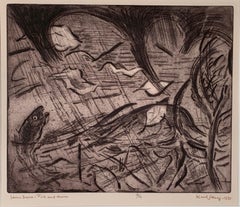
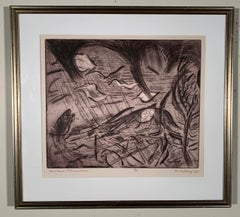
By Karl Schrag
Located in New York, NY
Karl Schrag (1912 - 1995)
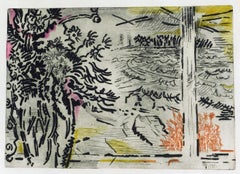
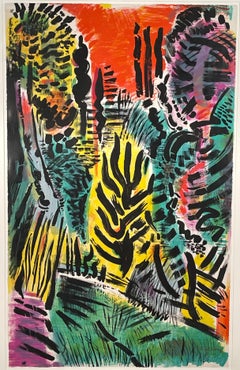
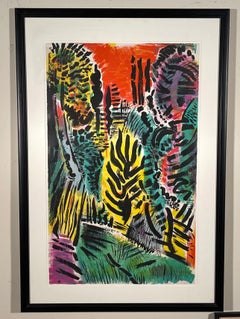
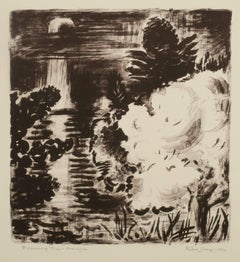
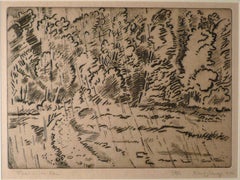
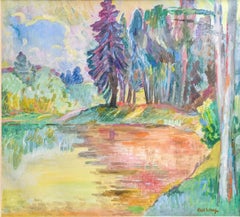
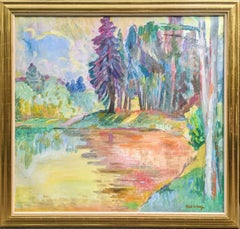
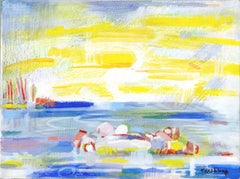
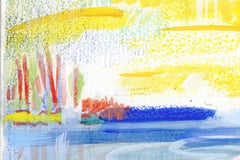
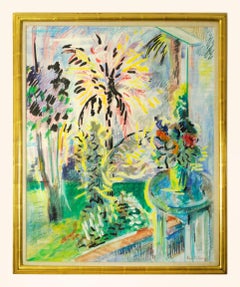
Noon Silence By A Pond, circa 1959
Oil on canvas
46 x 42 inches
Signed lower right
Provenance:
Kraushaar Galleries, New York
Private Collection, Sag Harbor, New York (acquired from the above)
Karl Schrag, a German-born American painter and printmaker whose work combined aspects of European and American modernism lived in New York and Deer Isle, Maine. In a career that spanned more than 60 years, Schrag came to specialize in a painting style characterized by loose, energetic brushwork and resonant colors that restated the concerns of van Gogh, Matisse and Kirchner in contemporary terms. Although he made many self-portraits, his stronger works were paintings and prints of gently pastoral landscapes inspired by his many summers in Maine, works whose cascading strokes and visionary demeanor often brought to mind the art of Charles Burchfield.
Schrag was born in Karlsruhe, Germany, in 1912, the son of a prominent lawyer, and settled on his vocation while still a teen-ager. After his family moved to Zurich in 1930, he studied art in Geneva and then in Paris, where his teachers included Roger Bissiere. He came to New York in 1938, continuing his studies at the Art Students League.
Schrag had his first solo show in New York in 1947 at the Kraushaar Gallery, which represented him for the rest of his life. Like his fellow emigres Louise Bourgeois, Chagall, Dali, Masson, Miro and others, together with such Americans as George Ortman, Jackson Pollock, and Anne Ryan, Schrag joined Stanley William Hayter's graphics workshop, Atelier 17, itself a transplant from Paris. By 1941, he was showing in the Whitney Annuals. He taught printmaking at Brooklyn College from 1953 to 1954 and at Cooper Union from 1954 to 1968.
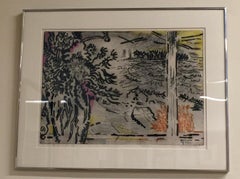
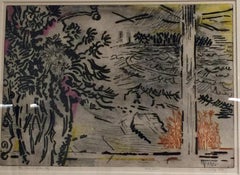
With the rise of Abstract Expressionism, the postwar period became "a night of the long knives" for figural artists. Schrag survived it better than most as he exhibited steadily, alone and in groups, for more than 40 years, in part because he was not antagonistic to the movement and, by way of Atelier 17 and bars like the Cedar Tavern, knew most of its leading lights. But as he explained in a catalogue statement, he himself did not care to join so "dominant" a direction in art, and besides, he was searching for his own "language of forms." Another reason for his success seems to have been his gift for and emphasis on printmaking. No less an authority than Riva Castleman, the Museum of Modern Art's curator of prints, is quoted as saying that Gabor Peterdi, Mauricio Lasansky and Schrag -- all three of them emigres -- "dominated" American graphics in the 1950's. Hence, it is no surprise to find that some of the finest images in this show are aquatints, one of which is the black-and-white self-portrait reproduced on this page. Another is the head of the writer Bernard Malamud, whose lemon yellow visage, ginger brown jacket and lavender tie...
Category
1960s Modern Karl Schrag Art