By Stefanie Schneider
Located in Morongo Valley, CA
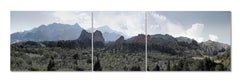
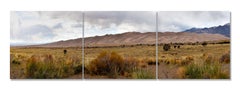
Desert Center (Stranger than Paradise) - 2000
Edition of 10,
20x20cm.
Archival Print, based on a Polaroid.
Mounted on dibond with matte UV-Protection.
Signature label and Certificate.
Artist Inventory No. 1986.
Published in Stranger than Paradise, Hatje Cantz (monograph)
Stefanie Schneider: A Discovery on Polaroid.
An essay by Eugen Blume
How is it that the photographic works of Stefanie Schneider do not allow anything other than one single association, namely that of America? Because they were taken in America itself? That fact alone would not yet be a compelling argument. Many photographs of America possess a reckless ambivalence which allows even the different country of their own particular creator to seem so similar as to be confused with America itself. Does this ambiguity have something to do with the ongoing, accelerating Americanization of the entire world? Or is it simply connected with our personal clichés which we attribute to a country the size of North America as valid expressions of its very essence, thereupon negligently allowing it not only to dwindle down into any size whatever, but also to expand to a great extent, from Germany by way of Luxembourg right through to Japan?
Now it is certainly true that the figures of Thelma and Louise in the desert do not represent an American reality, not even after their resurrection as Radha and Max in the series 29 Palms from 1999. Strangely enough, it is nature which allows this utterly artificial scene to grow into an American verity. The harsh sunlight in the barren landscape establishes the fundamental tone out of which the women emerge in excessive hysteria from beneath their colored wigs. It is inherently absurd to celebrate the feminine aspect in the middle of a mercilessly inhospitable environment. The image of the two women is a monument of resistance, the meaningful assertion of a lifestyle which stands in contradiction to each and every convention. The pictorial structure and the captured movement along the edge of the format are a means of blending the glaring luminosity with the plot in a manner which perhaps functions successfully only in the “simple” instant technique of the Polaroid. Stefanie Schneider’s pictorial narratives are striking in their formal elegance. She utilizes the chemical faults of the Polaroids, their tendency towards overexposure and double-images as a sovereignly controlled means of artistic design. The defects become, as it were, metaphorical levels which plumb depths lying far beneath the surface. The overly bright colors and schlieren seek out the uncanny; they provide a counterweight to a narration that is deliberately kept superficial. They tell of an invisible strand. They illuminate, in the truest sense of the word, underground processes. Although we are familiar with a series featuring American flags which could not indicate the site of its narrations any more clearly, nevertheless there remains a fundamental doubt as to whether the initially described association with America is identical with that which we deem to be America in a geographical sense.
Although I have in the meantime been in America several times, in both South and North America, deep down I remain uncertain as to whether the New World actually exists. Columbus’ error of continuing to believe, even when having arrived on land, that he was encountering the India which was the actual goal of his journey has burrowed down deep into the European unconscious as a cultural convention. Peter Bichsel’s amusing story “Amerika gibt es nicht” (There is no America) still remains today an undeniable truth: America’s northern half is a film, not a continent. Everything which signifies the U.S.A. – from the Indians, whose most noble savages were invented in Europe, all the way to September 11th and the subsequent war in Iraq, the aliens and the revival of the dinosaurs, the terminators as governors and presidents as actors and vice versa, the electric chairs, the godfather Marlon...
Category
Early 2000s Contemporary Kobby Dagan Art
MaterialsArchival Paper, Photographic Paper, C Print, Color, Polaroid