Kunichika Toyohara Art

Japanese, 1835-1900

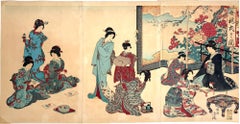
Kunichika Toyohara was born as Ōshima Yasohachi in 1835. Toyohara was one of the last Japanese Ukiyo-e painters. His first signed print is from 1852, but it was only in 1854 that he took the stage name Kunichika. Toyohara is best known for his prints of Kabuki actors, using the woodblock technique. He also painted beautiful women and for some special occasions, historical scenes. Toyohara was certainly a brilliant painter with unmistakable talent and dissipated life.

to
1
2
1
4
2
1
1
1
1
1
1
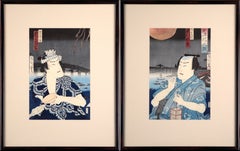
Kabuki Actor Diptych, Late 19th Century Figural Japanese Woodblock Prints (Pair)

Kabuki Actor Diptych, Late 19th Century Figural Japanese Woodblock Prints (Pair)

By Kunichika Toyohara

Located in Soquel, CA

Beautiful late 19th century Japanese woodblock print diptych of two kabuki actors by Kunichika Toyohara (Japanese, 1835-1900). This pair of prints is united by a continuous landscape...

Category

1870s Edo Kunichika Toyohara Art

Materials

Paper, Ink, Woodcut
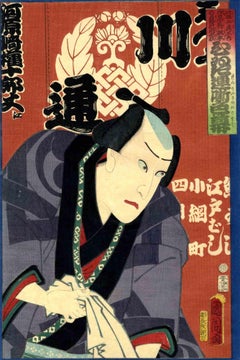
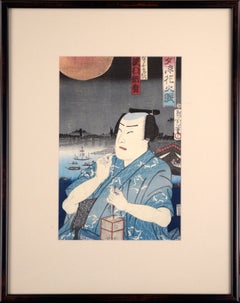
Portrait of the Actor Kawarazaki Gonjuro and Curtain by Kunichika Toyohara-1864

Portrait of the Actor Kawarazaki Gonjuro and Curtain by Kunichika Toyohara-1864

By Kunichika Toyohara

Located in Roma, IT

Portrait of the actor Kawarazaki Gonjuro and curtain is an original artwork realized in 1864 by Toyohara Kunichika (30 June 1835 – 1 July 1900) Oban. Bust portrait of the actor Kawarazaki Gonjuro in front of the brown theatre curtain with advertisement for the theatre performances. Signed: Kunichika ga. Publisher: Tsujiokaya Bunsuke. Censored by Aratame. Excellent impression with blind printing and very fine visible vertical wood grain in the brown curtain and haori, glossy black print (collar), a little bit creased. Toyohara Kunichika (30 June 1835 – 1 July 1900) was a ukiyo-e Japanese woodblock print artist. Talented as a child, at about thirteen he became a student of Tokyo's then-leading print maker, Utagawa Kunisada. His deep appreciation and knowledge of kabuki drama...

Category

1860s Modern Kunichika Toyohara Art

Materials

Woodcut

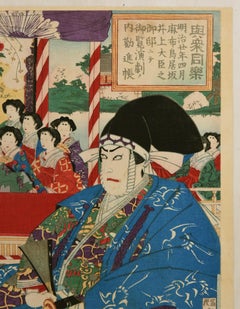
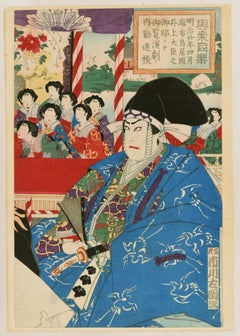
Kabuki Scene from "Kanjincho" -  Woodcut by 1887 ca.

Kabuki Scene from "Kanjincho" - Woodcut by 1887 ca.

By Kunichika Toyohara

Located in Roma, IT

A scene from the important representation of Tenno Kabuki's Play "Kanjincho", held during the Meiji Era in the House of Minister Kaoru Inoue at the presence of the Emperor Akinori Aki and of the Princess Akira Terada. Attributed to the Ukiyo-e Master Kinichika Toyohara (Oshima Yasohachi), specialised in the representations of Kabuki Scenes on Woodcut blocks...

Category

1820s Kunichika Toyohara Art

Materials

Woodcut

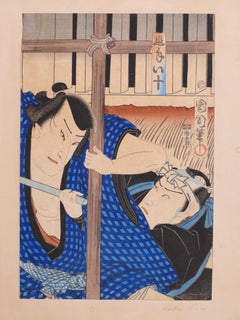
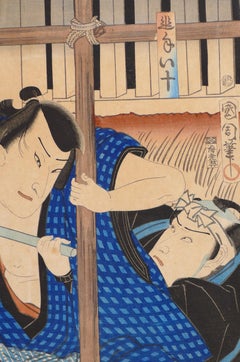
Two Samurai Fighting with a Stick -  Woodcut by Kunichika Toyohara

Two Samurai Fighting with a Stick - Woodcut by Kunichika Toyohara

By Kunichika Toyohara

Located in Roma, IT

Two Samurai Fighting with a Stick is a Japanese multi-colored print realized around the end of the XIX Century by Toyohara Kunichika (Edo period, 1835 - 1900). Original Woodcut on p...

Category

1880s Kunichika Toyohara Art

Materials

Woodcut

Related Items
Japanese Beauties Enjoy a Full Moon

Japanese Beauties Enjoy a Full Moon

By Utagawa Kunisada (Toyokuni III)

Located in Burbank, CA

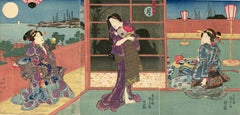
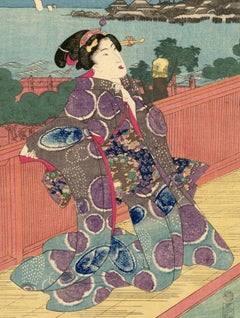
"Sun, Moon and Stars". Three beauties enjoy a full moon on the veranda of a teahouse or restuarant. The woman on the left kneels and adjusts her lavishly printed kimono. The beauty in the center has her hair down, and behind her is a screen against which shadows are beautifully silhouetted, which adds an air of mystery. The seated woman on the right is perhaps a geisha, as we see a shamisen lying next to her. Before her is a tray with an assortment of foods. One may surmise that the beauties are being compared to the sun, the moon, and the stars. On the left we glimpse a full moon shining over the peaceful bay, and boats at harbor. Original first edition Japanese color woodblock print triptych...

Category

1840s Edo Kunichika Toyohara Art

Materials

Mulberry Paper, Woodcut

Seishi Ai-oi Genji – Set of 12 Shunga works together w/astrological commentary

Seishi Ai-oi Genji – Set of 12 Shunga works together w/astrological commentary

By Utagawa Kunisada (Toyokuni III)

Located in Middletown, NY

Set of 12 woodblock prints in colors on handmade, laid mulberry paper, 6 3/4 x 10 1/4 inches (170 x 258 mm), printed in Ka-ei 4 (1851). Each print with minor handling wear, otherwise in excellent condition with bright and fresh color, and with details printed in silver ink. The images themselves contain several illusive characters indicating the publisher which are obfuscated by figures, as intended. Presented loose, as issued. A fine set. The astrological commentary print has a large and meandering blind stamp with a bird and palm frond motif. This print lists various phrases concerning the Twelve Zodiac Animals as historically counted in Japan, and appears to include erotic commentary on the traits of people born under each of the twelve signs. These Shunga images were issued in books that paralleled (in an erotic fashion...

Category

Mid-19th Century Edo Kunichika Toyohara Art

Materials

Ink, Handmade Paper, Woodcut

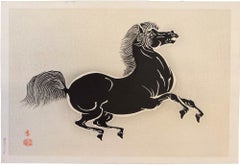
Black Horse
Black Horse

Black Horse

By Tokuriki Tomikichiro

Located in Middletown, NY

circa 1950. Woodblock print in black and gray ink on Japon laid paper, 10 1/4 x 15 3/4 inches (260 x 398 mm), full margins. With the artist's embossed chop mark in red ink in the l...

Category

Mid-20th Century Edo Kunichika Toyohara Art

Materials

Handmade Paper, Woodcut

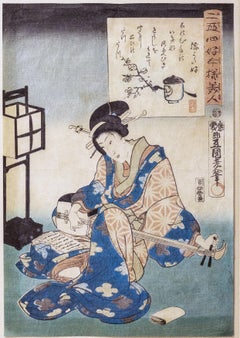
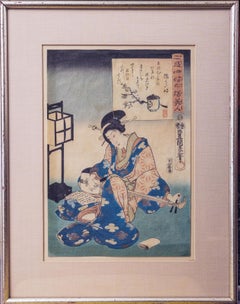
Women in Blue Kimono Playing Stringed Shamisen, Antique Japanese Woodblock Print

Women in Blue Kimono Playing Stringed Shamisen, Antique Japanese Woodblock Print

By Utagawa Kunisada (Toyokuni III)

Located in Austin, TX

Page Size: 10 x 14 in. Frame Size: 21 x 16.5 in. This exquisite ukiyo-e woodblock print by Utagawa Kunisada (Toyokuni III) captures a quiet, contemplative moment of artistic devotio...

Category

19th Century Edo Kunichika Toyohara Art

Materials

Woodcut

A 1928 Modernist Woodcut, Self-Portrait of Notable Chicago Modernist Emil Armin

A 1928 Modernist Woodcut, Self-Portrait of Notable Chicago Modernist Emil Armin

By Emil Armin

Located in Chicago, IL

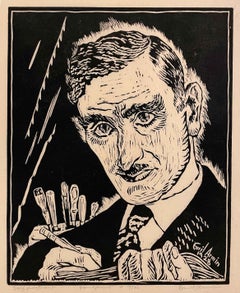
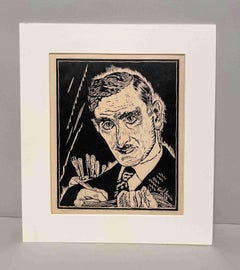
A 1928 woodcut on paper of a self-portrait of notable Chicago Modernist artist, Emil Armin. Artwork size: 10 1/2" x 8". Archivally matted to: 12 1/2" x 14 1/2. Signed, titled and numbered in pencil. Edition 7/30. Emil Armin was born in Radautz, Austria in 1883. By the age of 10, Armin was orphaned and was raised by his older siblings. He supported himself by working in restaurants and drew in his spare time. In 1905, at the age of 21, Armin immigrated to Chicago. He began studying at the Art Institute of Chicago in 1907, but financial difficulties forced him to start and stop a number of times, finally graduating in 1920. He studied with George Bellows and Randall Davey. Armin was an integral part of Chicago’s 57th Street Art Colony and exhibited in both the more avant-garde Chicago No-Jury Society Shows, as well as the more formal and conventional Chicago Society of Artists Exhibitions, the Chicago Renaissance Society and Art Institute of Chicago (1922-1949) exhibitions. He taught at Hull House...

Category

1920s American Modern Kunichika Toyohara Art

Materials

Paper, Woodcut

Kabuki Actors in the Play "Mimasu Mimasu Karigane Soga" Antique Japanese Print

Kabuki Actors in the Play "Mimasu Mimasu Karigane Soga" Antique Japanese Print

By Utagawa Kunisada (Toyokuni III)

Located in Austin, TX

Page Size: 13.5 x 27 in. Frame size: 21.5 x 33 in. This woodblock print depicts Kabuki Actors performing the play "Mimasu Mimasu Karigane Soga", from the Theater Nakamura. A dramat...

Category

19th Century Edo Kunichika Toyohara Art

Materials

Woodcut

Shunga: Twelve Signs of the Zodiac - Goat

Shunga: Twelve Signs of the Zodiac - Goat

Located in Fairlawn, OH

Shunga: Twelve Signs of the Zodiac - Goat Color woodcut with gauffrage (embossing) Unsigned (as usual) Format: Shikishiban Publisher: Privately produced Unusually well preserved with the fugitive blue still intact Image size: 5-1/8 x 5-3/4" Sheet size: 5 3/8 x 6 1/4" From Wikipedia, the free encyclopedia In this Japanese name, the surname is Isoda. Isoda Koryūsai (礒田 湖龍斎, 1735–1790) was a Japanese ukiyo-e print designer and painter active from 1769 to 1790. Life and career Koryūsai was born in 1735 and worked as a samurai in the service of the Tsuchiya clan. He became a masterless rōnin after the death of the head of the clan and moved to Edo (modern Tokyo) where he settled near Ryōgoku Bridge in the Yagenbori area. He became a print designer there under the art name Haruhiro in 1769, at first making samurai-themed designs. The ukiyo-e print master Harunobu died in 1770, and about that time Koryūsai began making prints in a similar style of life in the pleasure districts. Koryūsai was a prolific designer of individual prints and print series,[1] most of which appeared between 1769 and 1881. In 1782, Koryūsai applied for and received the Buddhist honour hokkyō ("Bridge of the Law") from the imperial court and thereafter used the title as part of his signature. His output slowed from this time, though he continued to design prints until his death in 1790. Works Koryūsai created a total of 2,500 known designs, or an average of four a week. According to art historian Allen Hockley, "Koryūsai may ... have been the most productive artist of the eighteenth century". The series Models for Fashion: New Designs as Fresh Young Leaves (Hinagata wakana no hatsumoyō, 1776–1781) ran for 140 prints, the longest known ukiyo-e print series of beauties. He designed at least 350 hashira-e pillar prints, numerous kachō-e bird-and-flower prints, a great number of shunga erotic prints, and others. Ninety of his nikuhitsu-ga paintings are known, making him one of the most productive painters of the period. Legacy Despite Koryūsai's productivity and popularity—both in his time and amongst later collectors—his work has attracted little scholarship. The first ukiyo-e histories written in the West in the 19th century elevated certain artists as exemplars; Koryūsai's work came to be seen as too indebted to Harunobu, who died in 1770, and inferior to that of Kiyonaga, whose peak period came in the 1880s. An example is Woldemar von Seidlitz's Geschichte des japanischen Farbenholzschnittes ("History of Japanese colour prints", 1897), the most popular of the early ukiyo-e histories, which paints Koryūsai as a successor to Harunobu and a rival of Kiyonaga in the 1770s who slipped into mediocrity and imitation of his rival by the end of the decade.[5] Interest lay mainly in the details of Koryūsai's life—a samurai who received court honours was unusual in the proletarian world of ukiyo-e. In 2021, contemporary woodblock printmaker David Bull...

Category

1770s Other Art Style Kunichika Toyohara Art

Materials

Woodcut

Father Stefan Fridolin, "Schatzbehalter" (Treasury of the True Riches

Father Stefan Fridolin, "Schatzbehalter" (Treasury of the True Riches

Located in Fairlawn, OH

Father Stefan Fridolin, "Schatzbehalter" (Treasury of the True Riches of Salvation): The 30th Figure - Astrological Diagram with Scene of the Nativity Woodcut, 1491 Unsigned, as issued Published by Anton Koberger Diagram has Zodiac signs on outer ring, planets in the lower registers, and Nativity in the center. Condition: Very good for a 15h century woodcut, with the usual slight age stains Sheet size: 11 1/2 x 8 1/4 inches Wogelmut was the teacher of Albrecht Durer and employed young Durer in many project of the last decade of the 15th century. Michel Wolgemut Biography Wolgemut trained with his father Valentin Wolgemut (who died in 1469 or 1470) and is thought to have been an assistant to Hans Pleydenwurff in Nuremberg. He worked with Gabriel Malesskircher in Munich early in 1471, leaving the city after unsuccessfully suing Malesskircher's daughter for breach of contract, claiming she had broken off their engagement. He then returned to his late father's workshop in Nuremberg, which his mother had maintained since Valentin's death. In 1472 he married Pleydenwurff's widow and took over his workshop;[3] her son Wilhelm Pleydenwurff worked as an assistant, and from 1491 a partner, to Wolgemut. Some consider Wilhelm a finer artist than Wolgemut, however he died in January 1494, when he was probably still in his thirties. Wilhelm's oeuvre remains unclear, though works in various media have been attributed to him. Woodcuts Michael Wolgemut, Danse Macabre, 1493 Two large and copiously illustrated books have woodcuts supplied by Wolgemut and his stepson Wilhelm Pleydenwurff; both were printed and published by Germany's largest publisher, the Nuremberger Anton Koberger, who was also Dürer's godfather. The first is the Schatzbehalter der wahren Reichthumer des Heils (1491); the other is the Historia mundi, by Schedel (1493), usually known as the Nuremberg Chronicle...

Category

15th Century and Earlier Old Masters Kunichika Toyohara Art

Materials

Woodcut

Plucking a Branch from a Neighbor's Plum Tree

Plucking a Branch from a Neighbor's Plum Tree

By Suzuki (Hozumi) Harunobu

Located in Middletown, NY

A mischievous tableau with sexual overtones. Tokyo: Shuei-Sha, 1768. Woodblock print in colors printed on laid mulberry paper, 10 3/4 x 7 7/8 inches (273 x 200 mm), full margins. I...

Category

Mid-18th Century Edo Kunichika Toyohara Art

Materials

Watercolor, Handmade Paper, Woodcut

Okarakuri Woodcut Print, Edo Style, Early 19th Century, 14.5x10

Okarakuri Woodcut Print, Edo Style, Early 19th Century, 14.5x10

By Kitagawa Utamaro 1

Located in Austin, TX

Page Size: 14.5 x 10 in. Frame Size: 22.5 x 15.5 in. The Large Peepshow (Ô-karakuri), from the series Fashionable Comparisons of Precious Children (Fûryû kodakara awase) 哥麿 筆 painte...

Category

Early 19th Century Edo Kunichika Toyohara Art

Materials

Woodcut

Edo Landscape Japanese Woodblock Print

Edo Landscape Japanese Woodblock Print

By Utagawa Hiroshige (Ando Hiroshige)

Located in Houston, TX

Edo Meisho woodblock print of a famous Japanese coastal dock. This woodblock is most likely apart of the series "One Hundred Famous Views of Edo." The woodblock print is printed on r...

Category

1850s Edo Kunichika Toyohara Art

Materials

Woodcut

Untitled From: The Travels of Sir John Mandeville, printed by Johannes Prüss

Untitled From: The Travels of Sir John Mandeville, printed by Johannes Prüss

Located in Fairlawn, OH

Untitled From: The Travels of Sir John Mandeville, printed by Johannes Prüss Woodcut on 15th cen. laid paper, 1488 Unsigned (as issued) Woodcuts attributed to the "Master of the Berg...

Category

15th Century and Earlier Old Masters Kunichika Toyohara Art

Materials

Woodcut

Previously Available Items
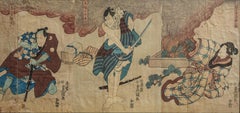
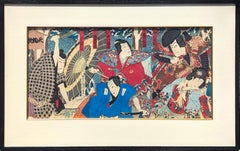
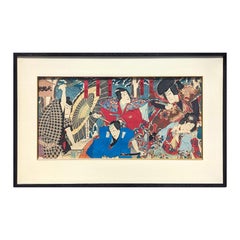
Colorful Dynamic Edo Period Kabuki Play Yakusha-e Woodblock Print Triptych

Colorful Dynamic Edo Period Kabuki Play Yakusha-e Woodblock Print Triptych

By Kunichika Toyohara

Located in Houston, TX

Colorful woodblock print by Japanese artist Toyohara Kunichika. The work features elaborately dressed kabuki actors in the middle of a dynamic scene. Currently hung in a black frame with a light cream matting and gold accents. Dimensions Without Frame: H 13.5 in. x W 27.25 in. Artist Biography: Toyohara Kunichika (June 30, 1835 - July 1, 1900) was a Japanese woodblock print artist. Talented as a child, at about thirteen he became a student of Tokyo's then-leading print maker, Utagawa Kunisada. His deep appreciation and knowledge of kabuki drama...

Category

19th Century Edo Kunichika Toyohara Art

Materials

Woodcut

Kunichika Toyohara art for sale on 1stDibs.

Find a wide variety of authentic Kunichika Toyohara art available for sale on 1stDibs. You can also browse by medium to find art by Kunichika Toyohara in woodcut print, ink, paper and more. Much of the original work by this artist or collective was created during the 19th century and is mostly associated with the modern style. Not every interior allows for large Kunichika Toyohara art, so small editions measuring 10 inches across are available. Customers who are interested in this artist might also find the work of Utagawa Yoshitora, Toyohara Kunichika, and Utagawa Kunisada (Toyokuni III). Kunichika Toyohara art prices can differ depending upon medium, time period and other attributes. On 1stDibs, the price for these items starts at $507 and tops out at $2,092, while the average work can sell for $750.

Artists Similar to Kunichika Toyohara