By Léon Augustin Lhermitte
Located in Marlow, Buckinghamshire
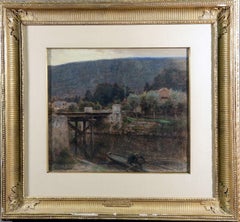
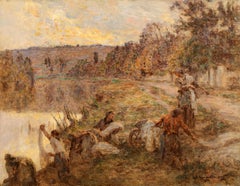
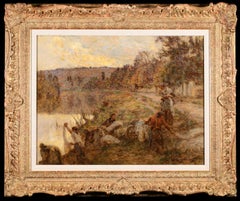
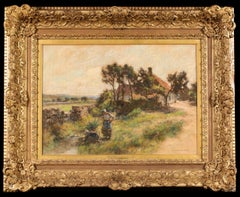
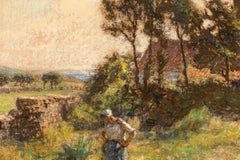
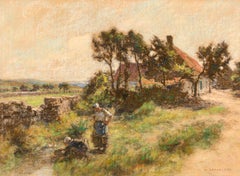
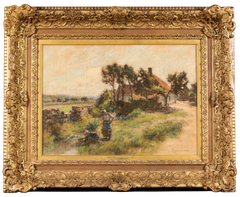
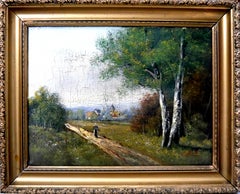
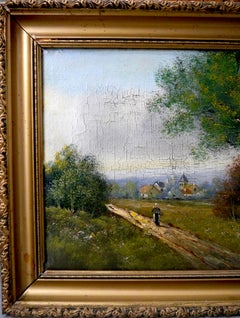
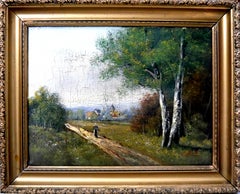
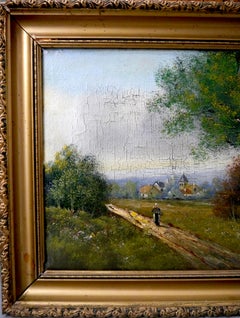
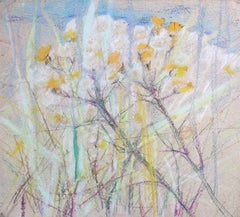
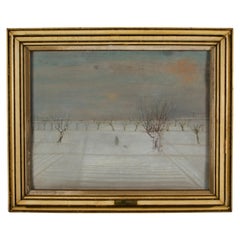
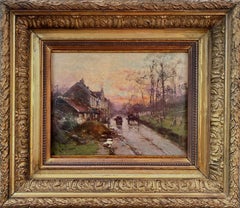
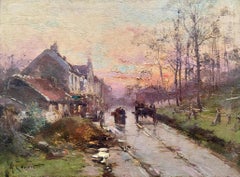
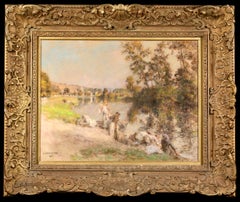
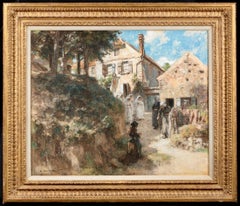
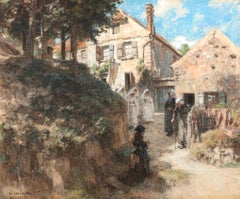
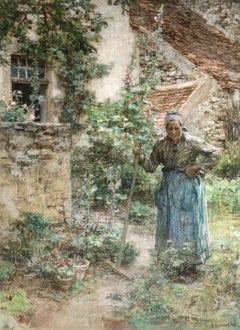
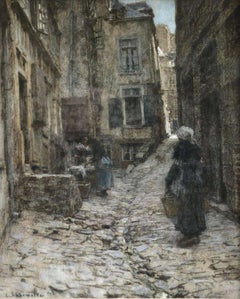
Signed Barbizon figures in landscape pastel on paper circa 1885 by French painter Leon Augustin Lhermitte. The piece depicts a first communion ceremony, with girls in white dresses and headscarves walking through a village as elder women look on. A wonderful piece in the artist's distinctive style.
Signature:
Signed lower left
Dimensions:
Framed: 27"x31"
Unframed: 20"x24"
Provenance:
Arthur Tooth & Sons - London (label verso)
Léon Augustin Lhermitte was the son of a school teacher. He painted from a very early age and settled in Paris in 1863, enrolling in the École Impériale de Dessin. His teacher was Lecocq de Boisboudran. In the early days of his career he earned a living doing illustrations for boxes of sweets and the catalogues of the cabinet-makers of the Faubourg St-Antoine, as well as publishing houses. In 1879 he went to Great Britain, to which he returned frequently. The same year he met the art dealer Paul Durant-Ruel who exhibited his works. He was one of the founders of the Société Nationale des Beaux-Arts, of which he became vice-president.
Lhermitte initially produced charcoal drawings which revealed his deep feeling for nature. His first attempt, Banks of the Marne near Alfort, caused a sensation. Following this he executed canvases, showing himself to be a fine landscape artist and a skilful draughtsman. He painted scenes from rural life almost exclusively and benefited from exceptional interest generated by the prizes awarded to the works of J. F. Millet. But although he was very much affected by the work of the painter of Angelus, he himself sought only the pictorial element and not a synthetic translation. Many other French masters of the period share his completely objective vision, for example Bastien Lepage, Roll, J. C. Cazin and Rafaelli. Like them, he put into practice very early on the technique of 'clear painting' made fashionable by the pursuit of Impressionism. But this group of artists borrowed from this method only those elements which appealed to public taste, and ignored chromatic elements. Lhermitte also paid the price for the easy success of those early days. His peasants, which found general favour with the public at the time, nowadays seem rather feeble alongside Camille Pissarro's renderings of the same subject.
However, in order to pass judgement on an artist such as Lhermitte, it is necessary to understand the era in which he worked, the era in which Realism was the only acceptable approach. It was in the atmosphere of the 'Théâtre Libre' of Antoine and the novels of Maupassant, Zola and their imitators that this type of art developed. In this context, Lhermitte is recognised as having painted the life of the peasants with great powers of objective observation and great insight into types and physiognomies. Nothing escaped his implacable eye and his bold and vigorous hand was guided by a lucid mind. The simplest elements of nature take on an air of true grandeur in his painting, despite their romantic and sentimental aspects. He is highly regarded both in France and in other countries by art lovers who look for nothing more than an attractive subject expertly painted. Among his most noteworthy works, outside those in museums, are: Les Halles, Washing the Sheep, Haymaking Time, and his large decorative panel...
Category
Late 19th Century Barbizon School Léon Augustin Lhermitte Art