Louis Claude Art

to
4
1
Overall Width
to
Overall Height
to
5
3
2
4
1
5
5
4
3
2
1
1
4
1
5
11,018
2,849
2,494
1,430
2
4
Artist: Louis Claude
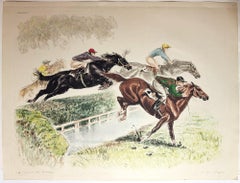
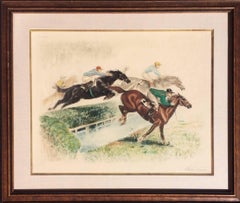
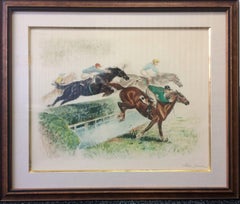
Saut de la Rivière (Steeplechase horses)

Saut de la Rivière (Steeplechase horses)

By Louis Claude

Located in Middletown, NY

New York: Sidney Lucas & The Paris Etching Society, c1970. Lithograph with colors on smooth cream wove paper, 20 x 25 3/4 inches (508 x 654 mm), full margins. Signed and inscribed i...

Category

Mid-20th Century Modern Louis Claude Art

Materials

Lithograph

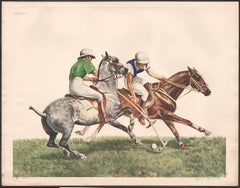
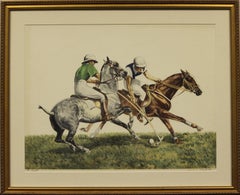
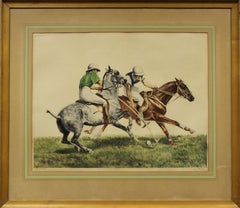
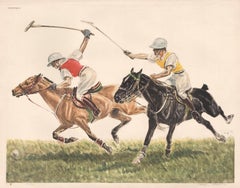
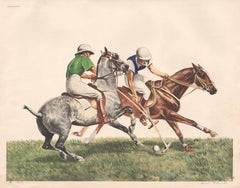
"French Deauville Polo" by Louis Claude`

"French Deauville Polo" by Louis Claude`

By Louis Claude

Located in Bristol, CT

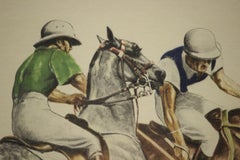
Art Sz:17 1/2"H x 23"W Frame Sz: 23 1/2"H x 28 3/4"W Classic Louis Claude pencil signed (LR) 'French 'Polo' colour plate

Category

1950s Louis Claude Art

Materials

Lithograph

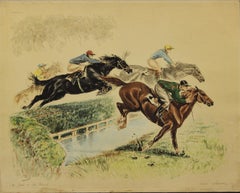
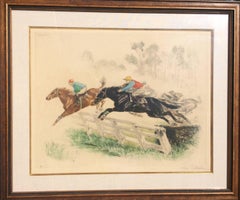
French Steeplechase Etching

French Steeplechase Etching

By Louis Claude

Located in Bristol, CT

Art Sz: 20"H x 25"W Paris Etching Society NY

Category

20th Century Louis Claude Art

Materials

Lithograph

Related Items
Peintre et Modele Etching, Aquatint on Rives Paper, Modern, 1966

Peintre et Modele Etching, Aquatint on Rives Paper, Modern, 1966

By Pablo Picasso

Located in Fairlawn, OH

Peintre et Modele Etching and aquatint on Rives wove paper, 1966 Signature stamp lower right (see photo) Annotated in pencil lower left: "epreuve avant acierage" (see photo) One of t...

Category

1960s Modern Louis Claude Art

Materials

Aquatint

Jean Cocteau - White Book - Original Handcolored Lithograph

Jean Cocteau - White Book - Original Handcolored Lithograph

By Jean Cocteau

Located in Collonge Bellerive, Geneve, CH

Jean Cocteau White Book - Autobiography about Cocteau's discovery of his homosexuality. The book was first published anonymously and created a scandal. Original Handcolored Lithograp...

Category

1930s Modern Louis Claude Art

Materials

Lithograph

after Henri Matisse - Acrobat

Henri Matisseafter Henri Matisse - Acrobat

$1,517

H 29.93 in W 22.05 in D 0.04 in

after Henri Matisse - Acrobat

By Henri Matisse

Located in Collonge Bellerive, Geneve, CH

after Henri Matisse - Acrobat Edition of 200 with the printed signature, as issued 76 x 56 With stamp of the Succession Matisse References : Artvalue - Succession Matisse

Category

1950s Modern Louis Claude Art

Materials

Lithograph

Leonor Fini - Walking on Death - Original Lithograph

Leonor Fini - Walking on Death - Original Lithograph

By Leonor Fini

Located in Collonge Bellerive, Geneve, CH

Leonor Fini - Walking on Death - Original Lithograph The Flowers of Evil 1964 Conditions: excellent Edition: 500 Dimensions: 46 x 34 cm Editions: Le Cercle du Livre Précieux, Paris...

Category

1960s Modern Louis Claude Art

Materials

Lithograph

Calm Water Blue Tones Diptych of Japanese Zen Pond Ripples, Feng Shui Cyanotype

Calm Water Blue Tones Diptych of Japanese Zen Pond Ripples, Feng Shui Cyanotype

By Kind of Cyan

Located in Barcelona, ES

This is an exclusive handprinted limited edition cyanotype. This diptych is titled "Japanese Zen Pond Ripples", and shows ripples of water from a calming pond. Details: + Title: Ja...

Category

2010s Abstract Louis Claude Art

Materials

Photographic Film, Emulsion, Watercolor, C Print, Color, Engraving, Lith...

Derriere Le Miroir-No. 190-Page 14-15

Derriere Le Miroir-No. 190-Page 14-15

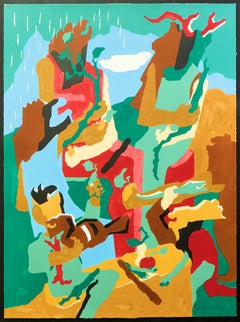
By Alexander Calder

Located in Fairlawn, OH

Derriere Le Miroir-No. 190-Page 14-15 Color lithograph, 1971 Unsigned (as issued) From: Derriere Le Miroir, No. 190, 1971 Publisher: Aime Maeght, Paris Printer: L’Imprimerie Arts, Pa...

Category

1970s Abstract Louis Claude Art

Materials

Lithograph

Double Personage
Double Personage

Wifredo LamDouble Personage, 1979

$450

H 12.25 in W 9.25 in

Double Personage

By Wifredo Lam

Located in Fairlawn, OH

Double Personage Color lithograph, 1975 (?) Unsigned (as issued) Edition: Large Edition Limited, (estimated to be approximately 2000) Published in: XXe Siecle, No. 52, Juin 1979 Published: G. di San Lazzaro Printer: Mourlot Imprimeur, Paris, France Reference: Lam-Tonneau-Ryckelynck L7513 Condition: Excellent, fresh colors Traces of glue residue along margin edge where it was bound in the book Image/sheet size: 12 1/4 x 9 1/4 inches Wilfredo Lam (1902-1982) Biography Wifredo Lam was born in Sagua la Grande, Cuba, on December 8, 1902. He was the eighth child born to Lam-Yam―born in Canton around 1820, an immigrant to the Americas in 1860―and to Ana Serafina Catilla―born in 1862 in Cuba of mixed African and Spanish ancestry. The luxuriant nature of Sagua la Grande had a strong impact on Lam from early childhood. One night in 1907, he was startled by the strange shadows cast on the wall of his bedroom of a bat in flight. He often recounted the incident as his first magnificent awakening to another dimension to existence. In 1916, Lam and part of his family settled in Havana. He was enrolled in the Escuela Profesional de Pintura y Escultura, Academia de San Alejandro, where he remained a student until 1923. This period, with exhibitions at the Salón de Bellas artes, was determinant in his choice to become a painter. In 1923, the municipality of Sagua la Grande awarded him a grant to study in Europe and by the autumn of that year, at the age of twenty-one, he left the country for Spain. His time in Spain―initially intended as a short stay on his way to Paris―lasted 14 years. In Madrid, he was exposed to the ideas and movements of modern art. He spent long hours at the Archeological Museum and the Prado. He studied the great masters of Spanish painting, Velázquez and Goya, but felt particularly drawn to the works of Bosch and Bruegel the Elder. In 1931, his first wife, Eva (Sébastiana Piriz) and their son Wilfredo Victor died of tuberculosis. The terrible suffering he endured led to numerous paintings of mother and child. Lam found solace in the company of his Spanish friends and made contact with several political organizations. In 1936, with the help of his friend Faustino Cordón, he joined the Republican forces in their fight against Franco. He designed anti-Fascist posters and took part in the struggle by working in a munitions factory. The violence of the struggle inspired his painting La Guerra Civil. In 1938, Lam left Spain for Paris. Shortly before leaving, he met Helena Holzer, who would become his wife in 1944. His meeting Picasso in his studio on the Rue des Grands Augustins proved decisive. Picasso introduced his new “cousin” to his painter, poet and art critic friends, Braque, Matisse, Miró, Léger, Eluard, Leiris, Tzara, Kahnweiler, Zervos. Lam also met Pierre Loeb, the owner of the Galerie Pierre in Paris, which hosted Lam’s first solo exhibition in 1939. Shortly before the Germans arrived, Lam left Paris for Bordeaux and then Marseille, where many of his friends, for the most part surrealists, had gathered around André Breton in the Villa Air Bel: Pierre Mabille, René Char, Max Ernst, Victor Brauner, Oscar Domínguez, André Masson, Benjamin Péret. In the Villa Air Bel, a meeting place for creativity and experimentation, Lam worked and produced, most notably, a series of ink drawings that set the tone for what would become his signature style of hybrid figures, a vocabulary he would develop more fully during his years in Cuba from 1941 to 1947. In January and February 1941, Lam illustrated Breton’s poem Fata Morgana which was censored by the Vichy government. On March 25, Lam and Helena Holzer embarked on the “Capitaine Paul Lemerle” headed for Martinique, in the company of some 300 other artists and intellectuals―André Breton and Claude Lévi-Strauss among them. Upon arrival, the passengers were interred at Trois Îles. It was during this forced passage in Martinique and before leaving for Cuba that Lam and Aimé Césaire met for the first time to become life-long friends. Newly settled in his native land after almost twenty years, Lam delved deeper into his artistic investigations, finding nourishment for his ideas in the surroundings of his childhood and youth. His sister Eloisa, whom he was closest to, explained to him in much detail the workings of Afro-Cuban rituals and he began attending ritual ceremonies with some of his friends. This contact with Afro-Cuban culture brought new impetus to his art. He painted over one hundred canvases, most notably La Jungla, making the year 1942 his most productive of this period. Over the next few years, a number of exhibitions followed in the United States, at the Institute of Modern Art of Boston, at the MoMA of New York, at the Galerie Pierre Matisse, where La Jungla was presented and created a scandal. In 1946, Lam and Helena travel to Haiti and attend voodoo ceremonies in the company of Pierre Mabille and André Breton. Talking about his experience in Haiti, Lam said, “It is often assumed that my work took its final form in Haiti, but my stay there, like the trips I made to Venezuela, Colombia or to the Brazilian Mato Grosso only broadened its scope. I could have been a good painter from the School of Paris, but I felt like a snail out of its shell. What really broadened my painting is the presence of African poetry.” Picasso_Lam_Vallauris_1954_vignette Wifredo Lam et Pablo Picasso, Vallauris, 1954 Lam then went on to New York where he renewed contact with Marcel Duchamp and made new acquaintances: Jeanne Reynal, James Johnson Sweeney, Arshile Gorky, John Cage, Roger Wilcox, Mercedes Matter, Ian Hugo, Jesse Fernández, John Cage, Sonia Sekula and Yves Tanguy. By the end of the 1940s, Lam divided his time between Europe, Havana and New York, where they stayed with Pierre and Teeny Matisse...

Category

1970s Surrealist Louis Claude Art

Materials

Lithograph

Surrealist Lithograph 'The Pleasure of Being Alone', Signed, 1931

Surrealist Lithograph 'The Pleasure of Being Alone', Signed, 1931

By Julio de Diego

Located in Fairlawn, OH

The Pleasure of Being Alone Lithograph, 1931 Signed lower right (see photo) Very rare early suurealist lithograph Edition: 15 (15/15), numbered lower left (see photo) Impressions of...

Category

1930s Surrealist Louis Claude Art

Materials

Lithograph

Leonor Fini - Pleasure - Original Lithograph

Leonor Fini - Pleasure - Original Lithograph

By Leonor Fini

Located in Collonge Bellerive, Geneve, CH

Leonor Fini - Pleasure - Original Lithograph The Flowers of Evil 1964 Conditions: excellent Edition: 500 Dimensions: 46 x 34 cm Editions: Le Cercle du Livre Précieux, Paris Unsigne...

Category

1960s Modern Louis Claude Art

Materials

Lithograph

Marc Chagall - Moses - Original Lithograph

Marc Chagall - Moses - Original Lithograph

By Marc Chagall

Located in Collonge Bellerive, Geneve, CH

Marc Chagall, Original Lithograph depicting an instant of the Bible. Technique: Original lithograph in colours Year: 1956 Sizes: 35,5 x 26 cm / 14" x 10.2" (sheet) Published by: Éditions de la Revue Verve, Tériade, Paris Printed by: Atelier Mourlot, Paris Documentation / References: Mourlot, F., Chagall Lithograph [II] 1957-1962, A. Sauret, Monte Carlo 1963, nos. 234 and 257 Marc Chagall (born in 1887) Marc Chagall was born in Belarus in 1887 and developed an early interest in art. After studying painting, in 1907 he left Russia for Paris, where he lived in an artist colony on the city’s outskirts. Fusing his own personal, dreamlike imagery with hints of the fauvism and cubism popular in France at the time, Chagall created his most lasting work—including I and the Village (1911)—some of which would be featured in the Salon des Indépendants exhibitions. After returning to Vitebsk for a visit in 1914, the outbreak of WWI trapped Chagall in Russia. He returned to France in 1923 but was forced to flee the country and Nazi persecution during WWII. Finding asylum in the U.S., Chagall became involved in set and costume design before returning to France in 1948. In his later years, he experimented with new art forms and was commissioned to produce numerous large-scale works. Chagall died in St.-Paul-de-Vence in 1985. The Village Marc Chagall was born in a small Hassidic community on the outskirts of Vitebsk, Belarus, on July 7, 1887. His father was a fishmonger, and his mother ran a small sundries shop in the village. As a child, Chagall attended the Jewish elementary school, where he studied Hebrew and the Bible, before later attending the Russian public school. He began to learn the fundamentals of drawing during this time, but perhaps more importantly, he absorbed the world around him, storing away the imagery and themes that would feature largely in most of his later work. At age 19 Chagall enrolled at a private, all-Jewish art school and began his formal education in painting, studying briefly with portrait artist Yehuda Pen. However, he left the school after several months, moving to St. Petersburg in 1907 to study at the Imperial Society for the Protection of Fine Arts. The following year, he enrolled at the Svanseva School, studying with set designer Léon Bakst, whose work had been featured in Sergei Diaghilev's Ballets Russes. This early experience would prove important to Chagall’s later career as well. Despite this formal instruction, and the widespread popularity of realism in Russia at the time, Chagall was already establishing his own personal style, which featured a more dreamlike unreality and the people, places and imagery that were close to his heart. Some examples from this period are his Window Vitebsk (1908) and My Fianceé with Black Gloves (1909), which pictured Bella Rosenfeld, to whom he had recently become engaged. The Beehive Despite his romance with Bella, in 1911 an allowance from Russian parliament member and art patron Maxim Binaver enabled Chagall to move to Paris, France. After settling briefly in the Montparnasse neighborhood, Chagall moved further afield to an artist colony known as La Ruche (“The Beehive”), where he began to work side by side with abstract painters such as Amedeo Modigliani and Fernand Léger as well as the avant-garde poet Guillaume Apollinaire. At their urging, and under the influence of the wildly popular fauvism and cubism, Chagall lightened his palette and pushed his style ever further from reality. I and the Village (1911) and Homage to Apollinaire (1912) are among his early Parisian works, widely considered to be his most successful and representative period. Though his work stood stylistically apart from his cubist contemporaries, from 1912 to 1914 Chagall exhibited several paintings at the annual Salon des Indépendants exhibition, where works by the likes of Juan Gris, Marcel Duchamp and Robert Delaunay were causing a stir in the Paris art world. Chagall’s popularity began to spread beyond La Ruche, and in May 1914 he traveled to Berlin to help organize his first solo exhibition, at Der Sturm Gallery. Chagall remained in the city until the highly acclaimed show opened that June. He then returned to Vitebsk, unaware of the fateful events to come. War, Peace and Revolution In August 1914 the outbreak of World War I precluded Chagall’s plans to return to Paris. The conflict did little to stem the flow of his creative output, however, instead merely giving him direct access to the childhood scenes so essential to his work, as seen in paintings such as Jew in Green (1914) and Over Vitebsk (1914). His paintings from this period also occasionally featured images of the war’s impact on the region, as with Wounded Soldier (1914) and Marching (1915). But despite the hardships of life during wartime, this would also prove to be a joyful period for Chagall. In July 1915 he married Bella, and she gave birth to a daughter, Ida, the following year. Their appearance in works such as Birthday (1915), Bella and Ida by the Window (1917) and several of his “Lovers” paintings give a glimpse of the island of domestic bliss that was Chagall’s amidst the chaos. To avoid military service and stay with his new family, Chagall took a position as a clerk in the Ministry of War Economy in St. Petersburg. While there he began work on his autobiography and also immersed himself in the local art scene, befriending novelist Boris Pasternak, among others. He also exhibited his work in the city and soon gained considerable recognition. That notoriety would prove important in the aftermath of the 1917 Russian Revolution when he was appointed as the Commissar of Fine Arts in Vitebsk. In his new post, Chagall undertook various projects in the region, including the 1919 founding of the Academy of the Arts. Despite these endeavors, differences among his colleagues eventually disillusioned Chagall. In 1920 he relinquished his position and moved his family to Moscow, the post-revolution capital of Russia. In Moscow, Chagall was soon commissioned to create sets and costumes for various productions at the Moscow State Yiddish...

Category

1950s Modern Louis Claude Art

Materials

Lithograph

Trout Fishing on the Gunnison (Colorado)

Trout Fishing on the Gunnison (Colorado)

By Adolf Dehn

Located in Fairlawn, OH

Trout Fishing on the Gunnison (Colorado) Lithograph, 1941 Signed and dated '42 in pencil lower right Annotated lower left: "40 Prints-The Gunnison River, Colorado-For Anne & Jack" Ed...

Category

1940s American Modern Louis Claude Art

Materials

Lithograph

Previously Available Items
Polo, colour etching, horses, circa 1950

Polo, colour etching, horses, circa 1950

By Louis Claude

Located in Melbourne, Victoria

Titled 'Polo' and signed 'Louis Claude' in pencil below the image. Printed in Paris for the Paris Etching Society, New York. 465mm by 595mm (pla...

Category

1950s Modern Louis Claude Art

Materials

Etching

Equestrian Jump
Equestrian Jump

Equestrian Jump

By Louis Claude

Located in Lake Worth Beach, FL

Equestrian Jump Size: 19x24 framed original frame 24x33x1 Paris Etching Society 1923. Original signed color etching title "Jump" by French artist Louis Claude. Shows two polo riders in a dual for the ball. Published by Paris Etching Society a division of the Phyllis Lucas Gallery.

Category

1920s Realist Louis Claude Art

Materials

Etching

Equestrian Jump
Equestrian Jump

Louis ClaudeEquestrian Jump, 1925

Sold

H 26 in W 31 in D 1 in

Equestrian Jump

By Louis Claude

Located in Lake Worth Beach, FL

Size: 19x24 framed 26x33x1 Hand-colored etching in the original frame pencil signed. Original signed color etching by French artist Louis Claude. Published by Paris Etching Society a division of the Phyllis Lucas Gallery.

Category

1920s Louis Claude Art

Materials

Etching

Louis Claude art for sale on 1stDibs.

Find a wide variety of authentic Louis Claude art available for sale on 1stDibs. You can also browse by medium to find art by Louis Claude in lithograph, etching, paint and more. Much of the original work by this artist or collective was created during the 20th century and is mostly associated with the modern style. Not every interior allows for large Louis Claude art, so small editions measuring 25 inches across are available. Customers who are interested in this artist might also find the work of Lucien Philippe Moretti, Georges Rohner, and Jean Gabriel Daragnès . Louis Claude art prices can differ depending upon medium, time period and other attributes. On 1stDibs, the price for these items starts at $650 and tops out at $2,275, while the average work can sell for $750.
Artists Similar to Louis Claude