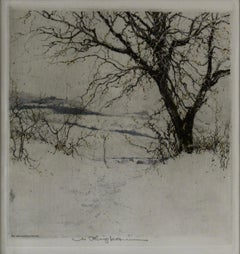
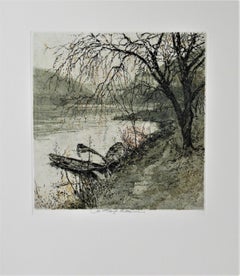
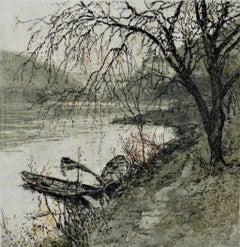
Louis Orr Art

American, 1879-1961

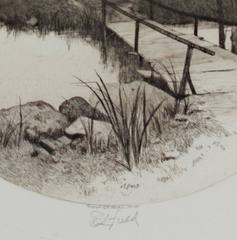
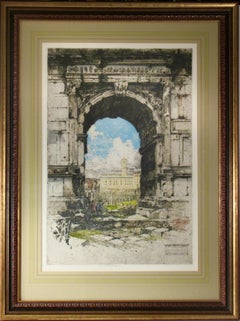
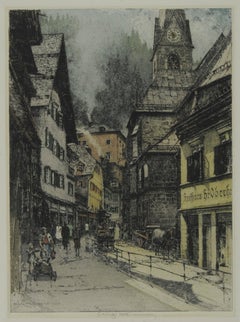
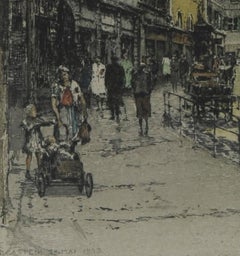
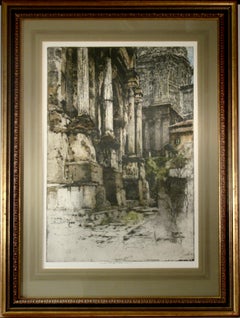
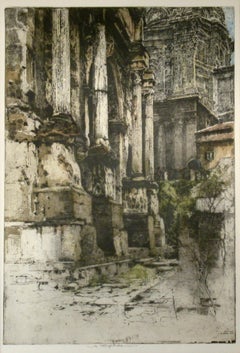
Louis Orr is celebrated for his large, detailed works of Paris, and domestically, for his extensive series of etchings of North Carolina landmarks. Orr studied at the Hartford Art School, the Art Students’ League in New York and the Académie Julian in Paris. Orr spent much of his life living between Hartford, Connecticut and Paris.

to
1
Overall Width
to
Overall Height
to
1
1
1
1
1
1
1
1
1
10,640
2,826
2,495
1,414
1
Artist: Louis Orr
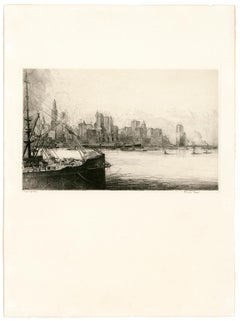
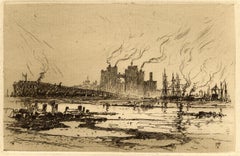
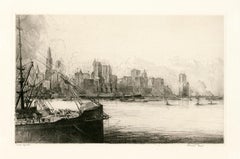
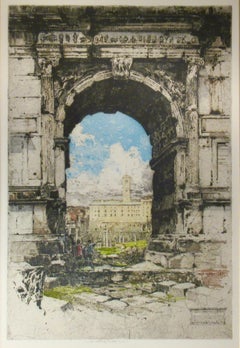
New York (from Ports of America)

New York (from Ports of America)

By Louis Orr

Located in Myrtle Beach, SC

Louis Orr, 'New York' (from the portfolio 'Ports of America', published by Yale University Press, 1928), etching, 1925, edition not stated. Signed and titled in pencil. Signed in the...

Category

1920s Realist Louis Orr Art

Materials

Etching

Related Items
Richard Haas - Puck Corner, SOHO, New York signed/N architectural art, Framed

Richard Haas - Puck Corner, SOHO, New York signed/N architectural art, Framed

By Richard Haas

Located in New York, NY

Richard Haas Puck Corner, SOHO, New York, 1971 Etching and Aquatint (affixed to white matting) Hand signed and numbered 10/100 by the artist on the lower front Elegantly matted and f...

Category

1970s Realist Louis Orr Art

Materials

Pencil, Etching, Aquatint

Home of Debose Heyward, Charleston

Home of Debose Heyward, Charleston

By Elizabeth Verner

Located in Grand Rapids, MI

Elizabeth O'Neill Verner (American, 1883 - 1979) Signed: Elizabeth O'Neill Verner (in pencil, lower, right) " Home of Dubose Heyward, Charleston ", circa 1930 Imp. V 12, (in pencil, Lower, Left) Etching 5" x 3 3/8" plate size 8" x 5 1/2" sheet size Housed in a 2" Period Carved Frame Overall Size: 16 1/2" x 13 1/4" This original print is in excellent original condition. A nice presentation, ready to be hung and enjoyed. DeBose Heyward (Am. 1885-1940) was a native of Charleston. And lived there until the mid-1930s. Author of the novel. " Porgy ", published in 1925. Artist Biography: A leader in establishing Charleston, South Carolina as a dynamic cultural center, Elizabeth Verner...

Category

Early 20th Century Realist Louis Orr Art
Materials

Etching

The Three Graces — Figurative Etching with Aquatint of Women Underwater

The Three Graces — Figurative Etching with Aquatint of Women Underwater

By Art Werger

Located in Palm Springs, CA

A print from his series titled "Submerged". The Three Graces is a richly colored etching with aquatint by Art Werger, depicting three female figures moving beneath the surface of wat...

Category

1990s Realist Louis Orr Art

Materials

Aquatint, Etching

Passaic Meadows (In the Newark Meadows)

Passaic Meadows (In the Newark Meadows)

By Thomas Moran

Located in Middletown, NY

Boston: American Art Review, 1880. Etching on cream laid paper, 5 3/4 x 8 3/4 inches (146 x 230mm), full margins. Light uniform age tone, scattered handling creases and minor toning ...

Category

Late 19th Century Realist Louis Orr Art
Materials

Laid Paper, Etching

Evening - The depth of the visible -

Evening - The depth of the visible -

Located in Berlin, DE

Max Clarenbach (1880 Neuss - Cologne 1952), Evening. Etching, 18 x 41 cm (platemark), 33.5 x 57 cm (frame), inscribed "Abend" in pencil at lower left, signed and dated "M. Clarenbach. 28.III.[19]09". Framed and mounted under glass. - Somewhat browned and slightly foxed. About the artwork The horizontally elongated etching depicts the panoramic view of a small town as seen from the other side of the river. There are gabled houses on the left and a mighty church spire on the right. The bourgeois houses and the large religious building indicate the urban character. These buildings are rendered in dark tones to emphasise the lighter row of houses in the centre of the picture, closer to the water. The chiaroscuro contrast creates two parallel planes that open up a space for the imagination of what the city could be. The imagination is stimulated by the almost entirely dark, barely recognisable buildings, while the arm of the river leading into the city further stimulates the imagination. However, as the silhouette of the city as a whole is reflected in the water, the parallel planes are perceived as a band of houses that stretches across the entire horizontality of the etching and seems to continue beyond the borders of the picture. The reflection has almost the same intensity as the houses themselves, so that the band of buildings merges with their reflection to form the dominant formal unit of the picture. Only the parallel horizontal hatching creates the convincing impression of seeing water, demonstrating Max Clarenbach's mastery of the etching needle. The water is completely motionless, the reflection unclouded by the slightest movement of the waves, creating a symmetry within the formal unity of the cityscape and its reflection that goes beyond the motif of a mere cityscape. A pictorial order is established that integrates everything in the picture and has a metaphysical character as a structure of order that transcends the individual things. This pictorial order is not only relevant in the pictorial world, but the picture itself reveals the order of the reality it depicts. Revealing the metaphysical order of reality in the structures of its visibility is what drives Clarenbach as an artist and motivates him to return to the same circle of motifs. The symmetry described is at the same time inherent an asymmetry that is a reflection on art: While the real cityscape is cut off at the top of the picture, two chimneys and above all the church tower are not visible, the reflection illustrates reality in its entirety. The reflection occupies a much larger space in the picture than reality itself. Since antiquity, art has been understood primarily as a reflection of reality, but here Clarenbach makes it clear that art is not a mere appearance, which can at best be a reflection of reality, but that art has the potential to reveal reality itself. The revealed structure of order is by no means purely formalistic; it appears at the same time as the mood of the landscape. The picture is filled with an almost sacred silence. Nothing in the picture evokes a sound, and there is complete stillness. There are no people in Clarenbach's landscape paintings to bring action into the picture. Not even we ourselves are assigned a viewing position in the picture, so that we do not become thematic subjects of action. Clarenbach also refrains from depicting technical achievements. The absence of man and technology creates an atmosphere of timelessness. Even if the specific date proves that Clarenbach is depicting something that happened before his eyes, without the date we would not be able to say which decade, or even which century, we are in. The motionless stillness, then, does not result in time being frozen in the picture, but rather in a timeless eternity that is nevertheless, as the title "Abend" (evening), added by Clarenbach himself, makes clear, a phenomenon of transition. The landscape of the stalls is about to be completely plunged into darkness, the buildings behind it only faintly discernible. The slightly darkened state of the sheet is in keeping with this transitional quality, which also lends the scene a sepia quality that underlines its timelessness. And yet the depiction is tied to a very specific time. Clarenbach dates the picture to the evening of 28 March 1909, which does not refer to the making of the etching, but to the capture of the landscape's essence in the landscape itself. If the real landscape is thus in a state of transition, and therefore something ephemeral, art reveals its true nature in that reality, subject to the flow of phenomena, is transferred to an eternal moment, subject to a supra-temporal structure of order - revealed by art. Despite this supratemporality, the picture also shows the harbingers of night as the coming darkening of the world, which gives the picture a deeply melancholy quality, enhanced by the browning of the leaf. It is the philosophical content and the lyrical-melancholic effect of the graphic that give it its enchanting power. Once we are immersed in the image, it literally takes a jerk to disengage from it. This etching, so characteristic of Max Clarenbach's art, is - not least because of its dimensions - a major work in his graphic oeuvre. About the artist Born into poverty and orphaned at an early age, the artistically gifted young Max Clarenbach was discovered by Andreas Achenbach and admitted to the Düsseldorf Art Academy at the age of 13. "Completely penniless, I worked for an uncle in a cardboard factory in the evenings to pay for my studies.” - Max Clarenbach At the academy he studied under Arthur Kampf, among others, and in 1897 was accepted into Eugen Dücker...

Category

Early 1900s Realist Louis Orr Art

Materials

Etching

Communipaw, NY; January Thaw

Communipaw, NY; January Thaw

By Thomas Moran

Located in Middletown, NY

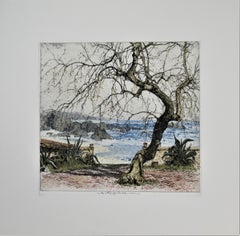
A delicate composition of an industrial Hudson River town, seen from lower Manhattan; a view of what is now Liberty State Park. New York: 1884. Etching with aquatint on cream laid p...

Category

Late 19th Century Realist Louis Orr Art
Materials

Laid Paper, Etching, Aquatint

Philip Pearlstein 'View Over Soho, Lower Manhattan' NYC signed, print

Philip Pearlstein 'View Over Soho, Lower Manhattan' NYC signed, print

By Philip Pearlstein

Located in San Rafael, CA

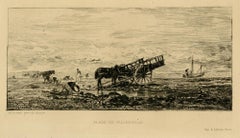
Philip Pearlstein (1924-2022) View Over Soho, Lower Manhattan, 1977 Aquatint in colors on wove paper Edition 7/41 Signed, editioned and titled in pencil lower left Printed by the Orl...

Category

1970s Realist Louis Orr Art
Materials

Aquatint

The original Whitney, Marcel Breuer Building (now Sotheby's), Woodcut engraving

The original Whitney, Marcel Breuer Building (now Sotheby's), Woodcut engraving

By Richard Haas

Located in New York, NY

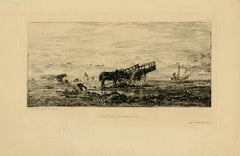
Richard Haas The Whitney (Marcel Breuer Building), 1979 Woodcut engraving Signed, titled, dated and numbered by the artist on the back. This is a rare Artist Proof 9/10, aside from ...

Category

1970s Realist Louis Orr Art
Materials

Engraving, Etching

Richard Haas, Downtown Los Angeles MOCA, Etching & Aquatint, Signed/N, Framed

Richard Haas, Downtown Los Angeles MOCA, Etching & Aquatint, Signed/N, Framed

By Richard Haas

Located in New York, NY

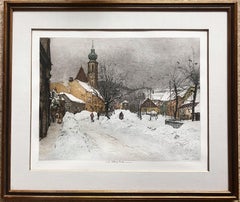
Richard Haas Downtown Los Angeles MOCA (Museum of Contemporary Art), 1991 Etching and aquatint on paper with printers blind stamp SIgned, dated '91 and numbered 14/35 in graphite pen...

Category

1990s Realist Louis Orr Art
Materials

Etching, Aquatint

Central Synagogue Lexington Avenue Looking North Etching and aquatint S/N Framed

Central Synagogue Lexington Avenue Looking North Etching and aquatint S/N Framed

By Richard Haas

Located in New York, NY

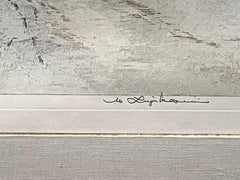
Richard Haas Central Synagogue - Lexington Avenue Looking North, 1991 Etching and aquatint on wove paper Signed, dated and numbered 8/35 in graphite pencil on the front; bears the or...

Category

1990s Realist Louis Orr Art
Materials

Etching, Aquatint

Richard Haas, Hong Kong, Etching & Aquatint, Signed 26/35, Framed

Richard Haas, Hong Kong, Etching & Aquatint, Signed 26/35, Framed

By Richard Haas

Located in New York, NY

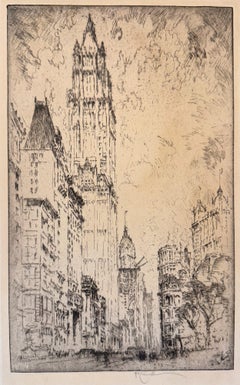
Richard Haas Hong Kong, 1990 Etching and Aquatint on wove paper Hand Signed, numbered 26/35 and dated on the front Frame included; held in the original vintage hand made wood frame ...

Category

1990s Realist Louis Orr Art
Materials

Etching, Aquatint

Italian Summer, Framed Etching by Michael Chapman

Italian Summer, Framed Etching by Michael Chapman

By Michael James Chaplin

Located in Brecon, Powys

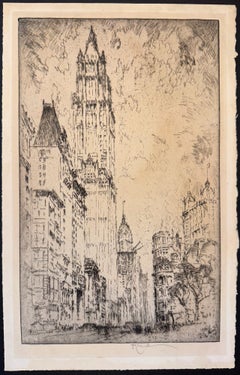
Etching from the studio of this acclaimed British Watercolorist. Good condition. Image 15.5" x 11.5" English artist Michael Chaplin is a Member of the Royal Watercolor Society, pa...

Category

1990s Realist Louis Orr Art
Materials

Etching

Louis Orr art for sale on 1stDibs.

Find a wide variety of authentic Louis Orr art available for sale on 1stDibs. You can also browse by medium to find art by Louis Orr in etching and more. Not every interior allows for large Louis Orr art, so small editions measuring 8 inches across are available. Customers who are interested in this artist might also find the work of Frank Wootton, Georges Schreiber, and Peter Moran. Louis Orr art prices can differ depending upon medium, time period and other attributes. On 1stDibs, the price for these items starts at $700 and tops out at $3,950, while the average work can sell for $1,750.

Artists Similar to Louis Orr