By Luigi Bartolini
Located in Roma, IT
Image dimensions: 17.4 x 23.5 cm.
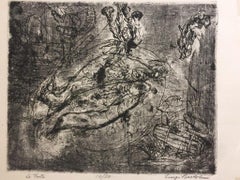
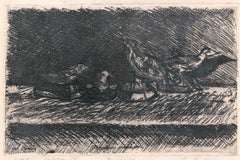
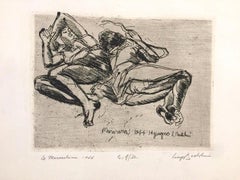
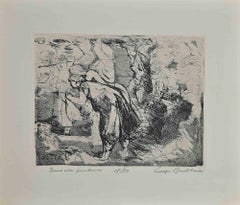
Le marocchine (Maurina e sua sorella) is an original artwork realized by Luigi Bartolini in 1944.
Original etching and China ink on paper.
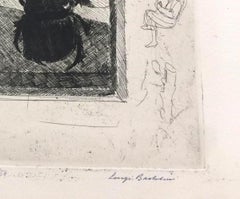
Titled, dated and signed on plate on the lower central: "Maurina 1944 14 giugno L. Bartolini".
Titled, dated, numbered and hand-signed in pencil at the bottom: "Le marocchine 1944 Es. 9/30 Luigi Bartolini".
Excellent conditions.
Other titles of the work: Maurina; Maurina e sua sorella; Le marocchine (Ragazze da marocchini).
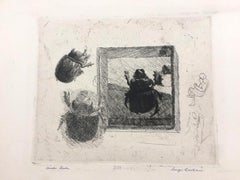
The work is also present in the book Arthur Rimbaud, Une saison en enfer - De Luigi, Rome, 1943.
Luigi Bartolini
Cupramontana (Ancona), 1892 – Rome 1963
An accomplished Twentieth Century Italian engraver, painter, writer, art critic and engraver. He spent his early years living in Rome, Siena, and Florence and was professionally formed through university courses in art and medicine, museums, and the Academy Belle Arti. He begins to study art in 1912 with a special preference for Goya, Rembrandt, and Fattori.
His success as an engraver arrives in 1924 with his exhibitions at Bragaglia’s House of Art and Casa Palazzi di Roma (70 etchings). In 1925 he participates in the II Roman Biennial and then in the Venice Biennial from 1928 to 1936.
He is considered, along with Morandi, the greatest Italian engraver. His expositive work continues with intensity in the post-war period with one-man exhibitions in both Italy and abroad. His last one-man exhibition takes place at the XXXI Venice Biennial and at the National Chalcography in Rome in 1962.
Bartolini lives through his era in complete liberty, dedicating himself to painting, to art criticism, to literature and teaching. This intellectual and artistic autonomy is well reflected in his engravings and it is exactly because of this characteristic of intellectual autonomy that he has never really belonged to the Scuola Romana although he was very attached to it because he frequented the Roman environment and it’s artists who he would often exhibit with. His literary production is gathered the volumes Polemiche (1940), Credo d’artista (1945), Il Fallimento della Pittura (1948) and Poesie 1911-1963(1964). As a critic, he collaborates with numerous magazines such as “Il Selvaggio”, “Quadrivio”, “La Tribuna”, “L’Ambrosiano” etc. After the war, “Bicycle Thieves...
Category
1940s Luigi Bartolini