Luigi Quaini Art

to
1
1
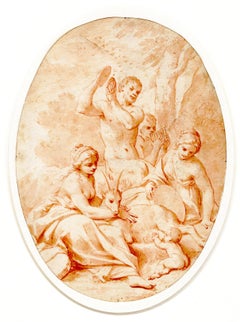
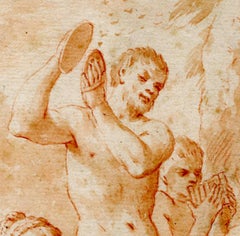
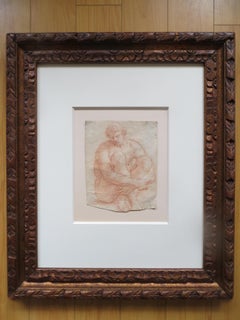
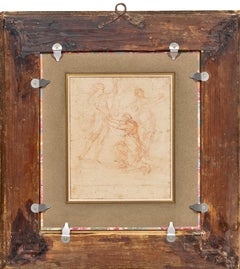
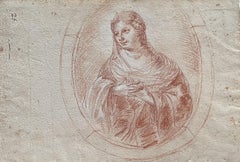
The Infant Jupiter Nursing from the She-Goat Amaltheia (The Birth of Jupiter)
By Luigi Quaini
Located in Fairlawn, OH
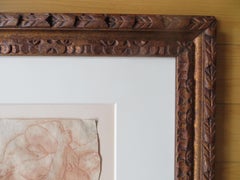
The Infant Jupiter Nursing from the She-Goat Amaltheia (The Birth of Jupiter) Red chalk and wash on off-white paper, c. 1700 Unsigned Attribuuted to Quaini by Dwight Miller, the sch...
Category

18th Century and Earlier Baroque Luigi Quaini Art

Materials

Chalk

Related Items
Italian School, Nicolo Grassi, 18th, Worship of Venus, The Venus Sacrifice, Amor
Located in Greven, DE
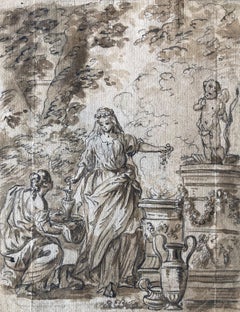
Italian School, 18th Century, Circle of Grassi, This old master drawing is drawn in the late-Baroque or Rococo style. It depicts a woman worshipping Venus/ preparing a sacrifice for ...
Category

Late 17th Century Baroque Luigi Quaini Art

Materials

Handmade Paper

Old Master French Sanguine Drawing of Hercules
Located in Pasadena, CA
Old Master, French School red chalk drawing on paper is not signed . Done in Sanguine on paper the nude appear like Hercule . The feel and look of the works while academic studies a...
Category

17th Century Baroque Luigi Quaini Art

Materials

Archival Paper

Part of the ring-wall of the Taj Mahal, Agra, India, 1914
Located in Amsterdam, NL
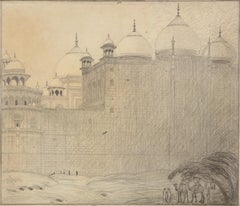
Part of the ring-wall of the Taj Mahal, Agra, India, 1914 Signed with initials and dated bottom right Black chalk on paper, 45.5 x 53 cm Literature: Ernst Braches en J.F. Heijbro...
Category

1910s Art Nouveau Luigi Quaini Art

Materials

Paper, Chalk

Fenzoni, Painting AND preparatorial Drawing, John the Baptist, Italy Renaissance
By Ferrau Fenzoni
Located in Greven, DE
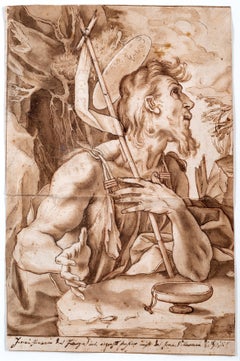
The painting and the preparatory drawing are offered together. Provenance Private collection, Germany, Trier, c. 1980- 2013 Saint John the Baptist Brown ink and wash over red chalk on oatmeal paper 31 x 20.5 cm Inscribed: „Ferrau Fenzonio da Faenza invt. esque … imp. da Fran. Villamena …“. bears the collector's mark of Henry Scipio Reitlinger (1882-1950; Lugt 2274a) on a tiny label glued to the verso On the reverse is a partial drawing of a Pieta, pricked for transfer. Provenance New York, Doyle, 14. October 2015, No. 6 The painting and the preparatory drawing resemble the composition of an engraving after Ferraù Fenzoni by Francesco Villamena. Drawing, engraving and painting are almost identical, except for minor differences. Even the measurements nearly correspond: painting (32 x 25,5 cm), drawing (30 x 20,5 cm), engraving (31,1 x 23,5 cm). Dr. Guiseppe Scavizzi confirmed the attribution of the present panting to Fenzoni and he dates it to c. 1590. The inscription on the drawing reads “Ferrau Fenzonio da Faenza invt. esque. . . imp. da Fran: Villamena . . .”. The engraving’s inscription also lists place and date “Ferra Fensionius inventor/F. Villamoena sculpsit Rome/Aspectu fruitur… antra puer/cum Privilegio… 1613”. Interestingly, the engraving is not mirrored as it is in most printing processes. Painting, drawing and engraving are not reversed but the same. It is remarkable to note that there are further paintings by Fenzoni which were engraved in the same order and not reverted. They also show strong parallels regarding the compositions and the measurements (see for example “Deposition of Christ” ). Ferraù Fenzoni was an Italian painter mainly active in Todi. He is also called Il Faenzone after his birthplace (Faenza). He apprenticed in Rome during the papacy of Gregory XIII and contributed to numerous fresco cycles under pope Sixtus V, such as the Loggia della Benedizioni in the Lateran Palace, the frescoes on the walls and vaults of the Scala Santa of the adjacent Basilica of San Giovanni in Laterano, and the decoration in the Sistine library. His expressive canvases straddle the styles of Mannerism and Baroque. In 1594, he moved to Todi. A “Last Judgement” by him is housed in the cathedral of Todi. He returned to Faenza in 1599, where he decorated chapels in the cathedral from 1612 to 1616. In 1622, he completed a “Deposition”, now in the local Pinacoteca. In 1640, Fenzoni was named “cavaliere dello speron d’oro” by Cardinal Colonna and, on 25th April 1634, he was nominated vicar and “castellano of Granarolo”. Fenzoni‘s style is characterized by a mixture of the Mannerism of the Northern Netherlands and the Italian Baroque. Saint John the Baptist, Old Master, 17th Century, By Fenzoni, Religious Scene, Rome Art...
Category

16th Century Mannerist Luigi Quaini Art

Materials

Canvas, Oil, Handmade Paper
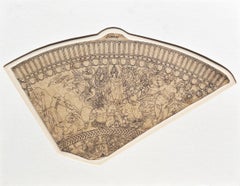
A dazzling Venetian Regatta Boat Study attributed to Alessandra Mauro
Located in PARIS, FR
This stunning Baroque study depicts a regatta boat, a type of vessel developed in eighteenth-century Venice for the regattas organized by the Serenissima during visits by royalty and princes. We propose to link this drawing to the work of Alessandro Mauro, an artist who specialized in this type of composition, as illustrated by a drawing from him at the Metropolitan Museum. 1. Description of the boat The greatest decorative fantasy reigns in this preparatory study, which blends mythological and exotic elements with references to ancient Egypt. Our drawing is probably an initial thought, destined to be refined and clarified later in pen and ink (as evidenced by the ink stain in the lower right). A quadriga of seahorses guided by Neptune stands at the stern of the boat, shown well above the waterline (perhaps to outline its empty volume). One of the seahorses is ridden by a newt, while Amphitrite lies at the feet of the sea god. The center of the boat is occupied by a vast baldachin resting on four atlantes and surmounted by a figure riding an animal (a dragon?). Three figures sit beneath the canopy, one of them on a griffin-shaped seat. This allusion to Egyptian antiquity echoes the winged sun (sometimes a symbol of the god Horus, as in the temple of Edfu in Egypt) that adorns the sides of the promontory on which this baldachin rests. Another flag-bearer figure crouches at the stern of the boat on a raised seat, on the reverse of which is a crowned mermaid whose arm, extended backwards, rests on a mascaron decorated with a radiant face (Helios?) and whose torso surmounts an elephant's head. The heads of the rowers and their oars are sketched all along the boat, whose sides are embellished with elongated naiads. 2. The Venetian regatta boats An exhibition held in 2013 at the Ca' Rezzonico (the Venetian eighteenth-century museum) paid tribute to these regatta boats through studies and prints depicting them. The regattas organized by the Serenissima in honor of visiting princes and sovereigns were among the most spectacular ceremonies in Venice. Some important artists of the 18th century contributed to the creation of these extravagant boats which were given exotic names such as bissona, malgarota or peota. The specialists in this field were Andrea Urbani and the brothers Alessandro and Romualdo Mauro. They were born into a family of theater decorators in Piedmont, but little is known about their detailed biography. Alessandro was the architect of the Dresden opera house and of the St. Samuel Theater in Venice (in collaboration with his brother Romualdo), but also worked as stagehand and set designer in Vienna, Rome and Turin. A drawing produced around 1737 from the Metropolitan Museum (7th photo in the gallery) bears witness to his activity as a regatta boat designer. This drawing is a much more elaborate version than the one presented here, having been entirely reworked in brown ink. However, a figure at the bow of the boat, executed solely in black chalk, still bears witness to a technique similar to that of our drawing. It is difficult to know whether the boat depicted in our drawing was a project for an actual boat or whether it remained in the planning stage, but the front of our boat (Neptune and the quadriga of seahorses ridden by a newt) bears several similarities to that of a parade boat depicted in the print published by Michele Marieschi entitled Regatta on the Grand Canal, between the Foscari and Balbi Palaces (last photo in the gallery). This print is dated 1741, which could confirm that our work dates from around 1740. The area between Neptune and the quadriga that precedes him on this strange paddle-boat appears to be partially submerged, confirming that the waterline of our boat was probably intended to be much lower than the one shown in our drawing. The Correr Museum’s collection holds one of the most important collection of engravings and drawings devoted to these specifically Venetian Baroque productions. These boats were intended to last the duration of a festival. Today, they are only documented by preparatory drawings or prints that testify to the sumptuousness of their decoration. This taste for regatta boats lasted throughout the Venetian eighteenth century, and the conception of regatta boats also attracted great masters such as Giambattista Tiepolo, Francesco Guardi or Giambattista Piranesi...
Category

Mid-18th Century Old Masters Luigi Quaini Art

Materials

Chalk

Leaning Nude Man (recto); Kneeling Man, Hands Tied Behind His Back (verso)
By Giovanni Francesco Barbieri (Il Guercino)
Located in Paris, Île-de-France
GIOVANNI FRANCESCO BARBIERI, known as GUERCINO (1591-1666) Leaning Nude Man (recto); Kneeling Man, Hands Tied Behind His Back (verso) Black chalk heightened with white on light blu...
Category

1620s Old Masters Luigi Quaini Art

Materials

Chalk, Charcoal

Allegory of Chastity, a drawing attributed to G. Porta with great provenance
Located in PARIS, FR
This magnificent drawing from the Venetian Renaissance intrigues us in many ways. It depicts an allegorical composition whose meaning partly escapes us: a veiled figure seated on a stone bench (which we have identified as Chastity), seems to be turning away from a woman's bust beside her, below which are two rabbits, a traditional allegory of fertility, but also sometimes of lust. This drawing, executed on blue paper, undoubtedly belongs to the Venetian Renaissance. The inscriptions on the back of the old mounting board indicate the various attributions considered by its last owner, the British painter and art historian Sir Lawrence Gowing. We have retained the attribution to Giuseppe Porta proposed by art historian John Arthur Gere as the most relevant. We were incredibly fortunate to find a hexagonal frame of a very similar format for this drawing, the upper corners of which were formerly cut (irregularly). This 17th-century Dutch frame comes from an aristocratic collection in Lombardy, and creates a kind of fascinating chase around this Venetian drawing...
Category

16th Century Luigi Quaini Art

Materials

Chalk

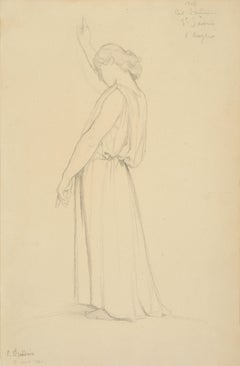
A Study for the Angel of Saint-Severin church in Paris, by Paul Flandrin
Located in PARIS, FR
After the restoration of the Saint-John chapel’s frescoes at the Saint-Severin church in Paris in 2022, the drawing presented here is a moving testimony to their creative process. It...
Category

1840s Old Masters Luigi Quaini Art

Materials

Chalk

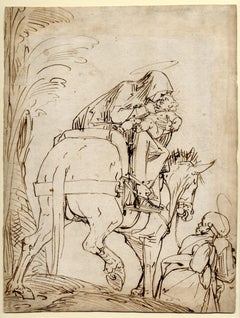
Old Master Drawing, 17th century, Netherlands, Dutch, Flemish, Mannerist
Located in Eltville am Rhein, DE
Probably Dutch Flemish master, 17th century Ink on paper / on backing Inscribed on the upper and lower margins Size: approx. 23 x 40 cm, plus passe-partout Viewing and collection...
Category

17th Century Mannerist Luigi Quaini Art

Materials

Ink

Capriccio Landscape View with Figures
Located in Houston, TX
Capriccio painting in a greek or Italian style with women around a river. Capriccio is a fanciful architectural landscape painting. It was popular in Italy in the 18th Century. Most ...
Category

Late 19th Century Baroque Luigi Quaini Art

Materials

Gouache

Capriccio Landscape View with Figures
$750
H 20 in W 17 in D 0.5 in
Portrait of a Man’s Head
By William Etty
Located in London, GB
Charcoal and white chalk highlight on paper Label of J.M Maas Gallery (verso) 36cm × 28cm (54cm × 43cm framed) Etty, a student of Thomas Lawrence, R.A., was the first significant Br...
Category

19th Century English School Luigi Quaini Art

Materials

Paper, Chalk, Charcoal

Portrait of a Man’s Head
$3,439
H 21.26 in W 16.93 in
Flemish School, Portrait Young Boy, Old Master Drawing, Baroque, 17th Century
Located in Greven, DE
Old Master Drawing, Flemish School, Portrait or Sketch of a standing young boy. Condition : see photos The drawing is on paper.
Category

17th Century Baroque Luigi Quaini Art

Materials

Crayon, Paper

Luigi Quaini art for sale on 1stDibs.

Find a wide variety of authentic Luigi Quaini art available for sale on 1stDibs. If you’re browsing the collection of art to introduce a pop of color in a neutral corner of your living room or bedroom, you can find work that includes elements of orange and other colors. You can also browse by medium to find art by Luigi Quaini in chalk and more. Not every interior allows for large Luigi Quaini art, so small editions measuring 7 inches across are available. Luigi Quaini art prices can differ depending upon medium, time period and other attributes. On 1stDibs, the price for these items starts at $4,500 and tops out at $4,500, while the average work can sell for $4,500.

Still Thinking About These?

All Recently Viewed