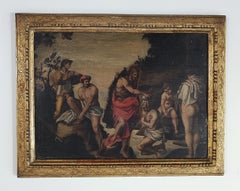
Marco Marcola Figurative Paintings

1740-1793

Marco Marcola was an Italian painter, born and mainly active in Verona. He was initially apprenticed to his father Giovanni Battista Marcola. Among his pupils were Antonio Pachera, Bellino Bellini and Domenico Zanconti. He is also known as Marco Marcuola. His sister Angela Marcola was also a painter.

to
1
1
Overall Width
to
Overall Height
to
1
1
1
1
1
1
1
1
1
1
1
511
313
283
233
1
1
Artist: Marco Marcola
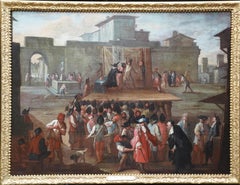
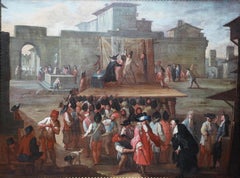
Travelling Comic Theatre - Italian 18thC art figurative landscape oil painting

Travelling Comic Theatre - Italian 18thC art figurative landscape oil painting

By Marco Marcola

Located in Hagley, England

This interesting Italian 18th century Old Master oil painting is by noted artist Marco Marcola, also known as Marco Marcuola. It was painted circa 1770 and has excellent provenance. ...

Category

1770s Old Masters Marco Marcola Figurative Paintings

Materials

Oil

Related Items
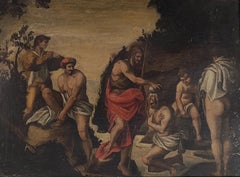
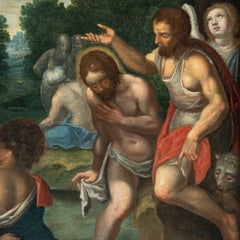
Flemish painter in Italy - 17th century religious painting - Baptism Christ

Flemish painter in Italy - 17th century religious painting - Baptism Christ

Located in Varmo, IT

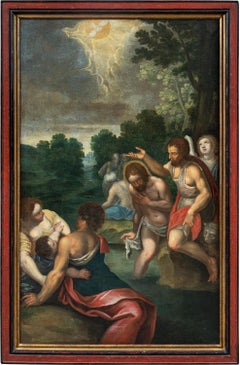
Flemish painter active in Italy (17th century) - Baptism of Christ. 122 x 74 cm (without frame) - 133 x 86 cm (with frame). Oil on canvas, in a wooden frame (not signed). The scen...

Category

Mid-17th Century Old Masters Marco Marcola Figurative Paintings

Materials

Oil, Canvas

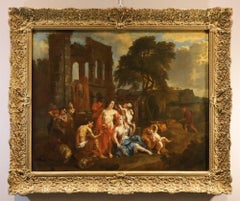
Myth Apollo Issa De Lairesse Paint 17/18th Century Oil on canvas Old master Art

Myth Apollo Issa De Lairesse Paint 17/18th Century Oil on canvas Old master Art

Located in Riva del Garda, IT

Gérard de Lairesse (Liège 1641 - Amsterdam 1711) workshop The Myth of Apollo and Issa (from Ovid, Metamorphoses, book VI, 122-124) Oil on canvas 65 x 82 cm. - Framed 84 x 99 cm...

Category

17th Century Old Masters Marco Marcola Figurative Paintings

Materials

Oil

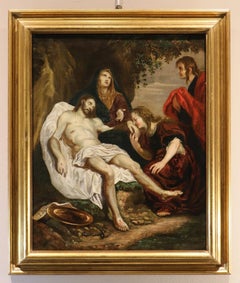
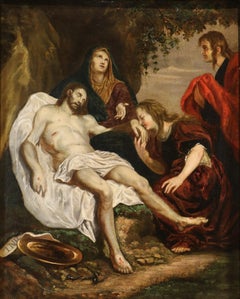
Lamentation Christ Van Dyck Paint 17/18th Century Oil on canvas Old master Art

Lamentation Christ Van Dyck Paint 17/18th Century Oil on canvas Old master Art

Located in Riva del Garda, IT

Lamentation of Christ Follower of Anthony van Dyck (Antwerp 1599 - London 1641) Late 17th-early 18th century Oil on canvas (64 x 51 cm. - Framed 77 x 65 cm.) This is a very...

Category

17th Century Old Masters Marco Marcola Figurative Paintings

Materials

Oil

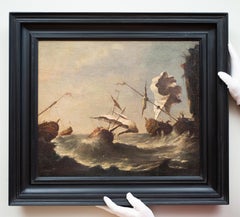
Shipping in Stormy Waters, Attributed to Italian Artist Francesco Guardi

Shipping in Stormy Waters, Attributed to Italian Artist Francesco Guardi

By Francesco Guardi

Located in Stockholm, SE

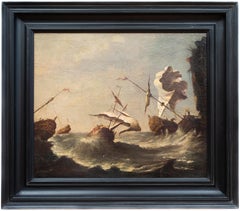
The splendour of the tragic sea Francesco Guardi and maritime painting in Venetian art No Venetian painter was a stranger to the sea. After all, Venice was not only one of the most prominent ports of the Mediterranean, but indeed a city literally submerged in the ocean from time to time. Curiously however, the famous Venetian school of painting showed little interest in maritime motifs, favouring scenes from the iconic architecture of the city rather than seascapes. That is why this painting is a particularly interesting window into not only the painter Francesco Guardi himself – but to the significance of the element of water in art history, in absence as well as in the centre of attention. Whether it be calm, sunny days with stunning views of the palaces alongside the canals of Venice or – more rarely – stormy shipwrecking tragedies at sea, water as a unifying element is integral to the works of painter Francesco Guardi (1712–1793). During his lifetime, Venetian art saw many of its greatest triumphs with names like Tiepolo or Canaletto gaining international recognition and firmly establishing Venice as one of the most vibrant artistic communities of Europe. While the city itself already in the 18th century was something of an early tourist spot where aristocrats and high society visited on their grand tour or travels, the artists too contributed to the fame and their work spread the image of Venice as the city of romance and leisure to an international audience, many of whom could never visit in person. Still today, the iconic image of Venice with its whimsical array of palaces, churches and other historic buildings is much influenced by these artists, many of whom have stood the test of time like very well and remain some of the most beloved in all of art history. It was not primarily subtility, intellectual meanings or moral ideals that the Venetian art tried to capture; instead it was the sheer vibrancy of life and the fast-paced city with crumbling palaces and festive people that made this atmosphere so special. Of course, Venice could count painters in most genres among its residents, from portraiture to religious motifs, history painting and much else. Still, it is the Vedutas and views of the city that seems to have etched itself into our memory more than anything else, not least in the tradition of Canaletto who was perhaps the undisputed master of all Venetian painters. Born into his profession, Francesco lived and breathed painting all his life. His father, the painter Domenico Guardi (1678–1716) died when Francesco was just a small child, yet both he and his brothers Niccolò and Gian Antonio continued in their fathers’ footsteps. The Guardi family belonged to the nobility and originated from the mountainous area of Trentino, not far from the Alps. The brothers worked together on more challenging commissions and supported each other in the manner typical of family workshops or networks of artists. Their sister Maria Cecilia married no other than the artist Giovanni Battista Tiepolo himself, linking the family to the most renowned Venetian name of the time. During almost a decade, Guardi worked in the studio of Michele Giovanni Marieschi, sometimes simply known as Michiel, a painted similar in both style and motif. Canaletto is, however, the artist Guardi is most often compared to since they shared a mutual fascination for depicting the architecture and cityscape of Venice. During the course of his career, Guardi tried his hand in many different genres. He was as swift in painting landscapes, Vedutas of Venice, sacred motifs, interiors and architectural compositions as he was in a number of other motifs. His style is typical of the Venetian school but also distinct and personal once we look a little closer. There is an absolute certainty in the composition, the choice of which sometimes feels like that of a carefully calculated photograph – yet it is also very painterly, in the best sense of the word: fluid, bold, sensitive and full of character. The brushwork is rapid, intense, seemingly careless and extraordinarily minute at the same time; fresh and planned in a very enjoyable mixture. His interiors often capture the breath-taking spacious glamour of the palaces and all their exquisite decor. He usually constructed the motif through remarkably simple, almost spontaneous yet intuitively precise strokes and shapes. The result was a festive, high-spirited atmospheric quality, far away from the sterile and exact likeness that other painters fell victim to when trying to copy Canaletto. The painting here has nothing of the city of Venice in it. On the contrary, we seem to be transported far away into the solitary ocean, with no architecture, nothing to hold on to – only the roaring sea and the dangerous cliffs upon which the ships are just moments away from being crushed upon. It is a maritime composition evoking both Flemish and Italian precursors, in the proud tradition of maritime painting that for centuries formed a crucial part of our visual culture. This genre of painting is today curiously overlooked, compared to how esteemed and meaningful it was when our relationship to the sea was far more natural than it is today. When both people and goods travelled by water, and many nations and cities – Venice among them – depended entirely on sea fare, the existential connection to the ocean was much more natural and integrated into the imagination. The schools and traditions of maritime art are as manifold as there are countries connected to the sea, and all reflect the need to process the dangers and wonders of the ocean. It could symbolize opportunity, the exciting prospects of a new countries and adventures, prospering trade, beautiful scenery as well as war and tragedy, loss of life, danger and doom. To say that water is ambivalent in nature is an understatement, and these many layers were something that artists explored in the most wondrous ways. Perhaps it takes a bit more time for the modern eye to identify the different nuances and qualities of historic maritime paintings, they may on first impression seem hard to differentiate from each other. But when allowing these motifs to unfold and tell stories of the sea in both fiction and reality – or somewhere in between – we are awarded with an understanding of how the oceans truly built our world. In Guardi’s interpretation, we see an almost theatrically arranged shipwrecking scene. No less than five ships are depicted right in the moment of utter disaster. Caught in a violent storm, the waves have driven them to a shore of sharp cliffs and if not swallowed by the waves, crushing against the cliffs seems to be the only outcome. The large wooden ships are impressively decorated with elaborate sculpture, and in fact relics already during Guardi’s lifetime. They are in fact typical of Dutch and Flemish 17th century ships, giving us a clue to where he got the inspiration from. Guardi must have seen examples of Flemish maritime art, that made him curious about these particular motifs. One is reminded of Flemish painters like Willem van de Velde and Ludolf Backhuysen, and this very painting has indeed been mistakenly attributed to Matthieu van Plattenberg...

Category

18th Century Old Masters Marco Marcola Figurative Paintings
Materials

Canvas, Oil

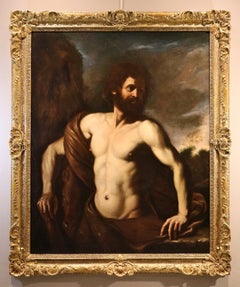
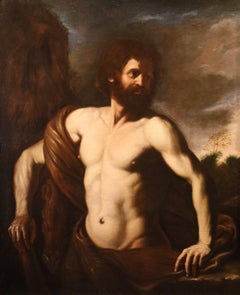
Hercules Guercino Paint 17th Century OIl on canvas Old master Emilian school Art

Hercules Guercino Paint 17th Century OIl on canvas Old master Emilian school Art

Located in Riva del Garda, IT

Workshop of Giovanni Francesco Barbieri, Il Guercino (1591–1666) Attributed to Ercole Gennari (Cento, 1597–Bologna, 1658) Victorious Hercules oil on canvas 136 x 112 cm. In ...

Category

17th Century Old Masters Marco Marcola Figurative Paintings
Materials

Oil

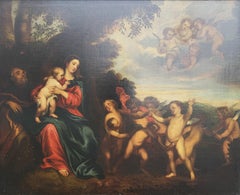
After Sir Anthony Van Dyck, Madonna & Child, The Rest on the Flight into Egypt

After Sir Anthony Van Dyck, Madonna & Child, The Rest on the Flight into Egypt

By (After) Anthony Van Dyck

Located in Milford, NH

A fine 18th/19th century oil painting in the old master style of the Madonna & Child titled The Rest on the Flight into Egypt, a well known painting circa 1630 by Flemish artist ...

Category

18th Century Old Masters Marco Marcola Figurative Paintings
Materials

Canvas, Oil

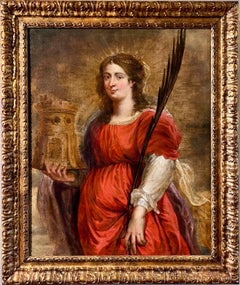
17th-Century Flemish Oil - Saint Barbara, A Symbol of Protection and Resilience

17th-Century Flemish Oil - Saint Barbara, A Symbol of Protection and Resilience

Located in Aartselaar, BE

17th century Flemish School, Saint Barbara This accomplished 17th-century Flemish oil painting depicts Saint Barbara, shown as a serene and powerful woman dressed in a luminous red gown, set against a warm, atmospheric background and proudly holding her traditional attribute; a tower. The invention of the present composition stems from 17th century Antwerp and was likely drawn by Theodoor van Thulden...

Category

17th Century Old Masters Marco Marcola Figurative Paintings
Materials

Canvas, Oil

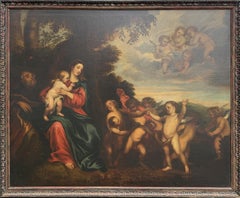
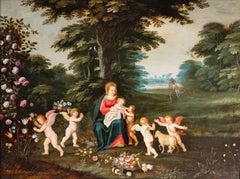
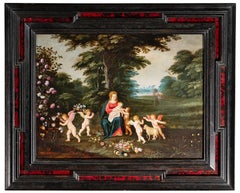
Rest on the Flight into Egypt - Attributed to Pieter Van Avont - 17th c. Flemish

Rest on the Flight into Egypt - Attributed to Pieter Van Avont - 17th c. Flemish

By Pieter van Avont

Located in PARIS, FR

Rest during the Flight into Egypt - The Virgin and Child with St. John the Baptist and the angels in a Landscape. Attributed to Pieter Van Avont (1600-1652) 17th century Antwerp School, circa 1630 Oil on oak panel, Dimensions: h. 38 cm, w. 50 cm (14.96 in x 19.68 in) Flemish style frame in ebonized and moulded wood Framed: h. 56 cm, w. 68.5 cm (22.04 in. x 26.97 in.) This artwork is sold with a certificate of authenticity guaranteeing its origin, date of execution, and attribution to the artist. In the heart of a lush wooded landscape, the Virgin with Jesus rests in a green clearing accompanied by Saint John the Baptist and the cherubs. Seated to the left of the composition, the Virgin Mary holds the Child on her lap; the little Saint John the Baptist wearing the camel-skin tunic (his attribute) stands before Jesus to exchange a few caresses. On the right, the couple of cherubs are playing with the lamb of Saint John the Baptist, bringing a jovial character to the scene. A pair of gardening putti on the left pick flowers to bring bouquets to the Virgin and Jesus. Spring flowers such as tulips, daffodils and anemones that grow abundantly around them and enrich the composition with their shimmering colors. A lush rose bush blooms to the left of the figures offering delicate roses. (The rose is the flower associated with the Virgin Mary, who is the "mystical rose," the one that does not bear the "thorn of sin") At the feet of the Virgin are bunches of grapes (symbol of the future passion of Christ) as well as apples (symbol of the original fall of Man but also of the Redemption in Christ) In the foreground we find a wicker basket filled in profusion with beautiful flowers and guinea pigs nibbling on the blades of grass. In a cleverly arranged disorder, these elements of the still life with their strong symbolic power accentuate the religious theme, but are also an opportunity for the artist to demonstrate his know-how in the still life genre that is gaining momentum in Antwerp. The landscape behind the figures consists of a large tree with a twisted trunk and a luminous opening to the horizon placed on the right. We see Saint Joseph arriving with a donkey, a small reminder from the artist that the composition is associated with the episode of Rest during the flight into Egypt. The calm expanse of this bucolic forest opening onto the luminous distance, with its profusion of symbolic flowers and fruits, is particularly suited to this sacred scene. The theme of Jesus' sacrifice and his tragic fate is mitigated by cherubs who play with innocence and carelessness in the face of the fragility of life symbolized by cut flowers. The great mastery of the painter is manifested by the finesse of the drawing enhanced by the delicacy in the application of the brushstrokes bringing a multitude of details. The richness of the whole is exacerbated thanks to the choice of colours, this varied palette is an undeniable asset of our work. The virtuosity of our artist lies in his versatility, as much concerned with the success of the landscape and flowers as with the modelling of his figures. The cherubs with their naked bodies are gracefully illuminated by warm colours with subtle shadows, while the still life is rendered with astonishing realism, both in the precision of the drawing and in the countless shades of the flowers. There are several compositions similar to ours, of which below are the closest versions: • Sale, Jean-Claude Anaf et Associés, Lyon, 08/02/1998, attributed to Pieter Van Avont, oil on panel, h. 48 cm, l. 71 cm (recorded on RKD n° 31451). Comment: identical composition, only St Joseph with the donkey is different) • Christie's New York sale, 29/01/1998, Pieter Van Avont, oil on copper, h. 23.8 cm, w. 24.8 cm • Dorotheum sale, Vienna, 25/04/2017, Pieter Van Avont and Jan Breughel II, oil on copper, h .26 cm, w. 39 cm • Hermitage Museum, Saint Petersburg, Russia, Pieter Van Avont, oil on panel, h. 50.5 cm, w. 71.7 cm Peter van Avont, Flemish painter (Mechelen, 1600 - Antwerp. 1652) Born in Mechelen, he is mentioned in 1620 as a member of the painters' guild of his hometown. He left in 1 622 for Antwerp, where he was also a member of the guild. He collaborated with many painters, including Jan Brueguel the Younger, David Vinckboons, Lucas van Uden...

Category

17th Century Old Masters Marco Marcola Figurative Paintings
Materials

Oak, Oil

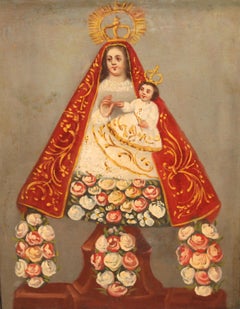
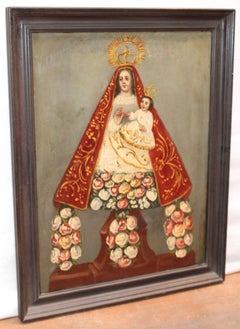
Escuela española - Virgen con niño - Óleo sobre tela

Escuela española - Virgen con niño - Óleo sobre tela

$1,431

H 37.01 in W 29.14 in D 1.58 in

Escuela española - Virgen con niño - Óleo sobre tela

Located in Sant Celoni, ES

Siglo XVIII - Escuela española. Como pueden apreciar, la obra no va firmada, es de autor anónimo Se presenta enmarcada la obra con un marco bastante actual El estado de la obra es ...

Category

18th Century Old Masters Marco Marcola Figurative Paintings

Materials

Oil

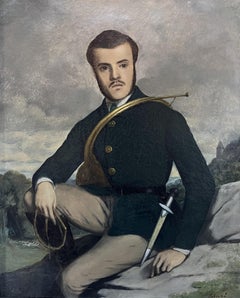
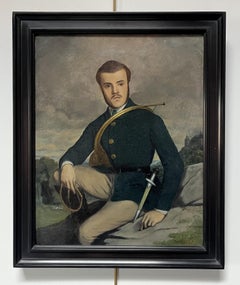
French school early 20th century, Portrait of a hunter, oil on canvas signed

French school early 20th century, Portrait of a hunter, oil on canvas signed

Located in Paris, FR

French school early 20th century, Portrait of a hunter signed lower right, the signature has not yet been deciphered oil on canvas 40 x 32.5 Framed : 47 x 39 cm In good condition, ...

Category

Early 20th Century Old Masters Marco Marcola Figurative Paintings
Materials

Oil

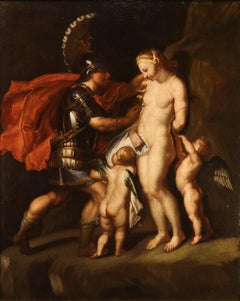
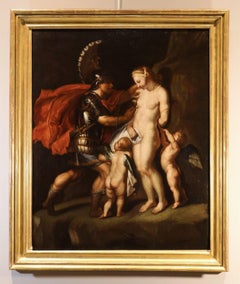
Perseus Andromeda Van Thulden Paint 17th Century Oil on canvas on table Flemish

Perseus Andromeda Van Thulden Paint 17th Century Oil on canvas on table Flemish

Located in Riva del Garda, IT

A follower of Peter Paul Rubens (Siegen 1577 – Antwerp 1640) Attributed to Theodoor van Thulden (Bois-Le-Duc, 1606 – 1669) Perseus Frees Andromeda oil on canvas, mounted on panel? 82 x 67 cm. - with frame 98 x 83 cm. The subject of the painting, derived from Ovid’s Metamorphoses (Book IV, lines 663–752), is inspired by the myth of Princess Andromeda, daughter of King Cepheus of Ethiopia and Queen Cassiopeia, depicted here as she is freed by the Greek hero Perseus after he has defeated the sea monster that held her captive. This cruel punishment had been imposed on her by Poseidon, god of the seas, to atone for the arrogance of her mother Cassiopeia, who had dared to compare herself and her daughter to the Nereids in beauty. When Perseus returned home on his winged horse Pegasus after his victory over the fearsome Medusa, he saw the princess chained to a rock on the coast and, overwhelmed by her beauty, decided to save her. The hero, clad in gleaming armour and wearing the red cloak of the victor and a crested helmet, is flanked by two small cherubs, one of whom helps him to break the chains binding Andromeda to the rock, emphasising the theme of love triumphing over danger. This is a smaller version derived from the famous ‘Perseus Frees Andromeda’ painted by Peter Paul Rubens around 1620, now housed in the Gemäldegalerie in Berlin, from which the main scene on the right has been taken. Rubens, who often employed sophisticated references to antiquity to emphasise the message of his paintings, modelled the figure of Andromeda and the cherub at her side, intent on loosening her chains, on the statue of the Happy Venus (Rome, Vatican Collections, which he saw during his stay in Rome. The success of Rubens’s work led to its widespread circulation and a substantial number of copies produced by his workshop (in Vienna at the Liechtenstein Gallery, in Potsdam at the Sanssouci Gallery, the Museum of Arles, and the Museum of Lisbon). It is our opinion that the authorship of the finely executed painting presented here is to be attributed to a Flemish artist active around the second half of the 17th century amongst Rubens’s followers...

Category

17th Century Old Masters Marco Marcola Figurative Paintings
Materials

Oil

The peace of your nights descends into their thoughts

The peace of your nights descends into their thoughts

$1,491

H 11.42 in W 15.16 in D 0.12 in

The peace of your nights descends into their thoughts

Located in Genève, GE

Work on paper mounted on wood 35.5 x 45.5 x 2 cm

Category

Late 18th Century Old Masters Marco Marcola Figurative Paintings
Materials

Oil

Marco Marcola figurative paintings for sale on 1stDibs.

Find a wide variety of authentic Marco Marcola figurative paintings available for sale on 1stDibs. You can also browse by medium to find art by Marco Marcola in oil paint, paint and more. Much of the original work by this artist or collective was created during the 18th century and is mostly associated with the Old Masters style. Not every interior allows for large Marco Marcola figurative paintings, so small editions measuring 48 inches across are available. Customers who are interested in this artist might also find the work of Paul Emile Léon Perboyre, Goyo Dominguez, and Antonio Savisio. Marco Marcola figurative paintings prices can differ depending upon medium, time period and other attributes. On 1stDibs, the price for these items starts at $76,638 and tops out at $76,638, while the average work can sell for $76,638.