Flemish School, 17th century
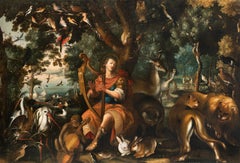
Orpheus Charming the Animals
Oil on canvas, 146.5 x 217 cm (57 5/8 x 85 3/8 in), c. 1650
This large and impressive painting shows the mythical singer Orpheus surrounded by a multitude of animals listening to his music. Across more than two metres, a wide landscape with a lake and a forest unfolds, populated by birds, deer and exotic animals. With its wealth of carefully observed species, its iconographic peculiarities and its echoes of Jan Brueghel the Younger, Roelant Savery and Peter Paul Rubens, it is a striking work of 17th-century Flemish painting.
THE SUBJECT
Orpheus sits at the centre in front of a tree whose trunk divides above his head. Its crown frames the scene towards the horizon and offers room for numerous birds. The left half of the picture is dominated by a lake, at whose edge the ruins of a castle can be seen in the far distance. This lake landscape, framed by mountains, is the only area where the sky is visible; here mainly waterfowl such as storks, herons, swans and ducks are gathered. On the right, the viewer looks into a deep forest, where land animals such as deer, rabbits and lions appear.
Orpheus wears sumptuous red and gold clothing and a white shirt beneath a blue breastplate, with a lion's mask on his shoulder. His feet are adorned with elaborate sandals, and his head is crowned with a laurel wreath, the sign of the "poeta laureatus". His harp, the laurel wreath and the surrounding animals clearly identify him as Orpheus, the singer and poet of Greek mythology.
THE MYTH
Orpheus was one of the Argonauts who sailed with Jason in search of the Golden Fleece. His music was said to calm even the raging sea, and on the voyage he drowned out the song of the Sirens. He was regarded as the greatest of all poets and musicians, and his song enchanted people, animals, trees and even stones.
THE ANIMALS
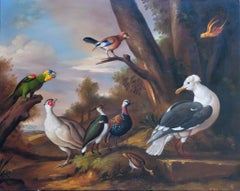
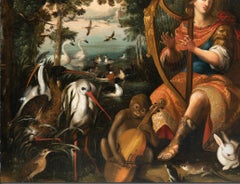
The painting depicts 51 birds of 37 species, nine species of mammals, as well as amphibians and reptiles. Most of the animals are rendered in great detail and, with few exceptions, can be identified. European species predominate. Exceptions include the South American rhea peering out from behind the deer, the large parrot at upper left, the Asian Java sparrow at upper right and the two lions.
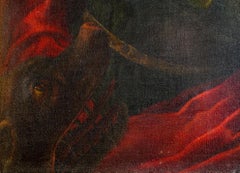
The large dark animal directly behind Orpheus on the right recalls an arctic fox in the shape of its head, although its body is far too large; the arctic fox was first described by Olaus Magnus in 1555. It could, however, also be a brown or black bear.
A remarkable detail is the small animal standing rather isolated in the right background and looking to the left. It cannot be identified with certainty, but it bears some resemblance to a kangaroo. The first European description of such an animal, a wallaby, was given by the Dutch merchant Francisco Pelsaert in 1629. If it is indeed meant as a kangaroo, it would be one of the earliest known painted depictions of the animal.
ICONOGRAPHIC PECULIARITIES
Orpheus is accompanied here by a small monkey playing a viola da gamba, an iconographic rarity. The painting also differs from other depictions of the subject in other respects. Orpheus is often placed at the centre, but he usually holds a lyre or a lira da braccio and is dressed in an antique manner, though less opulently. The choice of animals is also unusual: mainly European species are shown, with hardly any of the exotic animals such as camels or elephants found in comparable works.
The two lions in the right foreground are a quotation from Peter Paul Rubens's "Daniel in the Lions' Den", a composition that was widely known through prints.
ATTRIBUTION
The painterly and compositional approach places the painting in the Flemish School of the 17th century. Numerous depictions of the Orpheus theme are known from the circle of Jan Brueghel the Younger, often taken as an opportunity to show as many exotic animals as possible. The composition of the wooded landscape also recalls Jan Brueghel the Younger and Roelant Savery, while there are echoes of the Spanish painter Juan de Arellano...
Category
17th Century Baroque Martha Ochoa Art