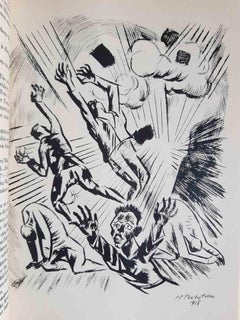
Max Pechstein More Art

German, 1881-1955

Pechstein was born in Zwickau, the son of a craftsman who worked in a textile mill. Early contact with the art of Vincent van Gogh stimulated Pechstein's development toward expressionism. After studying art first at the School of Applied Arts and then at the Royal Art Academy in Dresden, Pechstein met Erich Heckel and joined the art group Die Brucke in 1906. He was the only member to have formal art training. Later in Berlin, he helped to found the Neue Sezession and gained recognition for his decorative and colorful paintings that were lent from the ideas of Van Gogh, Matisse, and the Fauves. His paintings eventually became more primitivist, incorporating thick black lines and angular figures.

From 1933, Pechstein was vilified by the Nazis because of his art. A total of 326 of his paintings were removed from German museums. Sixteen of his works were displayed in the Entartete Kunst (Degenerate Art) exhibition of 1937. During this time, Pechstein went into seclusion in rural Pomerania. He was a prolific printmaker, producing 421 lithographs, 315 woodcuts and linocuts, and 165 intaglio prints, mostly etchings. Pechstein was a professor at the Berlin Academy for ten years before his dismissal by the Nazis in 1933. He was reinstated in 1945, and subsequently won numerous titles and awards for his work. He died in West Berlin. He is buried on the Evangelischer Friedhof Alt-Schmargendorf in Berlin.

to
1
Overall Width
to
Overall Height
to
1
1
1
1
1
8
266
223
126
1
Artist: Max Pechstein
Related Items
Nude Girl in Front of a Mirror / - The Reflection of Art -

Nude Girl in Front of a Mirror / - The Reflection of Art -

By Otto Mueller

Located in Berlin, DE

Otto Mueller (1874 Liebau - 1930 Obernigk), Nude Girl Before the Mirror, 1924. Lithograph on lightly hammered handmade paper, 38.9 cm x 28.9 cm (image), 57 cm x 44 cm (sheet size), s...

Category

1920s Expressionist Max Pechstein More Art

Materials

Paper

"Couple Making Love" by Gustav Klimt - Original Print from Courtesans Folio

"Couple Making Love" by Gustav Klimt - Original Print from Courtesans Folio

By Gustav Klimt

Located in Palm Beach, FL

Plate #4 from Gustav Klimt's 1907 "Dialogues of the Courtesans" portfolio, consisting of 15 collotypes on cream japon paper. The drawings in this folio are said to be studies for Kli...

Category

Early 1900s Vienna Secession Max Pechstein More Art
Materials

Paper

Jean Jansem (1920-2013), Les trois masques, 1980, Lithograph on paper

Jean Jansem (1920-2013), Les trois masques, 1980, Lithograph on paper

By Jean Jansem

Located in Les Acacias GE, GE

Jean Jansem (1920-2013), Les trois masques, 1980, Lithographie sur papier Arches justifiée Signée en bas à droite 76 x 55 cm CR Jansem, 1984, n°451 "Dans mes dernières lithograp...

Category

Late 20th Century Expressionist Max Pechstein More Art

Materials

Paper, Lithograph

"Masturbating Woman" by Gustav Klimt - Original Print from Courtesans Folio

"Masturbating Woman" by Gustav Klimt - Original Print from Courtesans Folio

By Gustav Klimt

Located in Palm Beach, FL

Plate #9 from Gustav Klimt's 1907 "Dialogues of the Courtesans" portfolio, consisting of 15 collotypes on cream japon paper. The drawings in this folio are said to be studies for Klimt's well-known Water Serpents paintings...

Category

Early 1900s Vienna Secession Max Pechstein More Art
Materials

Paper

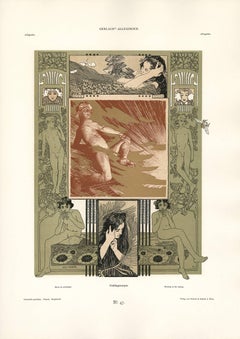
Gerlach's Allegorien Plate #47: "Morning in the Spring" Lithograph

Gerlach's Allegorien Plate #47: "Morning in the Spring" Lithograph

By Koloman Moser

Located in Palm Beach, FL

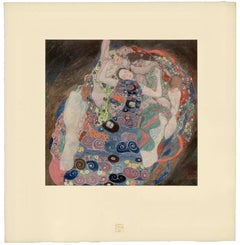
Koloman Moser (1868 –1918), AUSTRIAN Instead of applying his flair and art education solely to painting, Koloman Moser embodied the idea of Gesamt Kunstwerk (all-embracing art work) by designing architecture, furniture, jewelry, graphics, and tapestries meant to coordinate every detail of an environment. His work transcended the imitative decorative arts of earlier eras and helped to define Modernism for generations to come. Moser achieved a remarkable balance between intellectual structure (often geometric) and hedonistic luxury. Collaborating with Gustav Klimt and Josef Hoffmann, the artist was an editor and active contributor to Ver Sacrum, (Sacred Spring), the journal of the Viennese Secession that was so prized for its aesthetics and high quality production that it was considered a work of art. The magazine featured drawings and designs in the Jugendstil style (Youth) along with literary contributions from distinguished writers from across Europe. It quickly disseminated both the spirit and the style of the Secession. In 1903 Moser and Hoffmann founded and led the Wiener Werkstatte (Viennese Workshop) a collective of artisans that produced elegant decorative arts items, not as industrial prototypes but for the purpose of sale to the public. The plan, as idealistic then as now, was to elevate the lives of consumers by means of beautiful and useful interior surroundings. Moser’s influence has endured throughout the century. His design sensibility is evident from the mid-century modern furniture of the 1950s and ‘60s to the psychedelic rock posters...

Category

1890s Vienna Secession Max Pechstein More Art
Materials

Paper

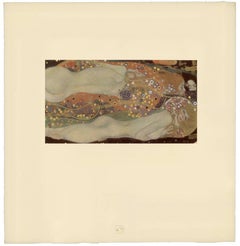
H.O. Miethke Das Werk folio "Water Snakes I" collotype print

H.O. Miethke Das Werk folio "Water Snakes I" collotype print

By Gustav Klimt & K.K. Hof-und Staatsdruckerei

Located in Palm Beach, FL

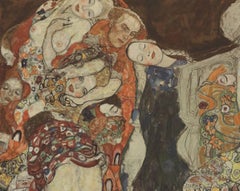
Water Snakes I, no. 9 from the first installment of Das Werk Gustav Klimts Known by various names, Women Friends, Girlfriends, Water Snakes I and what Kli...

Category

Early 1900s Vienna Secession Max Pechstein More Art
Materials

Paper

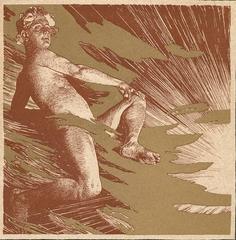
Adoration of the Magi / - The Rider of the Sun -

Adoration of the Magi / - The Rider of the Sun -

Located in Berlin, DE

Walter Helbig (1878 Falkenstein - 1968 Ascona), Adoration of the Magi, 1918. Hand-colored linocut, 30 cm x 22.5 cm (depiction), 50 cm x 35 cm (sheet size), signed “W.[alter] Helbig” in pencil lower right, inscribed “Adoration of the Magi” lower left and dated “1918”. Below this a handwritten dedication “with heartfelt Christmas greetings”. - Paper somewhat darkened and with slight creases, thumbtack holes in the corners - The Rider of the Sun - The 'apocalypse' of World War I brought about a return to sacred art. Walter Helbig belonged to the circle of the 'Brücke' and the 'Blauer Reiter'. With his reinterpretation of religious themes in an expressionist formal language, Helbig shaped an avant-garde neo-sacred art. This is symbolically expressed in the silhouette of the rider against the sun-like yellow background. It refers to the awakening initiated by the Blue Riding, which is now linked back to the sacred. The rider and horse "look" at Mary and the Christ Child, who occupy the entire field. Opposite them are the three kings, the eldest of whom kneels before Christ and offers him a gold-filled casket. The expressionist lines give rise to a tower that rises into the "sun", so that the gift has become a Gothic church, expressing the hope that the fallen world will be resurrected in the name of Christ. This dimension of meaning is emphasized by the magical effect of the color scheme. About the artist In 1895, Walter Helbig began studying at the Dresden Academy of Art, where he became friends with the future Brücke artist Otto Müller, with whom he lived in Dresden from 1903 to 1905. While studying in Italy from 1897 to 1899, he met Arnold Böcklin and Adolf von Hildebrand. After completing his studies, he first worked for Otto Gussmann, painting churches. From 1905 to 1909 he worked as a freelance painter in Hamburg. In 1909, through the mediation of Otto Müller, Helbig made the acquaintance of artists from the 'Brücke'. In 1910 he exhibited at the founding exhibition of the Berlin 'Neue Sezession'. In the same year, he moved to Switzerland, where, together with Hans Arp and Oscar Lüthy, he founded the 'Moderne Bund' in Weggis, to which Cuno Amiet and Giovanni Giacometti also belonged. At the second exhibition of the 'Moderne Bund' in Zurich in 1911, Henri Matisse and Robert Delaunay were represented alongside artists from the 'Blauer Reiter'. In 1913, Helbig traveled to Paris with Arp and Lüthy. After the dissolution of the 'Moderne Bund', Helbig was represented at the first Dada exhibition in Zurich in 1914. In 1919, he joined the Berlin 'Novembergruppe'. After the devastation of World War I, Helbig turned increasingly to religious themes in his work. In 1924, like many other artists of his time, he moved to Ascona for financial reasons, where he became a naturalized citizen in 1938. There he founded the artists' association "The Great Bear", to which Marianne von Werefkin...

Category

1910s Expressionist Max Pechstein More Art

Materials

Paper

E. Strache, Handzeichnungen folio, "Nursing Mother with Child" Collotype plate

E. Strache, Handzeichnungen folio, "Nursing Mother with Child" Collotype plate

By (after) Egon Schiele

Located in Palm Beach, FL

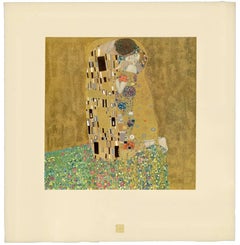
after Egon Schiele (1890 – 1918), AUSTRIA “ART CANNOT BE MODERN, ART IS PRIMORDIALLY ETERNAL.” -SCHIELE Defiantly iconoclastic in life and art, Egon Schiele is esteemed for his mas...

Category

1920s Vienna Secession Max Pechstein More Art
Materials

Paper

"Women Sleeping Face Down" by Gustav Klimt - Original Print from Courtesan Folio

"Women Sleeping Face Down" by Gustav Klimt - Original Print from Courtesan Folio

By Gustav Klimt

Located in Palm Beach, FL

Plate #12 from Gustav Klimt's 1907 "Dialogues of the Courtesans" portfolio, consisting of 15 collotypes on cream japon paper. The drawings in this folio are said to be studies for Klimt's well-known Water Serpents paintings...

Category

Early 1900s Vienna Secession Max Pechstein More Art
Materials

Paper

"Woman Leaning Forward" by Gustav Klimt - Original Print from Courtesans Folio

"Woman Leaning Forward" by Gustav Klimt - Original Print from Courtesans Folio

By Gustav Klimt

Located in Palm Beach, FL

Plate #3 from Gustav Klimt's 1907 "Dialogues of the Courtesans" portfolio, consisting of 15 collotypes on cream japon paper. The drawings in this folio are said to be studies for Klimt's well-known Water Serpents paintings...

Category

Early 1900s Vienna Secession Max Pechstein More Art
Materials

Paper

"Masturbating Woman on Couch" by Gustav Klimt - Original Print - Courtesan Folio

"Masturbating Woman on Couch" by Gustav Klimt - Original Print - Courtesan Folio

By Gustav Klimt

Located in Palm Beach, FL

Plate #5 from Gustav Klimt's 1907 "Dialogues of the Courtesans" portfolio, consisting of 15 collotypes on cream japon paper. The drawings in this folio are said to be studies for Kli...

Category

Early 1900s Vienna Secession Max Pechstein More Art
Materials

Paper

E. Strache, Handzeichnungen folio, "Crouching Female Nude" Collotype plate V

E. Strache, Handzeichnungen folio, "Crouching Female Nude" Collotype plate V

By (after) Egon Schiele

Located in Palm Beach, FL

Egon Schiele (1890 – 1918), AUSTRIA “ART CANNOT BE MODERN, ART IS PRIMORDIALLY ETERNAL.” -SCHIELE Defiantly iconoclastic in life and art, Egon Schiele is esteemed for his masterful...

Category

1920s Vienna Secession Max Pechstein More Art
Materials

Paper

Max Pechstein more art for sale on 1stDibs.

Find a wide variety of authentic Max Pechstein more art available for sale on 1stDibs. You can also browse by medium to find art by Max Pechstein in paper and more. Much of the original work by this artist or collective was created during the 1930s and is mostly associated with the Expressionist style. Not every interior allows for large Max Pechstein more art, so small editions measuring 6 inches across are available. Customers who are interested in this artist might also find the work of George Grosz, Oskar Kokoschka, and Diana Elena Chelaru. Max Pechstein more art prices can differ depending upon medium, time period and other attributes. On 1stDibs, the price for these items starts at $236 and tops out at $236, while the average work can sell for $236.