By Maxfield Parrish
Located in Fort Washington, PA
Medium: Oil on Paper Laid on Panel
Signature: Signed Lower Right
Initialed lower right: M.P.
Signed on the reverse: Maxfield Parish
Initialed and numbered by the artist's son on the reverse: M.P. Jr. / No. 68.
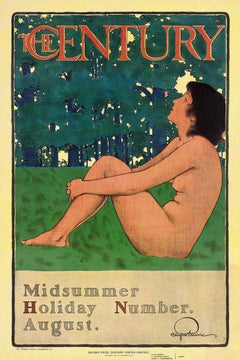
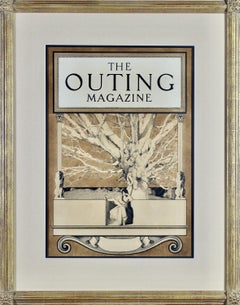
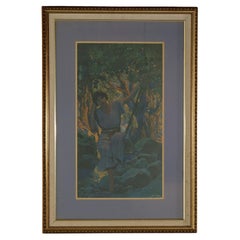
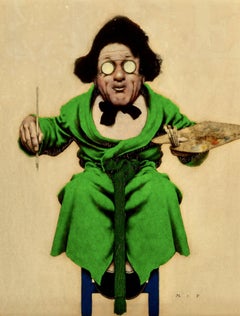
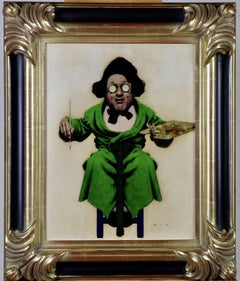
When Maxfield Parrish painted the comical A Dark Futurist in 1923 for Life magazine, he had already established himself as America's leading book and magazine illustrator. His early artwork for children's classics like L. Frank Baum's Mother Goose in Prose (1897), Kenneth Grahame's Dream Days (1900), and Eugene Field's Poems of Childhood (1904) popularized his signature atmospheric settings, cobalt blue-and-gold palette, and dreamy figures inhabiting magical worlds. Likewise, his covers for Century, Collier's, Harper's Bazaar, Ladies' Home Journal, Life, and Scribner's Magazine were highly desirous and instantly recognizable, often more stylized than his book imagery; no other journal illustrator could match Parrish's winning combination of precise draftsmanship, strong graphic design, and amusing characters.
According to David Apatoff, Art Critic, The Saturday Evening Post, "Parrish abandoned his customary heavy details and rainbow colors to present a bolder, more high-contrast design silhouetted against a stark white background - a treatment more suitable for a modern magazine cover vying for attention on a crowded newsstand.
A Dark Futurist is silhouetted against a white field with no background or details to prop it up. The composition is carefully centered with only differences in the hands and the artist's necktie to break the symmetry. These are crucial to the success of the design.
Just as important as Parrish's clean, high-contrast style in these pictures is the refreshing humor and sophistication in content, which is usually absent from Parrish's fairytale paintings.
A Dark Futurist shows us a different kind of modernism. Parrish steps out of his timeless fairy tales to tweak one of the most incendiary artistic movements of his day. Futurism, with its militant manifesto and its outspoken artists, was all the rage in Europe. Parrish pokes them, showing a "dark" and anxious futurist with pursed lips and thick glasses, poised to paint but not exactly sure of, or optimistic about, what the 'future' will hold. This suggests that Parrish was alert to, and had opinions about, current events of the day - something one might never guess from his usual subject matter."
In his early Collier's illustrations, Parrish also developed memorable themes that he would return to in his 1920s magazine work. One of his most popular characters was the "seer," or man with keen visual powers, most often depicted as an artist, but also appearing as a tourist, scientist, and philosopher. Parrish's seer was recognizable by particular physical attributes: round glasses, indicating his visual and analytical acuity, and an overcoat and/or hat signifying his role as observer of the outside world.
A Man of Letters, sold last year at Heritage Auctions, was one of the first Life covers Parrish rolled out for Gibson, and he repeated the character of the artist-seer, emphasizing the comic spin, for two later editions: A Dark Futurist (Life, March 1, 1923) captures a Parrish-like artist in foggy round glasses and a long green coat...
Category
1920s Maxfield Parrish Art
MaterialsPaper, Oil, Panel