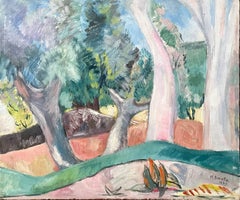
Michael Baxte Paintings

Russian, 1890-1972

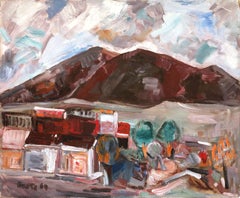
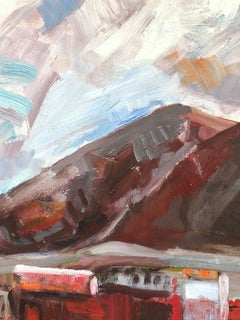
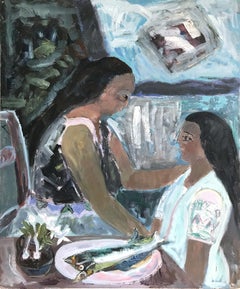
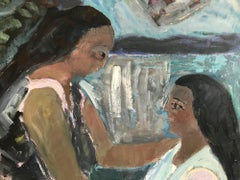
Michael Baxte was an American painter. His work was part of the painting event in the art competition at the 1936 Summer Olympics. During the 1930s Baxte and his wife, Violet, lived in France and spent most of their time in Paris, where Baxte became part of the School of Paris and exhibited his artwork in government-sponsored exhibitions, including the Salon d'Automne, helping as well to organize an exhibition of American painters. When World War II began, and Paris became unsafe, Baxte and his wife relocated to Mexico, where they continued to live and work. Baxte died in 1972 in Mexico.

to
1
7
8
Overall Width
to
Overall Height
to
16
1
10
1
16
11
5
9
7
6
2
2
1
1
1
1
1
1
1
16
16
14
14
1
16
759
757
731
671
1
4
16
Artist: Michael Baxte
"Mexican Landscape Water Scene with Figures and Boat" Expressionistic Style

"Mexican Landscape Water Scene with Figures and Boat" Expressionistic Style

By Michael Baxte

Located in New York, NY

A strong modernist oil painting depicted in the Mid Century by Russian painter Michael Baxte. Mostly known for his abstracted figures on canvas or street scenes, this piece is a wond...

Category

Mid-20th Century Expressionist Michael Baxte Paintings

Materials

Oil, Masonite
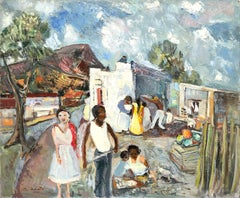
"Mexican Outdoor Scene with Figures" Expressionistic Style Oil Painting on Board

"Mexican Outdoor Scene with Figures" Expressionistic Style Oil Painting on Board

By Michael Baxte

Located in New York, NY

A strong modernist oil painting depicted in the Mid Century by Russian painter Michael Baxte. Mostly known for his abstracted figures on canvas or street scenes, this piece is a wond...

Category

1960s Expressionist Michael Baxte Paintings

Materials

Oil, Masonite
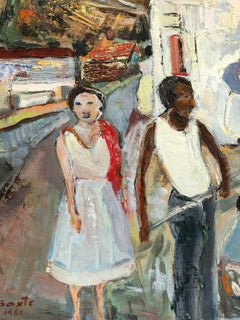
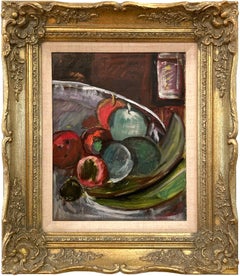
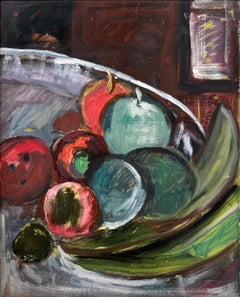
"Still Life with Apples" Fruit Modern Mid Century Oil Painting on Board Painting

"Still Life with Apples" Fruit Modern Mid Century Oil Painting on Board Painting

By Michael Baxte

Located in New York, NY

A strong modernist oil painting depicted in the mid Century by Russian painter Michael Baxte. Mostly known for his abstracted figures on canvas or street scenes, this piece is a wonderful representation of his bold still life paintings, with expressive use of color, shape, and form. Later in his career, Baxte explores Expressionism, infusing both European and North American stylistic trends. This piece is from later in his career, but we can feel this underlying style throughout. Art measures 15 x 11 inches Frame measures 22 x 19 inches Michael Posner Baxte was born in 1890 in the small town of Staroselje Belarus, Russia. For the first half of the 19th century, it was a center of the Chabad movement of Hasidic Jews, but this group was gone by the middle of the 19th century. By the time the Baxte family immigrated to the United States at the beginning of the 20th century, the Jewish population numbered only on the hundreds. The native language of the Baxte family was Yiddish. It is likely that the death of Michael Baxte’s father triggered the family’s immigration. Three older brothers arrived in New York between 1903 and 1905. Michael and his mother, Rebecca, arrived in 1907. By 1910 Michael, his mother, and brother, Joseph, were living in New Orleans and may have spent some time on a Louisiana plantation. Around 1912, Michael Baxte returned to Europe to study the violin. In 1914 he, his mother, and Joseph moved to New York City. Meanwhile, in Algeria, a talented young woman painter, Violette Mege...

Category

1960s Expressionist Michael Baxte Paintings

Materials

Oil, Board

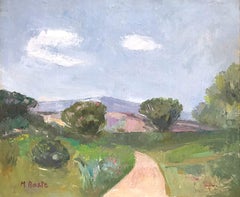
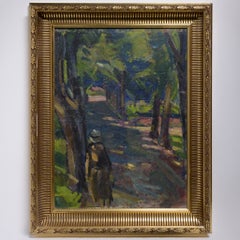
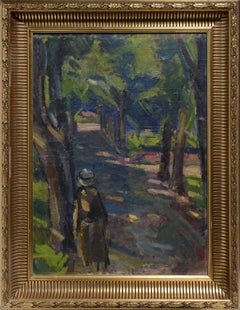
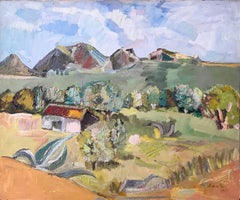
"Countryside Landscape Hills Scene with Path" Expressionistic Style Oil Painting

"Countryside Landscape Hills Scene with Path" Expressionistic Style Oil Painting

By Michael Baxte

Located in New York, NY

A strong modernist oil painting depicted in the Mid Century by Russian painter Michael Baxte. Mostly known for his abstracted figures on canvas or street scenes, this piece is a wonderful representation of his landscapes with expressive use of color, shape, and form. Later in his career, Baxte explores Expressionism, infusing both European and North American stylistic trends. Art measures 15 x 18 inches Michael Posner Baxte was born in 1890 in the small town of Staroselje Belarus, Russia. For the first half of the 19th century, it was a center of the Chabad movement of Hasidic Jews, but this group was gone by the middle of the 19th century. By the time the Baxte family immigrated to the United States at the beginning of the 20th century, the Jewish population numbered only on the hundreds. The native language of the Baxte family was Yiddish. It is likely that the death of Michael Baxte’s father triggered the family’s immigration. Three older brothers arrived in New York between 1903 and 1905. Michael and his mother, Rebecca, arrived in 1907. By 1910 Michael, his mother, and brother, Joseph, were living in New Orleans and may have spent some time on a Louisiana plantation. Around 1912, Michael Baxte returned to Europe to study the violin. In 1914 he, his mother, and Joseph moved to New York City. Meanwhile, in Algeria, a talented young woman painter, Violette Mege, was making history. For the first time, a woman won the prestigious Beaux Art competition in Algeria. At first, the awards committee denied her the prize but, with French government intervention, Mege eventually prevailed. She won again 3 years later and, in 1916, used the scholarship to visit the United States of America. When Violette came to New York, she met Baxte, who was, by then, an accomplished violinist, teacher, and composer. Baxte’s compositions were performed at the Tokyo Imperial Theater, and in 1922 he was listed in the American Jewish Yearbook as one of the prominent members of the American Jewish community. As a music teacher, he encouraged individual expression. Baxte stated, “No pupil should ever be forced into the imitation of the teacher. Art is a personal experience, and the teacher’s truest aim must be to awaken this light of personality through the patient's light of science.” By 1920 Michael Baxte and Violette Mege were living together in Manhattan. Although they claimed to be living as husband and wife, it seems that their marriage did not become official until 1928. On their “unofficial” honeymoon around 1917, in Algiers, Baxte confided to her his ambition to paint. There and later in New Mexico where the wonderful steeped sunlight approximates the coloring of Algiers, she taught him his heart’s desire. He never had any other teacher. She never had any other pupil. For ten years she devoted all her time, energy, and ambition to teaching, encouraging, inspiring him. Then in 1928, their mutual strivings were rewarded, as his works were being chosen as one of the two winners in the Dudensing National Competition for American Painters. Out of 150 artists from across the country participated in the Dudensing, and Michael Posner Baxte and, Robert Fawcett...

Category

Mid-20th Century Expressionist Michael Baxte Paintings

Materials

Oil, Masonite
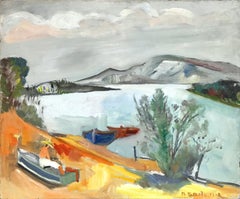
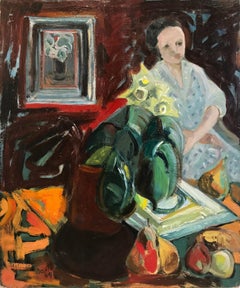
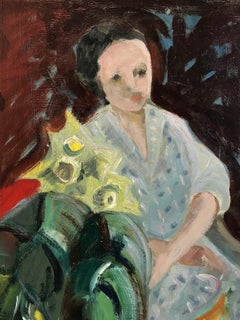
"Interior Scene with Figure" Expressionistic Style Oil Painting on Masonite

"Interior Scene with Figure" Expressionistic Style Oil Painting on Masonite

By Michael Baxte

Located in New York, NY

A strong modernist oil painting depicted in 1969 by Russian painter Michael Baxte. Mostly known for his abstracted figures on canvas or street scenes, this piece is a wonderful representation of his bold still life paintings, with expressive use of color, shape, and form. Later in his career, Baxte explores Expressionism, infusing both European and North American stylistic trends. This piece is from later in his career, but we can feel this underlying style throughout. Art measures 21.75 x 18 inches Michael Posner Baxte was born in 1890 in the small town of Staroselje Belarus, Russia. For the first half of the 19th century it was a center of the Chabad movement of Hasidic Jews, but this group was gone by the middle of the 19th century. By the time the Baxte family immigrated to the United States at the beginning of the 20th century, the Jewish population numbered only on the hundreds. The native language of the Baxte family was Yiddish. It is likely that the death of Michael Baxte’s father triggered the family’s immigration. Three older brothers arrived in New York between 1903 and 1905. Michael and his mother, Rebecca, arrived in 1907. By 1910 Michael, his mother, and brother, Joseph, were living in New Orleans and may have spent some time on a Louisiana plantation. Around 1912, Michael Baxte returned to Europe to study the violin. In 1914 he, his mother, and Joseph moved to New York City. Meanwhile, in Algeria, a talented young woman painter, Violette Mege, was making history. Since for the first time, a woman won the prestigious Beaux Art competition in Algeria. At first, the awards committee denied her the prize but, with French government intervention, Mege eventually prevailed. She won again 3 years later and, in 1916, used the scholarship to visit the United States of America. When Violette came to New York, she met Baxte, who was, by then, an accomplished violinist, teacher, and composer. Baxte’s compositions were performed at the Tokyo Imperial Theater, and in 1922 he was listed in the American Jewish Yearbook as one of the prominent members of the American Jewish community. As a music teacher he encouraged individual expression. Baxte stated, “No pupil should ever be forced into imitation of the teacher. Art is a personal experience, and the teacher’s truest aim must be to awaken this light of personality through the patient light of science.” By 1920 Michael Baxte and Violette Mege were living together in Manhattan. Although they claimed to be living as husband and wife, it seems that their marriage did not become official until 1928. On their “unofficial” honeymoon around 1917, in Algiers, Baxte confided to her his ambition to paint. There and later in New Mexico where the wonderful steeped sunlight approximates the coloring of Algiers, she taught him his heart’s desire. He never had any other teacher. She never had any other pupil. For ten years she devoted all her time, energy, and ambition to teaching, encouraging, inspiring him. Then in 1928, their mutual strivings were rewarded, as his works were being chosen as one of the two winners in the Dudensing National Competition for American Painters. Out of 150 artists from across the country participated in the Dudensing, and Michael Posner Baxte and, Robert Fawcett...

Category

1960s Expressionist Michael Baxte Paintings

Materials

Oil, Masonite
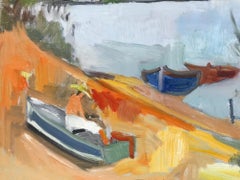
"Mexican Countryside Landscape Scene with Trees on Hills" Expressionistic Style

"Mexican Countryside Landscape Scene with Trees on Hills" Expressionistic Style

By Michael Baxte

Located in New York, NY

A strong modernist oil painting depicted in 1963 by Russian painter Michael Baxte. Mostly known for his abstracted figures on canvas or street scenes, this piece is a wonderful repre...

Category

1960s Expressionist Michael Baxte Paintings

Materials

Oil, Masonite
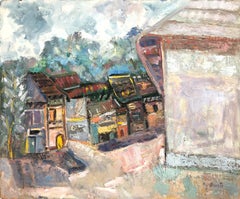
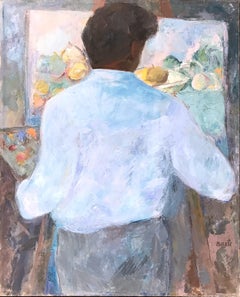
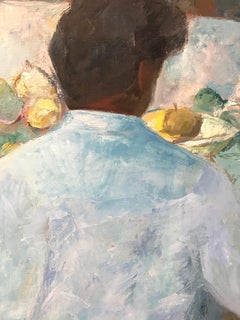
"Artist Painting Still Life" Expressionistic Style Oil Painting on Canvas

"Artist Painting Still Life" Expressionistic Style Oil Painting on Canvas

By Michael Baxte

Located in New York, NY

A strong modernist oil painting depicted in the Mid Centruy by Russian painter Michael Baxte. Mostly known for his abstracted figures on canvas or street scenes, this piece is a wonderful representation of his interior scenes with expressive use of color, shape, and form. Later in his career, Baxte explores Expressionism, infusing both European and North American stylistic trends. This painting measures 32 x 25.5 inches Michael Posner Baxte was born in 1890 in the small town of Staroselje Belarus, Russia. For the first half of the 19th century, it was a center of the Chabad movement of Hasidic Jews, but this group was gone by the middle of the 19th century. By the time the Baxte family immigrated to the United States at the beginning of the 20th century, the Jewish population numbered only on the hundreds. The native language of the Baxte family was Yiddish. It is likely that the death of Michael Baxte’s father triggered the family’s immigration. Three older brothers arrived in New York between 1903 and 1905. Michael and his mother, Rebecca, arrived in 1907. By 1910 Michael, his mother, and brother, Joseph, were living in New Orleans and may have spent some time on a Louisiana plantation...

Category

Mid-20th Century Expressionist Michael Baxte Paintings

Materials

Oil, Canvas

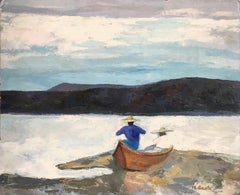
"Landscape Scene of Fisherman by Lake" Expressionistic Oil Painting on Masonite

"Landscape Scene of Fisherman by Lake" Expressionistic Oil Painting on Masonite

By Michael Baxte

Located in New York, NY

A strong modernist oil painting depicted in 1963 by Russian painter Michael Baxte. Mostly known for his abstracted figures on canvas or street scenes, this piece is a wonderful representation of his figures in water landscapes with expressive use of color, shape, and form. Later in his career, Baxte explores Expressionism, infusing both European and North American stylistic trends. This piece is from later in his career, but we can feel this underlying style throughout. Art measures 18 x 21.75 inches Michael Posner Baxte was born in 1890 in the small town of Staroselje Belarus, Russia. For the first half of the 19th century it was a center of the Chabad movement of Hasidic Jews, but this group was gone by the middle of the 19th century. By the time the Baxte family immigrated to the United States at the beginning of the 20th century, the Jewish population numbered only on the hundreds. The native language of the Baxte family was Yiddish. It is likely that the death of Michael Baxte’s father triggered the family’s immigration. Three older brothers arrived in New York between 1903 and 1905. Michael and his mother, Rebecca, arrived in 1907. By 1910 Michael, his mother, and brother, Joseph, were living in New Orleans and may have spent some time on a Louisiana plantation. Around 1912, Michael Baxte returned to Europe to study the violin. In 1914 he, his mother, and Joseph moved to New York City. Meanwhile, in Algeria, a talented young woman painter, Violette Mege, was making history. Since for the first time, a woman won the prestigious Beaux Art competition in Algeria. At first, the awards committee denied her the prize but, with French government intervention, Mege eventually prevailed. She won again 3 years later and, in 1916, used the scholarship to visit the United States of America. When Violette came to New York, she met Baxte, who was, by then, an accomplished violinist, teacher, and composer. Baxte’s compositions were performed at the Tokyo Imperial Theater, and in 1922 he was listed in the American Jewish Yearbook as one of the prominent members of the American Jewish community. As a music teacher he encouraged individual expression. Baxte stated, “No pupil should ever be forced into imitation of the teacher. Art is a personal experience, and the teacher’s truest aim must be to awaken this light of personality through the patient light of science.” By 1920 Michael Baxte and Violette Mege were living together in Manhattan. Although they claimed to be living as husband and wife, it seems that their marriage did not become official until 1928. On their “unofficial” honeymoon around 1917, in Algiers, Baxte confided to her his ambition to paint. There and later in New Mexico where the wonderful steeped sunlight approximates the coloring of Algiers, she taught him his heart’s desire. He never had any other teacher. She never had any other pupil. For ten years she devoted all her time, energy, and ambition to teaching, encouraging, inspiring him. Then in 1928, their mutual strivings were rewarded, as his works were being chosen as one of the two winners in the Dudensing National Competition for American Painters. Out of 150 artists from across the country participated in the Dudensing, and Michael Posner Baxte and, Robert Fawcett, were the winners. In his 1924 naturalization application, he indicated that he was sometimes known as “Michael Posner Baxte.” One of the witnesses to his application was Bernard Karfiol, a Jewish American artist. That’s when Michael may...

Category

1960s Expressionist Michael Baxte Paintings

Materials

Oil, Masonite
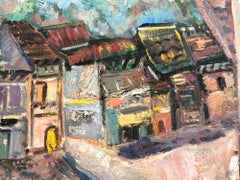
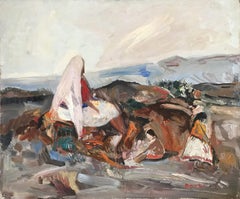
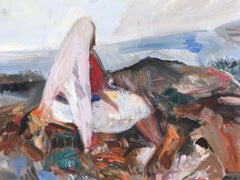
"Mexican Landscape Scene of Mother with Children" Expressionistic Style Painting

"Mexican Landscape Scene of Mother with Children" Expressionistic Style Painting

By Michael Baxte

Located in New York, NY

A strong modernist oil painting depicted in 1962 by Russian painter Michael Baxte. Mostly known for his abstracted figures on canvas or street scenes, this piece is a wonderful representation of his portraits in countryside landscapes with expressive use of color, shape, and form. Later in his career, Baxte explores Expressionism, infusing both European and North American stylistic trends. Art measures 21.25 x 25.5 inches Michael Posner Baxte was born in 1890 in the small town of Staroselje Belarus, Russia. For the first half of the 19th century, it was a center of the Chabad movement of Hasidic Jews, but this group was gone by the middle of the 19th century. By the time the Baxte family immigrated to the United States at the beginning of the 20th century, the Jewish population numbered only on the hundreds. The native language of the Baxte family was Yiddish. It is likely that the death of Michael Baxte’s father triggered the family’s immigration. Three older brothers arrived in New York between 1903 and 1905. Michael and his mother, Rebecca, arrived in 1907. By 1910 Michael, his mother, and brother, Joseph, were living in New Orleans and may have spent some time on a Louisiana plantation. Around 1912, Michael Baxte returned to Europe to study the violin. In 1914 he, his mother, and Joseph moved to New York City. Meanwhile, in Algeria, a talented young woman painter, Violette Mege, was making history. For the first time, a woman won the prestigious Beaux Art competition in Algeria. At first, the awards committee denied her the prize but, with French government intervention, Mege eventually prevailed. She won again 3 years later and, in 1916, used the scholarship to visit the United States of America. When Violette came to New York, she met Baxte, who was, by then, an accomplished violinist, teacher, and composer. Baxte’s compositions were performed at the Tokyo Imperial Theater, and in 1922 he was listed in the American Jewish Yearbook as one of the prominent members of the American Jewish community. As a music teacher, he encouraged individual expression. Baxte stated, “No pupil should ever be forced into the imitation of the teacher. Art is a personal experience, and the teacher’s truest aim must be to awaken this light of personality through the patient's light of science.” By 1920 Michael Baxte and Violette Mege were living together in Manhattan. Although they claimed to be living as husband and wife, it seems that their marriage did not become official until 1928. On their “unofficial” honeymoon around 1917, in Algiers, Baxte confided to her his ambition to paint. There and later in New Mexico where the wonderful steeped sunlight approximates the coloring of Algiers, she taught him his heart’s desire. He never had any other teacher. She never had any other pupil. For ten years she devoted all her time, energy, and ambition to teaching, encouraging, inspiring him. Then in 1928, their mutual strivings were rewarded, as his works were being chosen as one of the two winners in the Dudensing National Competition for American Painters. Out of 150 artists from across the country participated in the Dudensing, and Michael Posner Baxte and, Robert Fawcett...

Category

1960s Expressionist Michael Baxte Paintings

Materials

Oil, Masonite
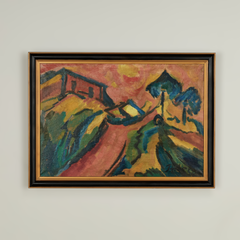
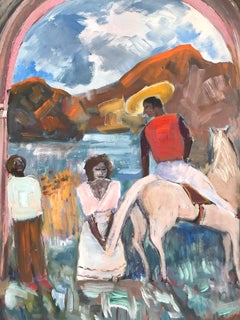
"Mexican Villagers Scene with Man on a Horse" Expressionistic Style Oil Painting

"Mexican Villagers Scene with Man on a Horse" Expressionistic Style Oil Painting

By Michael Baxte

Located in New York, NY

A strong modernist oil painting depicted in the Mid Century by Russian painter Michael Baxte. Mostly known for his abstracted figures on canvas or street scenes, this piece is a wonderful representation of his portraits in village landscapes with expressive use of color, shape, and form. Later in his career, Baxte explores Expressionism, infusing both European and North American stylistic trends. Art measures 25.5 x 21.25 inches Michael Posner Baxte was born in 1890 in the small town of Staroselje Belarus, Russia. For the first half of the 19th century, it was a center of the Chabad movement of Hasidic Jews, but this group was gone by the middle of the 19th century. By the time the Baxte family immigrated to the United States at the beginning of the 20th century, the Jewish population numbered only on the hundreds. The native language of the Baxte family was Yiddish. It is likely that the death of Michael Baxte’s father triggered the family’s immigration. Three older brothers arrived in New York between 1903 and 1905. Michael and his mother, Rebecca, arrived in 1907. By 1910 Michael, his mother, and brother, Joseph, were living in New Orleans and may have spent some time on a Louisiana plantation. Around 1912, Michael Baxte returned to Europe to study the violin. In 1914 he, his mother, and Joseph moved to New York City. Meanwhile, in Algeria, a talented young woman painter, Violette Mege, was making history. For the first time, a woman won the prestigious Beaux Art competition in Algeria. At first, the awards committee denied her the prize but, with French government intervention, Mege eventually prevailed. She won again 3 years later and, in 1916, used the scholarship to visit the United States of America. When Violette came to New York, she met Baxte, who was, by then, an accomplished violinist, teacher, and composer. Baxte’s compositions were performed at the Tokyo Imperial Theater, and in 1922 he was listed in the American Jewish Yearbook as one of the prominent members of the American Jewish community. As a music teacher, he encouraged individual expression. Baxte stated, “No pupil should ever be forced into the imitation of the teacher. Art is a personal experience, and the teacher’s truest aim must be to awaken this light of personality through the patient's light of science.” By 1920 Michael Baxte and Violette Mege were living together in Manhattan. Although they claimed to be living as husband and wife, it seems that their marriage did not become official until 1928. On their “unofficial” honeymoon around 1917, in Algiers, Baxte confided to her his ambition to paint. There and later in New Mexico where the wonderful steeped sunlight approximates the coloring of Algiers, she taught him his heart’s desire. He never had any other teacher. She never had any other pupil. For ten years she devoted all her time, energy, and ambition to teaching, encouraging, inspiring him. Then in 1928, their mutual strivings were rewarded, as his works were being chosen as one of the two winners in the Dudensing National Competition for American Painters. Out of 150 artists from across the country participated in the Dudensing, and Michael Posner Baxte and, Robert Fawcett...

Category

Mid-20th Century Expressionist Michael Baxte Paintings

Materials

Oil, Masonite
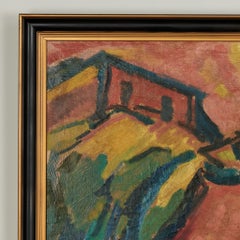
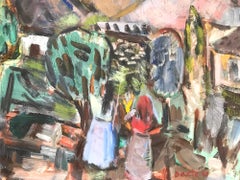
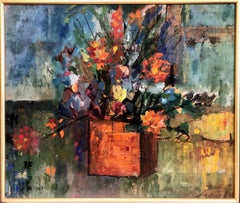
"Colorful Mexican Village Scene" Expressionistic Oil Painting on Masonite
"Colorful Mexican Village Scene" Expressionistic Oil Painting on Masonite
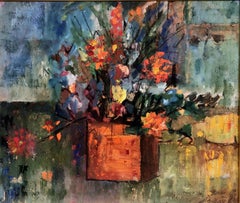
By Michael Baxte

Located in New York, NY

A strong modernist oil painting depicted Circa 1960 by Russian painter Michael Baxte. Mostly known for his abstracted figures on canvas or street scenes, this piece is a wonderful representation of his bold still life paintings, with expressive use of color, shape, and form. Later in his career, Baxte explores Expressionism, infusing both European and North American stylistic trends. This piece is from later in his career, but we can feel this underlying style throughout. Art measures 18 x 21.75 inches Michael Posner Baxte was born in 1890 in the small town of Staroselje Belarus, Russia. For the first half of the 19th century it was a center of the Chabad movement of Hasidic Jews, but this group was gone by the middle of the 19th century. By the time the Baxte family immigrated to the United States at the beginning of the 20th century, the Jewish population numbered only on the hundreds. The native language of the Baxte family was Yiddish. It is likely that the death of Michael Baxte’s father triggered the family’s immigration. Three older brothers arrived in New York between 1903 and 1905. Michael and his mother, Rebecca, arrived in 1907. By 1910 Michael, his mother, and brother, Joseph, were living in New Orleans and may have spent some time on a Louisiana plantation. Around 1912, Michael Baxte returned to Europe to study the violin. In 1914 he, his mother, and Joseph moved to New York City. Meanwhile, in Algeria, a talented young woman painter, Violette Mege, was making history. Since for the first time, a woman won the prestigious Beaux Art competition in Algeria. At first, the awards committee denied her the prize but, with French government intervention, Mege eventually prevailed. She won again 3 years later and, in 1916, used the scholarship to visit the United States of America. When Violette came to New York, she met Baxte, who was, by then, an accomplished violinist, teacher, and composer. Baxte’s compositions were performed at the Tokyo Imperial Theater, and in 1922 he was listed in the American Jewish Yearbook as one of the prominent members of the American Jewish community. As a music teacher he encouraged individual expression. Baxte stated, “No pupil should ever be forced into imitation of the teacher. Art is a personal experience, and the teacher’s truest aim must be to awaken this light of personality through the patient light of science.” By 1920 Michael Baxte and Violette Mege were living together in Manhattan. Although they claimed to be living as husband and wife, it seems that their marriage did not become official until 1928. On their “unofficial” honeymoon around 1917, in Algiers, Baxte confided to her his ambition to paint. There and later in New Mexico where the wonderful steeped sunlight approximates the coloring of Algiers, she taught him his heart’s desire. He never had any other teacher. She never had any other pupil. For ten years she devoted all her time, energy, and ambition to teaching, encouraging, inspiring him. Then in 1928, their mutual strivings were rewarded, as his works were being chosen as one of the two winners in the Dudensing National Competition for American Painters. Out of 150 artists from across the country participated in the Dudensing, and Michael Posner Baxte and, Robert Fawcett, were the winners. In his 1924 naturalization application, he indicated that he was sometimes known as “Michael Posner Baxte.” One of the witnesses to his application was Bernard Karfiol, a Jewish American artist. That’s when Michael may...

Category

1960s Expressionist Michael Baxte Paintings

Materials

Oil, Masonite
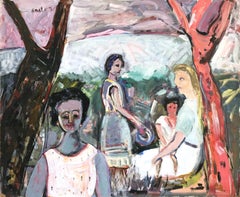
"Mexican Landscape Scene with Female Figures and Child" Expressionistic Style

"Mexican Landscape Scene with Female Figures and Child" Expressionistic Style

By Michael Baxte

Located in New York, NY

A strong modernist oil painting depicted in the Mid Century by Russian painter Michael Baxte. Mostly known for his abstracted figures on canvas or street scenes, this piece is a wond...

Category

1970s Expressionist Michael Baxte Paintings

Materials

Oil, Masonite
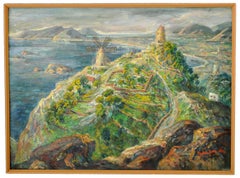
"Landscape Scene of Mexican Villagers" Expressionistic Oil Painting on Masonite
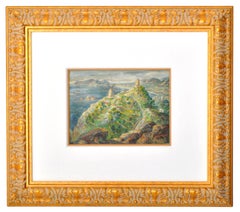
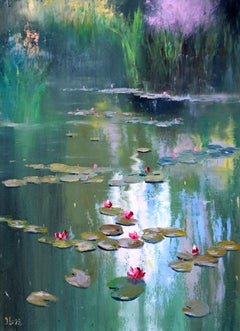
"Landscape Scene of Mexican Villagers" Expressionistic Oil Painting on Masonite

By Michael Baxte

Located in New York, NY

A strong modernist oil painting depicted in 1971 by Russian painter Michael Baxte. Mostly known for his abstracted figures on canvas or street scenes, this piece is a wonderful representation of his landscape paintings, with expressive use of color, shape, and form. Later in his career, Baxte explores Expressionism, infusing both European and North American stylistic trends. This piece is from later in his career, but we can feel this underlying style throughout. Art measures 18 x 21.75 inches Michael Posner Baxte was born in 1890 in the small town of Staroselje Belarus, Russia. For the first half of the 19th century it was a center of the Chabad movement of Hasidic Jews, but this group was gone by the middle of the 19th century. By the time the Baxte family immigrated to the United States at the beginning of the 20th century, the Jewish population numbered only on the hundreds. The native language of the Baxte family was Yiddish. It is likely that the death of Michael Baxte’s father triggered the family’s immigration. Three older brothers arrived in New York between 1903 and 1905. Michael and his mother, Rebecca, arrived in 1907. By 1910 Michael, his mother, and brother, Joseph, were living in New Orleans and may have spent some time on a Louisiana plantation. Around 1912, Michael Baxte returned to Europe to study the violin. In 1914 he, his mother, and Joseph moved to New York City. Meanwhile, in Algeria, a talented young woman painter, Violette Mege, was making history. Since for the first time, a woman won the prestigious Beaux Art competition in Algeria. At first, the awards committee denied her the prize but, with French government intervention, Mege eventually prevailed. She won again 3 years later and, in 1916, used the scholarship to visit the United States of America. When Violette came to New York, she met Baxte, who was, by then, an accomplished violinist, teacher, and composer. Baxte’s compositions were performed at the Tokyo Imperial Theater, and in 1922 he was listed in the American Jewish Yearbook as one of the prominent members of the American Jewish community. As a music teacher he encouraged individual expression. Baxte stated, “No pupil should ever be forced into imitation of the teacher. Art is a personal experience, and the teacher’s truest aim must be to awaken this light of personality through the patient light of science.” By 1920 Michael Baxte and Violette Mege were living together in Manhattan. Although they claimed to be living as husband and wife, it seems that their marriage did not become official until 1928. On their “unofficial” honeymoon around 1917, in Algiers, Baxte confided to her his ambition to paint. There and later in New Mexico where the wonderful steeped sunlight approximates the coloring of Algiers, she taught him his heart’s desire. He never had any other teacher. She never had any other pupil. For ten years she devoted all her time, energy, and ambition to teaching, encouraging, inspiring him. Then in 1928, their mutual strivings were rewarded, as his works were being chosen as one of the two winners in the Dudensing National Competition for American Painters. Out of 150 artists from across the country participated in the Dudensing, and Michael Posner Baxte and, Robert Fawcett, were the winners. In his 1924 naturalization application, he indicated that he was sometimes known as “Michael Posner Baxte.” One of the witnesses to his application was Bernard Karfiol, a Jewish American artist. That’s when Michael may...

Category

1960s Expressionist Michael Baxte Paintings

Materials

Oil, Masonite

"Mexican Countryside Landscape Mountain Scene with Trees" Expressionistic Style

"Mexican Countryside Landscape Mountain Scene with Trees" Expressionistic Style

By Michael Baxte

Located in New York, NY

A strong modernist oil painting depicted in 1962 by Russian painter Michael Baxte. Mostly known for his abstracted figures on canvas or street scenes, this piece is a wonderful repre...

Category

1960s Expressionist Michael Baxte Paintings

Materials

Oil, Masonite

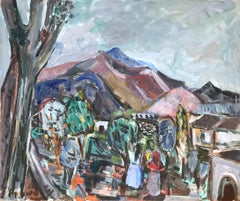
"Landscape of a Village Near Mountains" Expressionistic Oil Painting on Masonite

"Landscape of a Village Near Mountains" Expressionistic Oil Painting on Masonite

By Michael Baxte

Located in New York, NY

A strong modernist oil painting depicted in 1969 by Russian painter Michael Baxte. Mostly known for his abstracted figures on canvas or street scenes, this piece is a wonderful representation of his bold still life paintings, with expressive use of color, shape, and form. Later in his career, Baxte explores Expressionism, infusing both European and North American stylistic trends. This piece is from later in his career, but we can feel this underlying style throughout. Art measures 18 x 21.75 inches Michael Posner Baxte was born in 1890 in the small town of Staroselje Belarus, Russia. For the first half of the 19th century it was a center of the Chabad movement of Hasidic Jews, but this group was gone by the middle of the 19th century. By the time the Baxte family immigrated to the United States at the beginning of the 20th century, the Jewish population numbered only on the hundreds. The native language of the Baxte family was Yiddish. It is likely that the death of Michael Baxte’s father triggered the family’s immigration. Three older brothers arrived in New York between 1903 and 1905. Michael and his mother, Rebecca, arrived in 1907. By 1910 Michael, his mother, and brother, Joseph, were living in New Orleans and may have spent some time on a Louisiana plantation. Around 1912, Michael Baxte returned to Europe to study the violin. In 1914 he, his mother, and Joseph moved to New York City. Meanwhile, in Algeria, a talented young woman painter, Violette Mege, was making history. Since for the first time, a woman won the prestigious Beaux Art competition in Algeria. At first, the awards committee denied her the prize but, with French government intervention, Mege eventually prevailed. She won again 3 years later and, in 1916, used the scholarship to visit the United States of America. When Violette came to New York, she met Baxte, who was, by then, an accomplished violinist, teacher, and composer. Baxte’s compositions were performed at the Tokyo Imperial Theater, and in 1922 he was listed in the American Jewish Yearbook as one of the prominent members of the American Jewish community. As a music teacher he encouraged individual expression. Baxte stated, “No pupil should ever be forced into imitation of the teacher. Art is a personal experience, and the teacher’s truest aim must be to awaken this light of personality through the patient light of science.” By 1920 Michael Baxte and Violette Mege were living together in Manhattan. Although they claimed to be living as husband and wife, it seems that their marriage did not become official until 1928. On their “unofficial” honeymoon around 1917, in Algiers, Baxte confided to her his ambition to paint. There and later in New Mexico where the wonderful steeped sunlight approximates the coloring of Algiers, she taught him his heart’s desire. He never had any other teacher. She never had any other pupil. For ten years she devoted all her time, energy, and ambition to teaching, encouraging, inspiring him. Then in 1928, their mutual strivings were rewarded, as his works were being chosen as one of the two winners in the Dudensing National Competition for American Painters. Out of 150 artists from across the country participated in the Dudensing, and Michael Posner Baxte and, Robert Fawcett, were the winners. In his 1924 naturalization application, he indicated that he was sometimes known as “Michael Posner Baxte.” One of the witnesses to his application was Bernard Karfiol, a Jewish American artist. That’s when Michael may...

Category

1960s Expressionist Michael Baxte Paintings

Materials

Oil, Masonite

Related Items
Emile Albert Gruppe Bass Rocks 36x30

Emile Albert Gruppe Bass Rocks 36x30

By Emile Albert Gruppe

Located in Dallas, TX

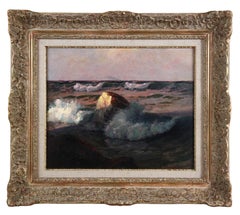
Emile Albert Gruppe (American, 1896-1978) Bass Rock, 1967 Oil on canvas 30 x 36 inches (76.2 x 91.4 cm) Signed lower right: Emile A. Gruppe Signed, dated, and titled on the stretcher...

Category

1960s Expressionist Michael Baxte Paintings

Materials

Canvas, Oil

Shadow marshes. Richard K Blades. Painting of sea at sunset. Turner influence.

Shadow marshes. Richard K Blades. Painting of sea at sunset. Turner influence.

Located in Coltishall, GB

A warm sunset over Norfolk's Cromer beach. Between Thoughts is a sublime oil painting that captures the mesmerizing tranquility of a sunset over thw North Sea. The horizon is ablaze...

Category

21st Century and Contemporary Expressionist Michael Baxte Paintings

Materials

Oil, Board

Two Under the Rain Original impasto Miniature oil painting for living room

Two Under the Rain Original impasto Miniature oil painting for living room

Located in Zofingen, AG

"Two Under the Rain" captures a profound connection amidst solitude. This original oil painting features two figures sharing an intimate moment under the rain. The artist's expressio...

Category

2010s Expressionist Michael Baxte Paintings

Materials

Oil, Canvas, Cardboard

Between Thoughts. Richard K Blades. Painting of sea at sunset. Turner influence.

Between Thoughts. Richard K Blades. Painting of sea at sunset. Turner influence.

Located in Coltishall, GB

A warm sunset over Norfolk's Cromer beach. Between Thoughts is a sublime oil painting that captures the mesmerizing tranquility of a sunset over thw North Sea. The horizon is ablaze...

Category

21st Century and Contemporary Expressionist Michael Baxte Paintings

Materials

Oil, Board

A Girl Running Through Puddles Original impasto Miniature oil painting

A Girl Running Through Puddles Original impasto Miniature oil painting

Located in Zofingen, AG

This original oil painting captures a girl running through puddles under a vibrant red umbrella. The artist's passion comes alive through bold strokes that create a beautiful contras...

Category

2010s Expressionist Michael Baxte Paintings

Materials

Canvas, Oil, Cardboard

Oil painting on board "Rough sea with steamer on the horizon" by S.A.Vinogradoff

Oil painting on board "Rough sea with steamer on the horizon" by S.A.Vinogradoff

Located in Gavere, BE

Sergey VINOGRADOV ( 1869 - 1938 ) Rough sea with steamer on the horizon Sergei Arsenievich Vinogradov ( Russian: 1869–1938 ) was a Russian-Soviet Impressionist painter; known for l...

Category

1920s Expressionist Michael Baxte Paintings

Materials

Gold Leaf

Last by Richard K Blades. Moody seascape with setting sun. Turner influence

Last by Richard K Blades. Moody seascape with setting sun. Turner influence

Located in Coltishall, GB

Sunset over the sea after a storm rolls by... portrays a mesmerizing seascape at dusk, where the horizon blurs in a harmonious blend of colors. Blades skillfully manipulates light a...

Category

21st Century and Contemporary Expressionist Michael Baxte Paintings

Materials

Oil, Board

Paul Collomb, Paris, Eiffel Tower, Invalides, The Beautiful View, Oil on Canvas

Paul Collomb, Paris, Eiffel Tower, Invalides, The Beautiful View, Oil on Canvas

Located in Saint Amans des cots, FR

Oil on canvas by Paul Collomb (1921-2010), France, 1960s. The beautiful view. Measurements : with frame: 54.5x41.2 cm - 21.5x16.2 inches, without frame: 46x33 cm - 18.1x13 inches, fo...

Category

1960s Expressionist Michael Baxte Paintings

Materials

Canvas, Oil

3 funny fashionistas.  Original impasto Miniature Oil Gift Art.

3 funny fashionistas. Original impasto Miniature Oil Gift Art.

Located in Zofingen, AG

This original oil painting captures the joyful spirit of three funny fashionistas. The artist's use of impasto creates a textured surface that brings these characters to life with pl...

Category

2010s Expressionist Michael Baxte Paintings

Materials

Canvas, Oil, Cardboard

"Morning at the Track" (2025), Original Impressionist Still-Life, Oil Painting

"Morning at the Track" (2025), Original Impressionist Still-Life, Oil Painting

By Carolyn Anderson

Located in Denver, CO

This piece measures at 8 x 10 in., and is framed at 13 x 15 in., ready to hang. Artist Biography: Carolyn Anderson, a nationally recognized artist, is an accomplished pastelist and ...

Category

2010s Expressionist Michael Baxte Paintings

Materials

Oil

"Girl in Green II" (2025), Original Expressionist Portrait, Oil Painting

"Girl in Green II" (2025), Original Expressionist Portrait, Oil Painting

By Carolyn Anderson

Located in Denver, CO

This piece measures at 10 x 8 in., and is framed at 16 x 14 in., ready to hang. Artist Biography: Carolyn Anderson, a nationally recognized artist, is an accomplished pastelist and ...

Category

2010s Expressionist Michael Baxte Paintings

Materials

Oil

19th Century Impressionist Manner Oil Seascape Winter Sunset Harbor Scene Signed

19th Century Impressionist Manner Oil Seascape Winter Sunset Harbor Scene Signed

Located in Stockholm, SE

This marine oil on canvas resonates with French Impressionism of the late 19th century (reminiscent of the circle or followers of Eugène Boudin) and captures the fleeting poetry of w...

Category

Late 19th Century Expressionist Michael Baxte Paintings

Materials

Canvas, Wood, Oil

Previously Available Items
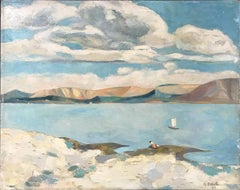
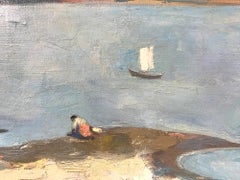
Mid Century Modern Oil Painting of Lake with Puffed Clouds and Sailboat & Figure

Mid Century Modern Oil Painting of Lake with Puffed Clouds and Sailboat & Figure

By Michael Baxte

Located in New York, NY

A strong modernist oil painting depicted in 1947 by Russian painter Michael Baxte. Mostly known for his abstracted figures on canvas or street scenes, this piece is a wonderful repre...

Category

Mid-20th Century Modern Michael Baxte Paintings

Materials

Canvas, Oil

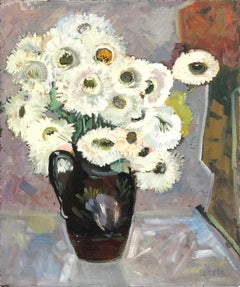
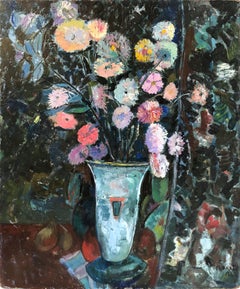
"Still Life with Flower Pot" Expressionistic Style Oil Painting on Masonite

"Still Life with Flower Pot" Expressionistic Style Oil Painting on Masonite

By Michael Baxte

Located in New York, NY

A strong modernist oil painting depicted in Circa 1960 by Russian painter Michael Baxte. Mostly known for his abstracted figures on canvas or street scenes, this piece is a wonderful representation of his bold still life paintings, with expressive use of color, shape, and form. Later in his career, Baxte explores Expressionism, infusing both European and North American stylistic trends. This piece is from later in his career, but we can feel this underlying style throughout. Art measures 21.75 x 18 inches Michael Posner Baxte was born in 1890 in the small town of Staroselje Belarus, Russia. For the first half of the 19th century it was a center of the Chabad movement of Hasidic Jews, but this group was gone by the middle of the 19th century. By the time the Baxte family immigrated to the United States at the beginning of the 20th century, the Jewish population numbered only on the hundreds. The native language of the Baxte family was Yiddish. It is likely that the death of Michael Baxte’s father triggered the family’s immigration. Three older brothers arrived in New York between 1903 and 1905. Michael and his mother, Rebecca, arrived in 1907. By 1910 Michael, his mother, and brother, Joseph, were living in New Orleans and may have spent some time on a Louisiana plantation. Around 1912, Michael Baxte returned to Europe to study the violin. In 1914 he, his mother, and Joseph moved to New York City. Meanwhile, in Algeria, a talented young woman painter, Violette Mege, was making history. Since for the first time, a woman won the prestigious Beaux Art competition in Algeria. At first, the awards committee denied her the prize but, with French government intervention, Mege eventually prevailed. She won again 3 years later and, in 1916, used the scholarship to visit the United States of America. When Violette came to New York, she met Baxte, who was, by then, an accomplished violinist, teacher, and composer. Baxte’s compositions were performed at the Tokyo Imperial Theater, and in 1922 he was listed in the American Jewish Yearbook as one of the prominent members of the American Jewish community. As a music teacher he encouraged individual expression. Baxte stated, “No pupil should ever be forced into imitation of the teacher. Art is a personal experience, and the teacher’s truest aim must be to awaken this light of personality through the patient light of science.” By 1920 Michael Baxte and Violette Mege were living together in Manhattan. Although they claimed to be living as husband and wife, it seems that their marriage did not become official until 1928. On their “unofficial” honeymoon around 1917, in Algiers, Baxte confided to her his ambition to paint. There and later in New Mexico where the wonderful steeped sunlight approximates the coloring of Algiers, she taught him his heart’s desire. He never had any other teacher. She never had any other pupil. For ten years she devoted all her time, energy, and ambition to teaching, encouraging, inspiring him. Then in 1928, their mutual strivings were rewarded, as his works were being chosen as one of the two winners in the Dudensing National Competition for American Painters. Out of 150 artists from across the country participated in the Dudensing, and Michael Posner Baxte and, Robert Fawcett...

Category

1960s Expressionist Michael Baxte Paintings

Materials

Oil, Masonite

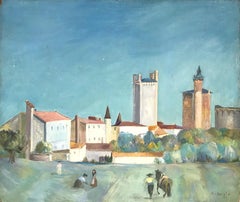
"European Village Landscape Scene" Modernist Style Painting Oil on Board

"European Village Landscape Scene" Modernist Style Painting Oil on Board

By Michael Baxte

Located in New York, NY

A strong modernist oil painting depicted in the Mid Century by Russian painter Michael Baxte. Mostly known for his abstracted figures on canvas or street scenes, this piece is a wond...

Category

1930s Modern Michael Baxte Paintings

Materials

Oil, Board

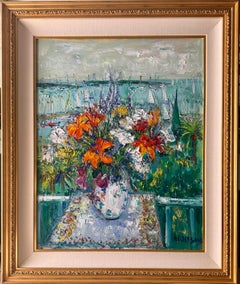
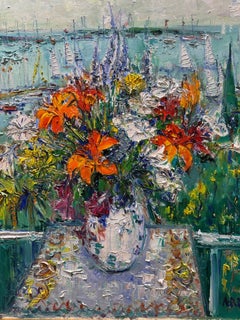
Still Life with Colorful Flowers in Vase

Still Life with Colorful Flowers in Vase

By Michael Baxte

Located in New York, NY

A strong modernist oil painting depicted in 1964 by Russian painter Michael Baxte. Mostly known for his abstracted figures on canvas or street scenes, this piece is a wonderful repre...

Category

1960s Modern Michael Baxte Paintings

Materials

Oil, Board

Mid Century  Landscape

Mid Century Landscape

By Michael Baxte

Located in New York, NY

A strong modernist oil painting depicted in 1965 by Russian painter Michael Baxte. Mostly known for his abstracted figures on canvas or street scenes, this piece is a wonderful repre...

Category

1960s Modern Michael Baxte Paintings

Materials

Oil, Board

Michael Baxte paintings for sale on 1stDibs.

Find a wide variety of authentic Michael Baxte paintings available for sale on 1stDibs. You can also browse by medium to find art by Michael Baxte in oil paint, paint, masonite and more. Much of the original work by this artist or collective was created during the 20th century and is mostly associated with the Expressionist style. Not every interior allows for large Michael Baxte paintings, so small editions measuring 18 inches across are available. Customers who are interested in this artist might also find the work of Lucien Génin, Benavente Solis, and Francisco Santos. Michael Baxte paintings prices can differ depending upon medium, time period and other attributes. On 1stDibs, the price for these items starts at $500 and tops out at $2,000, while the average work can sell for $1,800.