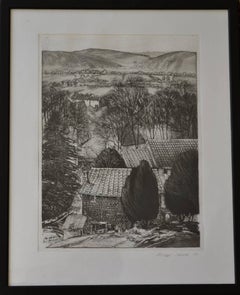
Rudolf Hayder (active in the 1st half of the 20th century), Heron. Color woodcut on thin Japanese paper, 24 x 29 cm (image), 29 x 36 cm (sheet size), signed by hand at lower right "R. Hayder" and titled by hand as "Reiher". Lower left inscribed by hand "Orig.[inal] woodcut, hand print".
- A little bit stained in the margins and very occasionally in the image, minimal hole above the signature, traces of creasing. At the back side's margins with remnants of an old mounting.
About the artwork
In the context of French Japonism, the color woodblock print, which was widespread in the Asian region, was rediscovered for Western art. The artists of the time, such as Édouard Manet, Claude Monet, Edgar Degas, Paul Gauguin and Vincent van Gogh, were inspired not only by the cultural influence, but also by the two-dimensionality of the pictorial spaces. Thus, color woodcuts became an important moment in the development of the modern pictorial concept founded by Impressionism.
In Rudolf Hayder's "Herons", too, the two-dimensionality of the pictorial space is decisive for the pictorial effect. The herons, surrounded by reeds, are framed by the yellow background of the lake, followed by the dark blue-greenish stripe of the opposite shore and, above it, the sky in a lighter blue-green. Formally, it is a sequence of planes, but the two-dimensionality of the motif creates a spatial effect. This spatiality in the surface creates an intense pictorial effect. Hayder intensifies this effect with the blazing lake. In terms of color, the water becomes a sunset. The yellow turns reddish brown toward the shore, then fades to brownish red, while the shore is a watery turquoise...
Category
Early 20th Century Realist Michael Chaplin Art