Murray Hantman Abstract Paintings

Shaped by his life experiences and a commitment to the practice of making art, the work of Murray Hantman represented a career of personal exploration and aesthetic refinement that took him from New York to Los Angeles, back to New York and eventually to the serene, yet dramatic, the coast of Maine, where he worked as part of the artists’ colony on Monhegan Island. Born in Pennsylvania in 1904, Hantman’s family moved many times to follow his father’s business opportunities, eventually settling in New York. A childhood of economic instability and dislocation formed Murray Hantman’s early years, making him independent and self-reliant from a very early age. Hantman’s father owned movie theatres and photography studios and, recognizing his son’s artistic ability, employed him to print hand-color photographs as a child. When he was eleven and living in Michigan, a public school teacher arranged for Hantman to receive a scholarship to the Detroit Museum of Art School, where after a year he was awarded another scholarship to study at the Detroit School of Design. He studied in Detroit for a year until his family abruptly moved to Alabama, interrupting his artistic and academic studies until the family moved to New York at the end of the first World War. As a young man, Hantman supported himself by working many different jobs in New York and New Jersey. Steady work with his brother at the Hartford and New Haven Railroad office in New York City finally allowed Hantman to pursue his artistic studies formally. In 1928, he enrolled in the Art Students League and became part of a social circle of artists and activists. While at the Art Students League, he worked with faculty members Boardman Robinson and Thomas Hart Benton on two mural projects. During the years around the Great Depression, Hantman worked in Los Angeles with a group of artists known as the Bloc of Painters. Recruited through an advertisement to attend a course on fresco painting, the Bloc group was headed by Mexican muralist David Alfaro Siqueiros, who had recently been exiled from Mexico for political activism. Through his work with Siqueiros, Hantman became motivated by social and political issues and their creative expression. In 1934, He returned to New York and found the community of artists there equally engaged in social justice issues. While enrolling at the newly-formed Artists’ Union to advocate for the labor rights of creative workers, Hantman met sculptor Jo Levy who would become his wife. Like many artists at the time, he found work through the Federal Art Project as a member of the Easel Painting Division, which strove to create “works of art for the public which have a definite social value to the community”. Along with the work he exhibited as a member of the WPA group, Hantman’s work from this period was in the style of Social Realism he learned from Siqueiros. Hantman and his wife, Jo Levy, believed in creating art for the public good. Their Artists’ Union friends and colleagues from the Federal Art Project formed the nucleus of their social circle and would become the community of artists who worked together during summers on Monhegan Island off the coast of Maine. In 1945, Hantman had his first solo painting show at Marquee Gallery in New York and visited Monhegan Island for the first time. The following summer, he and Levy spent the summer in Maine and would continue to do so for the next thirty years. The landscapes and seascapes of Maine would become a central subject in his work after 1946. The dramatic coastline of Monhegan Island had been an inspiration for other New York artists before Hantman, including George Bellows and Rockwell Kent. As Hantman matured as an artist he began to reject academic narrative in his work, moving towards a more expressionistic and abstract style. During this shift into abstraction, nature remained central to his work and the seascape and Maine light provided continual inspiration. In the late 1940s, Hantman began to reduce the landscape into elemental forms of color and shape. As he pursues this mode of painting, his work moves further into abstraction, juxtaposing large blocks of saturated color to convey the drama of sea and sky. Always a student and teacher, Hantman distilled the ideologies of Abstract Expressionism and synthesized its concepts into his work. Throughout the 1950s, he experimented with Action Painting, color, form and expression. By the late 1950s, Hantman’s mature style had developed into abstract works of pure color masses in simple geometric forms. His mastery of color and form continued into his late work, always reflecting the beauty of the natural world around him. Dedicated to the idea of exploration in his art, Hantman made hundreds of small color and form studies that hint at the large-scale works that would follow in the late 1960s and beyond. Hantman’s work from the ‘70s and ‘80s shows even more intensity of color and distillation of composition. The landscape of the Maine coast remained his muse throughout, the stark lines suggesting the flat plane of sea and horizon line beyond. Hantman and Jo Levy lived in New York and summered on Monhegan Island until 1975, followed by summers in Owls Head and New Harbor, Maine, until 1988, the year of his last solo exhibition, at the Portland Museum of Art. In 1989, Hantman showed with Levy in a group exhibition. Levy died in 1996, followed by Hantman in 1999.

to
2
2
Overall Width
to
Overall Height
to
2
2
2
2
1
1
1
1
4
680
644
560
336
2
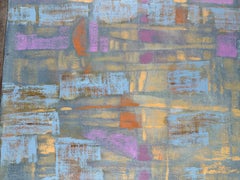
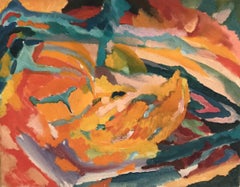
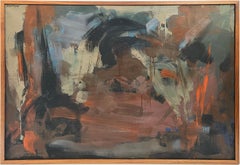
Artist: Murray Hantman
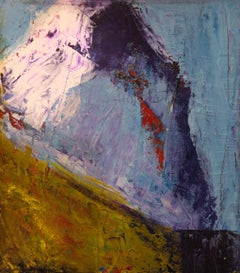
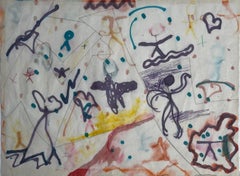
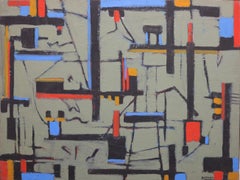
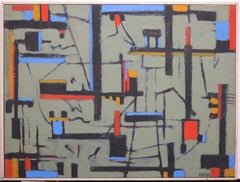
Untitled (Abstract Expressionist)

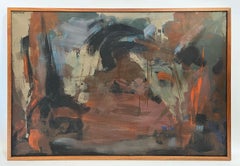
Untitled (Abstract Expressionist)

By Murray Hantman

Located in Wilton Manors, FL

Murray Hantman (1904-1999). Untitled, ca. 1950-55. Oil on canvas measures 20 x 26 inches, 26 x 32 inches in silver leaf vintage frame.. Signed lower right. Excellent condition with ...

Category

Mid-20th Century Abstract Expressionist Murray Hantman Abstract Paintings

Materials

Canvas, Oil

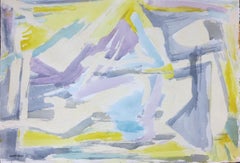
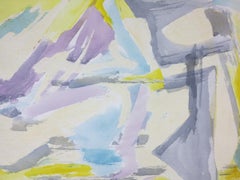
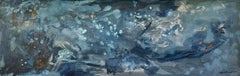
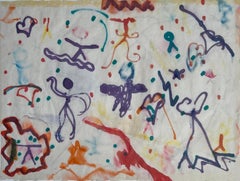
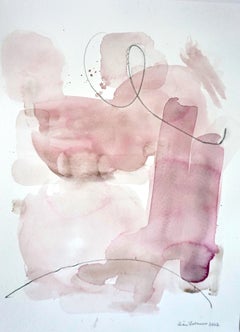
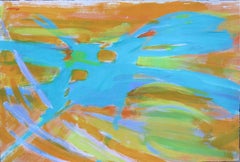
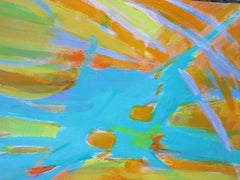
Composition (Abstract Expressionist mid-century gestural action painting)

Composition (Abstract Expressionist mid-century gestural action painting)

By Murray Hantman

Located in Wilton Manors, FL

Murray Hantman (1904-1999). Composition, 1951. Watercolor on paper, 14 x 21 inches. Unframed. Signed lower left. Signed, dated and titled en verso. Provenance: estate of Murray Hantman. Biography: Shaped by his life experiences and a commitment to the practice of making art, the work of Murray Hantman represents a career of personal exploration and aesthetic refinement that took him from New York, to Los Angeles, back to New York and eventually to the serene, yet dramatic, coast of Maine where he worked as part of the artists’ colony on Monhegan Island. Born in Pennsylvania in 1904, Hantman’s family moved many times to follow his father’s business opportunities, eventually settling in New York. A childhood of economic instability and dislocation formed Hantman’s early years, making him independent and self-reliant from a very early age. Hantman’s father owned movie theatres and photography studios and, recognizing his son’s artistic ability, employed him to print and hand-color photographs as a child. When he was eleven and living in Michigan, a public school teacher arranged for Hantman to receive a scholarship to the Detroit Museum of Art School where after a year he was awarded another scholarship to study at the Detroit School of Design. He studied in Detroit for a year until his family abruptly moved to Alabama, interrupting his artistic and academic studies until the family moved to New York at the end of the first World War. As a young man, Hantman supported himself by working many different jobs in New York and New Jersey. Steady work with his brother at the Hartford and New Haven Railroad...

Category

Mid-20th Century Abstract Expressionist Murray Hantman Abstract Paintings

Materials

Watercolor

Related Items
Large French Expressionist Abstract Oil Painting Beautiful Colors 20th Century

Large French Expressionist Abstract Oil Painting Beautiful Colors 20th Century

By Jean-Francois Pierre

Located in Cirencester, Gloucestershire

Absolutely stunning original French abstract oil painting on canvas, dating to 1961. The work is on a large scale, measuring 36 x 25.5 inches. It i...

Category

Mid-20th Century Abstract Expressionist Murray Hantman Abstract Paintings

Materials

Oil, Canvas

"Exuberance" by Rehfeld - Abstract Expressionism in Orange, Black, and Yellow

"Exuberance" by Rehfeld - Abstract Expressionism in Orange, Black, and Yellow

By Steven H. Rehfeld

Located in Carmel, CA

Steven H. Rehfeld (American, born 1954) "Exuberance" 2002 Oil paint, Canvas, Stretcher bars The artist signed the back of the painting. "Exuberance" by Steven Rehfeld is a visceral ...

Category

Early 2000s Abstract Expressionist Murray Hantman Abstract Paintings

Materials

Canvas, Oil, Stretcher Bars

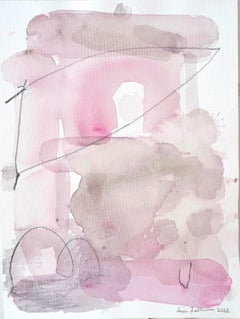
Untitled Figure (c. 1950s)

Adine StixUntitled Figure (c. 1950s), c. 1950s

$800

H 17.5 in W 12 in D 0.25 in

Untitled Figure (c. 1950s)

By Adine Stix

Located in Summit, NJ

Gorgeous oil and watercolor on paper by abstract expressionist artist Adine Stix. Beautiful shades of pink, purples, cobalt blue with s hint of orange cover the paper to create the h...

Category

1950s Abstract Expressionist Murray Hantman Abstract Paintings

Materials

Paper, Oil, Watercolor

Mid-Century Abstract Expressionist Watercolor by Charles Ragland Bunnell, 1950s

Mid-Century Abstract Expressionist Watercolor by Charles Ragland Bunnell, 1950s

By Charles Ragland Bunnell

Located in Denver, CO

This original abstract expressionist watercolor by Charles Ragland Bunnell (1897–1968) exemplifies mid-20th-century American abstraction and the pioneering spirit of Colorado moderni...

Category

1950s Abstract Expressionist Murray Hantman Abstract Paintings

Materials

Watercolor

Summer Mists, Contemporary Expressionist Style Seascape Painting, Coastal Art

Summer Mists, Contemporary Expressionist Style Seascape Painting, Coastal Art

Located in Deddington, GB

This painting reflects the summer sun over Skye on the break of day as the mist lies low in the valleys and the promise of a beautiful day. Using vibrant turquoises to convey the fee...

Category

21st Century and Contemporary Abstract Expressionist Murray Hantman Abstract Paintings

Materials

Paper, Ink, Acrylic, Watercolor

Blue Iris. Oil on Canvas, Floral, Iris, Horisontal, Impressionism, Interior

Blue Iris. Oil on Canvas, Floral, Iris, Horisontal, Impressionism, Interior

By Irina Matvienko

Located in Oslo, NO

Blue Iris. Stillife, Oil on Canvas, Floral, Flowers, Iris, Horisontal, Rectangular, Impressionism, Interior, Blue, Green, Medium. This painting was created in 2025. It's a rectang...

Category

2010s Abstract Expressionist Murray Hantman Abstract Paintings

Materials

Canvas, Oil

Abstract Expressionist Gouache Oil Painting on Paper John Von Wicht WPA Artist

Abstract Expressionist Gouache Oil Painting on Paper John Von Wicht WPA Artist

Located in Surfside, FL

John von Wicht (German American, 1888-1970) Hand signed lower right Oil and media painting on Japan paper Dimensions: 17 X 24 inches Johannes Von Wicht was born in Holstein, Germa...

Category

1960s Abstract Expressionist Murray Hantman Abstract Paintings

Materials

Oil, Gouache, Archival Paper

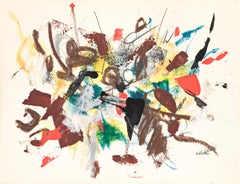
Abstract Poodle, Multi Colored Composition

Abstract Poodle, Multi Colored Composition

Located in Surfside, FL

Bright abstract multi colored painting

Category

20th Century Abstract Expressionist Murray Hantman Abstract Paintings

Materials

Paper, Gouache

Untitled
Untitled

Raymond ParkerUntitled, 1979

$9,500

H 18.88 in W 29.88 in

Untitled

By Raymond Parker

Located in Palm Desert, CA

"Untitled" is a watercolor painting by Raymond Parker. This work was painted in 1979, and is inscribed in pencil in the lower middle, "For Pat <3 RP 1979". The framed size is 25 1/4 ...

Category

Late 20th Century Abstract Expressionist Murray Hantman Abstract Paintings

Materials

Watercolor

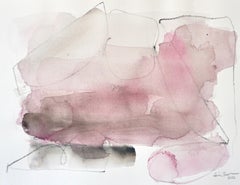
Untitled
Untitled

Adine StixUntitled, 1950

$1,900

H 26 in W 32 in D 1 in

Untitled

By Adine Stix

Located in Summit, NJ

Gorgeous watercolor by Adine Stix. This piece was painted in the 1950s and was acquired directly from Adine's daughter. It is beautifully framed and matted in a gold cube frame under...

Category

1950s Abstract Expressionist Murray Hantman Abstract Paintings

Materials

Paper, Watercolor

Abstract Watercolor Painting, 'Design for Sculpture', C. 1995 by David Ruth

Abstract Watercolor Painting, 'Design for Sculpture', C. 1995 by David Ruth

By David Ruth

Located in Oakland, CA

This is a contemporary abstract watercolor painting by artist David Ruth. This series of paintings often feature bright colors and vibrant layouts that draw the viewer in. They are c...

Category

1990s Abstract Expressionist Murray Hantman Abstract Paintings

Materials

Paper, Watercolor

Untitled
Untitled

Adine StixUntitled, 1963

$1,200

H 15 in W 22 in D 0.1 in

Untitled

By Adine Stix

Located in Summit, NJ

Gorgeous watercolor by Adine Stix. Wonderful colors on heavy paper with great edges. Signed “Adine” and dated ‘63 lower right.

Category

1960s Abstract Expressionist Murray Hantman Abstract Paintings

Materials

Paper, Watercolor

Previously Available Items
Vintage American Modernist Abstract Expressionist Signed Large Oil Painting

Vintage American Modernist Abstract Expressionist Signed Large Oil Painting

By Murray Hantman

Located in Buffalo, NY

Antique American modernist abstract expressionist painting by Murray Hantman (1904 - 1999). Oil on canvas, circa 1960. Signed. Framed. Image size, 40"L x 30"H.

Category

1960s Abstract Murray Hantman Abstract Paintings

Materials

Canvas, Oil

Double-sided color study 1183

Double-sided color study 1183

By Murray Hantman

Located in Wilton Manors, FL

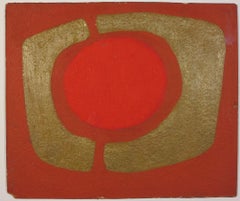
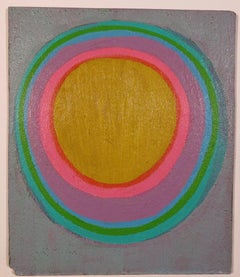
Murray Hantman (1904-1999). Double-sided color study Composition #1183, c. 1960s. Oil on illustration board, 6 x 7 inches. Unframed. Unsigned. Accession number lower right TL.86.1183. Provenance: estate of Murray Hantman. Biography: Shaped by his life experiences and a commitment to the practice of making art, the work of Murray Hantman represents a career of personal exploration and aesthetic refinement that took him from New York, to Los Angeles, back to New York and eventually to the serene, yet dramatic, coast of Maine where he worked as part of the artists’ colony on Monhegan Island. Born in Pennsylvania in 1904, Hantman’s family moved many times to follow his father’s business opportunities, eventually settling in New York. A childhood of economic instability and dislocation formed Hantman’s early years, making him independent and self-reliant from a very early age. Hantman’s father owned movie theatres and photography studios and, recognizing his son’s artistic ability, employed him to print and hand-color photographs as a child. When he was eleven and living in Michigan, a public school teacher arranged for Hantman to receive a scholarship to the Detroit Museum of Art School where after a year he was awarded another scholarship to study at the Detroit School of Design. He studied in Detroit for a year until his family abruptly moved to Alabama, interrupting his artistic and academic studies until the family moved to New York at the end of the first World War. As a young man, Hantman supported himself by working many different jobs in New York and New Jersey. Steady work with his brother at the Hartford and New Haven Railroad office in New York City finally allowed Hantman to pursue his artistic studies in a formal way. In 1928, he enrolled in the Art Students League and became part of a social circle of artists and activists. While at the Art Students League, Hantman worked with faculty members Boardman Robinson and Thomas Hart Benton on two mural projects. During the years around the Great Depression, Hantman worked in Los Angeles with a group of artists known as the Bloc of Painters. Recruited through an advertisement to attend a course on fresco painting, the Bloc group was headed by Mexican muralist David Alfaro Siqueiros who had recently been exiled from Mexico for political activism. Through his work with Siqueiros, Hantman became motivated by social and political issues and their creative expression. In 1934, Hantman returned to New York and found the community of artists there equally engaged in social justice issues. While enrolling at the newly-formed Artists’ Union to advocate for the labor rights of creative workers, Hantman met sculptor Jo Levy who would become his wife. Like many artists at the time, Hantman found work through the Federal Art Project as a member of the Easel Painting Division which strove to create “works of art for the public which have a definite social value to the community”. (1) Along with the work he exhibited as a member of the WPA group, Hantman’s personal work from this period was in the style of Social Realism he learned from Siqueiros. Hantman and his wife, Jo Levy, believed in creating art for the public good. Their Artists’ Union friends and colleagues from the Federal Art Project formed the nucleus of their social circle and would become the community of artists who worked together during summers on Monhegan Island off the coast of Maine. In 1945, Hantman had his first solo painting show at Marquie Gallery in New York, and visits Monhegan Island for the first time. The following summer, he and Levy spend the summer in Maine, and would continue to do so for the next thirty years. The landscapes and seascapes of Maine would become a central subject in his work after 1946. The dramatic coastline of Monhegan Island had been inspiration for other New York artists before Hantman, including George Bellows and Rockwell Kent. As Hantman matured as an artist he began to reject academic narrative in his work, moving towards a more expressionistic and abstract style. During this shift into abstraction, nature remained central to his work and the seascape and Maine light provided continual inspiration. In the late 1940s, Hantman begins to reduce the landscape into elemental forms of color and shape. As he pursues this mode of painting his work moves further into abstraction, juxtaposing large blocks of saturated color to convey the drama of sea and sky. Always a student and teacher, Hantman distilled the ideologies of Abstract Expressionism and synthesized its concepts into his own work. Throughout the 1950s, he experimented with Action Painting, color, form and expression. By the late 1950s, Hantman’s mature style had developed into abstract works of pure color masses in simple geometric forms. His mastery of color and form continued into his late work, always reflecting the beauty of the natural world around him. Dedicated to the idea of exploration in his art, Hantman made hundreds of small color and form studies that hint at the large-scale works that would follow in the late 1960s and beyond. Hantman’s work from the ‘70s and ‘80s shows even more intensity of color and distillation of composition. The landscape of the Maine coast remained his muse throughout, the stark lines suggesting the flat plane of sea and horizon line beyond. Hantman and Jo Levy lived in New York and summered on Monhegan Island until 1975, followed by summers in Owls Head and New Harbor...

Category

Mid-20th Century Abstract Murray Hantman Abstract Paintings

Materials

Oil, Illustration Board

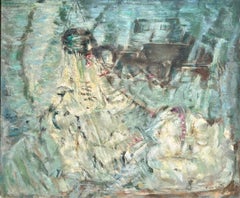
Untitled (Abstract Expressionist mid-century gestural action painting)

Untitled (Abstract Expressionist mid-century gestural action painting)

By Murray Hantman

Located in Wilton Manors, FL

Murray Hantman (1904-1999). Untitled, 1952. Acrylic on paper, 12 x 18.5 inches. Unframed. Signed upper left. Signed, dated and titled en verso. Provenance: estate of Murray Hantman. ...

Category

1950s Abstract Expressionist Murray Hantman Abstract Paintings

Materials

Acrylic

Industrial Composition

Industrial Composition

By Murray Hantman

Located in Wilton Manors, FL

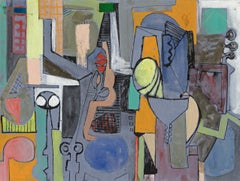
Murray Hantman (1904-1999). Industrial Composition, c.1948-50. Oil on canvas measures 18 x 24 inches, 19 x 25 inches in original simple wood strip frame. Signed lower right. Excellent condition with no conservation. Exhibition label affixed en verso. Provenance: estate of Murray Hantman. This piece was included in the exhibition Murray Hantman: From Image to Abstraction, Portland Museum of Art, 2005. Anonymous lender. Biography: Shaped by his life experiences and a commitment to the practice of making art, the work of Murray Hantman represents a career of personal exploration and aesthetic refinement that took him from New York, to Los Angeles, back to New York and eventually to the serene, yet dramatic, coast of Maine where he worked as part of the artists’ colony on Monhegan Island. Born in Pennsylvania in 1904, Hantman’s family moved many times to follow his father’s business opportunities, eventually settling in New York. A childhood of economic instability and dislocation formed Hantman’s early years, making him independent and self-reliant from a very early age. Hantman’s father owned movie theatres and photography studios and, recognizing his son’s artistic ability, employed him to print and hand-color photographs as a child. When he was eleven and living in Michigan, a public school teacher arranged for Hantman to receive a scholarship to the Detroit Museum of Art School where after a year he was awarded another scholarship to study at the Detroit School of Design. He studied in Detroit for a year until his family abruptly moved to Alabama, interrupting his artistic and academic studies until the family moved to New York at the end of the first World War. As a young man, Hantman supported himself by working many different jobs in New York and New Jersey. Steady work with his brother at the Hartford and New Haven Railroad office in New York City finally allowed Hantman to pursue his artistic studies in a formal way. In 1928, he enrolled in the Art Students League and became part of a social circle of artists and activists. While at the Art Students League, Hantman worked with faculty members Boardman Robinson and Thomas Hart Benton on two mural projects. During the years around the Great Depression, Hantman worked in Los Angeles with a group of artists known as the Bloc of Painters. Recruited through an advertisement to attend a course on fresco painting, the Bloc group was headed by Mexican muralist David Alfaro Siqueiros who had recently been exiled from Mexico for political activism. Through his work with Siqueiros, Hantman became motivated by social and political issues and their creative expression. In 1934, Hantman returned to New York and found the community of artists there equally engaged in social justice issues. While enrolling at the newly-formed Artists’ Union to advocate for the labor rights of creative workers, Hantman met sculptor Jo Levy who would become his wife. Like many artists at the time, Hantman found work through the Federal Art Project as a member of the Easel Painting Division which strove to create “works of art for the public which have a definite social value to the community”. (1) Along with the work he exhibited as a member of the WPA group, Hantman’s personal work from this period was in the style of Social Realism he learned from Siqueiros. Hantman and his wife, Jo Levy, believed in creating art for the public good. Their Artists’ Union friends and colleagues from the Federal Art Project formed the nucleus of their social circle and would become the community of artists who worked together during summers on Monhegan Island off the coast of Maine. In 1945, Hantman had his first solo painting show at Marquie Gallery in New York, and visits Monhegan Island for the first time. The following summer, he and Levy spend the summer in Maine, and would continue to do so for the next thirty years. The landscapes and seascapes of Maine would become a central subject in his work after 1946. The dramatic coastline of Monhegan Island had been inspiration for other New York artists before Hantman, including George Bellows and Rockwell Kent. As Hantman matured as an artist he began to reject academic narrative in his work, moving towards a more expressionistic and abstract style. During this shift into abstraction, nature remained central to his work and the seascape and Maine light provided continual inspiration. In the late 1940s, Hantman begins to reduce the landscape into elemental forms of color and shape. As he pursues this mode of painting his work moves further into abstraction, juxtaposing large blocks of saturated color to convey the drama of sea and sky. Always a student and teacher, Hantman distilled the ideologies of Abstract Expressionism and synthesized its concepts into his own work. Throughout the 1950s, he experimented with Action Painting, color, form and expression. By the late 1950s, Hantman’s mature style had developed into abstract works of pure color masses in simple geometric forms. His mastery of color and form continued into his late work, always reflecting the beauty of the natural world around him. Dedicated to the idea of exploration in his art, Hantman made hundreds of small color and form studies that hint at the large-scale works that would follow in the late 1960s and beyond. Hantman’s work from the ‘70s and ‘80s shows even more intensity of color and distillation of composition. The landscape of the Maine coast remained his muse throughout, the stark lines suggesting the flat plane of sea and horizon line beyond. Hantman and Jo Levy lived in New York and summered on Monhegan Island until 1975, followed by summers in Owls Head and New Harbor...

Category

Mid-20th Century Abstract Geometric Murray Hantman Abstract Paintings
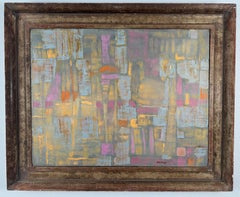
Materials

Canvas, Oil

Untitled (abstract expressionist painting)

Untitled (abstract expressionist painting)

By Murray Hantman

Located in Wilton Manors, FL

Murray Hantman (1904-1999). Untitled, 1955. Oil on canvas measures 30 x 40 inches, 31 x 41 inches in original simple wood strip frame. Signed lower right. Excellent condition with no...

Category

1950s Abstract Expressionist Murray Hantman Abstract Paintings
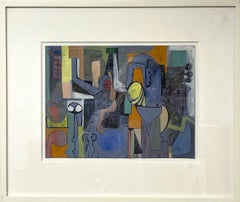
Materials

Canvas, Oil

Murray Hantman abstract paintings for sale on 1stDibs.
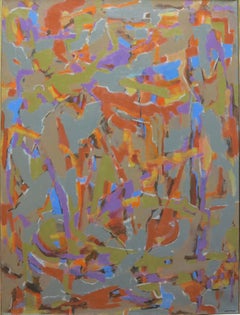
Find a wide variety of authentic Murray Hantman abstract paintings available for sale on 1stDibs. You can also browse by medium to find art by Murray Hantman in paint, canvas, fabric and more. Much of the original work by this artist or collective was created during the 20th century and is mostly associated with the abstract style. Not every interior allows for large Murray Hantman abstract paintings, so small editions measuring 21 inches across are available. Customers who are interested in this artist might also find the work of Jane Sangerman, Jack Graves III, and Larry Zox. Murray Hantman abstract paintings prices can differ depending upon medium, time period and other attributes. On 1stDibs, the price for these items starts at $850 and tops out at $4,000, while the average work can sell for $2,425.