Nili Carasso Art

to
1
2
Overall Width
to
Overall Height
to
3
1
1
1
1
3
3
1
1
1
3
11,842
2,888
2,541
1,618
3
Artist: Nili Carasso
Meeting, Bronze Animal Sculpture with Inscribed Signature by Nili Carasso

Meeting, Bronze Animal Sculpture with Inscribed Signature by Nili Carasso

By Nili Carasso

Located in Long Island City, NY

Nili Carasso was born in 1951, in Jerusalem. At the age of ten, Nili attended art classes at the Bezalel art school in Jerusalem. By the time Nili was 26, she graduated from David Ya...

Category

Early 2000s Folk Art Nili Carasso Art

Materials

Bronze

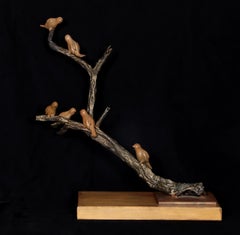
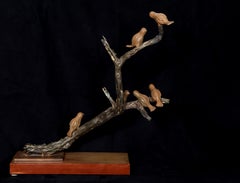
The Birds, Bronze Animal Sculpture by Nili Carasso

The Birds, Bronze Animal Sculpture by Nili Carasso

By Nili Carasso

Located in Long Island City, NY

Nili Carasso was born in 1951, in Jerusalem. At the age of ten, Nili attended art classes at the Bezalel art school in Jerusalem. By the time Nili was 26, she graduated from David Ya...

Category

Early 2000s Folk Art Nili Carasso Art

Materials

Granite, Bronze

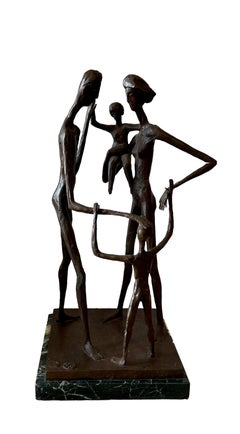
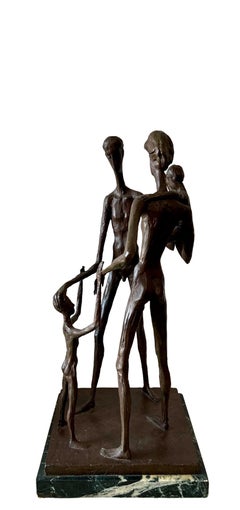
Family, Modern Bronze Sculpture by Nili Carasso

Family, Modern Bronze Sculpture by Nili Carasso

By Nili Carasso

Located in Long Island City, NY

Artist: Nili Carasso Title: Family Year: circa 2001 Medium: Pair of Bronze Sculptures on Base, signature and numbering inscribed Edition: 2/25 Size: Man: 11 x 7 x 4 inches ; Woman: 1...

Category

21st Century and Contemporary Expressionist Nili Carasso Art

Materials

Bronze

Related Items
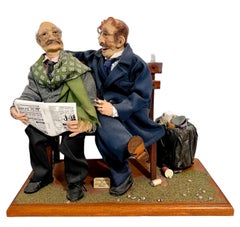
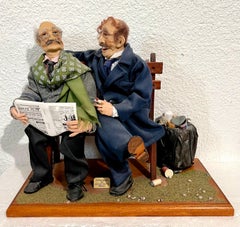
Hungarian Israeli Tourists Diorama Folk Art Doll Judaica Sculpture Magda Watts

Hungarian Israeli Tourists Diorama Folk Art Doll Judaica Sculpture Magda Watts

Located in Surfside, FL

Magda Watts (Israeli, b. 1928) Handmade Folk Art Sculpture Old Folks with a newspaper Hand signed to underside, Dimensions: 12"h x 14.5" l x 7.5"d. Magda Watts, Holocaust survivor, dollmaker She grew up in the Hungarian town of Nyiregyhaza, which the war reached in 1944. Jews were herded into a ghetto, where they remained for several weeks. Magda began making dolls while being held in the concentration camp at Auschwitz, Poland in 1944. Her creativity and imagination helped her to survive the horrors of the holocaust and led to an inspirational career in art and visual storytelling. A resident of Eilat, Israel, she is an internationally known artist. Her intricate soft fabric and textile dolls and panoramas bring the people of the shtetl back to life. She has recreated part of the Jewish community of her native Hungary in order that it might never be forgotten. A documentary was made on her life, “Liberation of the Spirit: The Journey of Magda Watts”. The film opens with a close-up of Watts' hands. She is shaping a doll head, pressing creases with a wooden tool into pliable sculpting resin that later will be hardened by baking. With a few nicks and strokes, human features begin to emerge from the shapeless lump. "I don't know why I am making old people," she says. "It is coming out from me. I can't order my hand what to do." She calls her dolls "small human beings. When you see them in half-dark, you see them dancing, speaking, like they are in life." She makes the dolls in batches of body parts, and also makes most of the props that go with them: miniature furniture, musical instruments, tiny leather shoes with wax soles, even treadle sewing machines. Watts survived the Auschwitz death factory, then the labor camp at Nuremberg. It was there that she created the ancestors of the folk-art masterpieces she now crafts, such artful and appealing rag dolls that Nazi guards would swap extra bread for them. That, she says, "was life" for her and her sister Shari, enough to keep them alive. The doll scene is typical of her work: lifelike yet cartoonish figures set in evocative tableaux. She makes them in her workshop in Israel. Starting at $1,500, Watts' soft dolls are sold only in Israel, but collected worldwide. She once made a panorama of the Jewish people's 5,000-year history for an Israel museum, and a violinist doll for concert great Isaac Stern. The dolls are tailors, jewelers, klezmer musicians, seamstresses, musicians, students, rabbis, a cast of characters from the shtetl of a bygone Europe and from small corners of the modern Jewish world. Like Frank Meisler but in fabric and cloth. They laugh and brood, gossip and smoke, fiddle and play cards. Infused, as if by some spiritual alchemy, with the full range of human emotion, they furrow their aging brows in worry and concentration. Soulful eyes gaze both outward and inward. Here and there, figures from her life emerge. "When I make the seamstress, I am thinking of my aunt. She had a little bit of a hunchback. She had a Singer machine and many drawers, with every one something beautiful inside." A careful observer can spot visual jokes in her work. "I'm making the Bible, and (a museum panorama character) is sitting on the camel with a cigarette in his hand. Nobody sees it, but I know it. I made it for myself. I have to make something that makes me laugh." From oven-baked clay and Styrofoam, she’s re-creating her past: rabbis, gossipy ladies, peddlers, jewelers, tailors, old couples and fish vendors from her small village in central Hungary. Nearly all perished during the Holocaust. Most were sent to the gas chambers in 1944 when Nazis overran her country, including some in Watts’ family. Her lifelike creations have been displayed – and sold – around the world. Her creations emerge from the back of her memory. She remembers a gentler Hungary, where Jewish communities thrived before the Nazis came. On one doll’s baked clay face, she paints the knotted frown of a rabbi concentrating on a Torah passage. Another doll grows into a man hawking fish. Women play cards. A stern schoolmaster presides over a class. “They love to love,” she says. She has exhibited with Malcah Zeldis. Her naive, whimsical images contain a number of storytelling devices and attempt to convey a narrative. She is also fond of Mea Shearim...

Category

20th Century Folk Art Nili Carasso Art

Materials

Fabric, Wood, Mixed Media
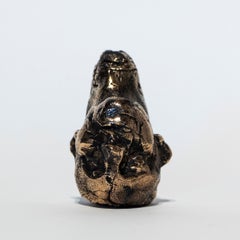
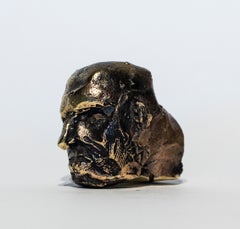
Inverted Polished Bronze Pocket-Sized Expressionist Figurative Head Sculpture

Inverted Polished Bronze Pocket-Sized Expressionist Figurative Head Sculpture

By Óscar Aldonza Torres

Located in FISTERRA, ES

Inverted pocket-sized figurative head sculpture in polished bronze with dark oxidised details, individually cast, sanded and hand-finished by Spanish artist Óscar Aldonza Torres. Or...

Category

2010s Expressionist Nili Carasso Art

Materials

Bronze

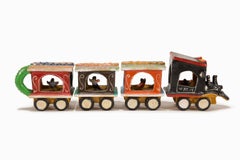
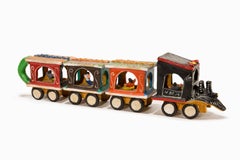
"El Tren" Ceramic, Glaze, Colors, Mexican Folk Art, Four Sections

"El Tren" Ceramic, Glaze, Colors, Mexican Folk Art, Four Sections

Located in Detroit, MI

SALE ONE WEEK ONLY "El Tren" is a whimsical and playful rendition of a train. It is beautifully glazed in various colors. This particular ceramic was from the collection of Jane and Richard Knight’s Estate. Jane Knight was a famous fiber and textile artist. Richard was a photographer who worked for Eliel Saarinen and Alexander Girard. The Knights and Girard became close friends and it was Girard who gifted “Santa Cruz De Las Huertas Jalisco” to the Knights. Alexander Girard left his personal collection to the Museum of International Folk Art, Santa Fe, NM. The Girards eventually amassed a collection of more than 106,000 objects from across the globe. Their 1978 gift of this collection to the Museum of International Folk art quintupled the size of their collection and prompted the construction of a new wing, which opened in 1982 and houses a mere 10% of the Girard Collection in the permanent exhibition Multiple Visions: A Common Bond, which was designed by Alexander Girard himself. This collection includes numerous multiples and is notable for its great breadth, including traditional arts, popular arts, and paper ephemera. “I believe we should preserve this evidence of the past, not as a pattern for sentimental imitation,” Girard once said, “but as nourishment for the creative spirit of the present.” Indeed, folk art was an important inspiration for Girard’s design work. The renowned Candelario Medrano...

Category

1950s Folk Art Nili Carasso Art

Materials

Ceramic, Glaze

Vintage Turtle Sculpture or Figure

Vintage Turtle Sculpture or Figure

Located in Palm Beach, FL

Life like, life size turtle sculpture crafted in composition in an amazing realistic replication. Labeled Animal Classics on the bottom.

Category

20th Century Folk Art Nili Carasso Art

Materials

Resin

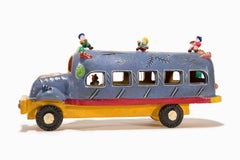
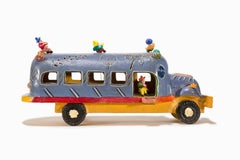
“Santa Cruz de las Huertas Jalisco”, Ceramic, Glaze, Colors, Mexican Folkart

“Santa Cruz de las Huertas Jalisco”, Ceramic, Glaze, Colors, Mexican Folkart

Located in Detroit, MI

SALE ONE WEEK ONLY “Santa Cruz de las Huertas Jalisco” is a whimsical, charming and colorfully ceramic rendition painted blue and red of a local bus that traversed the town where the artist Candelario Medrano...

Category

Mid-20th Century Folk Art Nili Carasso Art

Materials

Ceramic, Glaze

Large Modernist Bronze Abstract Figural Sculpture "Family" Wolfgang Behl

Large Modernist Bronze Abstract Figural Sculpture "Family" Wolfgang Behl

Located in Surfside, FL

This is a mid 20th century mod abstract large bronze sculpture by Wolfgang Behl (German/American, 1918-1994). The sculptural group titled "The Family" features a mother and father with two children. Numbered 20/20. Signed. 21" H x 10 1/4" x 10 1/4 Wolfgang (Johann Wolfgang) Behl (1918 - 1994) was active/lived in Connecticut, Illinois / Germany. Known for Sculpture and as an architectural carver. A carver,designer, and teacher, Wolfgang Behl was born in Berlin, Germany where he studied at the Berlin Academy of Fine Arts. His teacher was otto Hitzberger, sculptor and architecture carver. I have seen some his work, particularly in carved wood compared to Constantin Brancusi although this one seems way more reminiscent of Alberto Giacometti. In 1939, Behl came to the United States and taught briefly in Pennsylvania at the Perkiomen School and in Rhode Island at the Rhode Island School of Design. There in 1943, he won the Joseph N. Eisendrath prize for sculpture. He also became a friend of Louis Mayer, sculptor from Milwaukee. In 1944, Behl took a job as Art Director at the Lake Forest Academy in Lake Forest, Illinois, and he also began a one-year teaching assignment at the Layton School of Art in Milwaukee. The last years of his life until his death were in Hartford, Connecticut. Source: Peter C. Merrill, "German-Immigrant Artists in Early Milwaukee" Originally from Berlin, Germany, Mr. Behl immigrated to the United States in 1939 and became a citizen in 1947. He studied with Waldemar Raemisch at the Academy of Fine Arts in Berlin, and later at the Rhode Island School of Design. He began teaching at the Hartford Art School in 1955, retiring in 1983 to devote his time to sculpting. Mr. Behl had exhibitions throughout the United States and Germany. Some of his solo exhibitions include the Arts Exclusive in Simsbury from 1976 to 1981, and the Bertha Schaefer Gallery in New York City from 1950 to 1973. He showed at the New Britain Museum of American Art, in New Britain, Connecticut in 1969. He also had several retrospectives, including one at the Greater Hartford Jewish Community Center in West Hartford until the end of this month. His works in bronze have a German Expressionist quality to them a pathos found in the works of Kathe Kollwitz and the Expressionist movement. He was known for his classically inspired, but often surrealist sculpture. Among his most-well known pieces are a series of sculptures done for the University of Connecticut Health Center. Several examples of Behl’s work are found on the campus of the University of Hartford. He was included in the show Monumentality in Modern Sculpture at the Contemporary Arts Museum Houston, Texas, 1957. Artists featured in the exhibition: Kenneth Armitage, Hans Arp, Ernst Barlach, Wolfgang Behl, Dorothy Dehner, Edgar Degas, José de Rivera, Max Ernst, Alberto Giacometti, Joseph Glasco, Julio González, Paul Granlund...

Category

20th Century Expressionist Nili Carasso Art

Materials

Marble, Bronze

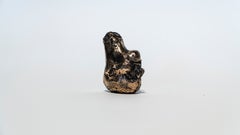
Archaic Dark Patinated Bronze Pocket Head Sculpture with Golden Highlights

Archaic Dark Patinated Bronze Pocket Head Sculpture with Golden Highlights

By Óscar Aldonza Torres

Located in FISTERRA, ES

Archaic-looking pocket head sculpture in dark patinated bronze with selectively polished golden highlights, individually cast and hand-finished by Spanish artist Óscar Aldonza Torres...

Category

2010s Expressionist Nili Carasso Art

Materials

Bronze

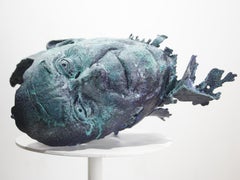
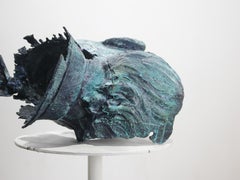
Fragmented Human Head with Verdigris Patina Lost-Wax Bronze Original Sculpture

Fragmented Human Head with Verdigris Patina Lost-Wax Bronze Original Sculpture

By Óscar Aldonza Torres

Located in FISTERRA, ES

This fragmented bronze head sculpture combines realist facial modelling with open cavities, irregular edges and a richly layered green and blue verdigris patina. Created by Spanish ...

Category

2010s Expressionist Nili Carasso Art

Materials

Bronze

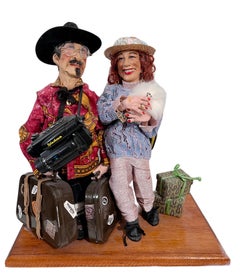
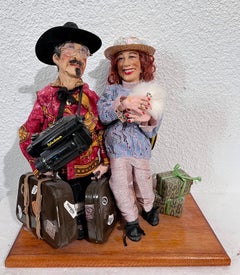
Hungarian Israeli Tourists Diorama Folk Art Doll Judaica Sculpture Magda Watts

Hungarian Israeli Tourists Diorama Folk Art Doll Judaica Sculpture Magda Watts

Located in Surfside, FL

Magda Watts (Israeli, b.1928) Handmade Folk Art Sculpture Tourists. Hand signed to underside, Dimensions: 12"h x 14.5" l x 7.5"d. Magda Watts, Holocaust survivor, dollmaker She grew up in the Hungarian town of Nyiregyhaza, which the war reached in 1944. Jews were herded into a ghetto, where they remained for several weeks. Magda began making dolls while being held in the concentration camp at Auschwitz, Poland in 1944. Her creativity and imagination helped her to survive the horrors of the holocaust and led to an inspirational career in art and visual storytelling. A resident of Eilat, Israel, she is an internationally known artist. Her intricate soft fabric and textile dolls and panoramas bring the people of the shtetl back to life. She has recreated part of the Jewish community of her native Hungary in order that it might never be forgotten. A documentary was made on her life, “Liberation of the Spirit: The Journey of Magda Watts”. The film opens with a close-up of Watts' hands. She is shaping a doll head, pressing creases with a wooden tool into pliable sculpting resin that later will be hardened by baking. With a few nicks and strokes, human features begin to emerge from the shapeless lump. "I don't know why I am making old people," she says. "It is coming out from me. I can't order my hand what to do." She calls her dolls "small human beings. When you see them in half-dark, you see them dancing, speaking, like they are in life." She makes the dolls in batches of body parts, and also makes most of the props that go with them: miniature furniture, musical instruments, tiny leather shoes with wax soles, even treadle sewing machines. Watts survived the Auschwitz death factory, then the labor camp at Nuremberg. It was there that she created the ancestors of the folk-art masterpieces she now crafts, such artful and appealing rag dolls that Nazi guards would swap extra bread for them. That, she says, "was life" for her and her sister Shari, enough to keep them alive. The doll scene is typical of her work: lifelike yet cartoonish figures set in evocative tableaux. She makes them in her workshop in Israel. Starting at $1,500, Watts' soft dolls are sold only in Israel, but collected worldwide. She once made a panorama of the Jewish people's 5,000-year history for an Israel museum, and a violinist doll for concert great Isaac Stern. The dolls are tailors, jewelers, klezmer musicians, seamstresses, musicians, students, rabbis, a cast of characters from the shtetl of a bygone Europe and from small corners of the modern Jewish world. Like Frank Meisler but in fabric and cloth. They laugh and brood, gossip and smoke, fiddle and play cards. Infused, as if by some spiritual alchemy, with the full range of human emotion, they furrow their aging brows in worry and concentration. Soulful eyes gaze both outward and inward. Here and there, figures from her life emerge. "When I make the seamstress, I am thinking of my aunt. She had a little bit of a hunchback. She had a Singer machine and many drawers, with every one something beautiful inside." A careful observer can spot visual jokes in her work. "I'm making the Bible, and (a museum panorama character) is sitting on the camel with a cigarette in his hand. Nobody sees it, but I know it. I made it for myself. I have to make something that makes me laugh." From oven-baked clay and Styrofoam, she’s re-creating her past: rabbis, gossipy ladies, peddlers, jewelers, tailors, old couples and fish vendors from her small village in central Hungary. Nearly all perished during the Holocaust. Most were sent to the gas chambers in 1944 when Nazis overran her country, including some in Watts’ family. Her lifelike creations have been displayed – and sold – around the world. Her creations emerge from the back of her memory. She remembers a gentler Hungary, where Jewish communities thrived before the Nazis came. On one doll’s baked clay face, she paints the knotted frown of a rabbi concentrating on a Torah passage. Another doll grows into a man hawking fish. Women play cards. A stern schoolmaster presides over a class. “They love to love,” she says. She has exhibited with Malcah Zeldis. Her naive, whimsical images contain a number of storytelling devices and attempt to convey a narrative. She is also fond of Mea Shearim...

Category

20th Century Folk Art Nili Carasso Art

Materials

Fabric, Wood, Mixed Media
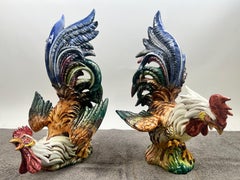
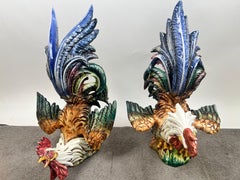
Vintage Hand-Painted Italian Majolica Ceramic Fighting Rooster Sculpture, a Pair

Vintage Hand-Painted Italian Majolica Ceramic Fighting Rooster Sculpture, a Pair

Located in Plainview, NY

Add Old World charm to your home with this striking pair of hand-painted Italian ceramic fighting roosters, crafted in the traditional majolica style. Each sculpture captures a drama...

Category

1980s Folk Art Nili Carasso Art

Materials

Ceramic

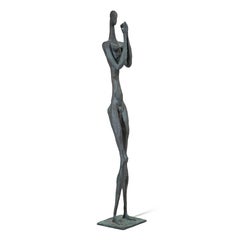
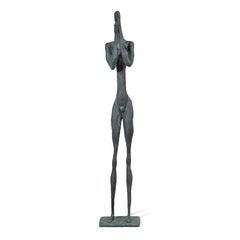
Fleet Moment
Fleet Moment

Doris CaesarFleet Moment, 1959

$28,500

H 30.5 in W 6 in D 5 in

Fleet Moment

By Doris Caesar

Located in Greenwich, CT

Featured in the Doris Caesar catalog by Martin H. Bush, page 110.

Category

1950s Expressionist Nili Carasso Art

Materials

Bronze

Previously Available Items
Flame
Flame

Nili CarassoFlame, 1981

Sold

H 10.25 in W 5.5 in D 2 in

Flame

By Nili Carasso

Located in Long Island City, NY

Artist: Nili Carasso Title: Flame Year: 1981 Medium: Polished Bronze, signature and number inscribed Edition: AP Size: 10.25 x 5.5 x 2 in. (26.04 x 13.97 x 5.08 cm) Base: 2...

Category

1980s Abstract Nili Carasso Art

Materials

Brass

Movement
Movement

Nili CarassoMovement

Sold

H 18 in W 21 in D 4 in

Movement

By Nili Carasso

Located in Long Island City, NY

Artist: Nili Carasso Title: Movement Medium: Bronze Sculpture, signature inscribed Edition: 10 Size: 18 x 21 x 4 inches

Category

1990s Contemporary Nili Carasso Art

Materials

Bronze

Nili Carasso art for sale on 1stDibs.

Find a wide variety of authentic Nili Carasso art available for sale on 1stDibs. You can also browse by medium to find art by Nili Carasso in bronze, metal and more. Much of the original work by this artist or collective was created during the 21st century and contemporary and is mostly associated with the Expressionist style. Not every interior allows for large Nili Carasso art, so small editions measuring 10 inches across are available. Customers who are interested in this artist might also find the work of Arieh Merzer, Branko Bahunek, and David Aronson. Nili Carasso art prices can differ depending upon medium, time period and other attributes. On 1stDibs, the price for these items starts at $2,500 and tops out at $2,500, while the average work can sell for $2,500.

Artists Similar to Nili Carasso