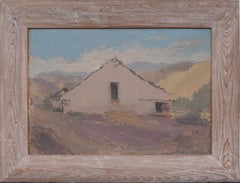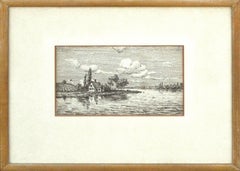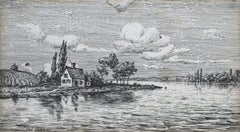
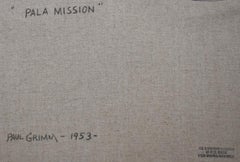
"PALA MISSION" Northern San Diego County California Reservation.
By Paul Grimm
Located in San Antonio, TX
Paul Grimm (1891-1974) California Artist Image Size: 24 x 30 Frame Size: 31 x 37 Medium: Oil on Canvas Dated 1953 "Pala Mission" The San Antonio de Pala Asistencia, or the "Pala Mission", was founded on June 13, 1816, as an asistencia or "sub-mission" to Mission San Luis Rey de Francia, some twenty miles inland upstream from the latter mission on the San Luis Rey River. Pala Mission was part of the Spanish missions, asistencias, and estancias system in Las Californias—Alta California. Today it is located in the Pala Indian Reservation located in northern San Diego County, with the official name of Mission San Antonio de Pala.[2][4] It is the only historic mission facility still serving a Mission Indian tribe. Pala (a derivation of the native term Pale, meaning water) was essentially a small rancho surrounded by large fields and herds. The Pala site had been noted by Father Juan Mariner and Captain Juan Pablo Grijalva on an exploratory trip in 1795, when they went up the San Diego River, and then through Sycamore Canyon to the Santa Maria Valley (or Pamó Valley) and into what they named El Valle de San José, now known as Warner Springs. Once Mission San Luis Rey began to prosper, it attracted the attention of numerous mountain Native Americans in the area, who were called the Luiseño by the Spanish. Spanish era The Franciscan fathers chose this site for the Pala Mission because it was a traditional gathering place and village for the Native American residents. Father Peyrí oversaw the addition of a chapel and housing to the granary complex, which was constructed at the spot in 1810.[4] The chapel's interior wall surfaces featured paintings by native artists, originally measuring 144 by 27 feet. Workers went into the Palomar Mountains and cut down cedar trees to use as roof beams.[5] Pala is unique among all of the Franciscan missions in that it boasts the only completely freestanding campanile, or "bell tower," in all of Alta California. By 1820, some 1,300 baptisms had been performed at the outpost.[6] Folk tales about the mission include mention of a prickly pear cactus, which became a local symbol of Christian victory, that grew up at the foot of the cross.[7] Mexican era After the nation achieved independence from Spain, the Mexican Congress passed An Act for the Secularization of the Missions of California on August 17, 1833 (the act was ratified in 1834).[8] Father Buenaventura Fortuna surrendered Mission San Luis Rey and all its holdings, including Las Flores Estancia and the Pala Asistencia, to government comisianados (commissioners) Pío Pico and Pablo de la Portillà on August 22, 1835; the assessed value of "Rancho de Pala" was $15,363.25.[9] More than a decade later, fearful of the impending conquest of Alta California by the United States as a result of the Mexican–American War...
20th Century Impressionist Paul Grimm Art
Oil