Paul Koch Prints and Multiples

to
1
Overall Width
to
Overall Height
to
1
1,109
1,002
902
684
1
1
1
1
1
1
1
1
1
Artist: Paul Koch
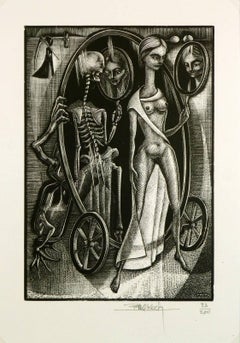
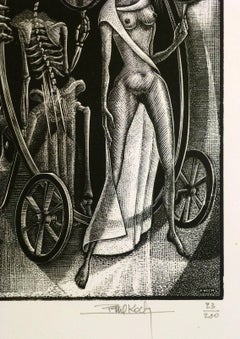
Female Figure and Skeletal Woodcut

Female Figure and Skeletal Woodcut

By Paul Koch

Located in Houston, TX

Woodcut of female figure and skeleton by English artist Paul Koch, 1964. Signed lower right. 23/200 Original artwork on paper displayed on a white mat with a gold border. Mat fits ...

Category

1970s Paul Koch Prints and Multiples

Materials

Woodcut

Related Items
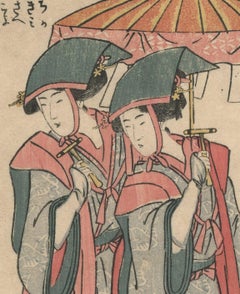
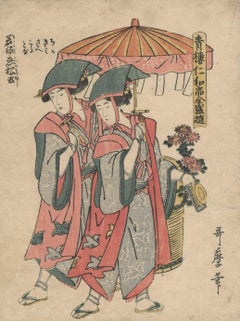
Famous Japanese woodcut artist Kitagawa Utamaro festival in the Yoshiwara

Famous Japanese woodcut artist Kitagawa Utamaro festival in the Yoshiwara

By Kitagawa Utamaro 1

Located in Fairlawn, OH

Kitagawa Utamaro (1750-1806) Wakamurasaki, Matsukaze ("Young Murasaki" and "Wind in the Pines.") Color woodcut, c. 1800 Signed in the block, Utamaro fude (see photo) Series: Seirō Niwaka Zensei Asobi ( "Popular Entertainment at the Niwaka Festival, Yoshiwara".) (Green Houses) is a poetic term for the pleasure quarters, specifically the Yoshiwara district."Niwaka" refers to amateur theatrical performances and parades held during the Niwaka festival Format: chuban Fresh colors and condition Housed in an 8 ply rag mat with OP3 Acrylic in a rounded corner Hackman 1" metal leaf frame Image size: 9 x 7 inches Frame size: 14-1/4 x 16-7/8 x 3/4" These are names of chapters from the classic 11th-century novel The Tale of Genji (Genji monogatari). The women in the print are likely performing a parody (mitate) or "modern" version of these classic themes. The print depicts two beauties in elaborate costumes, carrying umbrellas and flowers, typical of the processions held during the Niwaka festival in the Yoshiwara. Kitagawa Utamaro (1750-1806) Kitagawa Utamaro is highly appreciated as the dominating ukiyo-e artist of the late eighteenth century. Yet little is known about his life. Neither the precise date of Utamaro's birth, his birthplace, nor any substantial information about his parents are known. Utamaro’s original name was Ichitaro Kitagawa. It is generally agreed that he started his career as a pupil of the painter Toriyama Sekien. His early known works are actor portraits and theater programs, published under the name of Utagawa Toyoaki. In 1781/82 he changed his name to Kitagawa Utamaro. Around 1783 Utamaro started a successful cooperation with the publisher Tsutaya Juzaburo. Together they published several book illustrations. The early works of Utamaro were influenced by Torii Kiyonaga and Harunobu Suzuki...

Category

Early 1800s Other Art Style Paul Koch Prints and Multiples

Materials

Woodcut

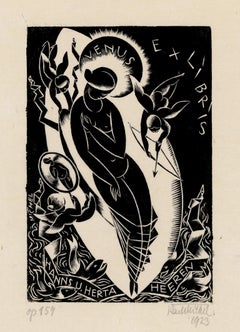
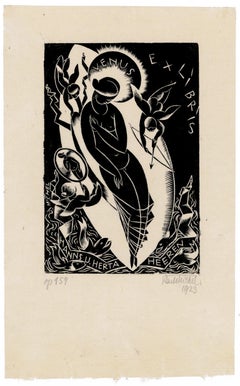
'Venus'  — German Expressionism

'Venus' — German Expressionism

By Karl Michel

Located in Myrtle Beach, SC

Karl Michel, 'Venus, Ex Libris - Hanns U. Herta Heeren', woodcut, 1923, edition not stated but small. Signed, dated, and numbered 'op.154' in pencil. Signed in the block, lower left. A fine impression, on cream Japan paper, with full margins (15/16 to 2 11/16 inches), in good condition. Printed by the artist. Matted to museum standards (unframed). . Translation: Venus Ex Libris for Hanns and Herta Heeren. Image size 5 15/16 x 4 inches (156 x 102 mm); sheet size 9 5/8 x 6 inches (245 x 152 mm). ABOUT THE ARTIST Karl Michel (1889-1984) was a noted graphic designer and expressionist printmaker during Germany's pre-Nazi Weimar Republic (1919-1933). Michel’s work was the subject of a feature article in the influential German graphic design magazine Das Plakat (The Poster) in 1920. An anti-war advocate, Michel created a suite of 12 wood engravings depicting his impressions of the humanitarian toll of WWII entitled ‘Humanitas’ (Humanity). The German publishing house Greifenverlag published the series in a reduced folio of unsigned prints. Michel’s graphic work is held in the permanent collections of the Auckland War Memorial Museum (New Zealand), Frederikshavn Kunstmuseum & Exlibrissamling (Denmark), Museum of Applied Arts (Budapest), The Robert Gore Rifkind Center for German Expressionist Studies at the Los Angeles County Museum of Art, and the German Expressionism...

Category

1920s Expressionist Paul Koch Prints and Multiples

Materials

Woodcut

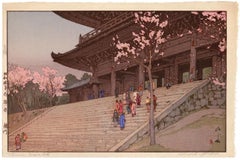
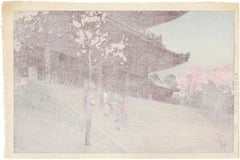
'Chion-in Temple Gate' from 'Eight Scenes of Cherry Blossoms' — Jizuri Seal

'Chion-in Temple Gate' from 'Eight Scenes of Cherry Blossoms' — Jizuri Seal

By Hiroshi Yoshida

Located in Myrtle Beach, SC

Hiroshi Yoshida, 'Chion-in Temple Gate (Sunset)' from the series 'Eight Scenes of Cherry Blossoms (Sakura hachi dai: Sakura mon)', color woodblock print, 1935. Signed in brush 'Yoshida' and in pencil 'Hiroshi Yoshida'. A superb, early impression, with fresh colors; the full sheet with margins, on cream Japan paper; an area of slight toning in the top right sheet corner, not affecting the image, otherwise in excellent condition. Marked with a jizuri (self-printed) seal, upper left margin. Self-published by the artist. Image size 9 5/8 x 14 3/4 inches (444 x 375 mm); sheet size 10 7/8 x 16 inches (276 x 406 mm). Archivally sleeved, unmatted. Provenance: M. Nakazawa, Tokyo. Literature: Japanese Landscapes of the 20th Century (Hotei Publishing calendar), 2001, May. Collections: Honolulu Museum of Art, Museum of Fine Arts, Boston. ABOUT THE IMAGE Located in Kyoto, Chionin is the main temple of the Jodo sect of Japanese Buddhism, one of the most popular Buddhist sects in Japan, having millions of followers. The Sanmon Gate, Chionin's entrance gate, standing 24 meters tall and 50 meters wide, it is the largest wooden temple gate in Japan and dates back to the early 1600s. Behind the gate, a broad set of stairs leads to the main temple grounds. ABOUT THE ARTIST Painter and printmaker Yoshida Hiroshi (1876-1950) is regarded as one of the greatest artists of the Japanese 'shin hanga' (New Print) movement. Yoshida was born as the second son of Ueda Tsukane in Kurume, Fukuoka Prefecture, a schoolteacher from an old samurai family. In 1891 he was adopted by his art teacher Yoshida Kasaburo in Fukuoka and took his surname. In 1893 he went to Kyoto to study painting, and the following year to Tokyo to join Koyama Shotaro's Fudosha private school; he also became a member of the Meiji Fine Arts Society. These institutions taught and advocated Western-style painting, greatly influencing Yoshida’s artistic development. In 1899 Yoshida had his first American exhibition at Detroit Museum of Art (now Detroit Institute of Art), making the first of many visits to the US and Europe. In 1902 he helped reorganize the Meiji Fine Arts Society, renaming it the Taiheiyo-Gakai (Pacific Painting...

Category

1930s Showa Paul Koch Prints and Multiples

Materials

Woodcut

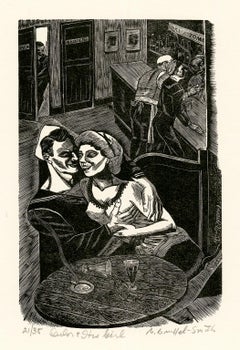
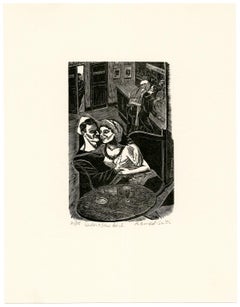
'Sailor and His Girl' —Mid-Century Modernism, WWII

'Sailor and His Girl' —Mid-Century Modernism, WWII

By Bernard Brussel-Smith

Located in Myrtle Beach, SC

Bernard Brussel-Smith, 'Sailor and His Girl', wood engraving, 1941, edition 35. Signed, titled, and numbered '21/35' in pencil. Signed in the block, lower right. A superb, richly-in...

Category

1940s American Modern Paul Koch Prints and Multiples

Materials

Woodcut

'Little Locomotive' – Artist's Personal Letterhead, Bauhaus Modernism

'Little Locomotive' – Artist's Personal Letterhead, Bauhaus Modernism

By Lyonel Feininger

Located in Myrtle Beach, SC

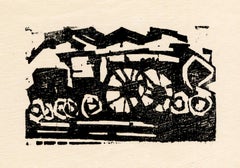
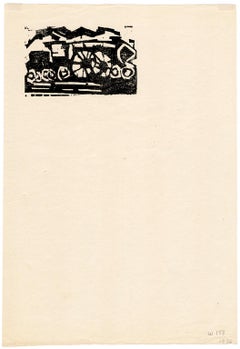
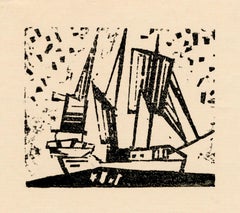
Lyonel Feininger, 'Little Locomotive (Kleine Lokomotive)', woodcut, 1936, one of a small but unknown number of letterhead proofs; Prasse W158. Annotated 'W 158' (Feininger catalogue number) and '1936' in pencil, in the bottom right sheet corner. A fine impression, on cream, laid letterhead stock; hinge remains on the left and right top sheet edges, verso, in excellent condition. Very scarce. Image size 2 1/4 x 3 5/16 inches; sheet size 10 x 7 inches. Archivally sleeved, unmatted. Exhibited: 'Lyonel Feininer, Woodcuts Used As Letterheads'; Associated American Artists; Feb 4 - March 2, 1974; New York, NY. Collections: Cleveland Museum of Art, Museum of Modern Art, Staatliche Museen zu Berlin (East Berlin KK). ABOUT THE ARTIST Lyonel Feininger (1871-1956) was born in New York City into a musical family—his father was a violinist and composer, his mother was a singer and pianist. He studied violin with his father, and by the age of 12, he was performing in public, but he also drew incessantly, most notably the steamboats and sailing ships on the Hudson and East Rivers, and the landscape around Sharon, Conn., where he spent time on a farm owned by a family friend. At the age of 16 he left New York to study music and art in Germany, from where his parents emigrated. Drawn more to the visual arts, he attended schools in Hamburg, Berlin, and Paris from 1887 to 1892. After completing his studies, Feininger began his artistic career as a cartoonist and illustrator, his originality leading him to great success. In 1906, after working for a dozen years in Germany, he was offered a job as a cartoonist at the Chicago Tribune, the largest circulation newspaper in the Midwest. He worked there for a year, inventing what became the standard design for the comic strip: in the words of John Carlin, “an overall pattern. . . that allowed the page to be read both as a series of elements one after the other, like language and as a group of juxtaposed images, like visual art.” His originality did not end there: he went on to become one of the great abstract painters. Like Kandinsky, music was his model, but Kandinsky only knew music from the outside—as a listener (inspired initially by Wagner, then by Schoenberg)—while Feininger knew it from the inside. He lived in Paris from 1906 to 1908, during which time he met and was influenced by the work of progressive painters Robert Delaunay and Jules Pascin, as well as that of Paul Cezanne and Vincent van Gogh. He began painting full-time, developing his distinctive Iyrical style based on Cubist and Expressionist idioms and a concern for the emotive qualities of light and color. He exhibited with the Der Blaue Reiter group in 1913, and in 1917, he had his first solo exhibition at Galerie Der Sturm in Berlin. One year after his solo exhibition, in 1918, Feininger began making woodcuts. He became enamored with the medium, producing an impressive 117 in his first year of exploring the printmaking medium. In 1919 at the invitation of the architect Walter Gropius, he was appointed the first master at the newly formed Staatliches Bauhaus in Weimar. His woodcut of a cathedral crowned...

Category

1930s Bauhaus Paul Koch Prints and Multiples
Materials

Woodcut

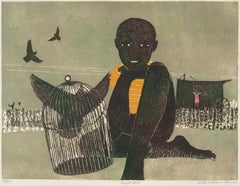
CAGED BIRD

CAGED BIRD

By Walter Henry Williams

Located in Portland, ME

Williams, Walter Henry (American 1920-1998). CAGED BIRD. Color woodcut, 1966. Edition of 210, signed, dated, titled and numbered 43/210 in pencil. 18 x 24 i...

Category

1960s Paul Koch Prints and Multiples

Materials

Woodcut

'Three Masted Ship, 2' – Artist's Personal Letterhead, Bauhaus Modernism

'Three Masted Ship, 2' – Artist's Personal Letterhead, Bauhaus Modernism

By Lyonel Feininger

Located in Myrtle Beach, SC

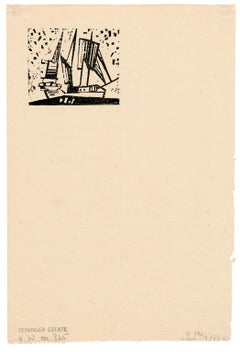
Lyonel Feininger, 'Three Masted Ship, 2 (Dreimastiges Schiff, 2)', woodcut, 1937, one of a small but unknown number of letterhead proofs; Prasse W296. Feininger estate stamp and inventory no. 'W 865' in pencil, bottom left sheet corner. Annotated 'W 296' and 'on block : 3702a' in pencil, bottom right sheet corner. A fine impression, on cream, laid, letterhead stock; hinge remains on the left and right top sheet edges, verso, in excellent condition. Very scarce. Image size 2 1/4 x 2 11/16 inches; sheet size 10 x 6 3/4 inches. Archivally sleeved, unmatted. Exhibited: 'Lyonel Feininer, Woodcuts Used As Letterheads'; Associated American Artists; Feb 4 - March 2, 1974; New York, NY. ABOUT THE ARTIST Lyonel Feininger (1871-1956) was born in New York City into a musical family—his father was a violinist and composer, his mother was a singer and pianist. He studied violin with his father, and by the age of 12, he was performing in public, but he also drew incessantly, most notably the steamboats and sailing ships on the Hudson and East Rivers, and the landscape around Sharon, Conn., where he spent time on a farm owned by a family friend. At the age of 16 he left New York to study music and art in Germany, from where his parents emigrated. Drawn more to the visual arts, he attended schools in Hamburg, Berlin, and Paris from 1887 to 1892. After completing his studies, Feininger began his artistic career as a cartoonist and illustrator, his originality leading him to great success. In 1906, after working for a dozen years in Germany, he was offered a job as a cartoonist at the Chicago Tribune, the largest circulation newspaper in the Midwest. He worked there for a year, inventing what became the standard design for the comic strip: in the words of John Carlin, “an overall pattern. . . that allowed the page to be read both as a series of elements one after the other, like language and as a group of juxtaposed images, like visual art.” His originality did not end there: he went on to become one of the great abstract painters. Like Kandinsky, music was his model, but Kandinsky only knew music from the outside—as a listener (inspired initially by Wagner, then by Schoenberg)—while Feininger knew it from the inside. He lived in Paris from 1906 to 1908, during which time he met and was influenced by the work of progressive painters Robert Delaunay and Jules Pascin, as well as that of Paul Cezanne and Vincent van Gogh. He began painting full-time, developing his distinctive Iyrical style based on Cubist and Expressionist idioms and a concern for the emotive qualities of light and color. He exhibited with the Der Blaue Reiter group in 1913, and in 1917, he had his first solo exhibition at Galerie Der Sturm in Berlin. One year after his solo exhibition, in 1918, Feininger began making woodcuts. He became enamored with the medium, producing an impressive 117 in his first year of exploring the printmaking medium. In 1919 at the invitation of the architect Walter Gropius, he was appointed the first master at the newly formed Staatliches Bauhaus in Weimar. His woodcut of a cathedral crowned...

Category

1930s Bauhaus Paul Koch Prints and Multiples
Materials

Woodcut

'Karl Michel Exhibition'  — German Expressionism

'Karl Michel Exhibition' — German Expressionism

By Karl Michel

Located in Myrtle Beach, SC

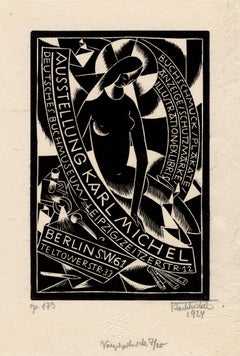
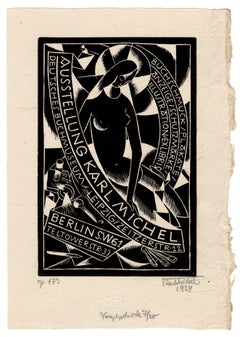
Karl Michel, 'Austellung Karl Michel', woodcut, 1924, edition 20. Signed, dated, numbered 'op. 173' (the artist's inventory number) and '7/20' (the impression number/edition size) and annotated 'Vorgesdruck' (artist's proof) in pencil. A fine, richly-inked impression on hand-made cream, wove paper, with full margins (1 1/16 to 1 1/2 inches); toning to the right sheet edge deckle, otherwise in good condition. With the artist's blind stamp in the bottom center margin. Designed and printed by the artist. Very scarce. Matted to museum standards (unframed). An elegantly designed, dynamic exhibition announcement with the German copy in the block: 'Austellung Karl Michel – Deutsches Buchmuseum Leipzig/Zeitzer str 12, Berlin S.W. 61 Teltower str 33 / Buchschmuck/ Plakate/ Anzeige/ Schultzmarke/ Illustrations/ Ex Libris'. English translation: 'Karl Michel Exhibition – German Book Museum, Leipzig Zeitzer Street 12, Berlin, S.W. 61 Teltower St. 33. / Book Decoration / Posters / Announcements / Illustrations / Ex Libris.' Image size 6 x 4 inches (152 x 102 mm); sheet size 8 1/16 x 5 1/2 inches (205 x 140 mm). ABOUT THE ARTIST Karl Michel (1889-1984) was a noted graphic designer and expressionist printmaker during Germany's pre-Nazi Weimar Republic (1919-1933). Michel’s work was the subject of a feature article in the influential German graphic design magazine 'Das Plakat' (The Poster) in 1920. An anti-war advocate, Michel created a suite of 12 wood engravings depicting his impressions of the humanitarian toll of WWII entitled ‘Humanitas’ (Humanity). The German publishing house Greifenverlag published the series in a folio of unsigned prints. Michel’s graphic work is held in the permanent collections of the Auckland War Memorial Museum (New Zealand), Frederikshavn Kunstmuseum & Exlibrissamling (Denmark), Museum of Applied Arts (Budapest), The Robert Gore Rifkind Center for German Expressionist Studies at the Los Angeles County Museum of Art, and the German Expressionism...

Category

1920s Expressionist Paul Koch Prints and Multiples

Materials

Woodcut

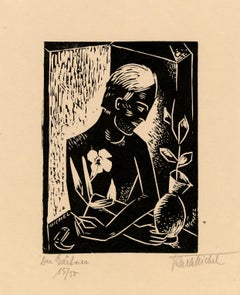
'Der Gartner' (The Gardener) — German Expressionism

'Der Gartner' (The Gardener) — German Expressionism

By Karl Michel

Located in Myrtle Beach, SC

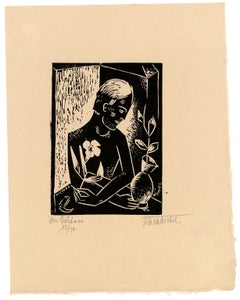
Karl Michel, 'Der Gartner' (The Gardener), woodcut, c. 1925. Signed, titled, and numbered '15/50' in pencil. Signed in the block, lower left and right. A fine, richly-inked impression on buff wove paper, with full margins (1 1/2 to 2 3/4 inches), in excellent condition. Matted to museum standards, unframed. Scarce. Image size 5 1/4 x 3 7/8 inches (133 x 98 mm); sheet size 10 x 7 3/4 inches (254 x 198 mm). ABOUT THE ARTIST Karl Michel (1889-1984) was a noted graphic designer and expressionist printmaker during Germany's pre-Nazi Weimar Republic (1919 - 1933). In 1920, his work was featured in the influential German graphic design magazine Das Plakat...

Category

1920s Expressionist Paul Koch Prints and Multiples

Materials

Woodcut

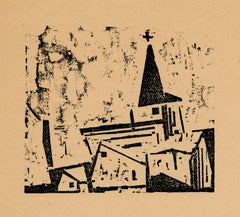
'Church with House and Tree' – Artist's Personal Letterhead, 1940s Modernism

'Church with House and Tree' – Artist's Personal Letterhead, 1940s Modernism

By Lyonel Feininger

Located in Myrtle Beach, SC

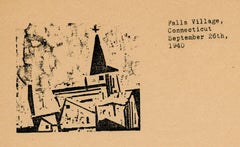
Lyonel Feininger, 'Church with House and Tree (Kirche mit Haus und Baum)', woodcut, 1936, one of a small but unknown number of letterhead proofs; Prasse W290 IV. Annotated 'PW 290 state IV / IV 3669', in pencil, in the bottom right sheet corner. With the artist's typed address and date adjacent to the letterhead image: 'Falls Village, Connecticut September 26th, 1940'. A fine impression, on buff, wove letterhead stock; several small losses, and tears, in the sheet edges (not affecting the image area); a crease in the bottom right sheet edge, otherwise in good condition. Very scarce. Image size: 2 3/8 x 2 3/4 inches; sheet size 11 x 8 5/8 inches. Archivally sleeved, unmatted. Feininger moved from Germany to New York City in 1938 and began spending his summers in Falls Village in 1940. Exhibited: 'Lyonel Feininer, Woodcuts Used As Letterheads'; Associated American Artists; Feb 4 - March 2, 1974; New York, NY. ABOUT THE ARTIST Lyonel Feininger (1871-1956) was born in New York City into a musical family—his father was a violinist and composer, his mother was a singer and pianist. He studied violin with his father, and by the age of 12, he was performing in public, but he also drew incessantly, most notably the steamboats and sailing ships on the Hudson and East Rivers, and the landscape around Sharon, Conn., where he spent time on a farm owned by a family friend. At the age of 16 he left New York to study music and art in Germany, from where his parents emigrated. Drawn more to the visual arts, he attended schools in Hamburg, Berlin, and Paris from 1887 to 1892. After completing his studies, Feininger began his artistic career as a cartoonist and illustrator, his originality leading him to great success. In 1906, after working for a dozen years in Germany, he was offered a job as a cartoonist at the Chicago Tribune, the largest circulation newspaper in the Midwest. He worked there for a year, inventing what became the standard design for the comic strip: in the words of John Carlin, “an overall pattern. . . that allowed the page to be read both as a series of elements one after the other, like language and as a group of juxtaposed images, like visual art.” His originality did not end there: he went on to become one of the great abstract painters. Like Kandinsky, music was his model, but Kandinsky only knew music from the outside—as a listener (inspired initially by Wagner, then by Schoenberg)—while Feininger knew it from the inside. He lived in Paris from 1906 to 1908, during which time he met and was influenced by the work of progressive painters Robert Delaunay and Jules Pascin, as well as that of Paul Cezanne and Vincent van Gogh. He began painting full-time, developing his distinctive Iyrical style based on Cubist and Expressionist idioms and a concern for the emotive qualities of light and color. He exhibited with the Der Blaue Reiter group in 1913, and in 1917, he had his first solo exhibition at Galerie Der Sturm in Berlin. One year after his solo exhibition, in 1918, Feininger began making woodcuts. He became enamored with the medium, producing an impressive 117 in his first year of exploring the printmaking medium. In 1919 at the invitation of the architect Walter Gropius, he was appointed the first master at the newly formed Staatliches Bauhaus in Weimar. His woodcut of a cathedral crowned...

Category

1930s Bauhaus Paul Koch Prints and Multiples
Materials

Woodcut

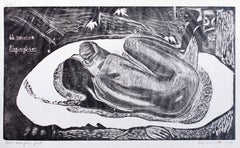
She is Haunted by a Spirit Woodcut Print, Modern Style, Signed 1921

She is Haunted by a Spirit Woodcut Print, Modern Style, Signed 1921

By Paul Gauguin

Located in Roma, IT

Second edition signed in 1921 by the Artist's son Pola Gauguin: lower left “Paul Gauguin fait”, lower left “Pola Gauguin imp”. Superb copy in perfect conditions printed on China pa...

Category

1890s Modern Paul Koch Prints and Multiples
Materials

Woodcut

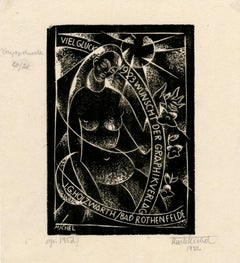
'Viel Gluck 1923' (Good Luck Wishes)  — German Expressionism

'Viel Gluck 1923' (Good Luck Wishes) — German Expressionism

By Karl Michel

Located in Myrtle Beach, SC

Karl Michel, 'Viel Gluck 1923 Wunscht der Graphikverlag, J.G. Holzwarth/Bad Rothenfelde', woodcut, 1922, edition 20. Signed and numbered op. 135d and 20/20 in pencil. Signed in the image, lower left. Annotated 'Vorgesdruck' [artist’s proof] in pencil. A fine, richly-inked impression, on heavy, cream Japan paper, with full margins (5/8 to 1 1/8 inches), in good condition. With the artist’s blind stamp in the top left margin. Printed by the artist. Matted to museum standards, unframed. New Year's Greeting - "1923, Good Luck Wishes from the Graphic Press, J.G. Holzwarth/Bad Rothfelde." Image size 5 x 3 1/2 inches (127 x 89 mm); sheet size 6 5/8 x 5 7/8 inches (168 x 149 mm). ABOUT THE ARTIST Karl Michel (1889-1984) was a noted graphic designer and expressionist printmaker during Germany's pre-Nazi Weimar Republic (1919-1933). Michel’s work was the subject of a feature article in the influential German graphic design magazine Das Plakat (The Poster) in 1920. An anti-war advocate, Michel created a suite of 12 wood engravings depicting his impressions of the humanitarian toll of WWII entitled ‘Humanitas’ (Humanity). The German publishing house Greifenverlag published the series in a reduced folio of unsigned prints. Michel’s graphic work is held in the permanent collections of the Auckland War Memorial Museum (New Zealand), Frederikshavn Kunstmuseum & Exlibrissamling (Denmark), Museum of Applied Arts (Budapest), The Robert Gore Rifkind Center for German Expressionist Studies at the Los Angeles County Museum of Art, and the German Expressionism...

Category

1920s Expressionist Paul Koch Prints and Multiples
Materials

Woodcut

Paul Koch prints and multiples for sale on 1stDibs.

Find a wide variety of authentic Paul Koch prints and multiples available for sale on 1stDibs. You can also browse by medium to find art by Paul Koch in woodcut print and more. Not every interior allows for large Paul Koch prints and multiples, so small editions measuring 16 inches across are available. Customers who are interested in this artist might also find the work of Henry George Moon, Owen Jones, and John Wilkes. Paul Koch prints and multiples prices can differ depending upon medium, time period and other attributes. On 1stDibs, the price for these items starts at $450 and tops out at $450, while the average work can sell for $450.