By Paul Signac
Located in Marlow, Buckinghamshire
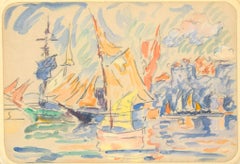
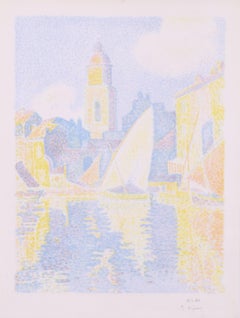
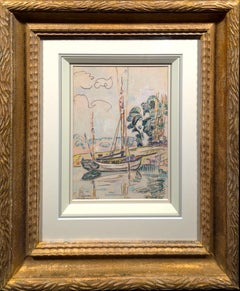
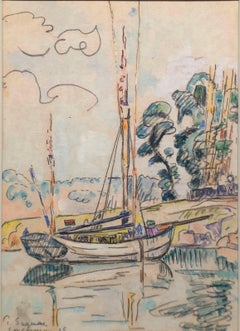
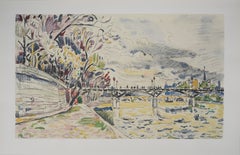
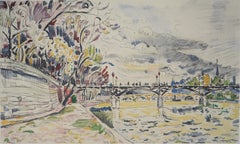
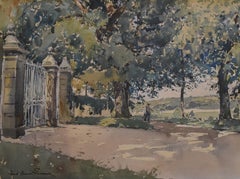
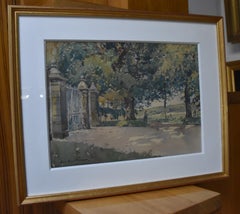
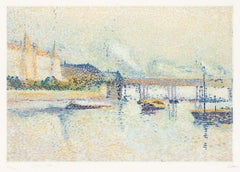
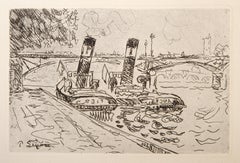
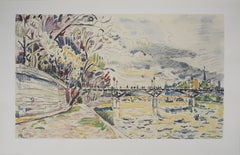
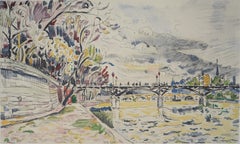
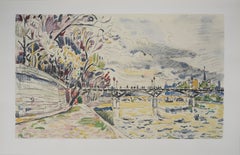
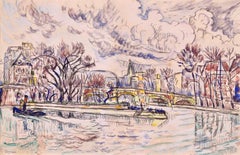
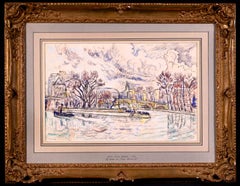
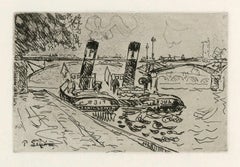
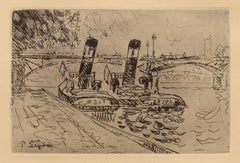
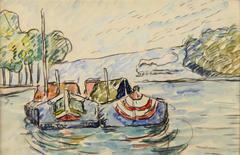
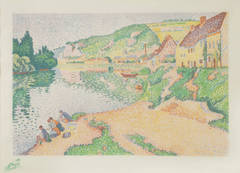
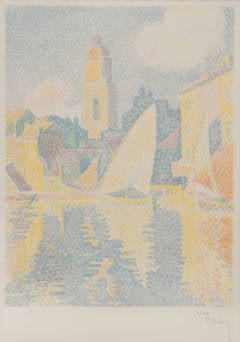
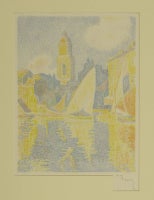
A charming watercolour, charcoal and graphite on paper circa 1925 by French neo impressionist painter Paul Signac depicting a view of the Pont Neuf bridge over the River Seine in Paris, France on a cool autumn day.
Signature:
Signed lower left
Dimensions:
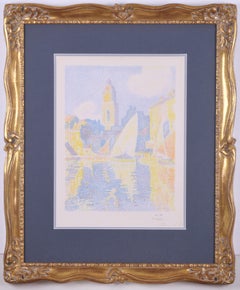
Framed: 19.5"x25.5"
Unframed: 11.5"x17.5"
Provenance:
The authenticity of this work has been confirmed by Marina Bocquillon-Ferretti.
Galleries Maurice Sternberg, Chicago - 1973
In 1880, having left school, Paul Signac contemplated becoming a scholar, his financial independence being assured by his prosperous family. In February 1882, he published a pastiche of Émile Zola’s work in the Parisian magazine Le Chat Noir, entitled Serendipity ( Une trouvaille), but on seeing reproductions of Claude Monet’s work in La Vie Moderne, he decided to turn his ambitions to painting. He took lessons with painter Émile Bin in Montmartre, and settled in successive studios in the area. He wrote to Monet, asking his advice, in 1883. In 1884 he met Armand Guillaumin and exhibited work at the Salon des Artistes Indépendants where he was introduced to Georges Seurat, whose Bathing at Asnières was a revelation to him. The two artists moved in the same avant-garde literary circles and became close friends. Both were part of the founding committee of the Société des Artistes Indépendants (Signac was its President from 1909 to 1934 and unceasingly encouraged younger avant-garde artists such as the Fauves and the Cubists). In 1885 Signac met Camille Pissarro at Durand-Ruel’s. He met Vincent Van Gogh in 1887 at Père Tanguy’s paint shop and the pair remained close friends. He spent summers in various parts of France (Les Andelys and Fécamp in 1886, Comblat-le-Château in Auvergne in 1887, Collioure on the Mediterranean coast, Portrieux in North Brittany in 1888, Cassis in 1889, Italy and Brittany in 1990, and Concarneau in 1891). In 1892 he discovered the little port of St-Tropez where he bought a villa – La Hune – in 1897. He returned there each summer, bringing with him several friends, artists, and writers, including Henri Matisse, who worked with Signac and Henri Edmond Cross for several months. Signac was constantly searching for new subjects to paint, often travelling to ports such as La Rochelle, Marseilles, Genoa, Rotterdam (1896), Switzerland (1903)), Venice (1904 and 1908), and Istanbul (1907). He received the Croix de la Légion d’Honneur in 1911. In 1913, after the birth of his daughter, Ginette, with his mistress Jeanne Selmershein-Desgranges, he separated from his wife and settled in Antibes.
In 1884, Signac discovered the writings of the chemist Michel-Eugène Chevreul, whose pioneering study of colour, The Law of Simultaneous Contrast (1839) had been developed by Hermann von Helmholtz (1878). Signac also read the work of David Sutter, whose articles on the Phenomena of Sight were published in 1880 in the review Art, and that of Edouard Rood (1881). Signac’s views on colour were also influenced by Eugène Delacroix, whose Journal was published between 1893 and 1895. Signac had a taste for mathematics, and in 1889 worked closely with his friend Charles Henry, a mathematician and physician. Henry was researching mathematical and geometric proportion and their potential application to the industrial arts. Signac was associated with the Symbolists of La Revue Indépendante. He was also an admirer of Jules Vallès and Joris-Karl Huysmans. He collaborated on the anarchist journal Le Cri du Peuple and throughout his life unceasingly expressed his social and political opinions. A competent writer, from 1890 he published various articles on art, provided texts for exhibition catalogues and wrote other publications including a volume on Stendhal (Antibes, December 1913-January 1914) and a monograph on Jongkind (Paris, Crès, 1927) which included a Watercolour Treatise ( Traité de l’aquarelle). In 1899 he published From Delacroix to Neo-Impressionism (Editions de la Revue blanche, Paris, 1899; H. Floury, Paris, 1911; Hermann, Paris, 1964), in which he analysed the principles of Neo-Impressionism which he had developed with Seurat. He methodically studied the composition and decomposition of light in coloured rays, and quickly established his role as the theoretician of the group, which included Cross, Théo Van Rysselberghe, Maximilien Luce, Henry van de Velde, Hippolyte Petitjean, Lucie Cousturier...
Category
1920s Post-Impressionist Paul Signac Art
MaterialsPaper, Charcoal, Watercolor, Graphite