Philip Rickman Art

to
3
Overall Width
to
Overall Height
to
1
2
3
3
3
3
3
3
11,597
2,880
2,492
1,601
3
1
3
Artist: Philip Rickman
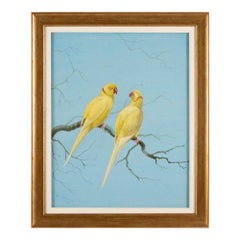
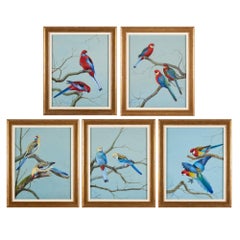
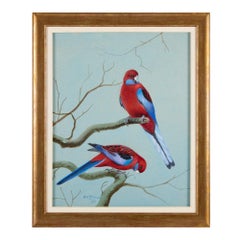
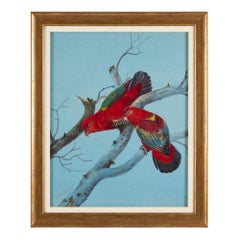
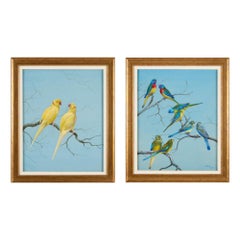
Pair of Watercolour Studies of Exotic Parrots by Philip Rickman

Pair of Watercolour Studies of Exotic Parrots by Philip Rickman

By Philip Rickman

Located in London, GB

Pair of Watercolour Studies of Exotic Parrots by Philip Rickman By Rickman, Philip (British, 1891–1982) Paper: Height 49cm, width 38cm Frame: Height 60cm, width 49.5cm, depth 3cm Th...

Category

21st Century and Contemporary Other Art Style Philip Rickman Art

Materials

Watercolor

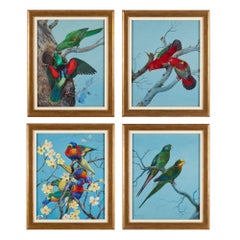
Four Watercolour Studies of Australian Parrots by Philip Rickman

Four Watercolour Studies of Australian Parrots by Philip Rickman

By Philip Rickman

Located in London, GB

Four Watercolour Studies of Australian Parrots by Philip Rickman By Rickman, Philip (British, 1891–1982) Paper: Height 49cm, width 38cm Frame: Height 60cm, width 49.5cm, depth 3cm T...

Category

21st Century and Contemporary Other Art Style Philip Rickman Art

Materials

Watercolor

Related Items
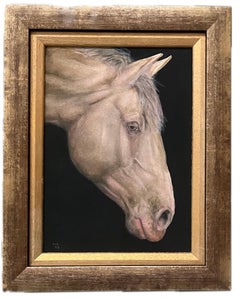
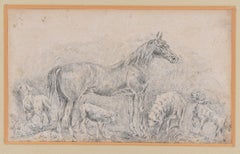
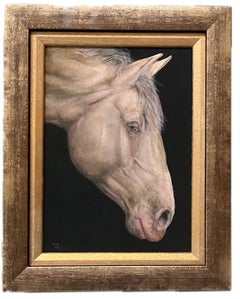
Rafael Mckenzie Soares, Wildlife artist, Horse or Equine portrait

Rafael Mckenzie Soares, Wildlife artist, Horse or Equine portrait

By Rafael Mckenzie Soares

Located in Harkstead, GB

A really charming and beautifully executed study of a horse by this very talented artist. A most attractive picture of this noble creature in ready to hang condition Rafael Mckenzi...

Category

2010s Naturalistic Philip Rickman Art

Materials

Paper, Watercolor

Birds of Europe by John and Elisabeth Goult, 1832

Birds of Europe by John and Elisabeth Goult, 1832

By John Gould and Elizabeth Gould

Located in Paris, FR

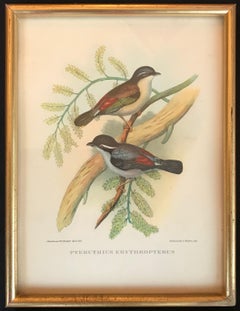
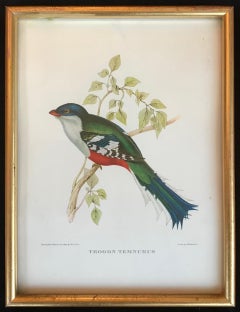
Rare Set of 6 beautiful Naturalistic hand-colored lithograph prints by John Gould from his work Birds of Europe, embelished with gum arabic in vibrant colors. Published 1832 - 1837 by Hullmandel, Walter and Walton. Presented in gold leaf wood frames. Very charming . The price includes the set of 6 framed ones. John Gould (1804–1881) is the most prolific publisher of ornithological subjects of all time. In 19th-century Europe, his name was as well known as Audubon’s was in North America. Unlike Audubon, whose life’s work focused on one region, Gould traveled widely and employed other artists to help create his lavish, hand-colored lithographic folios. John Gould’s love of natural history was fostered in the gardens of King George III where his father was chief gardener at Windsor Castle. Although trained as a gardener, Gould’s interests quickly evolved, and at the age of 20, he was appointed taxidermist to the Zoological Society of London. After three years, he progressed to the position of curator of birds and chief taxidermist. In 1830, newly married, Gould and his artist wife, Elizabeth Gould...

Category

1830s Naturalistic Philip Rickman Art

Materials

Lithograph

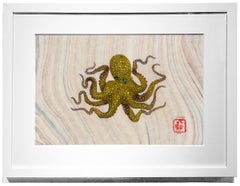
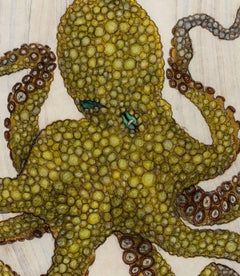
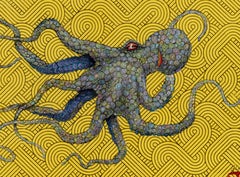
Lemon Meringue - Gyotaku Style Sumi Ink Painting of a Multi-Colored Octopus

Lemon Meringue - Gyotaku Style Sumi Ink Painting of a Multi-Colored Octopus

By Jeff Conroy

Located in Chicago, IL

A small octopus is inked in the Japanese style of Gyo-Taku print making. Using sumi ink to "print" the octopus, the artist then embellishes it with colored pencil to convey an extraordinary dimensionality. By printing it on Mulberry paper, which mimics the swirl of water, the artist achieves a beautiful aesthetic. The artwork is matted and framed in a simple white wooden frame measuring 18.25h x 24.25w x 1d inches. Jeff Conroy Lemon Meringue sumi ink and colored pencil on mulberry paper 12.50h x 18.25w in 31.75h x 46.35w cm JEC118 Gyotaku - A Japanese word translated from "gyo" meaning fish and "taku" meaning stone impression and is believed to get its inspiration from Chinese stone rubbings...

Category

21st Century and Contemporary Contemporary Philip Rickman Art

Materials

Sumi Ink, Watercolor, Mulberry Paper, Color Pencil

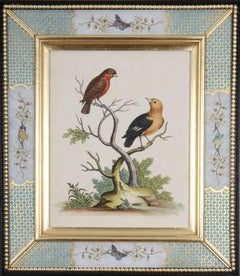
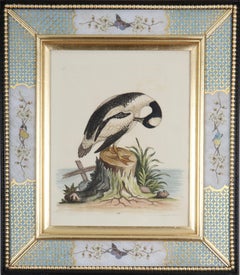
George Edwards: c18th Engravings of Birds in Decalcomania Frames

George Edwards: c18th Engravings of Birds in Decalcomania Frames

By George Edwards

Located in Richmond, GB

George Edwards: "A History of Uncommon Birds", 1749-1761. A prominent English naturalist and ornithologist, George Edwards (1694 -1773) is best known for his work, ""A Natural Histo...

Category

18th Century Philip Rickman Art

Materials

Watercolor, Etching

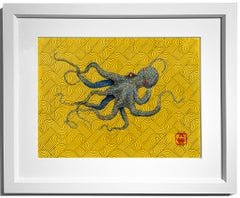
Goldilocks, Pastel - Gyotaku Style Sumi Ink Painting of an Octopus

Goldilocks, Pastel - Gyotaku Style Sumi Ink Painting of an Octopus

By Jeff Conroy

Located in Chicago, IL

A small octopus is inked in the Japanese style of Gyotaku print making. Using sumi ink to "print" the octopus, the artist then embellishes it with colored pe...

Category

21st Century and Contemporary Contemporary Philip Rickman Art

Materials

Sumi Ink, Watercolor, Mulberry Paper, Color Pencil

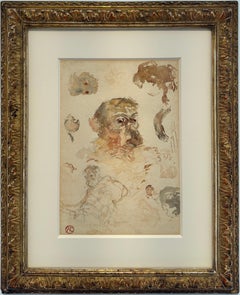
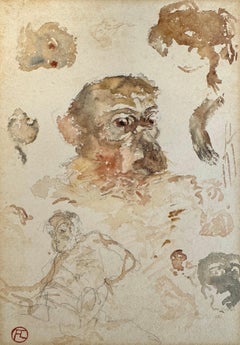
"Singes (Monkeys)" 1881 by Henri de Toulouse-Lautrec Watercolor & Graphite Study

"Singes (Monkeys)" 1881 by Henri de Toulouse-Lautrec Watercolor & Graphite Study

By Henri de Toulouse-Lautrec

Located in Yardley, PA

About this work: Before he became the celebrated chronicler of Montmartre’s nightlife, Lautrec was surrounded by a different kind of spectacle. At his family’s estates, the young art...

Category

1880s Naturalistic Philip Rickman Art

Materials

Paper, Watercolor, Graphite

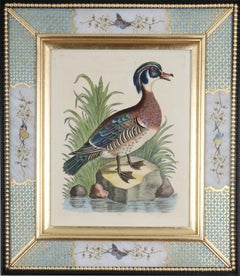
George Edwards: 18th Century Engravings of Ducks And Wading Birds

George Edwards: 18th Century Engravings of Ducks And Wading Birds

By George Edwards

Located in Richmond, GB

George Edwards: ""A History of Uncommon Birds"", 1749-1761. A prominent English naturalist and ornithologist, George Edwards (1694 -1773) is best known for his work, ""A Natural His...

Category

18th Century Philip Rickman Art

Materials

Watercolor

Vigilant Fox - The psyche of the fox -

Vigilant Fox - The psyche of the fox -

By Carl Friedrich Deiker

Located in Berlin, DE

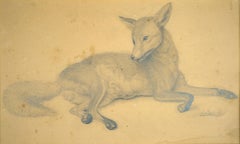
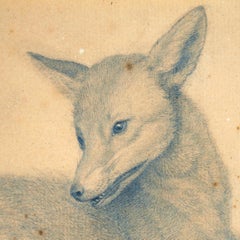
Carl Friedrich Deiker (1838 Wetzlar - 1892 Düsseldorf). Vigilant fox. Pencil drawing on brown paper, 18 × 29.5 cm (inside measurement), 31.5 x 43.5 cm (mount), signed and dated "Deiker [18]54" at lower right. - a little bit stained, with a light water stain at lower right About the artwork Carl Friedrich Deiker's consummate ability to depict animals is already evident in this early work. He brought a whole new psychological dimension to animal painting, so that one could literally speak of animal portraits. The naturalistic appearance of the fox alone makes it seem alive. Every strand of muscle, even every hair, is captured, which requires an intensive artistic study of animal anatomy and physiology. But the fox's real liveliness comes not from its natural appearance, but from its internal movement: Stretched out, it has been brought out of rest. It turns around and, with its ears pricked up, looks intently in the direction from which it has seen something. His mouth is slightly open and his pointed teeth are bared, as if he were growling. Tension gradually takes hold of his whole body. While the hind legs were still in a relaxed position, closely observed by Deiker, one front leg was already raised, ready to begin a rising movement. The fox seems so alarmed with all its senses that one gets the impression that, at any moment, its tail will move jerkily and the animal will jump up. While wild animals have traditionally been portrayed as beasts or anthropomorphised, often for caricatural purposes, Deiker explores their inherent nature by attempting to capture their psychic impulses. The wild animal is neither bestial nor human, but a creature in its own right, valued by Deiker for its own sake. In this way, he brought the dignity of the animal into representation and raised animal painting to a whole new artistic level. About the artist Carl Friedrich Deiker was the son of the drawing teacher Christian Friedrich Deiker and the younger brother of the animal painter Johannes Deiker. In addition to the family art lessons, Christian Friedrich shared a studio with his brother Johannes at Braunfels Castle, Deiker attended the drawing academy in Hanau, and from 1858 he was a student at the Karlsruhe Art Academy, where he studied under the landscape painter Johann Wilhelm Schirmer. Carl Friedrich Deiker was already in demand as an artist during his first year: Grand Duke Frederick I of Baden, Margrave Max of Baden and Grand Duke Michael of Russia bought hunting scenes by him. In 1859 he went on a study trip to the Reinhardswald. Just as the Barbizon School had rediscovered the landscape, Deiker opened up the forest for animal painting. From 1861-64 Deiker had his own studio in Karlsruhe, then moved to Düsseldorf, where his brother Johannes followed four years later. Deiker married a daughter of the landscape painter Karl Hilger and remained in Düsseldorf until his death. In 1868 he finally achieved international fame with his painting 'Pursued Noble Deer' and was regarded as a virtuoso new founder of animal painting. "Deiker brought for the first time a truly great artistic quality to animal painting [...]". - Hans Vollmer From 1870 he participated in the academic art exhibitions in Berlin, Dresden, Munich and Hanover. He was also very busy as an illustrator. He drew for the Gartenlaube, the Salon, the Universum, and produced many of the finely illustrated hunting and animal books of the period. He also worked as a printmaker, while his oil paintings circulated as reprints by Franz Dinger. From 1865 to 1892 Deiker was a member of the artists' association Malkasten. Carl Friedrich Deiker's life's work was honoured with a large posthumous memorial exhibition at the Düsseldorf Kunsthalle in 1892. His son Carl Deiker, born in 1879, also became a painter. Selection of art museums that own works by Carl Friedrich Deiker: Hamburger Kunsthalle / Kunsthalle Karlsruhe / Kunstmuseum Düsseldorf / Wallraff Richartz Cologne. Selected Bibliography H. Schmidt: Johannes and...

Category

1850s Naturalistic Philip Rickman Art
Materials

Pencil

Contemporary female artist parrots animal cage watercolor painting signed

Contemporary female artist parrots animal cage watercolor painting signed

By Alicia Czechowski

Located in Milwaukee, WI

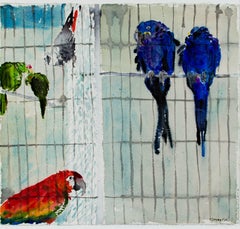
"Parrots" is an original watercolor signed by Alicia Czechowski. The artist signed the piece lower right. This piece depicts six multi-colored parrots in a cage. 16 3/4" x 18" art ...

Category

1960s Impressionist Philip Rickman Art

Materials

Watercolor

George Edwards: 18th Century Engravings of Ducks And Wading Birds

George Edwards: 18th Century Engravings of Ducks And Wading Birds

By George Edwards

Located in Richmond, GB

George Edwards: ""A History of Uncommon Birds"", 1749-1761. A prominent English naturalist and ornithologist, George Edwards (1694 -1773) is best known for his work, ""A Natural His...

Category

18th Century Philip Rickman Art

Materials

Watercolor

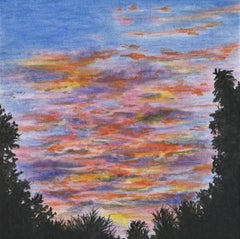
Nightfall, Original Landscape Drawing, 2018

Nightfall, Original Landscape Drawing, 2018

By Judith Simonds

Located in Boston, MA

Artist Commentary: A stunning, colorful Texas sunset. Keywords: Landscape & Nature Artist Biography: Judith grew up 15 miles north of Milwaukee in the ...

Category

21st Century and Contemporary Naturalistic Philip Rickman Art
Materials

Paper, Watercolor, Pencil

Philip Rickman art for sale on 1stDibs.

Find a wide variety of authentic Philip Rickman art available for sale on 1stDibs.

Artists Similar to Philip Rickman