By Pierre D'Avesn
Located in Ulm, DE
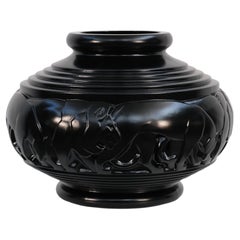
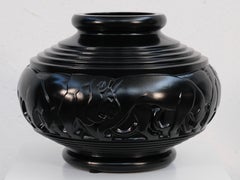
Pierre d’Avesn Art Deco lion vase, France, circa 1930, crafted from molded glass with a black lacquered finish. Its broad proportions, bold animal decoration, and stepped geometric details around the neck and base reflect the distinctive design language of French Art Deco.
The main decorative feature is the continuous frieze of stylized lions, modeled in pronounced relief around the body of the vase. Rather than being depicted naturalistically, the animals are reduced to strong, simplified forms with prominent heads, powerful bodies, and long, curved tails. The repetition of the lions creates a rhythmic pattern that extends around the entire vessel.
Multiple concentric stepped rings above and below the lion frieze provide a geometric counterpoint to the animal motif. The substantial circular foot and wide rim continue this horizontal structure and give the vase its characteristic silhouette. The black lacquered finish unifies the surface while allowing light and shadow to emphasize the relief of the lions and the stepped contours of the glass.
The vase was produced in molded and pressed glass (verre moulé-pressé), a technique that played an important role in French decorative glass during the 1920s and 1930s and allowed strongly defined relief decoration to be incorporated directly into the glass.
Pierre d’Avesn (1901–1990) was a French glass designer who began his career at a young age working for René Lalique. In the early 1930s, he worked for Daum in Nancy and was later also associated with Verlys. His designs frequently combine pronounced animal and natural motifs with the strong geometric vocabulary of the Art Deco period.
This signed Pierre d’Avesn vase...
Category
1930s French Art Deco Vintage Pierre D'Avesn