Located in Royal Tunbridge Wells, Kent
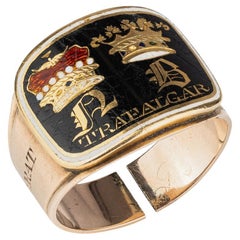
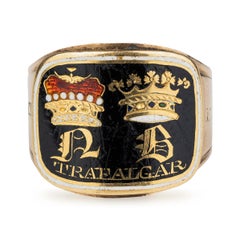
An extremely rare ring that commemorates the naval hero, Horatio Nelson, who died in 1805 at the Battle of Trafalgar, fighting against the Napoleonic forces. Dr William Nelson, the admiral's brother, ordered 58 mourning rings for family and friends and every admiral and post-captain who fought at the Battle of Trafalgar . The ring is inscribed on the bezel ‘Trafalgar’; outside the hoop with Nelson’s motto in Latin, ‘Let him who earned it bear the palm [of victory]’, adopted by Nelson from a poem ‘Ad Ventos’ written in 1727 by John Jortin (1698-1770). Inside is the inscription ‘Lost to his country 21 October 1805, aged 47’. The initials N and B stand for Nelson and Bronte.
Admiral Nelson was given the title of Duke of Bronte in 1799 by the King of Sicily and in 1801 became a Viscount. The two coronets above the initials refer to these titles. Tthe motto Palmam qui meruit ferat ("let him who has earned it, bear the palm") was added to his coat of arms in 1798 after the Battle of the Nile. Nelson was buried with full honours in St Paul's Cathedral. His cortege consisted of 32 admirals, over a hundred captains, and an escort of 10,000 soldiers.
This ring is an example of only fifty-eight that were made by Nelson's jeweller John Salter in 1806. Thirty-one were for Nelson's close family and friends, the rest for pall-bearers and other dignitaries (see The Nelson Dispatch, vol.3 pt.XII, oct.1990). Three similar examples of this ring are held extremely prestigious museums in the capital. One is in the Greenwich National Maritime Museum in London, another in The British Museum in London and another in the collection of the Victoria & Albert Museum, London, exhibited in the Jewellery Gallery, case 23, no. 8.
The ring has a particularly special provenance, arguably like no other mourning ring of Admiral Nelson’s. The ring belonged to the Reverend Alexander John Scott. The Reverend Alexander John Scott (1768-1840) was a British naval chaplain. He was appointed to the flagship H.M.S. Victory in 1803 where he served as private secretary to Lord Nelson. He was with Nelson when when he was shot on the quarter-deck of the Victory at the battle of Trafalgar on the 21st October 1805. Scott attended his dying chief in the cockpit of the flagship, receiving his last wishes. He refused to leave Nelson's body until it was brought back to England and placed in the coffin to lie in the Painted Hall Greenwich.
The ring, lock of hair and music book were passed down by the direct descendants of the Reverend Alexander John Scott's family and eventually gifted to the previous owners. The music book was a personal possession of the Reverend which gives watertight provenance of the person who owned the ring.
It is not clear exactly what Admiral Nelson’s last words really were although Scott documents Nelson’s last words to be “God and my country“. However, it is also recorded that a statement during his last hours was "Thank God I have done my duty.” Perhaps these two statements uttered in the last moments sound similar when mumbled by a feeble dying man. Nonetheless, it is noteworthy is that Scott remained by Admiral Nelson’s side as he died and his version is probably the most reliable.
The lock of hair is reputedly that of Lord Admiral Nelson. Without a DNA test there can be no conclusive proof of such. However, given that Reverend Alexander John Scott was with Nelson from the moment he was shot on the quarter-deck of H.M.S. Victory until the moment he was placed in his coffin, there is no reason to believe it is not a lock of Nelson’s hair.
It is difficult to overstate the significance and rarity of Nelson’s mourning rings. With only fifty-eight made, the vast majority of them were given to close family members and only a few were given to close friends. A close friend who receives a morning ring...
Category
19th Century English Antique Remploy