By Fritz Eichenberg
Located in Myrtle Beach, SC
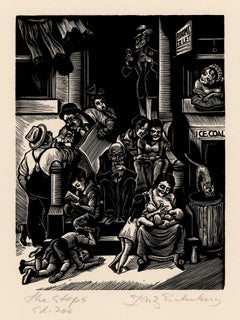
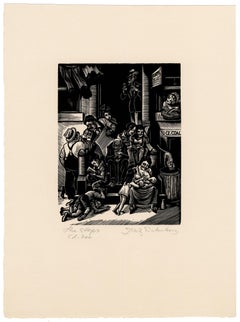
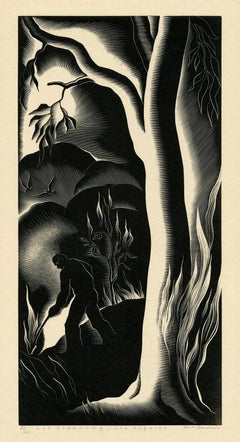
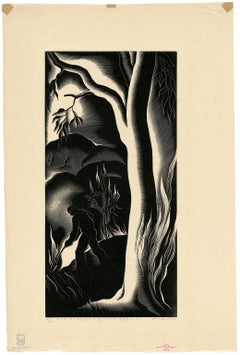
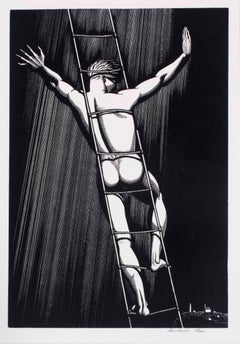
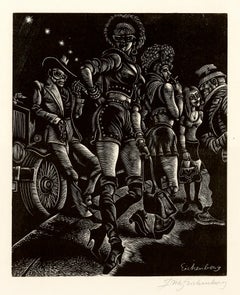
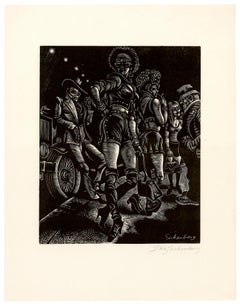
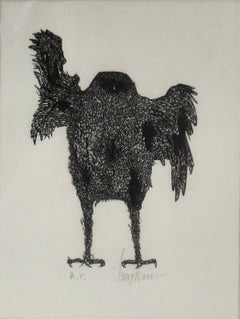
Fritz Eichenberg, 'The Pimp', wood engraving, 1980, artist's proof before the edition. Signed in pencil. Signed in the block, lower right. A fine, richly-inked impression, on cream wove paper, with full margins (2 3/16 to 3 1/2 inches), in excellent condition. Archivally sleeved, unmatted.
Image size 12 x 9 3/4 inches (305 x 248 mm); sheet size 18 x 14 inches (457 x 356 mm).
ABOUT THE ARTIST
Fritz Eichenberg (1901–1990) was a German-American illustrator and arts educator who worked primarily in wood engraving. His best-known works were concerned with religion, social justice, and nonviolence.
Eichenberg was born to a Jewish family in Cologne, Germany, where the destruction of World War I helped to shape his anti-war sentiments. He worked as a printer's apprentice and studied at the Municipal School of Applied Arts in Cologne and the Academy of Graphic Arts in Leipzig, where he studied under Hugo Steiner-Prag. In 1923 he moved to Berlin to begin his career as an artist, producing illustrations for books and newspapers. In his newspaper and magazine work, Eichenberg was politically outspoken and sometimes wrote and illustrated his reporting.
In 1933, the rise of Adolf Hitler drove Eichenberg, who was a public critic of the Nazis, to emigrate with his wife and children to the United States. He settled in New York City, where he lived most of his life. He worked in the WPA Federal Arts Project and was a member of the Society of American Graphic Artists.
In his prolific career as a book illustrator, Eichenberg portrayed many forms of literature but specialized in works with elements of extreme spiritual and emotional conflict, fantasy, or social satire. Over his long career, Eichenberg was commissioned to illustrate more than 100 classics by publishers in the United States and abroad, including works by renowned authors Dostoyevsky, Tolstoy, Charlotte and Emily Brontë, Poe, Swift, and Grimmelshausen. He also wrote and illustrated books of folklore and children's stories.
Eichenberg was a long-time contributor to the progressive magazine The Nation, his illustrations appearing between 1930 and 1980. Eichenberg’s work has been featured by such esteemed publishers as The Heritage Club, Random House, Book of the Month Club, The Limited Editions Club, Kingsport Press, Aquarius Press, and Doubleday.
Raised in a non-religious family, Eichenberg had been attracted to Taoism as a child. Following his wife's unexpected death in 1937, he turned briefly to Zen Buddhist meditation, then joined the Religious Society of Friends in 1940. Though he remained a Quaker until his death, Eichenberg was also associated with Catholic charity work through his friendship with Dorothy Day...
Category
1980s American Modern Robert Franz Von Neumann Art