Sir Henry Raeburn Paintings

British, 1756-1823
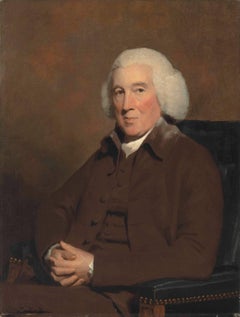
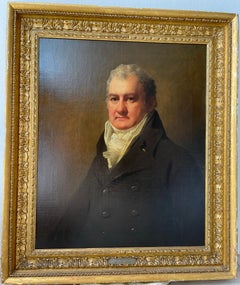
Sir Henry Raeburn, FRSE, RA, RSA (1756–1823) was a prominent Scottish portrait painter who is now largely credited for the revival of Scottish art in the early 19th century. Born in Stockbridge, Edinburgh, he was orphaned at a young age and subsequently educated at Heriot’s Hospital. He began his career as a goldsmith's apprentice, creating portrait miniatures before transitioning to oil painting, largely self-taught. Raeburn married the wealthy Ann Edgar, which enabled him to study art in Italy, where he was advised by Sir Joshua Reynolds and others. Upon returning to Edinburgh in 1787, Raeburn quickly gained success, painting notable figures like Sir Walter Scott and Dugald Stewart. He became known for his vigorous brushwork, strong characterizations, and dramatic lighting. His direct painting style and refusal to make preparatory sketches set him apart from contemporaries, incorporating elements of Romanticism. He was knighted by King George IV in 1822 and appointed the King’s limner for Scotland. He died in 1823 at his home in Stockbridge, Edinburgh. This distinguished three-quarter length portrait depicts Elizabeth Clough (b. circa 1970-1770s), matriarch of the Clough family of Keighley, West Yorkshire. The piece was commissioned by her son, John Clough (1799–1863), a prominent engineer and industrialist in Keighley. Clough owned and operated Grove Mills, a major worsted spinning and manufacturing facility which employed a significant portion of the local workforce. Elizabeth Clough is portrayed seated in an upholstered armchair, dressed in sober but elegant attire—a dark shawl and a crisp white cap tied beneath her chin. Her direct, steady gaze and flushed cheeks convey quiet strength and maternal dignity. The subdued, neutral background serves to emphasize the face and upper body, while still maintaining an airy and light feel. The face is rendered with sensitive modeling and naturalistic lighting, while the fabric of her garments contain blockier brushstrokes yet do not lose their sensitivity. These characteristics, combined with the information gleaned from the label, place this piece in the tradition of early 19th century Scottish portraiture.
to
2
2
2
Overall Width
to
Overall Height
to
2
2
1
1
4
4
3
3
2
2
1
1
1
4
4
1
1
5
784
753
753
663
4
3
1
Artist: Sir Henry Raeburn
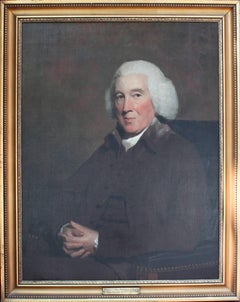
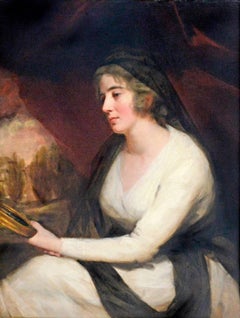
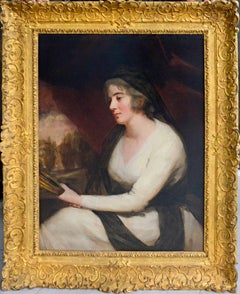
Portrait of Mrs. Johnstone, Realist Oil on Canvas, Circa 1800, Ornate Gilt Frame

Portrait of Mrs. Johnstone, Realist Oil on Canvas, Circa 1800, Ornate Gilt Frame

By Sir Henry Raeburn

Located in Miami, FL

This is one of Raeburn's best works from his best period, which is not in a museum or private collection. Three-quarter-length portrait, seated in a white dress with a black scarf ov...

Category

Early 1800s Realist Sir Henry Raeburn Paintings

Materials

Oil

Striking 18th Century Portrait of the 12th Earl of Caithness

Striking 18th Century Portrait of the 12th Earl of Caithness

By Sir Henry Raeburn

Located in London, GB

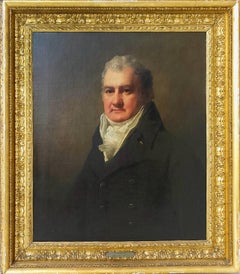
Sir Henry Raeburn (1756-1823) James Sinclair, 12th Earl of Caithness (1766-1823) Oil on Canvas 30 X 25 inches Unframed 37 X 32 inches framed Sir Henry Raeburn FRSE RA RSA (4 March 1756 – 8 July 1823) was a Scottish portrait painter and Scotland's first significant portrait painter since the Union to remain based in Scotland. He served as Portrait Painter to King George IV in Scotland. Raeburn was born the son of a manufacturer in Stockbridge, on the Water of Leith: a former village now within the city of Edinburgh. He had an older brother, born in 1744, called William Raeburn. His ancestors were believed to have been soldiers, and may have taken the name "Raeburn" from a hill farm in Annandale, held by Sir Walter Scott's family. Orphaned, he was supported by William and placed in Heriot's Hospital, where he received an education. At the age of fifteen he was apprenticed to the goldsmith James Gilliland of Edinburgh, and various pieces of jewellery, mourning rings and the like, adorned with minute drawings on ivory by his hand, still exist. Soon he took to the production of carefully finished portrait miniatures; meeting with success and patronage, he extended his practice to oil painting, at which he was self-taught. Gilliland watched the progress of his pupil with interest, and introduced him to David Martin, who had been the favourite assistant of Allan Ramsay the Latter, and was now the leading portrait painter in Edinburgh. Raeburn was especially aided by the loan of portraits to copy. Soon he had gained sufficient skill to make him decide to devote himself exclusively to painting. George Chalmers (1776; Dunfermline Town Hall) is his earliest known portrait. In his early twenties, Raeburn was asked to paint the portrait of a young lady he had noticed when he was sketching from nature in the fields. Ann was the daughter of Peter Edgar of Bridgelands, and widow of Count James Leslie of Deanhaugh. Fascinated by the handsome and intellectual young artist, she became his wife within a month, bringing him an ample fortune. The acquisition of wealth did not affect his enthusiasm or his industry, but spurred him on to acquire a thorough knowledge of his craft. It was usual for artists to visit Italy, and Raeburn set off with his wife. In London he was kindly received by Sir Joshua Reynolds, the president of the Royal Academy, who advised him on what to study in Rome, especially recommending the works of Michelangelo, and gave Raeburn letters of introduction for Italy. In Rome he met his fellow Scot Gavin Hamilton, Pompeo Girolamo Batoni and Byers, an antique dealer whose advice proved particularly useful, especially the recommendation that "he should never copy an object from memory, but, from the principal figure to the minutest accessory, have it placed before him." After two years of study in Italy he returned to Edinburgh in 1787, and began a successful career as a portrait painter. In that year he executed a seated portrait of the second Lord President Dundas. Examples of his earlier portraiture include a bust of Mrs Johnstone of Baldovie and a three-quarter-length of Dr James Hutton: works which, if somewhat timid and tentative in handling and not as confident as his later work, nevertheless have delicacy and character. The portraits of John Clerk, Lord Eldin, and of Principal Hill of St Andrews belong to a later period. Raeburn was fortunate in the time in which he practised portraiture. Sir Walter Scott, Hugh Blair, Henry Mackenzie, Lord Woodhouselee, William Robertson, John Home, Robert Fergusson, and Dugald Stewart were resident in Edinburgh, and were all painted by Raeburn. Mature works include his own portrait and that of the Rev. Sir Henry Moncrieff Wellwood, a bust of Dr Wardrop of Torbane Hill, two full-lengths of Adam Rolland of Gask, the remarkable paintings of Lord Newton and Dr Alexander Adam in the National Gallery of Scotland, and that of William Macdonald of St Martin's. Apart from himself, Raeburn painted only two artists, one of whom was Sir Francis Leggatt Chantrey, the most important and famous British sculptor of the first half of the 19th century. It has recently been revealed that Raeburn and Chantrey were close friends and that Raeburn took exceptional care over the execution of his portrait of the sculptor, one of the painter's mature bust-length masterpieces. It was commonly believed that Raeburn was less successful in painting female portraits, but the exquisite full-length of his wife, the smaller likeness of Mrs R. Scott Moncrieff in the National Gallery of Scotland, and that of Mrs Robert Bell, and others, argue against this. Raeburn spent his life in Edinburgh, rarely visiting London, and then only for brief periods, thus preserving his individuality. Although he, personally, may have lost advantages resulting from closer association with the leaders of English art, and from contact with a wider public, Scottish art gained much from his disinclination to leave his native land. He became the acknowledged chief of the school which was growing up in Scotland during the early 19th century, and his example and influence at a critical period were of major importance. So varied were his other interests that sitters used to say of him, "You would never take him for a painter till he seizes the brush and palette." In 1812 he was elected president of the Society of Artists in Edinburgh; and in 1814 associate, and in the following year full member, of the Royal Scottish Academy. On 29 August 1822 he was knighted by George IV and appointed His Majesty's limner for Scotland at the Earl of Hopetoun house. He died in Edinburgh. Raeburn had all the essential qualities of a popular and successful portrait painter. He was able to produce a telling and forcible likeness; his work is distinguished by powerful characterisation, stark realism, dramatic and unusual lighting effects, and swift and broad handling of the most resolute sort. David Wilkie recorded that, while travelling in Spain and studying the works of Diego Velázquez, the brushwork reminded him constantly of the "square touch" of Raeburn. Scottish physician and writer John Brown wrote that Raeburn "never fails in giving a likeness at once vivid, unmistakable and pleasing. He paints the truth, and he paints it with love". Raeburn has been described as a "famously intuitive"portrait painter. He was unusual amongst many of his contemporaries, such as Reynolds, in the extent of his philosophy of painting directly from life; he made no preliminary sketches. This attitude partly explains the often coarse modelling and clashing colour combinations he employed, in contrast to the more refined style of Thomas Gainsborough and Reynolds. However these qualities and those mentioned above anticipate many of the later developments in painting of the 19th century from romanticism to Impressionism. Sir Henry Raeburn died in St Bernard's House (17 St Bernards Crescent), Stockbridge, Edinburgh. He is buried in St. Cuthbert's churchyard against the east wall (the monument erected by Raeburn in advance) but also has a secondary memorial in the Church of St John the Evangelist, Edinburgh. James Sinclair, 12th Earl of Caithness was born at Barrogill Castle (Castle of Mey) on 31 May 1766. He was the son of Sir John Sinclair of Mey, Baronet who he succeeded in the baronetcy in 1774. He succeeded as 12th earl of Caithness in 1789. He was lord-lieutenant of the county of Caithness and lieutenant-colonel of the Ross-shire militia. He married at Thurso Castle on 2 January 1784 Jane, second daughter of Alexander Campbell...

Category

18th Century Sir Henry Raeburn Paintings

Materials

Oil

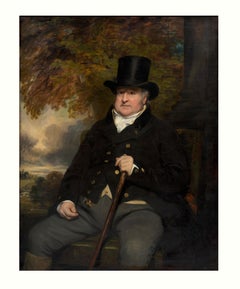
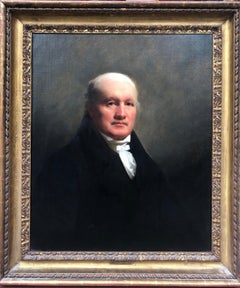
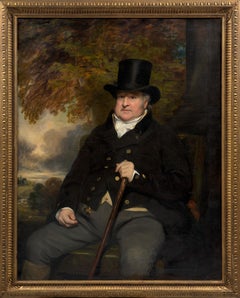
19th Century by Sir Henry Raeburn Portrait of a landowner Oil on canvas

19th Century by Sir Henry Raeburn Portrait of a landowner Oil on canvas

By Sir Henry Raeburn

Located in Milano, Lombardia

Sir Henry Raeburn (Stockbridge, Edinburgh, UK, 1756 - Edinburgh, UK, 1823) Title: Portrait of a landowner Year: Early 19th century, 1803 Medium: Oil on canvas Dimensions: Without fra...

Category

Early 19th Century Old Masters Sir Henry Raeburn Paintings

Materials

Canvas, Oil

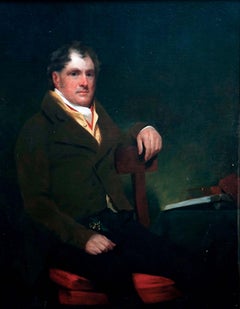
Portrait of Lord William Russell, three-quarter length

Portrait of Lord William Russell, three-quarter length

By Sir Henry Raeburn

Located in Taunton, GB

Portrait of Lord William Russell, three-quarter length seated at a table wearing a Brown Coat and a Yellow Waistcoat and a White Stock, a book by his side Oil on canvas 49 ½ x 39 ½...

Category

Late 17th Century Sir Henry Raeburn Paintings

Materials

Oil

Related Items
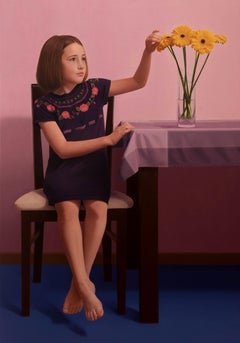
Gerberas - Contemporary Figurative Oil Painting, Realistic Little Girl Portrait

Gerberas - Contemporary Figurative Oil Painting, Realistic Little Girl Portrait

By Kamil Lisek

Located in Hallein, AT

KAMIL LISEK (born in 1980) Studied under the guidance of prof. Maciej Świeszewski at the faculty of painting at the Academy of Fine Arts in Gdansk. He graduated with distinction obta...

Category

2010s Realist Sir Henry Raeburn Paintings

Materials

Canvas, Oil, Linen

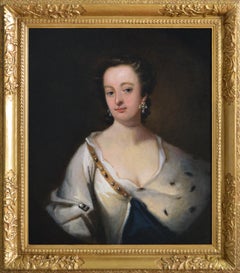
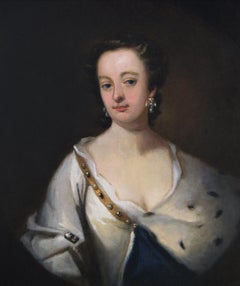
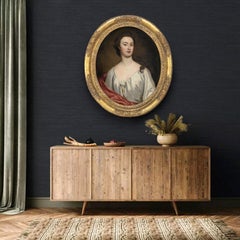
18th Century portrait oil painting of a lady in an ermine trimmed cloak

18th Century portrait oil painting of a lady in an ermine trimmed cloak

By Sir Godfrey Kneller

Located in Nr Broadway, Worcestershire

Circle of Sir Godfrey Kneller Dutch, (1646-1723) Portrait of a Lady in an Ermine Trimmed Cloak Oil on canvas Image size: 26.5 inches x 22.5 inches Size including frame: 33.5 inches x 29.5 inches A well-executed half-length portrait of a lady painted in a feigned oval, circle of Sir Godfrey Kneller. The use of a feigned oval was a device used in portraiture to give a sense of depth and add an intimacy to the painting, drawing your attention to the sitter. The subject, posed without her wig in the undressed fashion of the day, wears a blue ermine trimmed blue cloak over a white silk robe...

Category

18th Century Old Masters Sir Henry Raeburn Paintings

Materials

Canvas, Oil

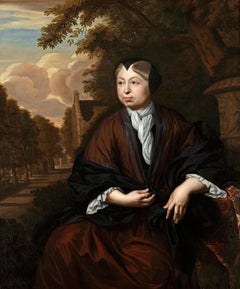
Male and female portrait, both in silk kimono, possibly textile dealers

Male and female portrait, both in silk kimono, possibly textile dealers

By Christoffel Lubieniecki

Located in Amsterdam, NL

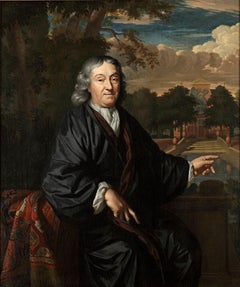
CHRISTOFFEL LUBIENIECKI (1659-1729) Pair of portraits of a gentleman and a lady, both in silk kimono, before a country house (circa 1680) Indistinctly signed “C.......” on a box under the man’s left hand Oil on canvas, 79.5 x 67 cm each Both sitters are portrayed wearing a silk “Japanese” coat. During the second half of the seventeenth the Japanese silk coat, an adapted Japanese kimono, became a real vogue in the Dutch elite. The exclusive Dutch trade contacts with Japan can explain the popularity of the kimono-style silk coats in the Netherlands. Everybody who could afford one, dressed in such a fashionable and comfortable coat and, like the present sitters, some proud owners had themselves portrayed in a “Japanese” coat often together with an oriental carpet to underline their standing and international connections. These portraits are the work of the Polish-born portraitist Christoffel Lubieniecki (also known as Lubienitski, Lubinitski or Lubiniecki) Lubieniecki was first trained in Hamburg under Julian Stuhr and after 1675 in Amsterdam under Adriaen Backer and Gerard de Lairesse. He specialized in landscapes, generally of an Italianate character, and in portraits. The loving execution of these contented burghers, enjoying the garden vistas of their country house, places him alongside Amsterdam portraitists such as Constantijn Netscher and Michiel van Musscher...

Category

1680s Old Masters Sir Henry Raeburn Paintings

Materials

Canvas, Oil

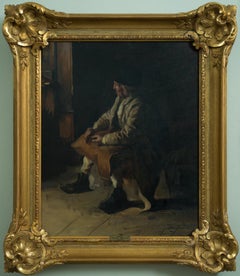
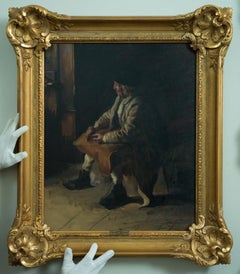
The Seated Man – An Intimate Glimpse into Daily Life

The Seated Man – An Intimate Glimpse into Daily Life

Located in Stockholm, SE

This masterfully executed painting by Emerik Stenberg (1873–1927) captures an intimate and atmospheric moment. The composition features a seated man, engrossed in his daily chores, b...

Category

Early 20th Century Realist Sir Henry Raeburn Paintings

Materials

Canvas, Oil

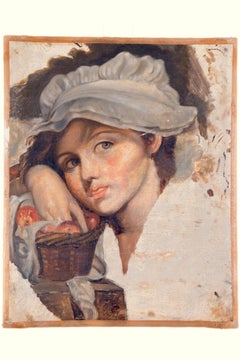
Young Girl with a Basket of Fruit, Oil on Canvas, French, Circa 1790

Young Girl with a Basket of Fruit, Oil on Canvas, French, Circa 1790

By Jean-Baptiste Greuze

Located in Paris, Île-de-France

French School, late 18th century, circle of Jean-Baptiste Greuze (1725–1805) Young Girl with a Basket of Fruit Oil on canvas, preparatory work, Unsigned 39 x 31 cm Provenance: Pri...

Category

1790s Old Masters Sir Henry Raeburn Paintings

Materials

Canvas, Oil

Portrait of a Gentleman in a Blue Coat Standing by a Curtain c.1695, Netscher

Portrait of a Gentleman in a Blue Coat Standing by a Curtain c.1695, Netscher

Located in London, GB

Portrait of a Gentleman in Blue Coat Standing by Curtain c.1695 Attributed to Constantyn Netscher (c.1668-c.1723), not signed The gentleman in this portrait has been depicted standi...

Category

17th Century Old Masters Sir Henry Raeburn Paintings

Materials

Canvas, Oil

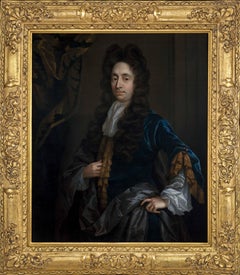
17th Century portrait oil painting of a gentleman

17th Century portrait oil painting of a gentleman

By John Riley

Located in Nr Broadway, Worcestershire

Circle of John Riley British, (1646-1691) Portrait of a Gentleman Oil on canvas Image size: 29 inches x 24 inches Size including frame: 36 inches x 31 inch...

Category

17th Century Old Masters Sir Henry Raeburn Paintings

Materials

Canvas, Oil

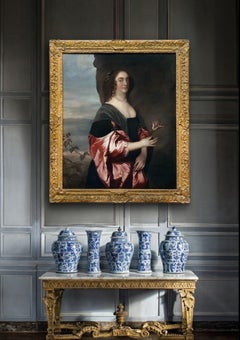
Portrait of a Lady, in Black Dress with Red Satin Sleeves and Pearls c.1660-1680

Portrait of a Lady, in Black Dress with Red Satin Sleeves and Pearls c.1660-1680

By Sir Peter Lely

Located in London, GB

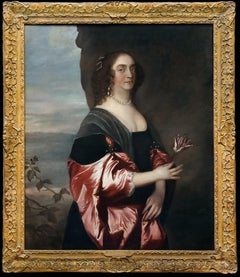
Portrait of a Lady, in a Black Dress with Red Satin Sleeves and Pearls English School c.1660–1680 Circle of Sir Peter Lely (1618-1680) This striking portrait is a compelling exampl...

Category

17th Century Old Masters Sir Henry Raeburn Paintings

Materials

Canvas, Oil

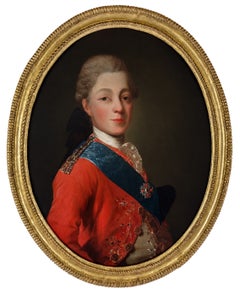
Portrait Painting Grand Duke Pavel Petrovich, Later Emperor Paul I, 18th century

Portrait Painting Grand Duke Pavel Petrovich, Later Emperor Paul I, 18th century

Located in London, GB

Portrait of Grand Duke Pavel Petrovich (1754–1801), later Emperor Paul I of Russia After Alexander Roslin (1718–1793) Oil on canvas, oval, late 18th century This is an exceptionally handsome and historically resonant eighteenth-century portrait, uniting the immediacy of an intimate likeness with the authority of one of the defining dynastic images of Imperial Russia. Grand Duke Pavel Petrovich, the future Emperor Paul I, turns towards the spectator with a composed, almost conversational expression, his youthful face emerging softly from the restrained brown background. The rich scarlet of his coat, the deep blue of the sash and the flashes of gold, lace and jewelled decoration give the picture remarkable visual distinction, while the oval format concentrates attention upon the sitter’s face and magnificent ceremonial attire. Painted during the eighteenth century, the present work is a contemporary reduced version of Alexander Roslin’s monumental state portrait of 1777, now in the State Hermitage Museum, St Petersburg. Roslin’s full-length original measures approximately 265 by 168 centimetres; here, its essential elements have been reformulated as a more intimate portrait suitable for display within an aristocratic residence, diplomatic household or private cabinet. Pavel is dressed in the height of European court fashion of the later 1770s. His scarlet habit à la française comprises a close-fitting coat and elaborately embroidered waistcoat, enriched with scrolling metallic ornament, floral motifs and a sequence of large decorative buttons. The shoulder is finished with a densely worked epaulette-like band, while a white linen stock and delicate lace jabot frame the face. His powdered hair is dressed in the fashionable bag-wig, drawn back and tied with a broad black silk ribbon. Although the costume is unmistakably Russian in its dynastic significance, its cut and ornament belong to the international language of court dress then prevailing from Versailles and Vienna to Stockholm and St Petersburg. In Roslin’s original full-length composition, the costume was completed by matching scarlet breeches, silk stockings, buckled shoes, a sword and a plumed tricorne, all identifying Pavel as both a prince of the blood and a cultivated participant in the ceremonial life of Europe’s great courts. Across his breast passes the broad blue watered-silk sash of the Imperial Order of St Andrew the First-Called, the senior Russian order of chivalry established by Peter the Great. The sash, conventionally worn from the right shoulder towards the left hip, proclaimed the sitter’s position at the summit of the imperial hierarchy. Superimposed upon it is the red-enamelled cross of the Order of St Anna, surrounded in the portrait by scintillating, jewel-like highlights. The cross had a particular dynastic resonance: the order had been founded by Pavel’s paternal grandfather, Duke Karl Friedrich of Holstein-Gottorp, in memory of his wife Anna Petrovna, daughter of Peter the Great. Pavel’s display of the two orders therefore asserted not only rank and honour, but his descent from the founder of Imperial Russia and his inheritance through the Romanov and Holstein-Gottorp lines. Contemporary portraits similarly identify Pavel through the blue sash and star of St Andrew and the red cross of St Anna. Born in St Petersburg in 1754, Pavel Petrovich was the only son of Grand Duke Peter Fyodorovich, later Emperor Peter III, and Grand Duchess Catherine Alexeyevna, the future Catherine the Great. Through his father he was a great-grandson of Peter the Great and inherited the Romanov and Holstein-Gottorp bloodlines; through his mother, born Princess Sophie of Anhalt-Zerbst, he was connected to the extensive network of German princely houses that shaped eighteenth-century European dynastic politics. His childhood was dominated by the uncertainties of imperial succession. Soon after his birth, the Empress Elizabeth removed him to her own household and assumed control of his upbringing. Educated under the statesman Nikita Panin, Pavel studied history, geography and mathematics and became fluent in Russian, French and German. He was eight when his father ascended the throne in 1762, only to be deposed by Catherine within months and to die shortly afterwards in confinement. Although Pavel remained the acknowledged heir, Catherine ruled for another thirty-four years and excluded him from meaningful political authority. He was therefore publicly honoured as the future sovereign while being denied the practical experience of government. In 1773 he married Princess Wilhelmina Louisa of Hesse-Darmstadt, who converted to Orthodoxy as Grand Duchess Natalia Alexeievna. She died in April 1776 after a prolonged labour, together with her stillborn child, leaving Pavel widowed and the succession unsecured. A second marriage was arranged within months. His new bride was Duchess Sophie Dorothea of Württemberg, daughter of Friedrich Eugen, later Duke of Württemberg, and Friederike Dorothea of Brandenburg-Schwedt. Raised at Montbéliard in a cultivated German princely household, she converted to Orthodoxy as Maria Feodorovna and married Pavel in October 1776. The union strengthened Russia’s links with Württemberg and Brandenburg-Prussia, but also became an enduring domestic and cultural partnership. Maria was intelligent and artistically gifted, practising drawing, embroidery, ivory carving and hardstone work, while collecting books and decorative art and later supporting charitable and educational institutions. The couple had ten children, nine of whom survived childhood. Their eldest son, Alexander, succeeded Pavel as Emperor Alexander I and ruled during the Napoleonic era; their younger son Nicholas later became Emperor Nicholas I. Constantine Pavlovich became a prominent military figure and briefly stood at the centre of the succession crisis of 1825. Their daughters married into leading European dynasties: Alexandra into the Austrian imperial family, Elena into Mecklenburg-Schwerin, Maria into Saxe-Weimar-Eisenach, Catherine into Württemberg and Anna into the Dutch royal house. Through their children, Pavel and Maria extended Romanov influence across much of Europe. The birth of Alexander in 1777 secured the succession and prompted Catherine to give the couple the estate that became Pavlovsk, south of St Petersburg. Its Neoclassical palace, begun by Charles Cameron in the early 1780s, became closely associated with Maria’s artistic interests, family life and refined sociability. Gatchina, by contrast, reflected Pavel’s more martial character. There he developed his own court and pursued his interests in military organisation, ceremony and administrative discipline. In 1781–82 Pavel and Maria travelled through Europe as the Count and Countess of the North, visiting royal courts, artists, manufactories and antiquities collections. They acquired paintings, furniture, bronzes, sculpture, textiles and porcelain, helping to make Pavlovsk one of Russia’s most sophisticated expressions of international Neoclassical taste. Yet Catherine continued to restrict their independence, taking charge of the upbringing of Alexander and Constantine just as Empress Elizabeth had once removed Pavel from his own parents. This repetition deepened the estrangement between mother and son. Pavel finally succeeded Catherine in 1796, aged forty-two. His reign lasted little more than four years, but his Act of Succession of 1797 established male-line primogeniture and ended much of the uncertainty surrounding the Russian imperial succession. His attempts to regulate the court, army and administration, and to reverse elements of Catherine’s policies, alienated powerful members of the nobility and officer corps. In March 1801 he was assassinated during a palace coup at the Mikhailovsky Castle and was succeeded by Alexander. This knowledge lends the portrait particular poignancy: Pavel appears not as the embattled emperor of his final years, but as the elegant young heir at a moment when marriage, dynasty and the anticipated birth of a son seemed to promise stability and renewal. Roslin’s portrait should be understood within this urgent dynastic context. The Swedish painter had travelled to St Petersburg in 1775 at the personal invitation of Catherine II and was commissioned to paint monumental state portraits of the Empress, Pavel and Maria Feodorovna. The pendant portraits of the young couple presented the heir and his new wife as the polished, fertile and internationally connected future of the Romanov dynasty. Roslin recorded in 1777 that the ruling family had ordered multiple copies. At least six versions of Pavel’s portrait and twelve of Maria’s are known, and such replicas were distributed as courtly and diplomatic gifts. A pair was presented to James Harris, later First Earl of Malmesbury, then the British ambassador to Russia. The existence of numerous eighteenth-century replicas was therefore not accidental or merely commercial: repetition was integral to the commission’s political purpose. Each version extended the official image of succession from the imperial palace into allied courts, embassies and aristocratic collections. The present portrait belongs to that wider culture of dynastic dissemination. Rather than reproducing Roslin’s entire monumental setting, with its architectural balustrade, extensive Neva prospect, sword, hat and full ceremonial costume, the painter has selected the head and upper body and adapted them to an oval. This transformation changes the character of the image. The grandeur of the original remains legible in the orders, costume and confident turn of the figure, but the reduced composition produces a greater sense of proximity to Pavel himself. The face becomes dominant, and the future emperor appears less as a remote emblem of state than as a recognisable young man. The type also circulated through prints: an oval engraved version published in 1781 and now represented in the British Museum demonstrates how rapidly Roslin’s conception entered the broader visual culture of late-eighteenth-century Europe. The artistic economy in which the portrait was created differed substantially from the modern open market. In Catherine’s Russia, the most prestigious portrait production was sustained by imperial commissions, aristocratic patronage and diplomatic gift-giving. Roslin’s success was extraordinary: during approximately two years in Russia he received around seventy-five commissions, many of which had to be completed after his return west. The appetite for his work reflected both the wealth of the Russian court and its determination to present itself through the most polished international style available. Alongside imported masters such as Roslin, Russia was developing its own institutional artistic culture. The Academy of the Three Noble Arts had been founded in St Petersburg in 1757 and was elevated by Catherine in 1764 to the Imperial Academy of Arts. It recruited European teachers, trained Russian...

Category

18th Century Old Masters Sir Henry Raeburn Paintings
Materials

Oil, Canvas

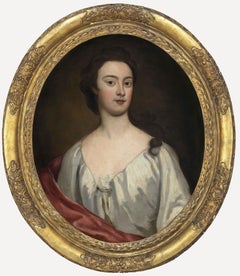
English Portrait of a Young Lady in White Dress c. 1730–1740, Fine Period Frame

English Portrait of a Young Lady in White Dress c. 1730–1740, Fine Period Frame

Located in London, GB

Portrait of a Young Lady, probably British c.1730–1740 Attributed to Jeremiah Davison (c. 1695–1745) What makes this portrait immediately compelling is its directness: the sitter’s ...

Category

18th Century Old Masters Sir Henry Raeburn Paintings
Materials

Oil, Canvas

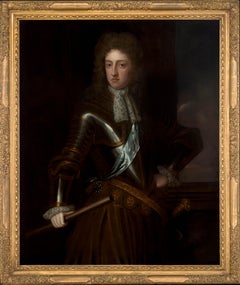
Portrait Prince George of Denmark, Duke of Cumberland c.1690–1695 Oil painting

Portrait Prince George of Denmark, Duke of Cumberland c.1690–1695 Oil painting

By Sir Godfrey Kneller

Located in London, GB

Portrait of Prince George of Denmark, Duke of Cumberland (1653–1708) c.1690–1695 Studio of Sir Godfrey Kneller (1646–1723) Few portraits embody the visual authority and dynastic sy...

Category

17th Century Old Masters Sir Henry Raeburn Paintings
Materials

Canvas, Oil

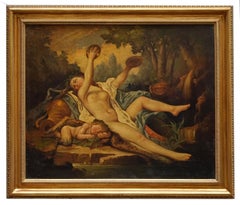
ALLEGORICAL SCENE - Giovanni Faliero - Italy  Oil on Canvas Painting

ALLEGORICAL SCENE - Giovanni Faliero - Italy Oil on Canvas Painting

By Giovanni Faliero

Located in Napoli, IT

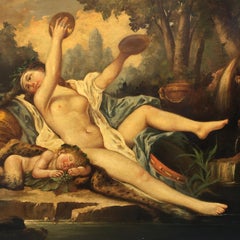
Allegorical Scene - Giovanni Faliero Italia 2009 - Oil on canvas cm. 90x110. This beautiful oil on canvas is the personal reinterpretation of the magnificent painting “Bacchant playing the Cymbals” by Jean-Simon Berthélemy, a French painter of the 18th century. Here we admire a mythological scene showing a naked bacchant playing cymbals next to a wooded stream, with a small sleeping faun...

Category

Early 2000s Old Masters Sir Henry Raeburn Paintings
Materials

Canvas, Oil

Previously Available Items
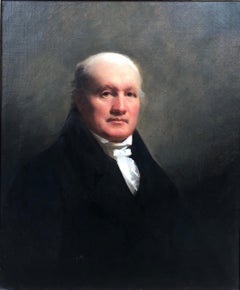
18th Century Oil Painting Portrait of Provost John Pitcairn of Dundee

18th Century Oil Painting Portrait of Provost John Pitcairn of Dundee

By Sir Henry Raeburn

Located in London, GB

The pendant to the present portrait showing John Pitcairn's wife Jean, née Robertson, is in the Huntington Art Gallery, San Marino. Both works are datable to the 1790s. Pitcairn, who served as Provost of Dundee from 1782-84, a position his father-in-law also held from 1731-32, later sat to Raeburn for another portrait, dated to circa 1820, which is now in the Royal Scottish Academy, Edinburgh Sale of Christie's London: Wednesday, July 9, 2014 [Lot 00212] Old Master & British Paintings Day Sale Sold For 22,500 GBP Premium Provenance By descent from the sitter to his great-grandson, Ronald Andrew Pitcairn of Pitcullo; Christie's, London, 25 June 1904, lot 58 (200 gns. to Wallis). Alexander Reid, Glasgow. With Agnew's, London, where acquired by A.R. Wilson Wood, 7 April 1909; Christie's, London, 26 June 1914, lot 78 (850 gns. to Agnew). Anonymous sale; Christie's, London, 24 November 1972, lot 27 (320 gns.) Private collection, Dublin, Ireland Exhibition Edinburgh, Royal Scottish Academy, 1876, no. 256 Literature W. Armstrong, Sir Henry Raeburn, London, 1901, p. 110. J. Greig, Sir Henry Raeburn, R.A., His life and work with a catalogue of his pictures, London, 1911, p. 55. R. Asleson and S.M. Bennett, British Paintings at The Huntington, New Haven and London, 2001, p. 312, fig. 12 Sir Henry Raeburn FRSE RA RSA (4 March 1756 – 8 July 1823) was a Scottish portrait painter and Scotland's first significant portrait painter since the Union to remain based in Scotland. He served as Portrait Painter to King George IV in Scotland. Raeburn was born the son of a manufacturer in Stockbridge, on the Water of Leith: a former village now within the city of Edinburgh. He had an older brother, born in 1744, called William Raeburn. His ancestors were believed to have been soldiers, and may have taken the name "Raeburn" from a hill farm in Annandale, held by Sir Walter Scott's family. Orphaned, he was supported by William and placed in Heriot's Hospital, where he received an education. At the age of fifteen he was apprenticed to the goldsmith James Gilliland of Edinburgh, and various pieces of jewellery, mourning rings and the like, adorned with minute drawings on ivory by his hand, still exist. Soon he took to the production of carefully finished portrait miniatures; meeting with success and patronage, he extended his practice to oil painting, at which he was self-taught. Gilliland watched the progress of his pupil with interest, and introduced him to David Martin, who had been the favourite assistant of Allan Ramsay the Latter, and was now the leading portrait painter in Edinburgh. Raeburn was especially aided by the loan of portraits to copy. Soon he had gained sufficient skill to make him decide to devote himself exclusively to painting. George Chalmers (1776; Dunfermline Town Hall) is his earliest known portrait. In his early twenties, Raeburn was asked to paint the portrait of a young lady he had noticed when he was sketching from nature in the fields. Ann was the daughter of Peter Edgar of Bridgelands, and widow of Count James Leslie of Deanhaugh. Fascinated by the handsome and intellectual young artist, she became his wife within a month, bringing him an ample fortune. The acquisition of wealth did not affect his enthusiasm or his industry, but spurred him on to acquire a thorough knowledge of his craft. It was usual for artists to visit Italy, and Raeburn set off with his wife. In London he was kindly received by Sir Joshua Reynolds, the president of the Royal Academy, who advised him on what to study in Rome, especially recommending the works of Michelangelo, and gave Raeburn letters of introduction for Italy. In Rome he met his fellow Scot Gavin Hamilton, Pompeo Girolamo Batoni and Byers, an antique dealer whose advice proved particularly useful, especially the recommendation that "he should never copy an object from memory, but, from the principal figure to the minutest accessory, have it placed before him." After two years of study in Italy he returned to Edinburgh in 1787, and began a successful career as a portrait painter. In that year he executed a seated portrait of the second Lord President Dundas. Examples of his earlier portraiture include a bust of Mrs Johnstone of Baldovie and a three-quarter-length of Dr James Hutton...

Category

18th Century Old Masters Sir Henry Raeburn Paintings
Materials

Oil

Sir Henry Raeburn paintings for sale on 1stDibs.

Find a wide variety of authentic Sir Henry Raeburn paintings available for sale on 1stDibs. You can also browse by medium to find art by Sir Henry Raeburn in oil paint, paint and more. Much of the original work by this artist or collective was created during the 18th century and is mostly associated with the Old Masters style. Not every interior allows for large Sir Henry Raeburn paintings, so small editions measuring 24 inches across are available. Customers who are interested in this artist might also find the work of Constance Anne Parker, Alfred Munnings, and Andrew Grant Kurtis. Sir Henry Raeburn paintings prices can differ depending upon medium, time period and other attributes. On 1stDibs, the price for these items starts at $27,622 and tops out at $522,000, while the average work can sell for $138,338.

Questions About Sir Henry Raeburn Paintings
  • 1stDibs ExpertApril 5, 2022
    Henry Raeburn is famous for his work as a portrait artist. King George IV made the Scottish artist his official portrait painter based in Scotland. Raeburn was born 1756 and died in 1823. Find a range of Henry Raeburn art on 1stDibs.