Frans Francken the Younger
1581 - Antwerp - 1642
Flemish Painter
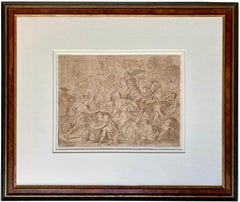
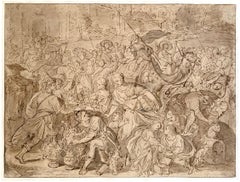
'The Departure of the Israelites from Egypt – The Exodus', c. 1610 - 1620
Medium: pen in sepia on paper
Dimensions: mage size 26 x 34,5 cm, frame size 55 x 65,5 cm
Biography: Frans Francken the Younger, born in Antwerp in 1581 and passing away on May 6, 1642, also in Antwerp, was a distinguished Flemish painter. He is recognized as the most prominent and productive member of the renowned Francken family of artists. Francken explored a wide range of subjects, creating large altarpieces for churches and producing smaller works depicting historical, mythological, and allegorical scenes. Notably, his depictions of collectors’ cabinets established a popular new genre of art during his era. He was known for collaborating with other artists, enriching their works with his skilled renderings of figures and narrative elements, complementing specialists in landscape, architectural scenes, and floral still-life painting.
Francken was born to Frans Francken the Elder and Elisabeth Mertens. His father was a pupil of Antwerp’s leading history painter, Frans Floris, and a significant creator of altarpieces in Flanders during his time. Francken received his artistic training under the guidance of his father. Additionally, it is possible that Frans and his brother, Hieronymus Francken II, received further instruction in the workshop of their uncle, Hieronymus Francken I, in Paris.
A versatile artist, Francken made significant contributions to various genres within Flemish art, introducing new themes and subjects. Many of his works comprised small-scale historical, allegorical, and biblical cabinet paintings, often emphasizing figures. He is credited with either inventing or popularizing several novel themes that gained popularity in Flemish painting, including genre scenes featuring monkeys (also known as singeries) and Kunstkammer or gallery paintings, presenting a plethora of natural and artistic treasures against a neutral wall. Francken introduced various other unconventional themes that later gained traction, such as the ‘Triumphal Procession of Amphitrite’ and ‘Croesus and Solon.’ He also produced a series of paintings depicting witches and witchcraft, including portrayals of witches’ sabbats.
His remarkable paintings are held in the collections of numerous major museums throughout Europe. Francken specialized in rendering the human figure, as evidenced by etched and engraved portraits of the artist by Anthony van Dyck (after Peter Paul Rubens), identifying him with the Latin inscription: ‘ANTVERIÆ PICTOR HVMANARVM FIGVRARVM’ (Figure painter of Antwerp). He was frequently invited to contribute figures to compositions by other esteemed artists, including landscape artists such as Tobias Verhaecht, Abraham Govaerts, and Joos de Momper...
Category
Early 17th Century Baroque Srinivas Pulagam Art