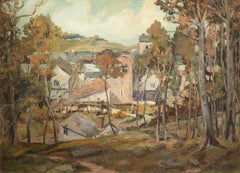
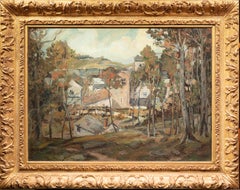
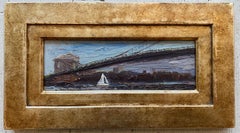
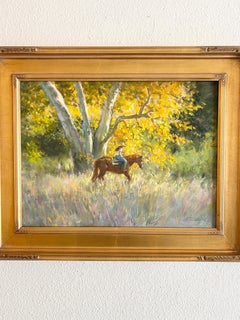
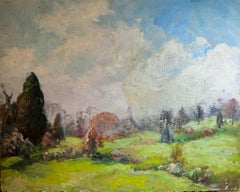
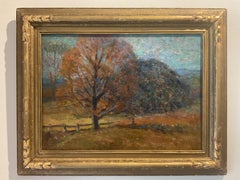
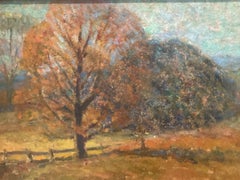
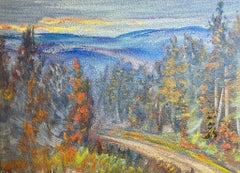
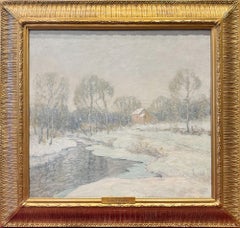
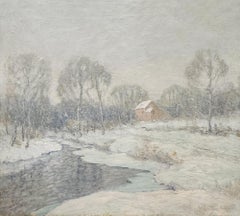
By Walter Elmer Schofield
Located in Lambertville, NJ
Exhibited: Pennsylvania Academy of Fine Art 1898
Provenance: Estate of Artist, with letter from Grandniece
Walter Elmer Schofield (1877-1944)
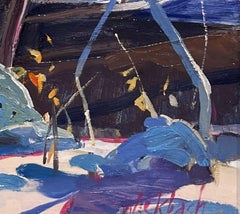
Many early twentieth century art critics considered Schofield to be one of the daring innovators among American Impressionist landscape painters. As he was quoted in International Studio magazine, February, 1913, “Zero weather, rain, falling snow and wind; all these things to contend with only make the open-air painter love the fight”. Walter Elmer Schofield was born in Philadelphia on September 10, 1867, the son of a prosperous businessman. He attended classes at the Pennsylvania Academy from 1889 to 1892, under Thomas Anshutz. While there, he frequented the Tuesday night open houses that Robert Henri held at his studio. There close friendships developed with Henri, Edward Redfield, William Glackens, Colin Campbell Cooper, Augustus Koopman, Charles Grafly and John Sloan. He left in 1892 to enroll at the Academie Julian in Paris, where he studied under Bouguereau, Gabriel Ferrier, and Henri Lucien Doucet.
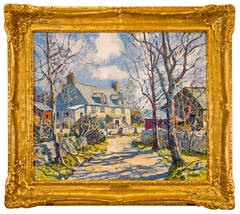
Schofield met and in 1896, married, an English girl by the name of Murielle Redmayne. In 1901, they moved abroad to St. Ives in Cornwall. Although Schofield established his residence in England, he made annual trips to the United States where he usually remained from October through April. He spent much of his time painting his famed Pennsylvania snow scenes, when not attending to obligations to Galleries and art institutions.
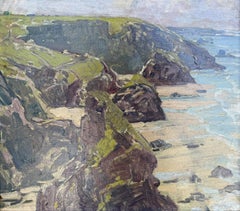
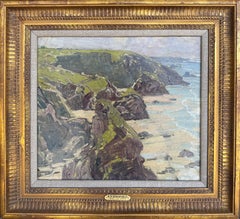
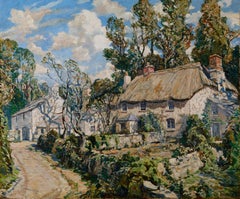
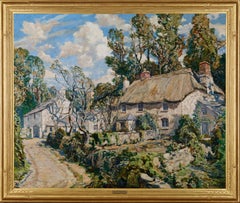
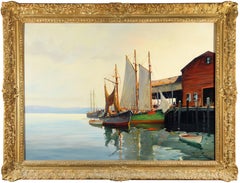
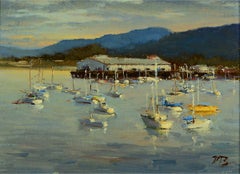
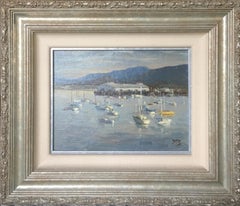
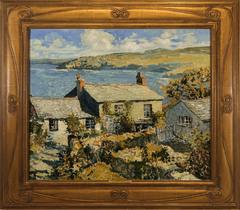
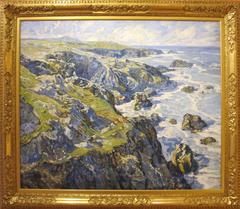
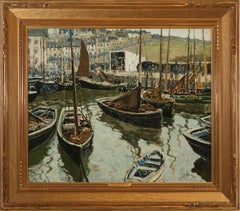
The majority of Schofield's work depicts the coastal fishing villages of Cornwall and Devon. The rolling hillsides, rocky coasts and clusters of cottages made for desirable subjects. His stately manor house in Cornwall, called "Godolphin”, with its rich grounds, lily pond and formal gardens, also provided the artist with idyllic scenery to paint.
Often compared to his contemporary, Redfield, a competitive rivalry developed between the two artists. A frequent visitor to Edward Redfield's home in Bucks County, Schofield became convinced that painting large canvases out of doors with bold, rapid brush strokes was the direction he wished to follow. By 1904, animosity had developed between the two artists and their friendship cooled.
During his lifetime he garnered many awards, medals and prizes. His exhibition record includes the Pennsylvania Academy of the Fine Arts(1903 Gold Medal,1914 Gold Medal), the Paris Salon, the Philadelphia Art Club(1898 prize), the Society of American Artists(1900 prize), the Paris Exposition(1900 prize), the National Academy of Design(1901 prize,1911 Gold...
Category
19th Century American Impressionist Walter Elmer Schofield Art