William King (b.1925) Art

American, 1925-2015

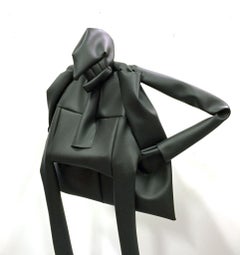
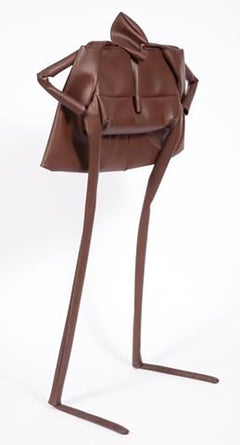
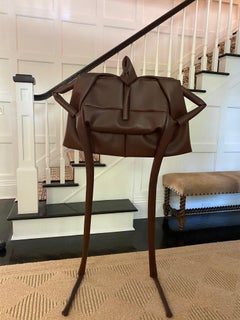
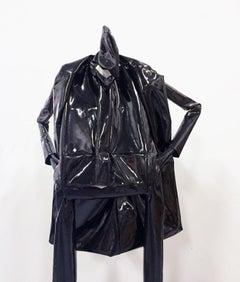
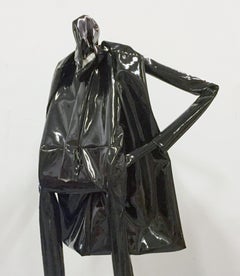
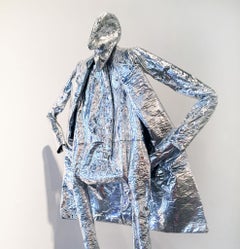
American artist William King was best known for his comedic sculptures — working in clay and a range of metals, he created a wide variety of toy-like figures over the years that were cartoonish in their contorted forms and unlikely poses. King emphasized posture and body language in his art and poked fun at societal conventions as well as how we navigate the trials of our daily lives in a cheerful, clever manner.

Born in Jacksonville, Florida, King grew up in Coconut Grove, a historic Miami neighborhood. He studied at the University of Florida and later moved to New York City, finishing his studies at the Cooper Union in the late 1940s. King subsequently traveled to Rome on a Fulbright scholarship and explored the arts of Europe, including in London and Athens. In 1953, after returning to the United States, he began teaching at the Brooklyn Museum Art School.

In 1954, King had his first solo show at Alan Gallery in New York and continued to exhibit in and around the city until 2014. He worked across a wide variety of media, most frequently metal, such as bronze, aluminum and steel of varying finishes. His more serious pieces saw an integration of darker materials with rougher textures to amplify his figures' reflective, dismayed or generally somber expressions.

King received numerous awards for his work, including acknowledgments from the Guggenheim Foundation, National Endowment for the Arts and the San Francisco Arts Commission, as well as an honorary doctorate from the San Francisco Art Institute.

Find original William King figurative sculptures, abstract sculptures and prints on 1stDibs. 

to
1
1
2
3
5
Overall Width
to
Overall Height
to
8
3
2
3
4
3
2
1
1
1
3
2
1
1
1
1
1
5
4
2
2
2
11
11,124
2,854
2,494
1,436
1
11
Artist: William King (b.1925)
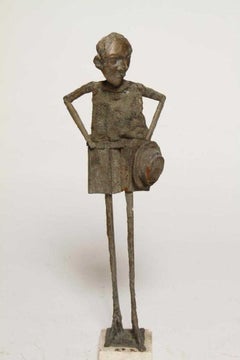
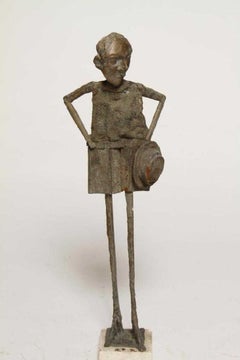
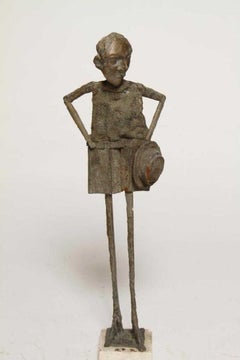
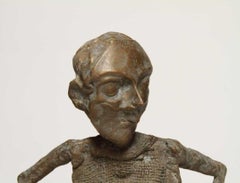
1960s Pop Art Unique Cast Bronze Sculpture Americana Folk Art William King
1960s Pop Art Unique Cast Bronze Sculpture Americana Folk Art William King
By William King (b.1925)

Located in Surfside, FL

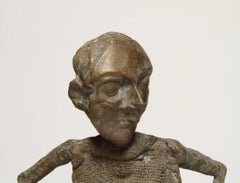
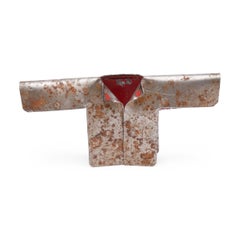
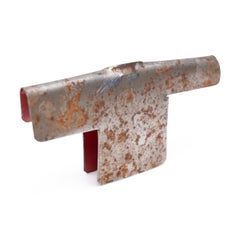
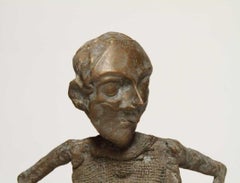
Mid-Century Modern wrought iron sculpture a person with oversize top, shorts, and carrying a hat, signed, artist's monogram and cipher, further mounted on a plaster base. 28" H. This a unique piece. It is interesting in that it speaks of a transition, leading into the later aluminum public pieces that kind of defined his work in the 70's. According to his estate this is most probably cast bronze. It might possibly be wrought iron.. William Dickey King was born in 1925 in Jacksonville, Florida and grew up in the Coconut Grove neighborhood of Miami. As a boy, William King made model airplanes and helped his father and older brother build furniture and boats. “I was 19, 20, my mother gave me a hundred bucks, says, ʻGet out of this state and don’t come back until you’re 65; there is nothing here for you,’ ” Bill King recalled in a video interview for the Smithsonian museum. He came to New York, where he attended the Cooper Union and began selling his early sculptures even before he graduated. He later studied with the sculptor Milton Hebald and traveled to Italy on a Fulbright grant. He was a contemporary, at the Cooper Union, of Alex Katz and Lois Dodd, his first wife, and remained close in many ways to their common aesthetic grounding, shared also with younger sculptors such as Red Grooms and Marisol Escobar. The hallmark of King’s early work was radical experiment keeping company with social connection and hedonism. The mix of big, important, innovative ideas and immediate, sensory, in-the-moment experience was a kind of visual jazz. For this was not just the time of Franz Kline’s big open defiant brushstrokes and Jackson Pollock’s all-over mists of intricately drooling line, but of Charlie Parker and Dizzy Gillespie. If we look at the works that King made in the early 1950s when he got back from his Fulbright to Italy we see free, experimental, open forms that take their cue from jazz as much as art in their fusion of virtuosity and cool.American sculptor King is most noted for his long-limbed figurative public art sculptures depicting people engaged in everyday activities such as reading or conversing. He created his busts and figures in a variety of materials, including clay, wood, metal, and textiles. Mr. King worked in clay, wood, bronze, vinyl, burlap and aluminum. He worked both big and small, from busts and toylike figures to large public art pieces depicting familiar human poses — a seated, cross-legged man reading; a Western couple (he in a cowboy hat, she in a long dress) holding hands; a tall man reaching down to tug along a recalcitrant little boy; a crowd of robotic-looking men walking in lock step. Mr. King’s work often reflected the times, taking on fashions and occasional politics. In the 1960s and 1970s, his work featuring African-American figures (including the activist Angela Davis, with hands cuffed behind her back) evoked his interest in civil rights. But for all its variation, what unified his work was a wry observer’s arched eyebrow, the pointed humor and witty rue of a fatalist. His figurative sculptures, often with long, spidery legs and an outlandishly skewed ratio of torso to appendages, use gestures and posture to suggest attitude and illustrate his own amusement with the unwieldiness of human physical equipment. His subjects included tennis players and gymnasts, dancers and musicians, and he managed to show appreciation of their physical gifts and comic delight at their contortions and costumery. His suit-wearing businessmen often appeared haughty or pompous; his other men could seem timid or perplexed or awkward. Oddly, or perhaps tellingly, he tended to depict women more reverentially, though in his portrayals of couples the fragility and tender comedy inherent in couplehood settled equally on both partners. His first solo exhibit took place in 1954 at the Alan Gallery in New York City. William Dicky King was elected to the American Academy of Arts and Letters in 2003, and in 2007 the International Sculpture Center honored him with the Lifetime Achievement in Contemporary Sculpture Award. Mr. King’s work is in the collections of the Metropolitan Museum of Art, Guggenheim Museum, Whitney Museum and the Museum of Modern Art in New York and the Hirshhorn Museum at the Smithsonian American Art Museum in Washington, among other places, and he had dozens of solo gallery shows in New York and elsewhere. Reviews of his exhibitions frequently began with the caveat that even though the work was funny, it was also serious, displaying superior technical skills, imaginative vision and the bolstering weight of a range of influences, from the ancient Etruscans to American folk art to 20th-century artists including Giacometti, Calder and Elie Nadelman. The New York Times critic Holland Cotter once described Mr. King’s sculpture as “comical-tragical-maniacal,” and “like Giacometti conceived by John Cheever.” From an article by David Cohen "In a career that ran in tandem with the hegemony of formal abstraction in sculpture, Bill King inevitably struggled with the prejudice that sculpture full of humanity and humor can’t be quite as serious as sculpture devoid of them. But the tide has clearly turned in ways that ought to work in King’s favor, with an increasing number of sculptors, fêted internationally, who are producing work that looks remarkably close in spirit, if not quite as regal in sheer mastery of form, as his own. When art historians of the future connect the dots of modern sculpture then artists like Franz West, Stephan Balkenhol, Huma Bhabha...

Category

1960s Pop Art William King (b.1925) Art

Materials

Bronze
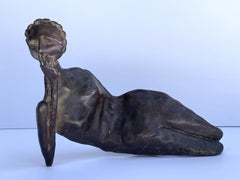
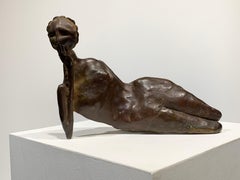
Reclining Figure (woman)

Reclining Figure (woman)

By William King (b.1925)

Located in Wilton Manors, FL

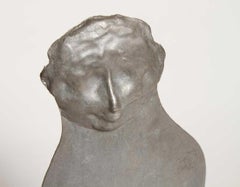
William King (1925-2015). Reclining figure, ca. 1965. Cast and welded bronze, 7 x 9.5 x 5 inches. Unsigned. William King, a sculptor in a variety of materials whose human figures traced social attitudes through the last half of the 20th century, often poking sly and poignant fun at human follies and foibles, died on March 4 at his home in East Hampton, N.Y. He was 90. His death was confirmed by Scott Chaskey, who is married to Mr. King's stepdaughter, Megan Chaskey. Mr. King worked in clay, wood, bronze, vinyl, burlap and aluminum. He worked both big and small, from busts and toylike figures to large public art pieces depicting familiar human poses -- a seated, cross-legged man reading; a Western couple (he in a cowboy hat, she in a long dress) holding hands; a tall man reaching down to tug along a recalcitrant little boy; a crowd of robotic-looking men walking in lock step. But for all its variation, what unified his work was a wry observer's arched eyebrow, the pointed humor and witty rue of a fatalist. His figurative sculptures, often with long, spidery legs and an outlandishly skewed ratio of torso to appendages, use gestures and posture to suggest attitude and illustrate his own amusement with the unwieldiness of human physical equipment. His subjects included tennis players and gymnasts, dancers and musicians, and he managed to show appreciation of their physical gifts and comic delight at their contortions and costumery. His suit-wearing businessmen often appeared haughty or pompous; his other men could seem timid or perplexed or awkward. Oddly, or perhaps tellingly, he tended to depict women more reverentially, though in his portrayals of couples the fragility and tender comedy inherent in couplehood settled equally on both partners. Mr. King's work is in the collections of the Metropolitan Museum of Art and the Museum of Modern Art in New York and the Smithsonian American Art Museum in Washington, among other places, and he had dozens of solo gallery shows in New York and elsewhere. But the comic element of his work probably caused his reputation to suffer. Reviews of his exhibitions frequently began with the caveat that even though the work was funny, it was also serious, displaying superior technical skills, imaginative vision and the bolstering weight of a range of influences, from the ancient Etruscans to American folk art to 20th-century artists including Giacometti, Calder. and Elie Nadelman. The critic Hilton Kramer, one of Mr. King's most ardent advocates, wrote in a 1970 essay accompanying a New York gallery exhibit that he was, "among other things, an amusing artist, and nowadays this can, at times, be almost as much a liability as an asset." A "preoccupation with gesture is the focus of King's sculptural imagination," Mr. Kramer wrote. "Everything that one admires in his work - the virtuoso carving, the deft handling of a wide variety of materials, the shrewd observation and resourceful invention - all this is secondary to the concentration on gesture. The physical stance of the human animal as it negotiates the social arena, the unconscious gait that the body assumes in making its way in the social medium, the emotion traced by the course of a limb, a torso, a head, the features of a face, a coiffure or a costume - from a keen observation of these materials King has garnered a large stock of sculptural images notable for their wit, empathy, simplicity and psychological precision." William Dickey King...

Category

Mid-20th Century Abstract William King (b.1925) Art

Materials

Bronze
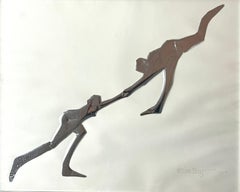
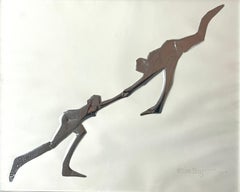
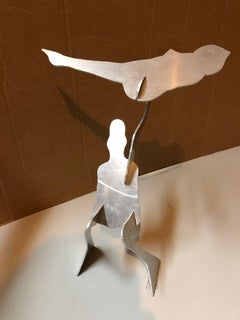
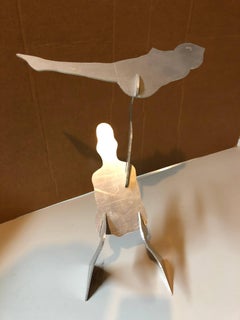
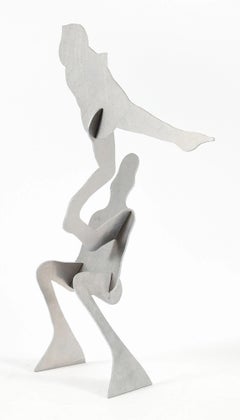
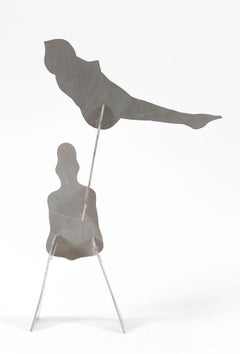
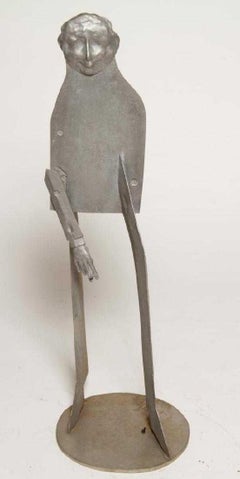
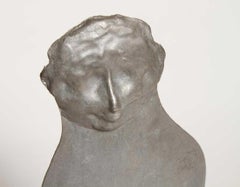
The Test, Assembled Kinetic Modernist Sculpture Puzzle Construction

The Test, Assembled Kinetic Modernist Sculpture Puzzle Construction

By William King (b.1925)

Located in Surfside, FL

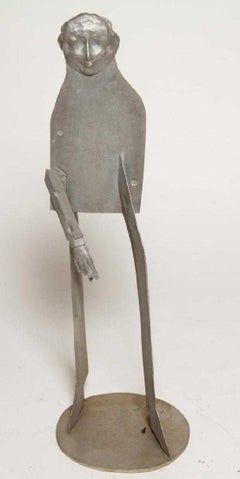
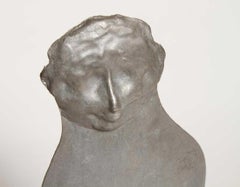
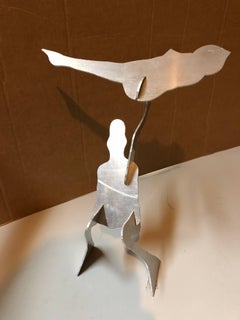
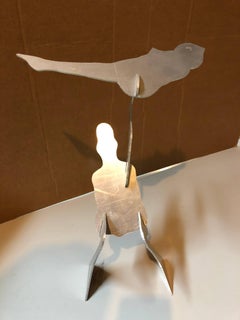
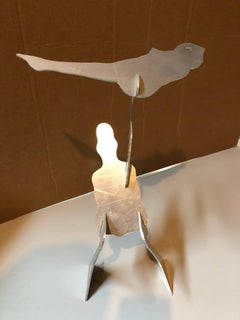
"The Test," 1970 Aluminum sculpture in 5 parts. Artist's cipher and AP stamped into male figure, front, 20 5/16" x 12 1/2" x 6 5/7" (approx.) American sculptor King is most noted fo...

Category

1970s American Modern William King (b.1925) Art

Materials

Metal

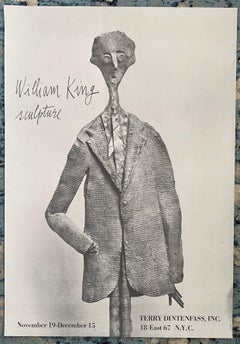
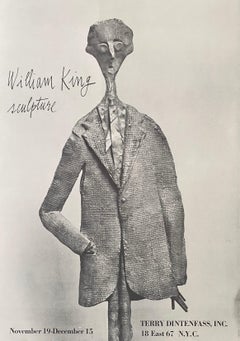
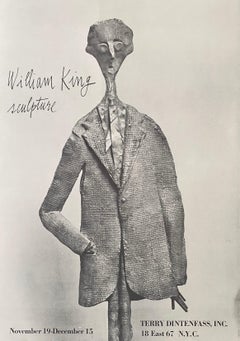
Vintage Lithograph Poster William King Terry Dintenfass Gallery NYC

Vintage Lithograph Poster William King Terry Dintenfass Gallery NYC

By William King (b.1925)

Located in Surfside, FL

Sculptor William King is widely renowned for his signature flattened and stilt-legged figures, gesturing dramatically. Humorous and rife with social commentary, his work first offered an alternative to Abstract Expressionism in the 1950s, then to Minimalism and conceptual art in the 1960s and 1970s. Through one radical art historical shift after another, King has maintained his commitment to the figure and social realism. Working with aluminum and vinyl, he arranges his painted figures in configurations that transform various social activities into satirical or fantastic situations. A man in a business suit with hands in his pockets is a recurring figure throughout his work. King was born in Jacksonville, Florida, in 1925, and grew up in Coconut Grove, Miami. After attending the University of Florida between 1942 and 1944, he came to New York in 1945, enrolling that year at Cooper Union and graduating in 1948. The following year he went to Rome on a Fulbright scholarship. Beginning in 1953, he taught for three years at the Brooklyn Museum Art School. He has also taught at the University of California, Berkeley, and elsewhere. He is a member of the American Academy of Arts and Letters, and was President of the National Academy of Design between 1994 and 1998. He is the father of Eli King and Amy King, and lives with his wife, Connie Fox...

Category

Late 20th Century American Modern William King (b.1925) Art

Materials

Lithograph

“Magic”
“Magic”

“Magic”

By William King (b.1925)

Located in Southampton, NY

Original collage mylar figural three dimensional artwork by the well known Long Island New York sculptor William King. Signed and dated lower right by the artist. Copyright mark lowe...

Category

1970s Post-Modern William King (b.1925) Art

Materials

Mylar, Archival Paper

1960s Pop Art Unique Cast Aluminum Sculpture Cool Cat Bell Bottoms Americana

1960s Pop Art Unique Cast Aluminum Sculpture Cool Cat Bell Bottoms Americana

By William King (b.1925)

Located in Surfside, FL

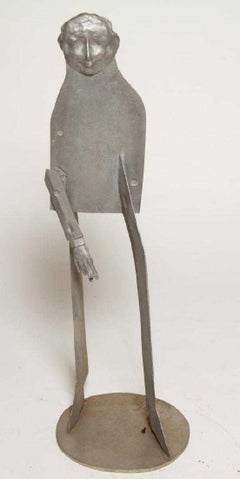
Mid-Century Modern cut steel sculpture depicting a man in bell bottom pants standing casually with a cigarette in his right hand, His left hand is in his back pocket, signed and dated, artist's monogram and cipher and "1968." This a unique piece. It is interesting in that it speaks of a transition, leading into the later aluminum public pieces that kind of defined his work in the 70's. According to his estate this is most probably cast and sheet aluminum. It might possibly be steel. William Dickey King was born in 1925 in Jacksonville, Florida and grew up in the Coconut Grove neighborhood of Miami. As a boy, William King made model airplanes and helped his father and older brother build furniture and boats. “I was 19, 20, my mother gave me a hundred bucks, says, ʻGet out of this state and don’t come back until you’re 65; there is nothing here for you,’ ” Bill King recalled in a video interview for the Smithsonian museum. He came to New York, where he attended the Cooper Union and began selling his early sculptures even before he graduated. He later studied with the sculptor Milton Hebald and traveled to Italy on a Fulbright grant. He was a contemporary, at the Cooper Union, of Alex Katz and Lois Dodd, his first wife, and remained close in many ways to their common aesthetic grounding, shared also with younger sculptors such as Red Grooms and Marisol Escobar. The hallmark of King’s early work was radical experiment keeping company with social connection and hedonism. The mix of big, important, innovative ideas and immediate, sensory, in-the-moment experience was a kind of visual jazz. For this was not just the time of Franz Kline’s big open defiant brushstrokes and Jackson Pollock’s all-over mists of intricately drooling line, but of Charlie Parker and Dizzy Gillespie. If we look at the works that King made in the early 1950s when he got back from his Fulbright to Italy we see free, experimental, open forms that take their cue from jazz as much as art in their fusion of virtuosity and cool.American sculptor King is most noted for his long-limbed figurative public art sculptures depicting people engaged in everyday activities such as reading or conversing. He created his busts and figures in a variety of materials, including clay, wood, metal, and textiles. Mr. King worked in clay, wood, bronze, vinyl, burlap and aluminum. He worked both big and small, from busts and toylike figures to large public art pieces depicting familiar human poses — a seated, cross-legged man reading; a Western couple (he in a cowboy hat, she in a long dress) holding hands; a tall man reaching down to tug along a recalcitrant little boy; a crowd of robotic-looking men walking in lock step. Mr. King’s work often reflected the times, taking on fashions and occasional politics. In the 1960s and 1970s, his work featuring African-American figures (including the activist Angela Davis, with hands cuffed behind her back) evoked his interest in civil rights. But for all its variation, what unified his work was a wry observer’s arched eyebrow, the pointed humor and witty rue of a fatalist. His figurative sculptures, often with long, spidery legs and an outlandishly skewed ratio of torso to appendages, use gestures and posture to suggest attitude and illustrate his own amusement with the unwieldiness of human physical equipment. His subjects included tennis players and gymnasts, dancers and musicians, and he managed to show appreciation of their physical gifts and comic delight at their contortions and costumery. His suit-wearing businessmen often appeared haughty or pompous; his other men could seem timid or perplexed or awkward. Oddly, or perhaps tellingly, he tended to depict women more reverentially, though in his portrayals of couples the fragility and tender comedy inherent in couplehood settled equally on both partners. His first solo exhibit took place in 1954 at the Alan Gallery in New York City. William Dicky King was elected to the American Academy of Arts and Letters in 2003, and in 2007 the International Sculpture Center honored him with the Lifetime Achievement in Contemporary Sculpture Award. Mr. King’s work is in the collections of the Metropolitan Museum of Art, Guggenheim Museum, Whitney Museum and the Museum of Modern Art in New York and the Hirshhorn Museum at the Smithsonian American Art Museum in Washington, among other places, and he had dozens of solo gallery shows in New York and elsewhere. Reviews of his exhibitions frequently began with the caveat that even though the work was funny, it was also serious, displaying superior technical skills, imaginative vision and the bolstering weight of a range of influences, from the ancient Etruscans to American folk art to 20th-century artists including Giacometti, Calder and Elie Nadelman. The New York Times critic Holland Cotter once described Mr. King’s sculpture as “comical-tragical-maniacal,” and “like Giacometti conceived by John Cheever.” From an article by David Cohen "In a career that ran in tandem with the hegemony of formal abstraction in sculpture, Bill King inevitably struggled with the prejudice that sculpture full of humanity and humor can’t be quite as serious as sculpture devoid of them. But the tide has clearly turned in ways that ought to work in King’s favor, with an increasing number of sculptors, fêted internationally, who are producing work that looks remarkably close in spirit, if not quite as regal in sheer mastery of form, as his own. When art historians of the future connect the dots of modern sculpture then artists like Franz West, Stephan Balkenhol, Huma Bhabha...

Category

1960s Pop Art William King (b.1925) Art

Materials

Metal

Untitled
Untitled

Untitled

By William King (b.1925)

Located in Boca Raton, FL

Vinyl and Aluminum Sculptor William King is widely renowned for his signature flattened and stilt-legged figures, gesturing dramatically. Humorous and rife with social commentary, h...

Category

21st Century and Contemporary Contemporary William King (b.1925) Art

Materials

Mixed Media

Take It or Leave It

Take It or Leave It

By William King (b.1925)

Located in Boca Raton, FL

Take It Or leave It is a life size sculpture constructed of mylar over an aluminum frame. Sculptor William King is widely renowned for his signature flattened and stilt-legged figu...

Category

20th Century Contemporary William King (b.1925) Art

Materials

Mylar, Mixed Media

Onward

Onward

By William King (b.1925)

Located in Boca Raton, FL

Vinyl and Aluminum Sculptor William King is widely renowned for his signature flattened and stilt-legged figures, gesturing dramatically. Humorous and rife with social commentary, h...

Category

21st Century and Contemporary Contemporary William King (b.1925) Art

Materials

Mixed Media

I'm Trying
I'm Trying

I'm Trying

By William King (b.1925)

Located in Boca Raton, FL

Vinyl and Aluminum Sculptor William King is widely renowned for his signature flattened and stilt-legged figures, gesturing dramatically. Humorous and rife with social commentary, h...

Category

21st Century and Contemporary Contemporary William King (b.1925) Art

Materials

Mixed Media

Related Items
"He had Pure Thoughts with Blue Flowers" Dog Sculpture in Resin with Flowers

"He had Pure Thoughts with Blue Flowers" Dog Sculpture in Resin with Flowers

By Gillie and Marc Schattner

Located in New York, NY

A whimsical yet very strong piece depicting the Weim character from Gillie and Marc's iconic figures of the Dog/Bunny Human Hybrid, which has picked up much esteem across the globe. ...

Category

2010s Pop Art William King (b.1925) Art

Materials

Resin

CHROMA aka Rick Wolfryd COMPANION WITH HEART SERIES 28.5 inches . . .

CHROMA aka Rick Wolfryd COMPANION WITH HEART SERIES 28.5 inches . . .

By CHROMA aka Rick Wolfryd

Located in Cuauhtemoc, Ciudad de México

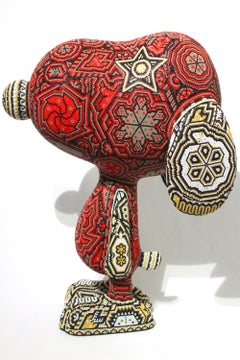
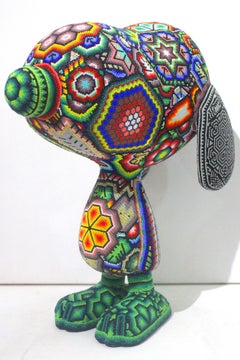
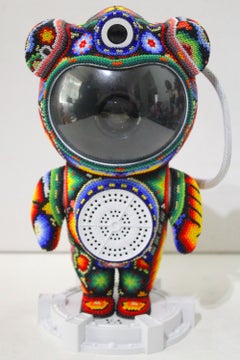
CHROMA “Companion With Heart” Sculpture — 28.5 Inches Mixed Media, Resin, Glass Beads, Acrylic Mexico City, Contemporary This striking 28.5-inch CHROMA “Companion With Heart” sculpt...

Category

2010s Pop Art William King (b.1925) Art

Materials

Glass, Resin, Mixed Media

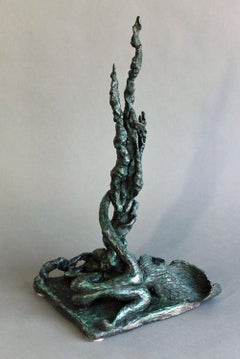
Woman Lying Down & Growing with Tree bronze sculpture by Yulla Lipchitz

Woman Lying Down & Growing with Tree bronze sculpture by Yulla Lipchitz

Located in Hudson, NY

Organic, abstract bronze sculpture by Yulla Lipchitz of a woman lying down with a tree. About this artist: Yulla Lipchitz, née Halberstadt, was born on April 21, 1911 in Berlin, Ge...

Category

1970s Modern William King (b.1925) Art

Materials

Bronze

They were the Authentic Vespa Riders in Rome (Bronze with Green Patina)

They were the Authentic Vespa Riders in Rome (Bronze with Green Patina)

By Gillie and Marc Schattner

Located in New York, NY

A whimsical yet very strong piece depicting the two figures from Gillie and Marc's iconic figures of the Dog/Bunny Human Hybrid, which has picked up much esteem across the globe. Her...

Category

2010s Pop Art William King (b.1925) Art

Materials

Bronze

Walter Midener "Contemplation" Seated Figure Clay Sculpture Mid-Century Modern

Walter Midener "Contemplation" Seated Figure Clay Sculpture Mid-Century Modern

Located in Detroit, MI

“Contemplation” is an abstract clay sculpture of a female. The figure has both arms and legs extended, but the dignified pose suggests an intimate rather than a sexual moment. The sculpture is delicately rendered, but monumental in pose and clean composition reminiscent of the English artist Henry Moore. The surface is warm and slightly rough to the touch. This sculpture is in the round and beautifully balanced geometrically with the hands clasped behind the head forming a slightly flattened polygon shape that is echoed in the positioning of the legs and draped fabric of a presumed dress. The figure draws the viewer into her contemplation, peace and confidence. An exceptional piece by Midener. Walter Midener...

Category

Mid-20th Century Modern William King (b.1925) Art

Materials

Clay

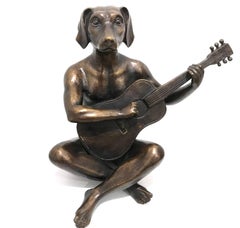
"He Played Like He Was Keith Richards" Dogman with Guitar Bronze Sculpture

"He Played Like He Was Keith Richards" Dogman with Guitar Bronze Sculpture

By Gillie and Marc Schattner

Located in New York, NY

A whimsical yet very strong piece depicting the Dog Man from Gillie and Marc's iconic figures of the Dog/Bunny Human Hybrid, which has picked up much esteem across the globe. Here we...

Category

2010s Pop Art William King (b.1925) Art

Materials

Bronze

"Labor in a Diesel Plant" Machine Age American Scene Industrial Mid 20th Century

"Labor in a Diesel Plant" Machine Age American Scene Industrial Mid 20th Century

By Letterio Calapai

Located in New York, NY

"Labor in a Diesel Plant" Machine Age American Scene Industrial Mid 20th Century Letterio Calapai (American 1902-1993) ''Labor in A Diesel Plant'' Wood engraving, 1940 17 x 10 1/2...

Category

1940s American Modern William King (b.1925) Art

Materials

Lithograph

Corten Steel Sculpture Oleg Sohanievich Non Conformist Avant Garde Ukrainian

Corten Steel Sculpture Oleg Sohanievich Non Conformist Avant Garde Ukrainian

By Oleg Sohanievich

Located in Surfside, FL

Oleg Sohanievich (Soviet Ukrainian, American 1935-2017) Steel plates and rods Stress Steel Sculpture, 1997, Hand signed and dated Oleg Sohanievich '97, Dimensions: 18 1/2" h., 21" ...

Category

1970s Post-Modern William King (b.1925) Art

Materials

Steel

"Zofar" Boaz Vaadia, Human Body, Bronze and Stone, Anthropomorphic Sculpture

"Zofar" Boaz Vaadia, Human Body, Bronze and Stone, Anthropomorphic Sculpture

By Boaz Vaadia

Located in New York, NY

Boaz Vaadia Zofar, 1997 Bronze, bluestone, and boulder Overall 20 x 29 x 27 inches From the edition of 7 Provenance Elaine Baker Gallery, Boca Raton, Florida Boaz Vaadia is the in...

Category

1990s American Modern William King (b.1925) Art

Materials

Stone, Bluestone, Bronze

Kubik Colorful Geometric Figurative Painted Steel Contemporary Sculpture

Kubik Colorful Geometric Figurative Painted Steel Contemporary Sculpture

By Héctor Francesch

Located in FISTERRA, ES

Colorful geometric painted steel sculpture with stylized figurative forms and playful contemporary graphic language. Kubik is a contemporary steel sculpture by Héctor Francesch from...

Category

2010s Pop Art William King (b.1925) Art

Materials

Steel

Morris Brose "Bronze Bull" Figurative Sculptural Abstract

Morris Brose "Bronze Bull" Figurative Sculptural Abstract

Located in Detroit, MI

"Bronze Bull" is an exquisite example of Morris Brose's abstract/figurative sculpture. No soft edges on this piece and no invitation to caress, the power, strength and beauty of the bronze are front and center and create awe. "Bronze Bull" is a free-standing piece signed on the base. Morris Brose, Polish/American was born in Wyszkow, Poland. He became a sculptor and instructor of sculpture at the Detroit Institute of Arts, Wayne State University and Cranbrook Academy of Art, Bloomfield Hills, Michigan. Cranbrook was designed by architect and faculty member, Eliel Saarinen who collaborated with Charles and Ray Eames on chair and furniture design. Numerous creative artists who are alumni of Cranbrook include: Harry Bertoia, Florence Knoll, Jack Lenor Larsen, Donald Lipski...

Category

Late 20th Century Modern William King (b.1925) Art

Materials

Bronze

Previously Available Items
The Test, Assembled Kinetic Modernist Sculpture Puzzle Construction

The Test, Assembled Kinetic Modernist Sculpture Puzzle Construction

By William King (b.1925)

Located in Surfside, FL

"The Test," 1970 Aluminum sculpture in 5 parts. Artist's cipher and AP stamped into male figure, front, 20 5/16" x 12 1/2" x 6 5/7" (approx.) American sculptor King is most noted for his long-limbed figurative public art sculptures depicting people engaged in everyday activities such as reading or conversing. He created his busts and figures in a variety of materials, including clay, wood, metal, and textiles. William Dickey King was born in Jacksonville, Florida. As a boy, William made model airplanes and helped his father and older brother build furniture and boats. He came to New York, where he attended the Cooper Union and began selling his early sculptures even before he graduated. He later studied with the sculptor Milton Hebald and traveled to Italy on a Fulbright grant. Mr. King worked in clay, wood, bronze, vinyl, burlap and aluminum. He worked both big and small, from busts and toylike figures to large public art pieces depicting familiar human poses — a seated, cross-legged man reading; a Western couple (he in a cowboy hat, she in a long dress) holding hands; a tall man reaching down to tug along a recalcitrant little boy; a crowd of robotic-looking men walking in lock step. Mr. King’s work often reflected the times, taking on fashions and occasional politics. In the 1960s and 1970s, his work featuring African-American figures (including the activist Angela Davis, with hands cuffed behind her back) evoked his interest in civil rights. But for all its variation, what unified his work was a wry observer’s arched eyebrow, the pointed humor and witty rue of a fatalist. His figurative sculptures, often with long, spidery legs and an outlandishly skewed ratio of torso to appendages, use gestures and posture to suggest attitude and illustrate his own amusement with the unwieldiness of human physical equipment. His subjects included tennis players and gymnasts, dancers and musicians, and he managed to show appreciation of their physical gifts and comic delight at their contortions and costumery. His suit-wearing businessmen often appeared haughty or pompous; his other men could seem timid or perplexed or awkward. Oddly, or perhaps tellingly, he tended to depict women more reverentially, though in his portrayals of couples the fragility and tender comedy inherent in couplehood settled equally on both partners. His first solo exhibit took place in 1954 at the Alan Gallery in New York City. King was elected to the American Academy of Arts and Letters in 2003, and in 2007 the International Sculpture Center honored him with the Lifetime Achievement in Contemporary Sculpture Award. Mr. King’s work is in the collections of the Metropolitan Museum of Art, Guggenheim Museum, Whitney Museum and the Museum of Modern Art in New York and the Hirshorn Museum at the Smithsonian American Art Museum in Washington, among other places, and he had dozens of solo gallery shows in New York and elsewhere. Reviews of his exhibitions frequently began with the caveat that even though the work was funny, it was also serious, displaying superior technical skills, imaginative vision and the bolstering weight of a range of influences, from the ancient Etruscans to American folk art to 20th-century artists including Giacometti, Calder and Elie Nadelman. The New York Times critic Holland Cotter once described Mr. King’s sculpture as “comical-tragical-maniacal,” and “like Giacomettis conceived by John Cheever.”

Category

1970s American Modern William King (b.1925) Art

Materials

Metal

Vintage Lithograph Poster William King Terry Dintenfass Gallery NYC

Vintage Lithograph Poster William King Terry Dintenfass Gallery NYC

By William King (b.1925)

Located in Surfside, FL

Sculptor William King is widely renowned for his signature flattened and stilt-legged figures, gesturing dramatically. Humorous and rife with social commentary, his work first offered an alternative to Abstract Expressionism in the 1950s, then to Minimalism and conceptual art in the 1960s and 1970s. Through one radical art historical shift after another, King has maintained his commitment to the figure and social realism. Working with aluminum and vinyl, he arranges his painted figures in configurations that transform various social activities into satirical or fantastic situations. A man in a business suit with hands in his pockets is a recurring figure throughout his work. King was born in Jacksonville, Florida, in 1925, and grew up in Coconut Grove, Miami. After attending the University of Florida between 1942 and 1944, he came to New York in 1945, enrolling that year at Cooper Union and graduating in 1948. The following year he went to Rome on a Fulbright scholarship. Beginning in 1953, he taught for three years at the Brooklyn Museum Art School. He has also taught at the University of California, Berkeley, and elsewhere. He is a member of the American Academy of Arts and Letters, and was President of the National Academy of Design between 1994 and 1998. He is the father of Eli King and Amy King, and lives with his wife, Connie Fox, in East Hampton, New York. King’s earliest one-person shows were with the Alan Gallery, New York, beginning in 1954. The majority of his subsequent New York exhibitions were with the Terry Dintenfass Gallery. Of note in the writings about the artist are reviews by Fairfield Porter, in 1954 (in Art News) and 1960 (in The Nation), and numerous essays and reviews by Hilton Kramer. The fullest biographical account of the artist is by Gerald Nordland, in a 1994 gallery exhibition catalog entitled William King: Forty Years of Work in Wood. Previous awards include the Guggenheim Foundation Fellowship, National Endowment for the Arts Individual Artist Grant, San Francisco Arts Commission Award for Outstanding Achievement in Sculpture, Honorary Doctorate for Outstanding Achievement in Sculpture from the San Francisco Art Institute, Honorary Doctorate from the California College of Arts and Crafts, and Honorary Doctorate from the Corcoran School of Art, Washington, D.C. EDUCATION University of Florida, 1942 – 1944 Cooper Union Art School, New York, 1945 – 1948 Brooklyn Museum Art School, New York, 1949 Academia dei Belle Arti, Rome, 1949 – 1950 Central School, London, England, 1952 AWARDS Sculpture Prize, Cooper Union Art School, New York, 1948 Fulbright Grant, 1949 – 1950 Margaret Tiffany Blake Fresco Award, 1951 Augustus St. Gaudens Medal, Cooper Union, New York, 1964 Creative Artists Public Service Award and Grant, 1974 Hakone Open-Air Museum, Japan, Distinction Prize, 1980 National Academy of Design, New York, Gold Medal, 1986 American Academy of Arts and Letters, New York, Louise Nevelson Award, 1995 Guild Hall of East Hampton, Lifetime Achievement in the Arts, Visual Arts Award, 1997 SELECTED SOLO EXHIBITIONS Alan Gallery, New York, 1954, 1955, 1961 San Francisco Museum of Art, San Francisco, California, 1970 Santa Barbara Museum of Art, Santa Barbara, California, 1970 Indianapolis Museum of Art, Indianapolis, Indiana, 1971 Contemporary Arts Center, Cincinnati, Ohio, 1971 Ringling Museum, Sarasota, Florida, 1971 Dag Hammerskjold Plaza, New York, 1971 Alpha Gallery, Boston, Massachusetts, 1971, 1982 Montgomery Museum of Art, Montgomery, Alabama, 1972, 1987 Jacksonville Art Museum, Jacksonville, Florida, 1972 Hopkins Art Center, Dartmouth College, Hanover, New Hampshire, 1972 Worcester Art Museum, Worcester, Massachusetts, 1972 Wadsworth Atheneum, Hartford, Connecticut, 1972 Tennessee Fine Arts Center, Nashville, Tennessee, 1972 University of Nebraska, Lincoln, Nebraska, 1972 Elvehjem Art Center, University of Wisconsin, Eau Claire, 1973 University of Georgia, Athens, Georgia, 1973 William Benton Museum, University of Connecticut, 1973 State Universities of New York (traveling exhibitions), 1974 Benson Gallery, Bridgehampton, New York, 1976 Zabriskie Gallery, New York, 1977 Louise Himmelfarb Gallery, Water Mill New York, 1980 Wingspread Gallery, Northeast Harbor, Maine, 1981 Gallery Paule Anglim, San Francisco, California, 1985, 1987 Hooks-Epstein Gallery, Houston, Texas, 1986 Hunter Museum, Chattanooga, Tennessee, 1987 David Heath...

Category

Late 20th Century American Modern William King (b.1925) Art

Materials

Lithograph

My Pleasure

William King (b.1925)My Pleasure

Sold

H 69 in W 32 in D 20 in

My Pleasure

By William King (b.1925)

Located in Boca Raton, FL

mixed media = vinyl and aluminum Sculptor William King is widely renowned for his signature flattened and stilt-legged figures, gesturing dramatically. Humorous and rife with social commentary, his work first offered an alternative to Abstract Expressionism in the 1950s, then to Minimalism and conceptual art in the 1960s and 1970s. Through one radical art historical shift after another, King has maintained his commitment to the figure and social realism. Working with aluminum and vinyl, he arranges his painted figures in configurations that transform various social activities into satirical or fantastic situations. A man in a business suit with hands in his pockets is a recurring figure throughout his work. King was born in Jacksonville, Florida, in 1925, and grew up in Coconut Grove, Miami. After attending the University of Florida between 1942 and 1944, he came to New York in 1945, enrolling that year at Cooper Union and graduating in 1948. The following year he went to Rome on a Fulbright scholarship. Beginning in 1953, he taught for three years at the Brooklyn Museum Art School. He has also taught at the University of California, Berkeley, and elsewhere. He is a member of the American Academy of Arts and Letters, and was President of the National Academy of Design between 1994 and 1998. He is the father of Eli King and Amy King, and lives with his wife, Connie Fox...

Category

21st Century and Contemporary Contemporary William King (b.1925) Art

Materials

Mixed Media

1960s Pop Art Unique Cast Bronze Sculpture Americana Folk Art William King

1960s Pop Art Unique Cast Bronze Sculpture Americana Folk Art William King

By William King (b.1925)

Located in Surfside, FL

Mid-Century Modern wrought iron sculpture a person with oversize top, shorts, and carrying a hat, signed, artist's monogram and cipher, further mounted on a plaster base. 28" H. This a unique piece. It is interesting in that it speaks of a transition, leading into the later aluminum public pieces that kind of defined his work in the 70's. According to his estate this is most probably cast bronze. It might possibly be wrought iron.. William Dickey King...

Category

1960s Pop Art William King (b.1925) Art

Materials

Bronze

1960s Pop Art Unique Cast Aluminum Sculpture Cool Cat Bell Bottoms Americana

1960s Pop Art Unique Cast Aluminum Sculpture Cool Cat Bell Bottoms Americana

By William King (b.1925)

Located in Surfside, FL

Mid-Century Modern cut steel sculpture depicting a man in bell bottom pants standing casually with a cigarette in his right hand, His left hand is in his back pocket, signed and dated, artist's monogram and cipher and "1968." This a unique piece. It is interesting in that it speaks of a transition, leading into the later aluminum public pieces that kind of defined his work in the 70's. According to his estate this is most probably cast and sheet aluminum. It might possibly be steel. William Dickey King...

Category

1960s Pop Art William King (b.1925) Art

Materials

Metal

The Test, Assembled Kinetic Modernist Sculpture Puzzle Construction

The Test, Assembled Kinetic Modernist Sculpture Puzzle Construction

By William King (b.1925)

Located in Surfside, FL

"The Test," 1970 Aluminum sculpture in 5 parts. Artist's cipher and AP stamped into male figure, front, 20 5/16" x 12 1/2" x 6 5/7" (approx.) American sculptor King is most noted for his long-limbed figurative public art sculptures depicting people engaged in everyday activities such as reading or conversing. He created his busts and figures in a variety of materials, including clay, wood, metal, and textiles. William Dickey King...

Category

1970s American Modern William King (b.1925) Art

Materials

Metal

William King (b.1925) art for sale on 1stDibs.

Find a wide variety of authentic William King (b.1925) art available for sale on 1stDibs. You can also browse by medium to find art by William King (b.1925) in mixed media, metal, bronze and more. Much of the original work by this artist or collective was created during the 20th century and is mostly associated with the contemporary style. Not every interior allows for large William King (b.1925) art, so small editions measuring 10 inches across are available. Customers who are interested in this artist might also find the work of Norma Minkowitz, Matt Gil, and Robert Holmes. William King (b.1925) art prices can differ depending upon medium, time period and other attributes. On 1stDibs, the price for these items starts at $450 and tops out at $48,000, while the average work can sell for $21,000.

Artists Similar to William King (b.1925)