Japanese Yoshidaya Saiko Kutani Ceramic Dish
By Yoshidaya
Located in Atlanta, GA
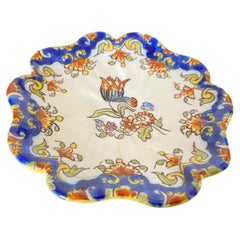
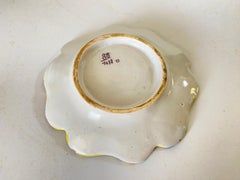
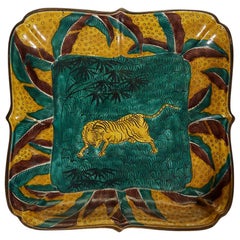
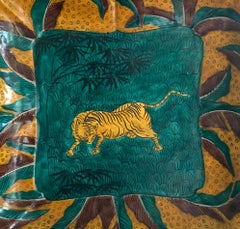
A Japanese Ao-Kutani stoneware dish with overglaze decoration in the shape of barbed quatrefoil shape from late Edo period, circa early mid-19th century. Around 1804, 100 years after Ko-Kutani (old-Kutani) ware disappeared abruptly after thriving from 1655-early 1700s, saiko-kutani (revived-kutani) was attempted by many kilns and several distinguished styles developed. Among them, Yoshidaya kiln attempted to revive the original style of Ko-Kutani known as Aote, which employed four dark colors: green, yellow, dark blue/black and aubergine to create bold and striking design. The Yoshidaya production was short-lived and lasted roughly from 1823-1831. This dish is likely dated from this period or shortly after. The overglaze design centered around a crouching tiger under a black bamboo grove in a deep green background, surrounded by luxuriant banana leaves in green and aubergine with black outlines. The base of a similar concentric barbed quatrefoil design is further decorated with black foliage outlines and marked with a square Fuku mark. For a Yoshidaya dish with identical shape but different landscape decoration, see lot 79 of sale 6547 Christie's London. Important Japanese and Chinese Art...
19th Century Japanese Japonisme Antique Yoshidaya Serveware, Ceramics, Silver and Glass
Ceramic