Warner Brothers Studios

to
2
2
2
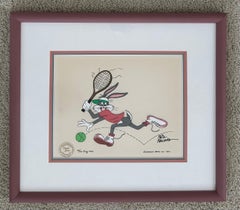
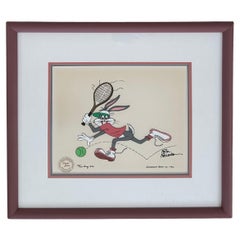
Warner Brothers "Bugs Bunny" Original Animation Production Cell by Friz Freleng
By Isadore (Friz) Freleng, Warner Brothers Studios
Located in San Diego, CA
A very rare and authentic Warner Brothers "Bugs Bunny" original hand-painted animation production cell by Friz Freleng, circa 1982. The drawing of Bugs Bunny playing tennis is from a...
Category

Mid-20th Century American Warner Brothers Studios

Materials

Plastic

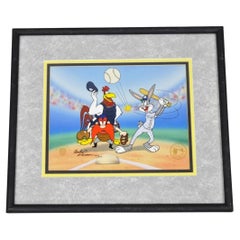
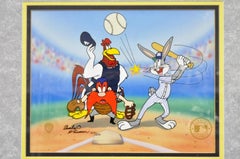
Vintage 1992 Warner Bros New York Yankees Artist Proof Cel Homerun Hare 229/250
By Warner Brothers Studios
Located in Philadelphia, PA
Vintage 1992 Warner Bros New York Yankees Artist Proof Cel "Homerun Hare" 229/250 Signed Mckimson. Circa Mid 20th Century. Measurements: 16.5" H x 19" W x 1.25" D. Cell Area 9.5" H x...
Category

Mid-20th Century Other Warner Brothers Studios

Materials

Paper

Related Items
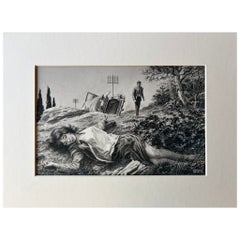
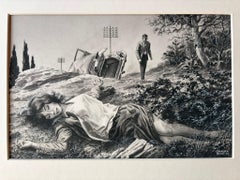
The Accident – Original Noir Illustration by Charles Burki, 1964
Located in Langweer, NL
The Accident – Original Noir Illustration by Charles Burki, 1964 This dramatic original illustration by Charles Burki (1909–1994), signed and dated 1964, captures a moment of chilli...
Category

1960s Dutch Vintage Warner Brothers Studios

Materials

Paper

Artists Kashiro Ashimi Meiji Period Bird Scroll Japan 20c Artist Nihonga
Located in Amsterdam, Noord Holland
As you can see, Kashiro Asami brush flower and bird (sparrow) figure Axle. In addition to the flowers expressed in simple yet calm shades, the bird (sparrow) seen at the top is a w...
Category

20th Century Japanese Showa Warner Brothers Studios

Materials

Silk

Artists Kashiro Ashimi Meiji Period Bird Scroll Japan 20c Artist Nihonga
$741 Sale Price
20% Off
H 74.41 in W 17.92 in D 0.04 in
Lovely Scroll Painting Japan, 20th Century 'Showa' Artist Flower
Located in Amsterdam, Noord Holland
Overall perfect: Size scroll... 142.0cm × about 55.0cm. Painting about 40.0cm × about 41.5cm. 30-12-18-1-11 (65) Condition Overall Perfect: Size scroll... 142.0cm × about 55.0cm...
Category

20th Century Japanese Showa Warner Brothers Studios

Materials

Fabric

Lovely Scroll Painting Japan, 20th Century 'Showa' Artist Flower
$492 Sale Price
44% Off
H 55.91 in W 21.66 in D 0.04 in
Original Illustration ‘The Office Fight’ by Charles Burki, 1973 – Gouache
Located in Langweer, NL
Original Illustration "Office Fight Scene" by Charles Burki, 1973 – Gouache Description: Original 1973 gouache and ink illustration by Charles Burki (1909–1994), one of the Netherla...
Category

1970s Dutch Vintage Warner Brothers Studios

Materials

Paper

Lovely Fusetsu NakamuraScroll Painting Japan Artist Flowers Painted
Located in Amsterdam, Noord Holland
Fusetsu Nakamura 1866-1943 of the Showa-life painter and calligrapher Tokyo students real name: Taro issue: Fusetsu, Kanzan, Anakatatei, Goinoshishi teacher, long life, Reitsubotoki ...
Category

Mid-20th Century Japanese Showa Warner Brothers Studios

Materials

Silk

Lovely Fusetsu NakamuraScroll Painting Japan Artist Flowers Painted
$1,567 Sale Price
20% Off
H 185.5 in W 52.5 in D 0.1 in
Artists Kawai Gyokudō Showa Period Scroll Japan 20c Artist Nihonga
Located in Amsterdam, Noord Holland
Kawai Gyokudo (?? ??, November 24, 1873-June 30, 1957) was the pseudonym of a Japanese painter in the Nihongo school, active from Meiji through Showa period Japan. His real name was Kawai Yoshisaburo. Contents Biography Gyokudo was born in what is now Ichinomiya city, Aichi Prefecture, as the eldest son of a paper, ink and brush merchant. He went to Kyoto in 1887 to study under Kono Bairei of the Maruyama-Shijo school of painting. In 1896, he moved to Tokyo and he became the student of Hashimoto Gaho, of the Kano school. He also studied Western-style painting and developed a highly personal style, especially in the field of landscape painting. Gyokudo is noted for his polychrome and occasionally monochrome works depicting the mountains and rivers of Japan in the four seasons, with humans and animals shown as part of the natural landscape. Among his representative works are Futsuka zuki (“The New Moon”), Yuku haru (“The Departing Spring”), Mine-no-yu (“Evening at the Mountain Top”), and Bosetsu (“Snow in the Evening”). In 1898, Gyokudo joined with Okakura Tenshin and Yokoyama Taikan...
Category

20th Century Japanese Taisho Warner Brothers Studios

Materials

Silk

Artists Kawai Gyokudō Showa Period Scroll Japan 20c Artist Nihonga
$1,890 Sale Price
20% Off
H 71.26 in W 20.87 in D 0.04 in
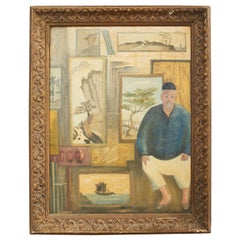
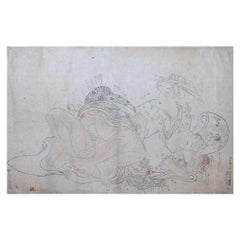
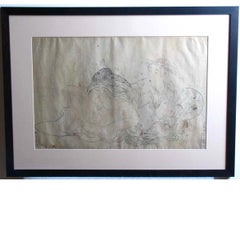
Framed Japanese ink on paper artist's instruction for a Shunga print
Located in Point Richmond, CA
Japanese ink on paper wood block shunga artist’s color and pattern illustration with instructions for the woodblock carver and printer, depicting...
Category

Late 19th Century Japanese Meiji Antique Warner Brothers Studios

Materials

Paper

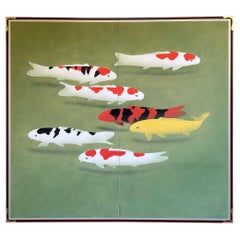
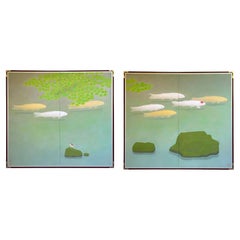
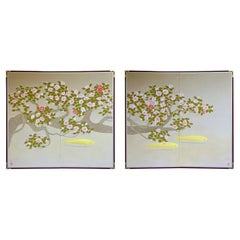
Set of screens by Nitten artist Tozaburo Ohno (大野藤三郎)
Located in Fukuoka, JP
Tozaburo Ohno (大野藤三郎) A Japanese-style painter known for his refined depictions of koi carp and seasonal flowers. Born in 1917 in Osaka (though some sources cite Kyoto), he studied ...
Category

20th Century Japanese Showa Warner Brothers Studios

Materials

Wood, Paper

Set of  screens by Nitten artist Tozaburo Ohno (大野藤三郎)
$10,300 / set
H 67.72 in W 74.41 in D 1.58 in
Artists Kawai Gyokudō Showa Period Scroll Japan 20c Artist Nihonga
Located in Amsterdam, Noord Holland
Kawai Gyokudo (?? ??, November 24, 1873-June 30, 1957) was the pseudonym of a Japanese painter in the Nihongo school, active from Meiji through Showa period Japan. His real name was Kawai Yoshisaburo. Contents Biography Gyokudo was born in what is now Ichinomiya city, Aichi Prefecture, as the eldest son of a paper, ink and brush merchant. He went to Kyoto in 1887 to study under Kono Bairei of the Maruyama-Shijo school of painting. In 1896, he moved to Tokyo and he became the student of Hashimoto Gaho, of the Kano school. He also studied Western-style painting and developed a highly personal style, especially in the field of landscape painting. Gyokudo is noted for his polychrome and occasionally monochrome works depicting the mountains and rivers of Japan in the four seasons, with humans and animals shown as part of the natural landscape. Among his representative works are Futsuka zuki (“The New Moon”), Yuku haru (“The Departing Spring”), Mine-no-yu (“Evening at the Mountain Top”), and Bosetsu (“Snow in the Evening”). In 1898, Gyokudo joined with Okakura Tenshin and Yokoyama Taikan...
Category

20th Century Japanese Taisho Warner Brothers Studios

Materials

Silk

Artists Kawai Gyokudō Showa Period Scroll Japan 20c Artist Nihonga
$1,890 Sale Price
20% Off
H 53.75 in W 26.38 in D 0.04 in
Vietnamese Scene by French Artist J Buttin
Located in Jersey City, NJ
J Buttin was a French artist who lived in Indochina. This painting shows water carrier women under banana leaves. It is signed.. The painting has been recently cleaned by a professio...
Category

1960s French Vintage Warner Brothers Studios

Materials

Canvas, Wood

Vietnamese Scene by French Artist J  Buttin
$1,650
H 19.6 in W 24 in D 0.625 in
Original Drawing by Leonce Pelletier Dated 1932
Located in Miami, FL
Very well drawn piece of art signed Leonce Pelletier, dated 1932. This subtle work depicts the very well known fish market in Nice, France most likel...
Category

20th Century French Warner Brothers Studios

Materials

Paper

Original Drawing by Leonce Pelletier Dated 1932
$220 Sale Price
20% Off
H 12.5 in W 9.5 in D 0.07 in
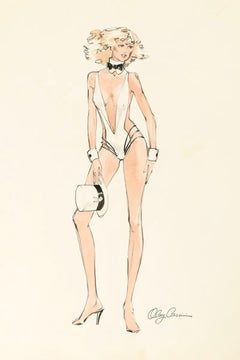
White Bunny Drawing by Oleg Cassini for Playboy October 1979, Signed
By Oleg Cassini
Located in Brooklyn, NY
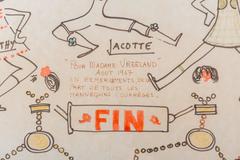
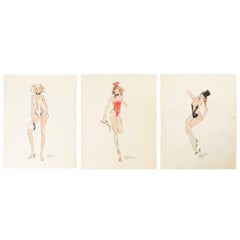
White Bunny Drawing by Oleg Cassini for Playboy October 1979, Signed. Illustration of a woman wearing a white body suit, choker, and hat. Signed by Oleg Cassini. Notice the body suit is in the shape of the head of a bunny with clever use of the 'whiskers'. Approximate Measurements: Length: 11" Width: 14" Property from the Collection of Steven Rosengard, Chicago, Illinois This original drawing was commissioned by Playboy and included in the October 1979 issue of Playboy Magazine (pages 225-227) in a feature that included works from designers such as Bill Blass, Oleg Cassini, Edith Head, Fernando Sanchez, and Monika Tilley, among others, who create their versions of the Playboy bunny costume. Candace Collins can be seen modeling some of the designs in the feature. Oleg Cassini is an icon of twentieth-century fashion. Though born to Russian aristocracy and raised in Italy, he built a fashion empire that was unmistakably American. Cassini is perhaps best known for the hundreds of designs he created for First Lady Jacqueline Kennedy (see images 4-8), but his achievements as a collector, connoisseur, and quintessential twentieth-century man go far beyond Camelot. In 1913, Oleg Cassini was born in Paris to the Russian diplomat Count Alexander Loiewski and Countess Marguerite Cassini, a Russian aristocrat of Italian ancestry who also had an interesting link to America. The daughter of Count Arthur Cassini, Russian Ambassador to the United States during the McKinley and Roosevelt administrations, Marguerite dazzled turn-of-the-century Washington as her father’s official hostess and left her mark on the capital city. Stationed in Denmark when the Russian Revolution toppled the czar, Ambassador Cassini and family were exiled to Switzerland before settling in Florence, Italy, where young Oleg was raised. A true Renaissance man, he spoke Russian, French, and Danish before adding Italian and English; he studied medieval and modern European military history and costume and learned to draw; he learned horseback riding, fencing, and the art of chivalry; and, most importantly, he came to understand the struggles of the Russian titled class and other European aristocrats in the wake of the Russian Revolution and World War I. Countess Cassini started a successful fashion business in Florence, and soon the talented young Oleg was sent to Paris to sketch the latest collections for recreation in Italy. In Rome in his early 20s, Cassini created fashions for high society women and designed for a few films, which planted the seed for his move to Hollywood. The drive to reinvent himself brought Cassini to America in the 1930s; in his autobiography he describes arriving nearly penniless in mid-Depression New York City where his title as an exiled Russian Count meant even less than in war-devastated Europe. Down and out, Cassini struggled for employment, having sketching skills but no knowledge of the wholesale trade required for survival in Manhattan’s Seventh Avenue fashion district. However, he excelled at making connections, and Cassini slowly entered New York society. He was soon joined by younger brother Igor (who had studied in America and travelled with the young Emilio Pucci) and his parents, the once-dazzling Countess and his father, the displaced diplomat still loyal to Russia. The family settled in Washington, D.C., and Igor worked his way up the Hearst newspaper chain to become the famous society columnist Cholly Knickerbocker. In New York, Oleg Cassini married the troubled socialite Merry Fahrney (who would go on to marry eight times), but the marriage ended in scandal for Oleg, and he decided to follow his original intention and head for Hollywood. Despite initial difficulties, Cassini gained access to Hollywood’s elite (partially through his skills on the tennis court), and was soon hired as a designer at Paramount Pictures alongside the redoubtable Edith Head. In her 1941 film debut I Wanted Wings, Veronica Lake wore a memorable Cassini design. That same year, Cassini met and married the newest young Hollywood star on the scene, the beautiful 20th Century Fox–talent Gene Tierney. With the outbreak of World War II, Cassini enlisted in the Coast Guard but was transferred to the U.S. Army Cavalry which allowed officers of foreign birth. He attended basic training at Fort Riley, Kansas, and the horsemanship he learned as a boy served him greatly. He attended Officer Candidate School and reached the rank of First Lieutenant (he also became an American citizen at this time, losing his title of Count). Cassini spent several years posted at Fort Riley, where Tierney joined him before he landed a convenient military post in Hollywood. As Tierney’s career thrived (she played the title role in Otto Preminger’s Laura in 1944), she was able to assert her influence over 20th Century Fox’s head Daryl Zanuck, who hired Cassini as designer for Tierney on her 1946 film The Razor’s Edge, which proved to be a brilliant showcase for his talents. The pair separated the same year and, again seeking reinvention, Cassini re-established himself in New York City as a fashion designer. By 1950, the Oleg Cassini label was born. Combining his knowledge of Old World and modern Europe, Hollywood, the tennis courts of Palm Beach and Newport, and of course, New York City, Oleg Cassini invented a new brand of fashion that was distinctly American and of its moment. For his first collection, Cassini took to the stage, narrating the looks and imbuing the scene with his personality, unusual in an industry where the designers typically remained backstage and the models were called by number over a PA. The first collection was a smash — the president of Lord & Taylor devoted all of their storefront windows to his designs — and by 1955 sales had reached $5,000,000. Oleg Cassini’s career had turned a very positive corner. Cassini spent the early 1950s traversing the country, personally selling his collections to department stores in the interior, something his predecessors had never done, and moving between the Hollywood and New York scenes. Cassini’s brother Igor coined the term “the Jet Set” for this generation that constantly flew from New York to Los Angeles (then a ten-hour flight), Las Vegas, Paris, Rome, and the Riviera. In 1954, Cassini set out to woo Grace Kelly and sent her roses every day. The two were briefly engaged before her marriage to Prince Rainier of Monaco. In December 1960, Cassini’s career-defining opportunity came when he was chosen by Jacqueline Kennedy to design her fashions for the White House. Cassini had long known Joe Kennedy and his war-hero son John, and had first met Jacqueline Bouvier before her marriage in the early 1950s. Invited by President-Elect Kennedy to meet Jacqueline at Georgetown Hospital (she had just given birth to son John Jr.) to present to her drawings of potential dresses and First Lady looks, Cassini worked furiously to prepare a new line for the First Lady. Mrs. Kennedy had always had her clothes made by the top French couturiers of the day, but for the White House she wanted an American designer. Cassini wrote in his autobiography that he told the First Lady: “‘You have an opportunity here,’ I said, ‘for an American Versailles.’ She understood completely what I was trying to communicate; she began to talk excitedly about the need to create an entirely new atmosphere at the White House. She wanted it to become the social and intellectual capital of the nation” (Oleg Cassini, In My Own Fashion, 1987, p. 327). Mrs. Kennedy loved Cassini’s design for a gown to wear to the Inaugural Gala (she had already ordered a dress from Bergdorf’s for the Inaugural Ball), and Cassini was selected as the First Lady’s designer and was soon dubbed the “Secretary of Style.” From 1960 to 1963, Oleg Cassini would design over 300 items for Mrs. Kennedy, creating the “Jackie Look” that contributed not only to a fashion revolution but also the dawn of a new age. Cassini wrote that “Jackie played a very active role in the selection of her clothes. She loved brilliant colors — pistachio, hot pink, yellow, and white among others. Her sense of style was very precise; she would make editorial comments on the sketches I sent her. She always knew exactly what she wanted; her taste was excellent” (Oleg Cassini, In My Own Fashion, 1987, p. 334). After the Camelot years, Cassini’s business flourished and grew into a major industry; his name appeared on everything from couture to tennis-, sport-, and swimwear, car interiors, housewares, and perfume. He collected beautiful and rare artwork, arms and armor, and antique furniture, and lived the lifestyle projected by his image. From this period onward, Cassini also came to live in important homes. Of his Gothic Gramercy Park townhouse on Manhattan’s 19th Street he would write imaginatively, “I walked into the foyer and immediately fell in love. It was a place unlike any other in New York, a sixteenth-century Dutch house transported brick by brick from Europe by the Wells Fargo family in the early twentieth century. There was a vaulted, twenty-foot ceiling in the living room, leaded windows, elegantly carved wood paneling...
Category

Mid-20th Century Italian Warner Brothers Studios
Materials

Paper

White Bunny Drawing by Oleg Cassini for Playboy October 1979, Signed
$2,580 Sale Price
25% Off
H 14 in W 11 in D 1 in
Previously Available Items
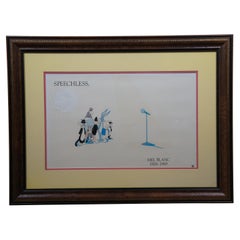
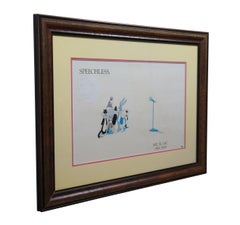
Warner Bros 1989 Mel Blanc Looney Toons Speechless Tribute Print 36"
By Warner Brothers Studios
Located in Dayton, OH
Vintage Warner Brother's tribute poster titled "Spechless," commemorating the death of voice actor Mel Blanc (1908-1989), depicting a selection...
Category

1980s Vintage Warner Brothers Studios
Materials

Paper

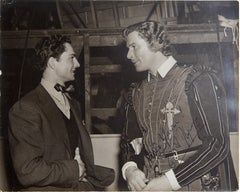
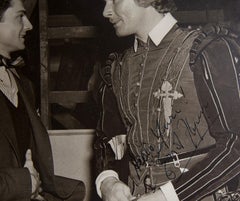
Errol Flynn Autographed Photograph on set of “The Sea Hawk” 1940 with Zoritch
By Warner Brothers Studios
Located in Glenford, NY
Errol Flynn with dancer George (Yuri) Zoritch on the set of “The Sea Hawk” in 1940 - Autographed by Flynn - “Hello Yuri! Errol Flynn” This is a original mint quality photograph signed and given to dancer George (Yuri) Zoritch by Errol Flynn in 1940. Flynn is in costume for “The Sea Hawk”. The photograph is in excellent condition and has a mat finish on heavy weight photo paper. This is not a reprint. It is an original high quality vintage photograph. Errol Flynn (1909 – 1959) was an Australian-American actor who achieved worldwide fame during the Golden Age of Hollywood. He was known for his romantic swashbuckler roles, frequent partnerships with Olivia de Havilland, and reputation for his womanising and hedonistic personal life. His most notable roles include Robin Hood in The Adventures of Robin Hood (1938), which was later named by the American Film Institute as the 18th-greatest hero in American film history, the lead role in Captain Blood (1935), the lead role in the extravagant The Sea Halk (1940), Major Geoffrey Vickers in The Charge of the Light Brigade (1936), and the hero in a number of Westerns such as Dodge City (1939), Santa Fe Trail, Virginia City (both 1940) and San Antonio (1945). Flynn was awarded two stars on the Hollywood Walk of Fame for his contributions to the motion pictures and television industry in 1960. George Zoritch (born Yuri Zoritch 1917– 2009), was a Russian-born American ballet dancer who was a star dancer is the the Ballet Russe companies throughout Europe, South America and the United States in the 1930s. In the early 1940s he came to Hollywood and over the next decade was a featured dancer in 8 major films working with Alexis Smith...
Category

1940s Other Art Style Warner Brothers Studios
Materials

Silver Gelatin

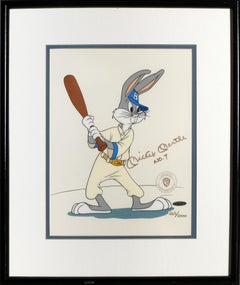
Baseball Bugs with Mickey Mantle Autograph
By Warner Brothers Studios
Located in Long Island City, NY
Animation Cel of Bugs Bunny in a baseball jersey signed by legendary Yankees player, Mickey Mantle. This sericel is numbered lower right and authenticate...
Category

1990s Pop Art Warner Brothers Studios
Materials

Screen

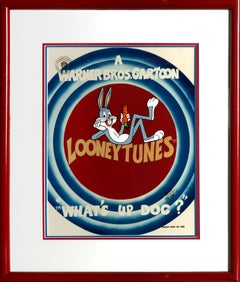
What’s Up Doc?
By Warner Brothers Studios
Located in Long Island City, NY
A hand-painted limited edition animation cel created for the classic American cartoon Looney Tunes, including Bugs Bunny. This cel is signed by animator Friz Freleng lower right.
Category

1980s Pop Art Warner Brothers Studios
Materials

Screen

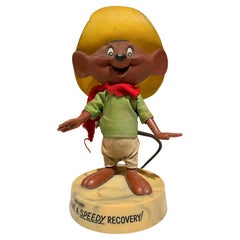
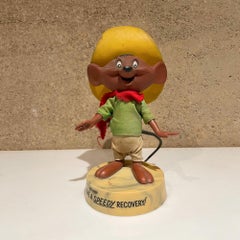
1971 Too Cute Speedy Gonzales Have a SPEEDY RECOVERY Looney Tunes Warner Bros
By Warner Brothers Studios
Located in Chula Vista, CA
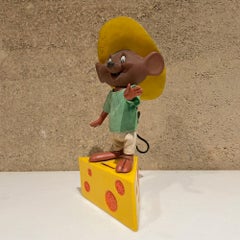
Speedy Gonzales Speedy Recovery! 1971 Cute Speedy Gonzales figure stating: Have a SPEEDY RECOVERY! Looney Tunes Warner Bros Vintage by R Dakin and Co....
Category

1970s Hong Kong Mid-Century Modern Vintage Warner Brothers Studios
Materials

Plastic

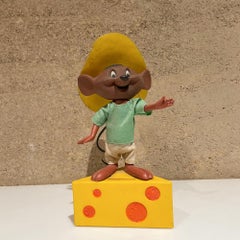
1971 Cute Speedy Gonzales Cheese Piggy Bank Looney Tunes Warner Bros R. Dakin
By Warner Brothers Studios
Located in Chula Vista, CA
Speedy Gonzales Bank 1971 Oh so cute Speedy Gonzales Cheese Wedge Piggy Bank by R. Dakin and Co Looney Tunes Warner Brothers Plastic, made in Hong Kong...
Category

1970s Hong Kong Mid-Century Modern Vintage Warner Brothers Studios
Materials

Plastic

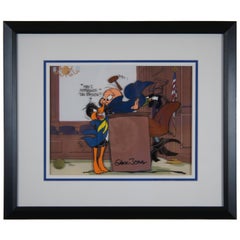
1988 Chuck Jones Signed Animation Cel Courtroom Scene Loony Tunes Warner Bros
By Warner Brothers Studios
Located in Dayton, OH
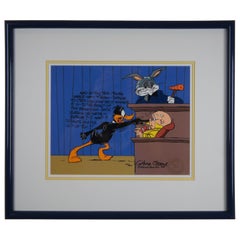
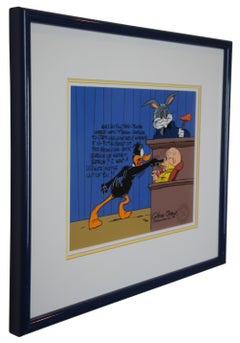
Vintage framed 1988 limited edition hand painted Looney Tunes / Warner Bros / Disney animation cel signed by Chuck Jones, numbered 257/300, stampe...
Category

1980s Vintage Warner Brothers Studios
Materials

Plastic

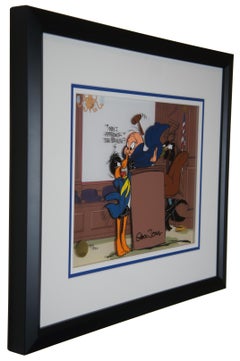
Chuck Jones Signed Animation Cel Approach the Bench Looney Tunes Warner Bros COA
By Warner Brothers Studios
Located in Dayton, OH
Vintage framed limited edition number 127/200 Looney Tunes / Warner Bros / Disney animation cel signed by Chuck Jones, titled Approach the Bench; ...
Category

Late 20th Century Warner Brothers Studios
Materials

Plastic

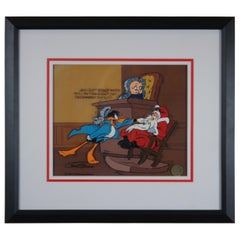
Chuck Jones Signed Animation Cel Santa on Trial Looney Tunes Warner Bros COA
By Warner Brothers Studios
Located in Dayton, OH
Vintage framed 1995 limited edition number 379/500 Looney Tunes / Warner Bros / Disney animation cel signed by Chuck Jones, titled Santa on Trial;...
Category

1990s Warner Brothers Studios
Materials

Plastic

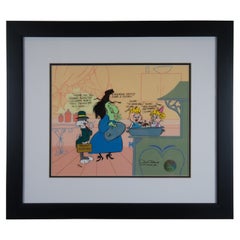
1993 Looney Tunes Chuck Jones Cel Bugs & Witch Hazel Truant Officer COA
By Warner Brothers Studios
Located in Dayton, OH
Vintage framed 1993 limited edition number 94/750 Looney Tunes / Warner Bros / Disney animation cel signed by Chuck Jones, titled Bugs and Witch Hazel: Truant Officer; includes certificate of authenticity. Features Bugs Bunny dressed as a truant officer scolding Witch Hazel as Hansel and Gretel...
Category

1990s Warner Brothers Studios
Materials

Plastic

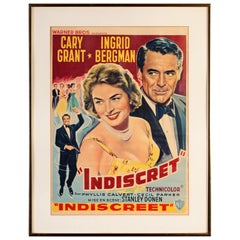
Cary Grant and Ingrid Bergman Indiscret Movie Poster, circa 1958
By Warner Brothers Studios
Located in New York, NY
From Warner Brothers is this Original Belgium Movie Poster of Indiscret starring Cary Grant and Ingrid Bergman that was found in Paris over 35 years ago. Indiscreet is a 1958 Technicolor British romantic comedy film directed by Stanley Donen and starring Cary Grant and Ingrid Bergman. An actress falls in love with a man she believes to be married, who is secretly concealing from her the fact that he has no wife. A great piece of movie memorabilia...
Category

1950s Belgian Vintage Warner Brothers Studios
Materials

Aluminum

Warner Brothers Studios furniture for sale on 1stDibs.
Warner Brothers Studios furniture are available for sale on 1stDibs. These distinctive items are frequently made of plexiglass and are designed with extraordinary care. Many of the original furniture by Warner Brothers Studios were created in the mid-century modern style in united states during the 20th century. If you’re looking for additional options, many customers also consider furniture by NASA, Allan D'Arcangelo, and Christie's. Prices for Warner Brothers Studios furniture can differ depending upon size, time period and other attributes — on 1stDibs, these items begin at $230 and can go as high as $495, while a piece like these, on average, fetch $363.
Recently Viewed

View All