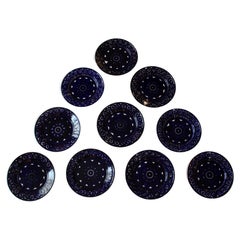
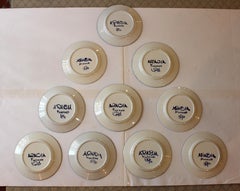
By Arabia
Located in Delft, NL
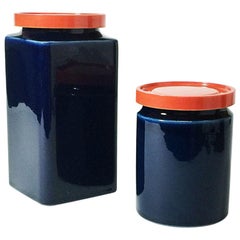
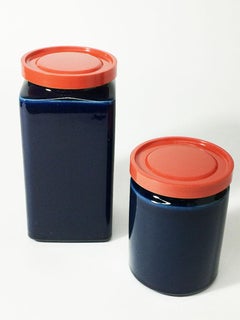
Two blue and red Arabia Finland stock jars, 1949-1954
The lidded jars are stackable, by placing the round on the square
The porcelain jars has a lid made of strong solid plastic
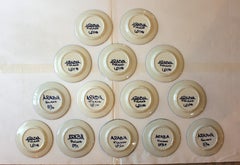
Marked on the bottom, used during 1949-1954
The measurements are 20 and 13 cm high, 9,5 cm square and 9,8 cm diagonal
The weight in total is 1253 gram
In 1873 the Finnish factory Arabia started off with the manufacture of porcelain and earthenware on a plot of land carrying the same name on the northern outskirts of Helsinki. Being a subsidiary of the Swedish ceramics factory Rörstrand, it was up to Arabia to serve the Russian market in a period of Boom. After the successful World Fair, which was held in Paris in 1900, a period of economic decline began and demand from Russia and North America for porcelain and earthenware from Finland started to slacken off. At the end of WW I, Arabia was passed into Finnish hands and a period of prosperity began. In 1929, the factory took over parent company Rörstrand. After the economic depression in 1932, demand for earthenware and porcelain collapsed and the company started to Pioneer by automatising the production process and improving efficiency.
During WW II the factory had expanded enormously and employed some 2,000 workers. Kaj Franck was hired in 1945 who designed and introduced the 'Kilta' range in the early 50s, a leading example of the modernisation process, involving new concepts relating to kitchen ware that a household might need. This took Arabia into the realm of modern communication and advisory work which included educating the public, consultation and press services. In addition to the Kilta range, other new products came on the market including 'AR-Heini' (Kaarina Aho...
Category
Mid-20th Century Finnish Pottery
MaterialsPorcelain, Plastic