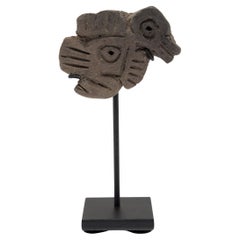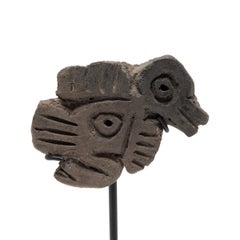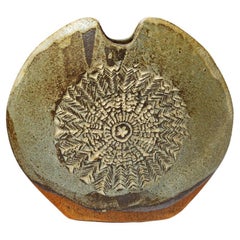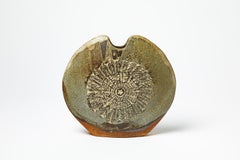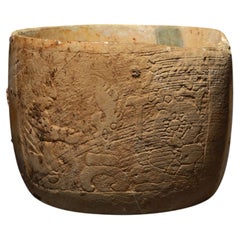
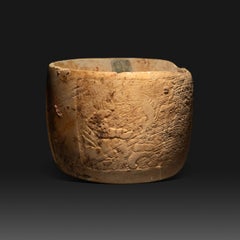
Cylindrical vase with figurative reliefs. Maya, 600 - 900 AD. 12 cm D. Alabaster
Located in BARCELONA, ES
Cylindrical vase with figurative reliefs Maya, Classic Period, 600 - 900 AD. Alabaster (Tecali stone). Diameter 12 cm and height 9.5 cm. Condition In good condition, it has a vertical crack on one side up to the middle of the base. It presents two holes parallel to the crack, a sign of an old restoration of the time. Inside, traces of polychromy and stucco are preserved in the more translucent areas of the vase. Provenance - Antique collection Le Corneur, France. Rémy Audoin, 1967. - Arts des Amériques Gallery, circa 1980. - Collection of Michel Vinaver, French writer and playwright (Paris, 1927 -2022). - To his children, Anouk, Barbara, Delphine and Ivan Vinaver, 2022. - French art market. Description Cylindrical vessel with slightly curved walls and base, with a straight and narrow mouth, without a lip. It presents two pairs of parallel holes around an old crack, which show an old restoration with staples. Currently, marks of the roots of the plants that grew around the piece when it was buried can be seen, irregular and asymmetric shapes that enrich the texture of the vase. It is made of tecali stone, a type of travertine also known as Mexican onyx or alabaster, although it is a different mineral from Egyptian alabaster. The stone presents a translucent vein, of regular width, which was probably the reason why the artist chose this specific piece of tecali, given its prominence at an ornamental level: it forms a vertical line, perpendicular to the mouth, which crosses the base, dividing it in two halves and finally rises from the opposite end of the glass, forming a meander. A similar effect can be observed, obtained in this case with varnish or pigment, in the ceramic vase cataloged by Kerr as K623. The formal importance of this vein is also reflected in the preserved remains of polychrome stucco, applied only to it and leaving the rest of the piece free. In the case of this glass, the translucent vein could represent a snake, an animal of great importance within the Mayan religion; vehicle for contact with heavenly bodies, it was a symbol of death and resurrection. One of the most important serpents in Mayan mythology, the Vision Serpent, was considered the gate between the natural and supernatural worlds, and was therefore often depicted on ritual vessels, usually carved stone. The glass is also decorated with a figurative scene that occupies approximately one third of its surface. It is worked in relief on two planes, and is framed by a smooth rectangular profile with rounded corners. It is a composition with two characters facing each other, usual to indicate dialogue, something that is also reflected in the conventional gestures of the hands. The formal style is synthetic: the background has been sunk, clearly delimiting the silhouettes of the characters, which are perfectly drawn. This linearity is repeated in the internal details of the figures, indicated by fine incisions. The schematism, however, is combined with a certain naturalism in the movement of the figures: slightly inclined heads, the position of an arm on the lap... One of the fundamental characteristics of Mayan figurative art was the search for naturalistic positions and compositions, dynamic, with bodies that rotate and elements that overlap, reaching between the 7th and 8th centuries a mastery unmatched by any other Mesoamerican culture. This search for naturalism was combined with a symbolic convention that never quite disappeared. The figure on the left appears seated in profile to the right, with a headdress tied in the front, a pectoral ornament, and a skirt typical of Mayan art, which forms parallel folds at the base of the back and whose end falls over the top. the hip. The figure extends her right hand towards the center of the composition, where an altar with an inverted C-shaped base is located. A fire seems to be burning on it with what could be offerings, two rounded shapes represented within the flames. The representation of the fire is strange, asymmetrical and crested, which could indicate that it is not flames but rather the representation of a scepter of the type known as a flint eccentric. On the right side is the second figure, seated facing forward with its head inclined towards the center of the composition, turned in profile to the left. With his legs crossed, he rests his left arm on his lap, pointing at his interlocutor with a clearly differentiated index finger, and extends his right, now lost due to erosion, towards the fire. She sports ankle, cheek and wrist ornaments, and a large headdress. On her chest she wears a medallion with a possibly solar motif, a central circle surrounded by six smaller ones. The character is seated on a throne, a symbol of authority; with seat, cushion and high, wide and open backrest, adorned with projections on both sides. The figure on the opposite side instead sits on a simple pedestal, indicating his inferior position relative to his companion, possibly a deity or ancestor. The circle on the cheek (allusive to the fur of the jaguar) and the pendant of the supernatural character allow a possible identification with the god of corn, one of the most important of the Mayan pantheon. He was a benevolent deity who represented life, prosperity, and abundance. He could be considered the creator of the world, and he was also associated with the change of seasons. Likewise, the story of his death and rebirth was a central metaphor for the belief in the apotheosis of Maya kings. Identified as Hun-Hunahpu in the Popol Vuh, a compendium of Maya lore put down in writing in the 16th century, the maize god achieved cultural hero status during the Classic period. The use of tecali, a precious material used to manufacture luxury and ritual objects, spread throughout Mesoamerica. The vases made of this stone are relatively rare, and for the most part they are painted, following the models of contemporary ceramic vases. Within the corpus of Mayan carved vessels, on the other hand, it is more common to find vessels made of this and other stones, although the majority will be ceramic. Among them, simple relief on two planes predominates, as in the case of the piece under study, with figurative motifs, inscriptions or geometric patterns, often combined. Some present compositions similar to that of this tecali stone vase, with one or more pairs of characters seated and facing each other, in an attitude of dialogue. Mayan vases...
15th Century and Earlier Pre-Columbian Antique Alabaster Ceramics
Alabaster