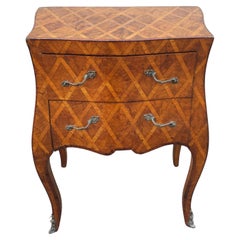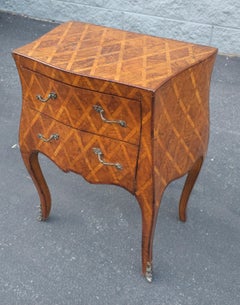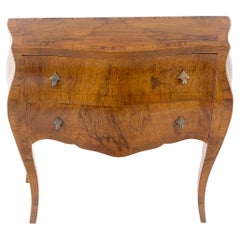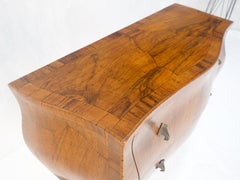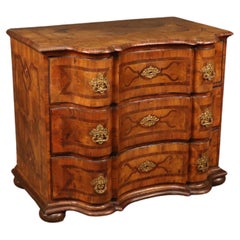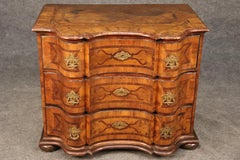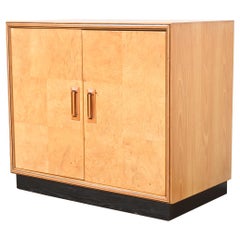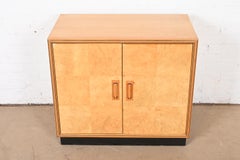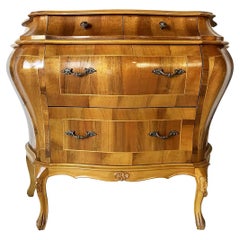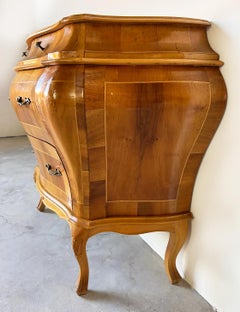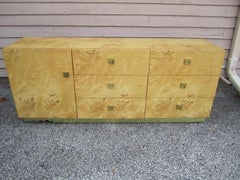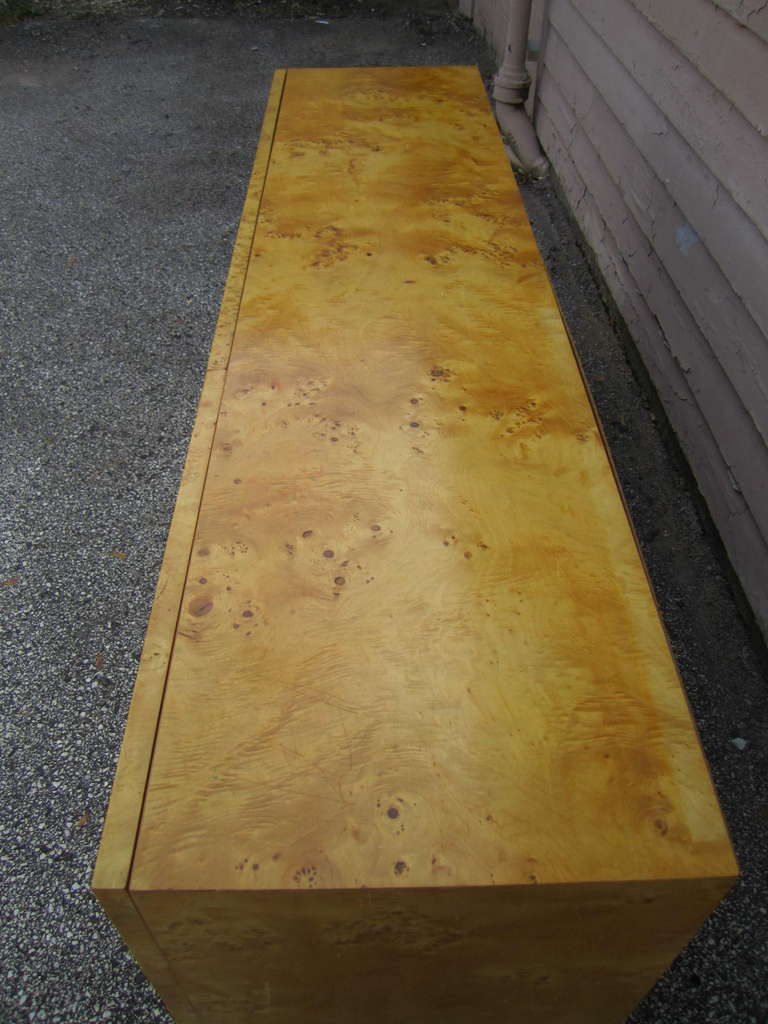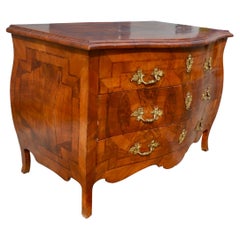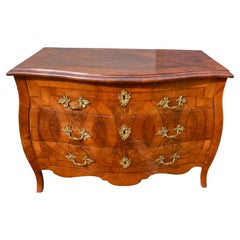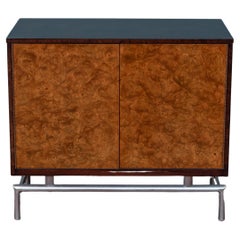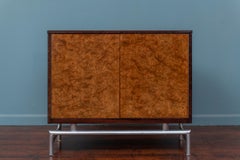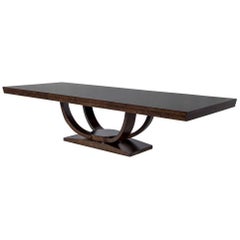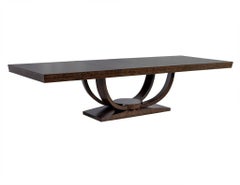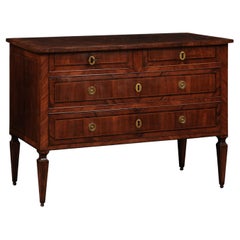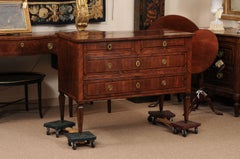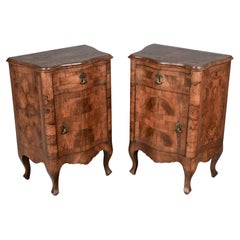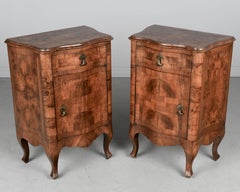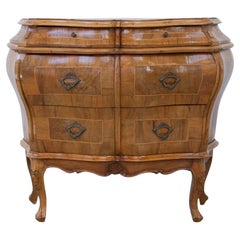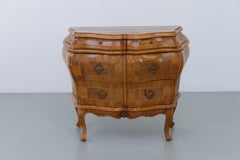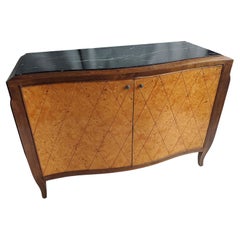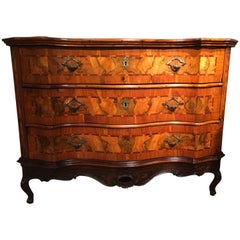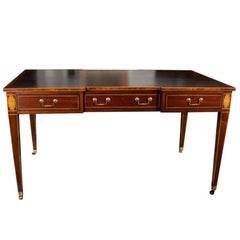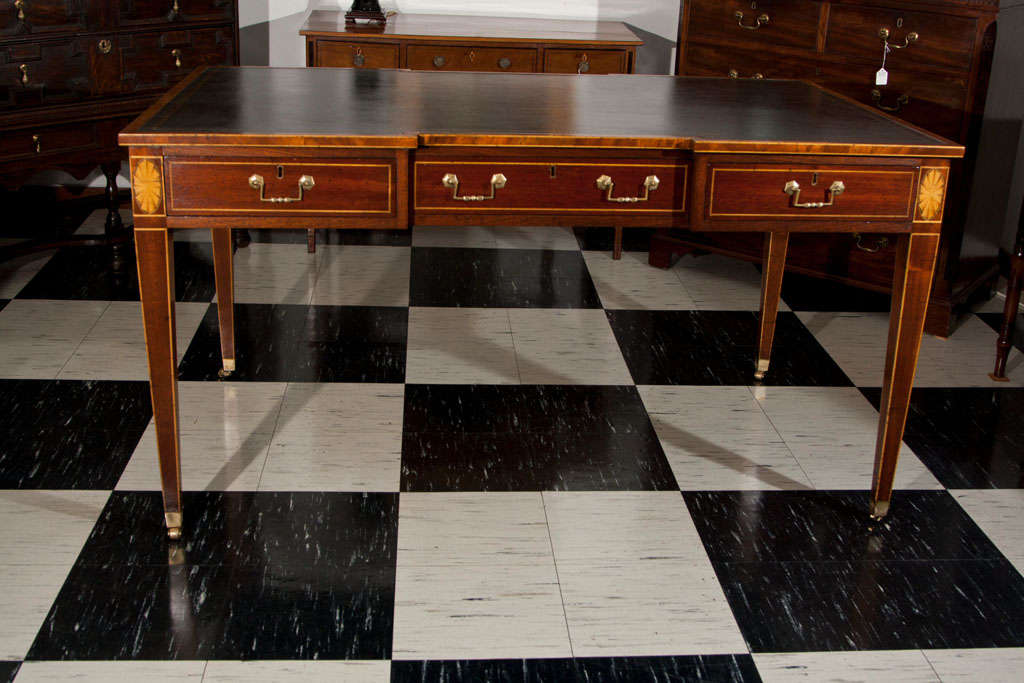
A stunning, rare, and very fine quality French Transitional Louis XV - Louis XVI style mahogany inlaid marble-top chest after Jean-François Oeben / Jean-Henri Riesener.
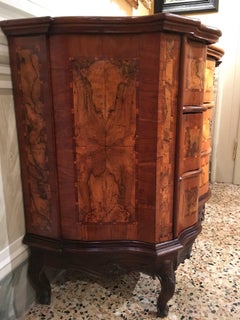
Exquisitely hand-crafted in France, born in the late 19th / early 20th century, exceptionally executed Parisian work, retaining the original shaped marble top with contoured molded edge, over conforming solid mahogany case extensively inlaid with rich floral decoration and geometric trompe l'oeil marquetry-work. Embellished with finely sculpted and chisled gilt bronze ormolu mounts, the case fitted with three high quality locking bar mounted cabinet doors, each adorned with matched ornate escutcheon and opening thanks to the original keys, revealing a mahogany finished interior with single shelf. Featuring rare and exotic woods inlaid, all rising on bronze mounted transitional cabriole legs, ending in the finest quality patinated bronze sabots.
Its three doors do not interfere with its delicate marquetry with decorations of geometric cubes and beautiful flowers on gilt gold ground, its two flat uprights with cut sides inviting finesse and harmony, while its bronzes, with antique motifs indicate the return to refined classic taste.
A fine example of the Transition style, this chest subtly combines Louis XV marquetry with shapes that are already more rectilinear. From the middle of the 18th century, certain French artists, at the head of which the architects Blondel and Contant d'Ivry as well as the painter Louis-Joseph Le Lorrain, rose up against the excesses of the rococo style and advocated a calming of lines by the use of classical or even ancient principles. If the "Greek" style was too categorical a response to these requests, the Transition style, soon launched by the Marquis de Marigny, brother of Madame de Pompadour and Minister of the Arts, was much more measured and appreciated. Dutch cabinetmaker Matthijs Horrix was also front and center, a leader a Transition style.
Celebrated ebanista Jean-François Oeben was one of the leaders of this new taste, with Jean-Henri Riesener following in the 19th century. Oeben a genius with inlay, he gave birth to several patterns, both sober and elegant, such as the marquetry of bottomless cubes, which was adopted by many of his colleagues including Jacques Dautriche and Charles Chevallier.
Jean-François Oeben was particularly known for his "Louis XV or Transition furniture, adorned with leaf veneers, flower inlays or geometric patterns", according to Pierre Kjellberg (Le Mobilier français du XVIIIe, éditions de l'Amateur, 1989). A small secretary in the Transition cabinet...
Category
19th Century French Louis XV Antique Olive Furniture
MaterialsMarble, Bronze, Ormolu