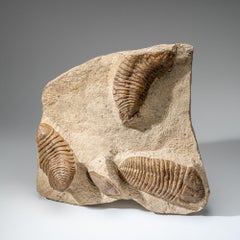
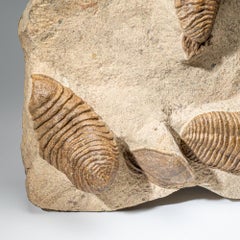
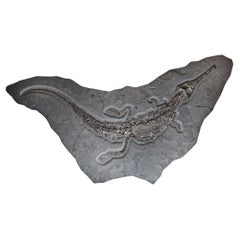
Giant Crocodile Fossil Wall Plate, Germany. 180 Million Years Old.
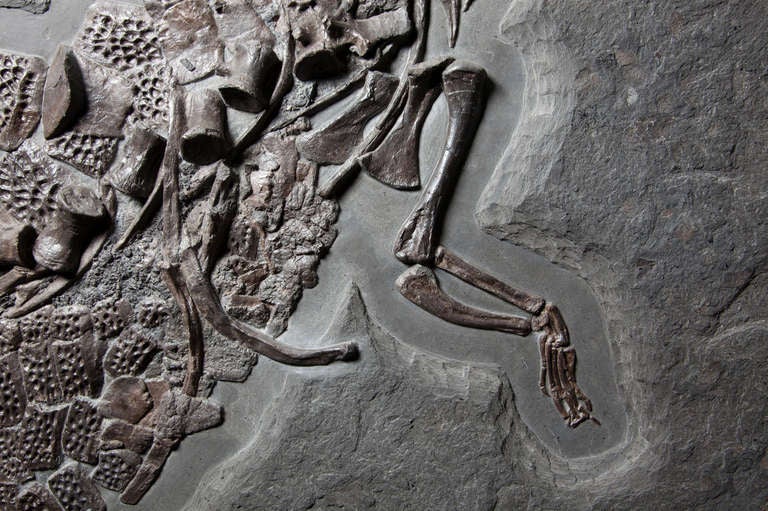
This outstanding fossilised skeleton is that of the ancestral crocodile species Steneosaurus bollensis that lived during the early Jurassic period. The skeleton, complete with armoured plates, has been exquisitely preserved and recovered from the Holzmaden Oil Shale of south Germany.
The crocodile was once buried in fine, muddy sediment 195 million years ago at the bottom of the Tethys Ocean, which once existed between Europe and Africa. The calm, deep water provided a rare anoxic (without oxygen) environment, which prevented the skeleton from any significant decomposition before burial. The mud has since been compressed into oil shale, leaving the immense skeleton completely in-tact.
This specimen is one of the few skeletons of Steneosaurus bollensis ever to be discovered. We can deduce much about the life of this reptile from the size and perfect preservation of the piece. Similar to present-day crocodiles, we can see that the two front limbs of the Steneosaurus are much shorter than the back two. This indicates that crocodile ancestors were bipedal; indeed, we believe that crocodiles evolved from the same reptile species as the dinosaurs and airborne pterosaurs.
Dinosaurs ruled the lands during the late Triassic and early Jurassic. This made terrestrial life increasingly difficult for ancestral crocodiles, as there were many predators and prey was scarce. However, the seas were rich in fish, shellfish, starfish, crabs, squid… You can even see fossil belemnite guards (bullet shells of squid-like organisms) and the beautiful spiral shells of ammonites preserved around the crocodile skeleton...
Category
15th Century and Earlier German Antique Other Furniture