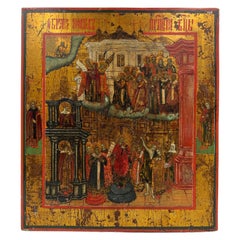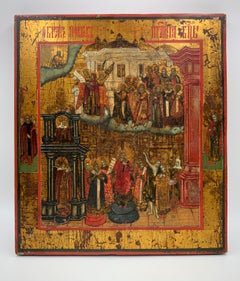
19th Century Russian Orthodox Crucifixion Icon, Inscribed Extensively
Located in West Palm Beach, FL
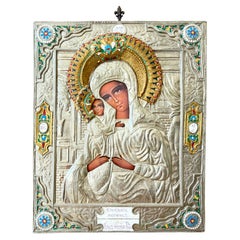
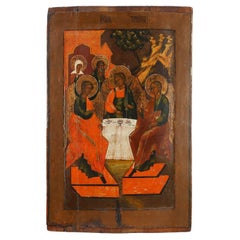
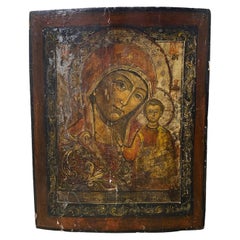
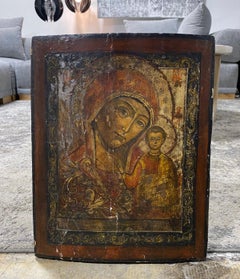
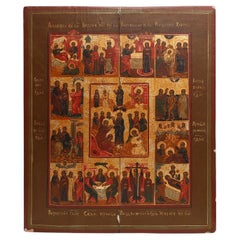
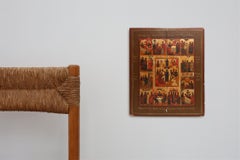
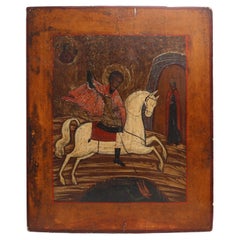
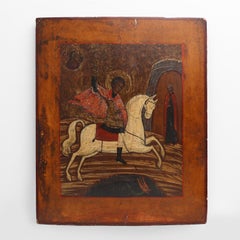
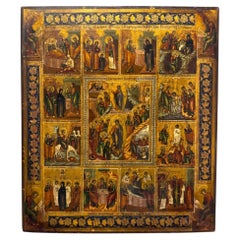
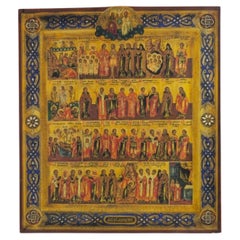
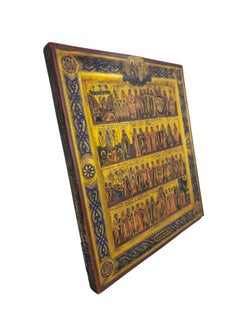
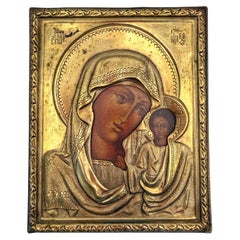
19th-Century Russian Orthodox Crucifixion Icon with Extensive Church Slavonic Inscriptions A deeply atmospheric and finely detailed 19th-century Russian Orthodox icon depicting the Crucifixion of Christ, executed in the traditional Byzantine manner with extensive Church Slavonic inscriptions and an unusually decorative turquoise and gilt border evocative of cloisonné enamelwork. The icon presents Christ crucified upon a dark wooden cross, flanked by the mourning figures of the Virgin Mary and Saint John the Theologian, all rendered with elongated proportions and solemn devotional expression characteristic of Russian icon painting of the period. The arched upper register bears the title “Распятие Господне” Translated: “The Crucifixion of the Lord.” The cross plaque is inscribed with “І.Н. Ц.І.” The Church Slavonic equivalent of INRI, translating to the following: “Jesus of Nazareth, King of the Jews.” Above Christ appears the sacred Christogram. “ІС ХС” Translated: “Jesus Christ.” Additional inscriptions include: “ЦРЬ СЛВЫ” Translated: “King of Glory.” and likely: “СЫН БОЖИЙ” Translated: “Son of God.” The Virgin is identified by the traditional Greek abbreviation "MR. ΘΥ.” Meaning: “Mother of God.” while Saint John is inscribed. “СТЫ ИОАНН БОГОСЛОВ” Translated: “Saint John the Theologian.” The richly ornamented border with geometric floral motifs provides exceptional decorative presence, uncommon among more austere provincial examples. The reverse retains an old typed collection or import label reading, “Russian Icon of the Crucifixion, 14 in. by 12 in., 19th Century," along with an apparent 1971 import or inventory date stamp, suggesting the work entered the United States through an early dealer, estate, or ecclesiastical collection. Presented on traditional joined wood panel construction with horizontal butons. Surface wear, craquelure, scattered paint losses, edge wear, and age-related abrasions are present throughout and should be viewed as consistent with the devotional use, age, and authenticity of the icon rather than defects. These surfaces contribute to the deeply timeworn spiritual character prized in antique Orthodox icons...
Mid-19th Century Antique Russian Furniture
Wood