Want more images or videos?
Request additional images or videos from the seller
1 of 3

Pair Recamier Sofas with Winged Paw Feet

You May Also Like

More From This Seller

View All
Small Settee in the Neoclassical Taste

Small Settee in the Neoclassical Taste

Located in New York, NY

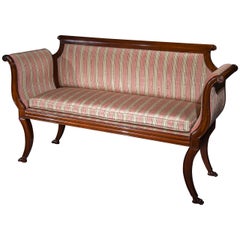
Small Settee in the neoclassical taste Boston, Massachusetts (active 1804–17), about 1810 Mahogany (secondary woods: ash) Measures: 35 1/8 in. high, 59 3/4 in. long, 19 1/8 in. deep Although the diminutive scale of this settee places it in a unique category, the piece itself partakes of a vocabulary that is common in Boston furniture of the Late Federal period. Its sabre legs, for example, as seen straight on from the left and right ends, are closely related to the legs, as seen from the front, on a group of chairs of undisputed Boston origin, including a spectacular armchair with scrolled arms (see Stuart P. Feld, Boston in the Age of Neo-Classicism, 1810–1840, exhib. cat. [New York: Hirschl & Adler Galleries, 1999], p. 37 no. 6 illus. in color), as well as a number of side chairs, including a set made for Nathan Appleton (see Page Talbott, “Boston Empire Furniture, Part I,” The Magazine Antiques, CVII [May 1975], p. 887 fig. 12). In all, the legs are ornamented with two bold, somewhat flattened reeds set between corner beads, a pattern which is repeated here on the front and end seat rails as well. The superb quality of the piece is further demonstrated in the finely drawn profile of the arms, as well as the delicately bulbous surface of the fronts of the arms and legs. As in the best of the related chairs, the sabre legs end in delicately carved paw feet. The added refinement of the beautifully carved rosettes at both the fronts and backs of the arms suggests that the piece may have been designed to be used in the round. Stylistically harmonious with these pieces is also a group of larger sofas with frontally set sabre legs and scrolled arms (see Page Talbott, “Seating Furniture in Boston, 1810–1835,” The Magazine Antiques, CXXXIX [May 1991], p. 963 pl. 11) that represent an indigenously Boston form. Although none of the furniture in this group has been effectively attributed, they can certainly be related to various Boston card tables...

Category

Antique Early 19th Century American Neoclassical Settees

Materials

Wood

Pair Side Chairs with Lyre Back

Pair Side Chairs with Lyre Back

Located in New York, NY

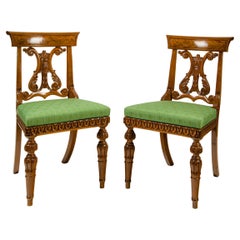
“I know of no other chair like the single [sic] ‘lyre back’ one. . . . I certainly recognize it as a Boston chair considering all the individual elements, but the combination is particularly elegant.” So wrote noted scholar of Boston furniture Page Talbott when a set of four chairs of this design originally surfaced in the 1980s. Although the existence of four chairs in a specific pattern might imply that the chairs were originally part of a larger set, no additional chairs of this form have appeared in the intervening years. The lyre became a popular motif during the Neo-Classical period, and is frequently encountered as the back splat of klismos chairs, in no example more familiar than in a group of Duncan Phyfe chairs...

Category

Antique 1820s American Neoclassical Chairs

Materials

Mahogany

Center Table with Scroll Legs, Paw Feet and Marble Tops

Center Table with Scroll Legs, Paw Feet and Marble Tops

By Thomas Seymour

Located in New York, NY

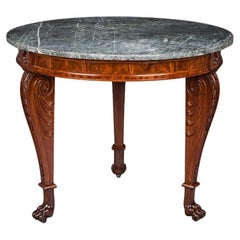
Center Table, about 1818–20 Attributed to Thomas Seymour (1771–1848), working either for James Barker or for Isaac Vose & Son, with Thomas Wightman (1759...

Category

Antique 1810s American American Classical Center Tables

Materials

Wood, Mahogany

Klismos Chair

Klismos Chair

By William Hancock

Located in New York, NY

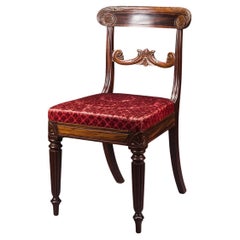
In general, wealthy families in and around Boston in the early years of the nineteenth century chose homes, paintings, furniture, silver, glass, and other decorative accessories that...

Category

Antique Early 19th Century American Neoclassical Chairs

Materials

Velvet, Ash, Birch, Mahogany, Oak

Card Table in the Rococo Taste

Card Table in the Rococo Taste

By Charles A. Baudoine

Located in New York, NY

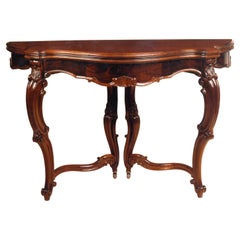
RECORDED: cf. Anna Tobin D’Ambrosio, ed., Masterpieces of American Furniture from the Munson-Williams-Proctor Institute (Syracuse University Press, Utica, New York, 1999), pp. 85, 86, 87 illus. the Munson-Williams-Proctor tables // cf. The Metropolitan Museum of Art, New York, 19th Century America–Furniture and Other Decorative Arts (1970), exhib. cat., [n.p.] no.133 This table is identical to a pair of card tables bearing the stenciled label of Charles A. Baudouine of 335 Broadway, New York, which were acquired by James and Helen Munson Williams of Utica, New York, in May 1852 for their home, Fountain Elms, which is where they remain today as part of the Munson-Williams-Proctor Art Institute collection. The Williams tables were billed as “1 Rosewood Multiform Table” at $160 for the pair, and they were indeed “multiform” in that they could be used separately and folded as a pair of console tables, opened as a pair of card tables, or joined together as a center table. The present table varies essentially in the fact that it does not include the mechanism that would have allowed it to be attached to another to form a center table. Of French descent, Baudouine was born in New York in 1808. He made his debut as a cabinetmaker in the New York directory of 1829/30, where he is listed at 508 Pearl Street. By 1839/40 he relocated to Broadway, where he remained in business at various addresses until about 1854. A sense of the scale of Baudouine’s operation is given by German immigrant cabinetmaker Ernest Hagen...

Category

Antique Mid-19th Century North American Rococo Revival Card Tables and T...

Materials

Wood, Rosewood

Butler's Desk and Etagére, New York, Possibly Duncan Phyfe

Butler's Desk and Etagére, New York, Possibly Duncan Phyfe

By Duncan Phyfe

Located in New York, NY

Butler’s Desk and Etagére, circa 1825 New York, possibly by Duncan Phyfe Mahogany (secondary woods: mahogany, pine, poplar), with ormolu mounts, marble,...

Category

Antique 1820s American Neoclassical Cabinets

Materials

Mahogany