Want more images or videos?
Request additional images or videos from the seller.

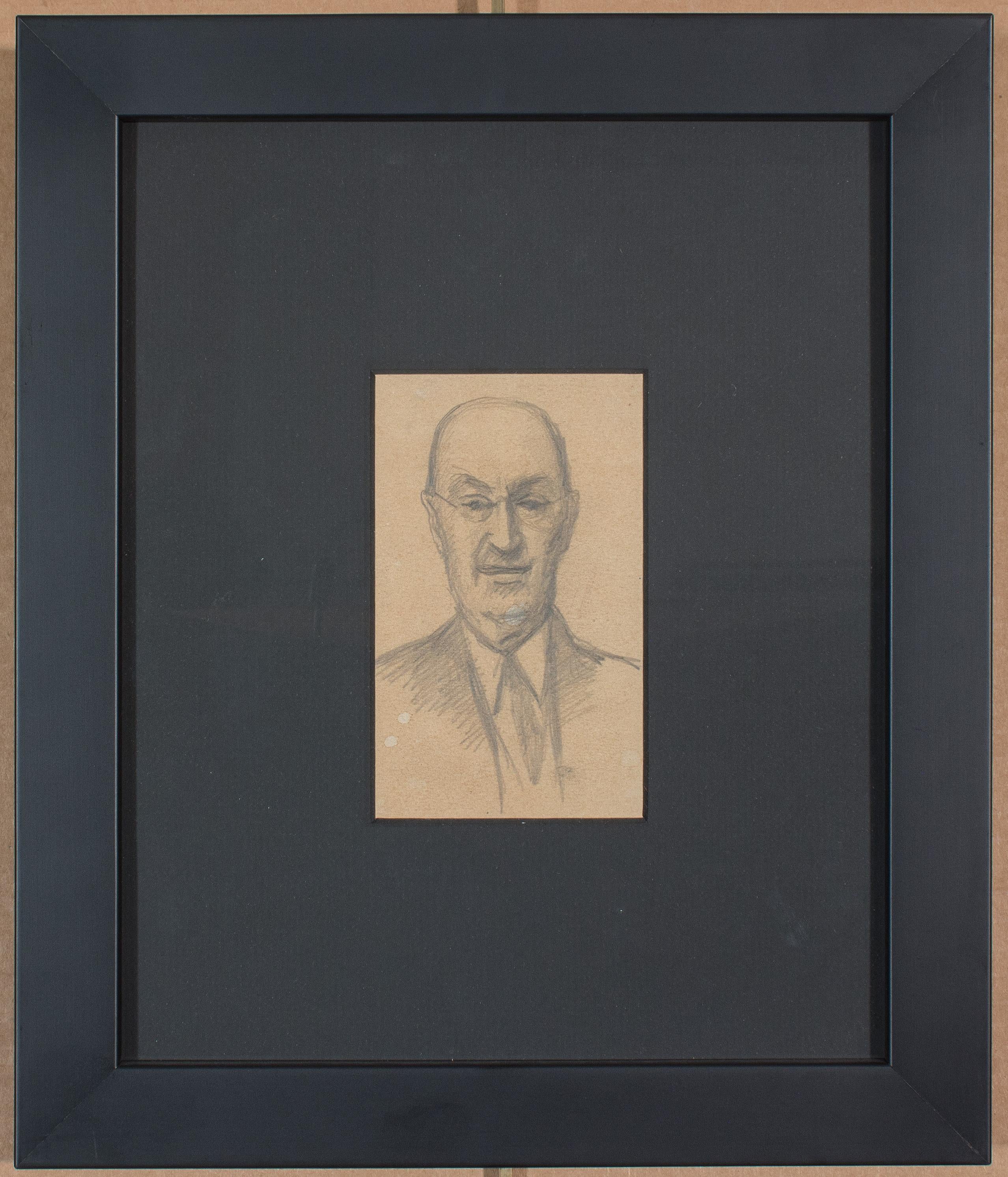
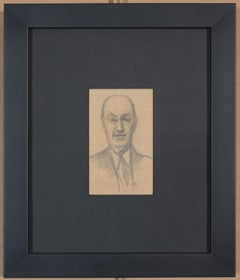
Portrait of Ben Nicholson

1928

$1,724.46
£1,275
€1,556.69
CA$2,459.08
A$2,521.37
CHF 1,436.59
MX$32,094.90
NOK 16,501.34
SEK 17,216.84
DKK 11,636.59

About the Item

Christopher ' Kit ' Wood 1901-1930, was an English painter who briefly attended Liverpool University to study architecture but pursued an artistic career. He trained at the Academy Julienne in Paris where he met some of the most famous artist of the day, Picasso, Cocteau, Diaghilev and others. He was a member of the London Group and the Seven and Five Society where he met and became friends of Ben and Winifred Nicholson, he stayed with them in 1928 in their North country cottage where it is thought this portrait was drawn. The writer Sebastien Faulks wrote a book called ' The Fatal Englishman ' which describes the possibility of the place, date and time of this picture, when Wood and Nicholson went out for a day of painting. I have listed below a biography of the artist for your interest. Christopher Wood (1901–1930) was an influential English painter. He combined raw, untutored styles with sophisticated modern techniques. His short life left a lasting mark on British modernism. Wood was born in Knowsley, near Liverpool. He survived a severe childhood bout of poliomyelitis. This illness caused a lifelong limp but sparked his interest in drawing. He briefly studied architecture at Liverpool University. In 1921, he moved to Paris to study art. He attended the Académie Julian and immersed himself in the avant-garde scene. Wood quickly befriended key figures like Jean Cocteau and Pablo Picasso. Picasso heavily influenced his early approach to form and figure drawing. In 1926, Wood joined the London Group and the Seven and Five Society. He formed close bonds with Ben and Winifred Nicholson. Together, they painted in Cumberland and Cornwall. In 1928, Wood and Ben Nicholson discovered self-taught fisherman-artist Alfred Wallis in St Ives. Wallis’s raw, direct style profoundly altered Wood's artistic direction. Wood adopted a deliberately naive approach, utilizing heavy brushwork, muted tones, and coastal themes. Wood wrestled with severe financial anxiety and a growing addiction to opium. Despite these struggles, his output in 1930 was astonishingly prolific. He spent the summer painting feverishly in Brittany, producing dozens of canvases. His mental health deteriorated due to drug-induced paranoia. On 21 August 1930, Wood fell under a train at Salisbury railway station and died at the age of 29. His unique fusion of English landscape painting and French modernism remains highly celebrated. His works are held in major public collections, including Tate Britain. In the Spring of 1928 Wood stayed at Bankshead, the Nicholsons' renovated, spartan stone farmhouse located in Cumbria (Cumberland). He spent an exhilarating six weeks working there during March and April 1928. Wood was deeply impacted by this trip, writing that the rustic "Bankshead life" was the ultimate "painter's life". We think that this drawing may have been produced during this trip. Thereafter in the Summer/Autumn 1928, he stayed in Cornwall the Location in August, Wood rejoined the Nicholsons in Feock, Cornwall. The Nicholsons were renting a house called Haylands, located near Pill Creek. Wood stayed with them through August and September. It was during this specific period that Wood and Ben Nicholson took a fateful day trip to St Ives and discovered the self-taught artist Alfred Wallis. After the Nicholsons returned to London in October, Wood extended his time in Cornwall, staying on alone in a rented cottage on Porthmeor Beach until November 1928.
  • Attributed to:
    Christopher Wood 1 (1901 - 1930, British)
  • Creation Year:
    1928
  • Dimensions:
    Height: 12 in (30.48 cm)Width: 9 in (22.86 cm)Depth: 1 in (2.54 cm)
  • Medium:
  • Period:
  • Condition:
  • Gallery Location:
    Douglas, GB
  • Reference Number:
    Seller: No. 191stDibs: LU2373215418762

More From This Seller

View All
Portrait of John Seymour Lucas

Portrait of John Seymour Lucas

By Alphonse Legros

Located in Douglas, Isle of Man

Alphonse Legros 1837-1911, was a French painter and sculptor, who lived in London from 1863 until his death in 1911. He was a teacher of etching and drawing and became Slade Professo...

Category

1910s Portrait Drawings and Watercolors

Materials

Paper, Charcoal

Lord David Cecil

Lord David Cecil

Located in Douglas, Isle of Man

Albert Daniel Rutherston 1881-1953, was an English artist who painted, portraits, landscapes, illustrated books and designed stage sets. Two of his brothers were Sir William Rothenst...

Category

1940s Portrait Drawings and Watercolors

Materials

Pencil, Paper

Proffesor Nevill Coghill

Proffesor Nevill Coghill

Located in Douglas, Isle of Man

Albert Rutherston 1881-1953, was an English artist, who painted portraits, landscapes, illustrated books and designed stage sets. Two of his brothers were Sir William Rothenstein and...

Category

1940s Portrait Drawings and Watercolors

Materials

Pencil

Portrait of an unknown sitter thought to be American

Portrait of an unknown sitter thought to be American

By Alphonse Legros

Located in Douglas, Isle of Man

Alphonse Legros 1837-1911, was a French painter and sculptor, who lived in London from 1863 until his death in 1911. He was a teacher of etching and drawing and became Slade Professo...

Category

Early 20th Century Portrait Drawings and Watercolors

Materials

Paper, Charcoal

The Chelsea Pensioner

The Chelsea Pensioner

Located in Douglas, Isle of Man

Anne Marjorie Robinson 1858 - 1924, was a British painter in oil and watercolour of portraits and miniatures. Annie as she was sometimes known was born in Belfast Northern Ireland and moved to London in 1907, there she studied miniature portrait painting under the best miniature painter of the time Alyn Williams. Annie exhibited at the Royal Academy, the National Gallery in Ireland, the Belfast Museum, the Walker Art Gallery in Liverpool and the Royal Hibernian Academy, and others. She was a well known and much admired painter in Northern Ireland and a number of her works are held in the Ulster Museum. This picture is of a old soldier who resided with the Chelsea Pensioners and he is known a such. He looks as if he is wearing the coat of an officer of the Royal Marines Light Infantry and the medals he is wearing and the ribbons are for the Indian Mutiny issued between 1857 - 1859, he is also wearing the General Indian Service Medal which was issued between 1852 -1859. As an officer he would have worn this darker, and more expensive coat but the general service infantry would have worn red simply because it was cheaper to produce in mass production methods during the 19th Century. Visibility did not seem to be considered an issue then as the troops would have marched directly towards the enemy firing and bayonetting away without the later consideration of camouflage and personal survival. The advantage of camouflage did not come into force until WW1. The buttons on the coat are most interesting as they are dated back to the Duke of Wellington's time, and reflect the imitation of Royal and upper class serviceman's fashion in general. The frame appears to be original to the painting and the labels show that it was exhibited almost certainly at the Royal Academy, and the other label with the London address shows the home of what was once the home of James McNeil Whistler. I am extremely thankful to Jonathon Russell, from the Annie Swynnerton website, for his help in catalouging this painting and the help he received from the National Army Museum Experience Team. I have included a further biography here for your interest :- Annie Marjorie Robinson (1858–1924) was a Belfast-born Irish artist known for her portraits and miniature paintings, as well as for her sculptures. Education and early career Early training: Robinson trained as an illuminator and attended the Belfast Government School of Design. Move to London: In 1907, she relocated to London to focus on portraiture, studying under Alyn Williams of the Royal Society of Miniature Painters. While there, she also studied modelling. Return to Belfast: She returned to Belfast in 1914 after the outbreak of World War I. Exhibitions and memberships Robinson was a frequent exhibitor throughout her career: Royal Academy: She exhibited nine works at the Royal Academy in London between 1914 and 1923. Royal Hibernian Academy: Her work was regularly shown at the Royal Hibernian Academy in Dublin. Other venues: She also exhibited at the Walker Art Gallery in Liverpool and with the Belfast Arts Society. Arts & Crafts Society: In 1917, she displayed two decorative panels at the 5th exhibition of the Arts & Crafts Society in Dublin. Robinson was an active member of the artistic community and held several prestigious memberships: Associate of the Royal Miniature Society (ARMS), elected in 1912. Associate of the Society of Women Artists (ASWA), elected in 1918. Member of the Belfast Ramblers' Sketching Club (1886–1890) and the Belfast Arts Society (1895–1924). Artworks and legacy Subject matter: A regular subject in Robinson's work was Saint Brigid of Kildare. Paintings exploring this theme, including It Was Brigit Wove the First Cloth in Ireland, are now part of a triptych in the Ulster Museum. Legacy at Ulster Museum: After her death on October 22, 1924, her brother John B. Robinson donated 22 miniature portraits, as well as sculptures, watercolours, and an oil-on-canvas self-portrait, to the Ulster Museum. Other posthumous tributes Memorial exhibition: In 1925, the Belfast Municipal Art Gallery held an exhibition of Robinson's oil paintings...

Category

1890s Portrait Paintings

Materials

Canvas, Oil

Summer shade, 1935. Muriel Cooke, pioneer for the Guide Dogs for the Blind

Summer shade, 1935. Muriel Cooke, pioneer for the Guide Dogs for the Blind

Located in Douglas, Isle of Man

Muriel Elise Cooke, ( Crooke ) 1901 - 1975, was an English artist who painted in watercolour and oil, she was also an engraver Cooke studied in Paris, France and in her twenties exh...

Category

1930s Landscape Drawings and Watercolors

Materials

Paper, Watercolor

You May Also Like

Pencil Portrait of a Young Man by 20th Century British Artist John Sergeant

Pencil Portrait of a Young Man by 20th Century British Artist John Sergeant

By John Sergeant

Located in London, GB

JOHN SERGEANT (1937-2010) Head of a Young Man Pencil 32 by 25 cm., 12 ½ by 10 in. (frame size 51 by 43 cm., 20 by 17 in.) Sergeant was born in London, the son of a civil servant....

Category

1960s Realist Portrait Drawings and Watercolors

Materials

Pencil

Portrait of a Man by Philadelphia artist Julius Bloch

Portrait of a Man by Philadelphia artist Julius Bloch

By Julius Bloch

Located in Philadelphia, PA

Julius Thiengen Bloch (American, born Germany, 1888–1966) Portrait of a Man, c. 1943 Pencil on paper, 5 1/2 x 3 1/2 inches FRAMED: 13 x 11 inches (approx.) This sketch comes direct...

Category

1940s Realist Portrait Drawings and Watercolors

Materials

Paper, Pencil

Portrait of Leopold Myers by Sir William Rothenstein

Portrait of Leopold Myers by Sir William Rothenstein

By Sir William Rothenstein

Located in Soquel, CA

Stately sanguine portrait of Leopold Hamilton Myers (Novelist) by Sir William Rothenstein (English, 1872-1945). Captured in Rothenstein's characteristic style, Myers looks directly at the viewer with a neutral expression. Although this portrait uses only two colors and minimal shading, the likeness of Myers is incredibly well captured. Leo (Leopold) Hamilton Myers (1881 – 1944) was a British novelist. Numerous examples like this one of the writer are in the Tate Museum. Initialed and dated in the lower right corner ("W.R. 1936") Inscription on verso indicating materials, subject, and artist. Presented in a new cream colored mat with foamcore backing. Mat size: 18"H x 12"W Paper size: 15.25"H x 10.75"W William Rothenstein (English, 1872-1945) was born into a German-Jewish family in Bradford, West Yorkshire. His father, Moritz, emigrated from Germany in 1859 to work in Bradford's burgeoning textile industry. Soon afterwards he married Bertha Dux, and they had six children, of which William was the fifth. Rothenstein was knighted in 1931. Rothenstein left Bradford Grammar School at the age of sixteen to study at the Slade School of Art*, London (1888-1893), where he was taught by Alphonse Legros, and the Académie Julian* in Paris (1889-1893), where he met and was encouraged by James McNeill Whistler, Edgar Degas and Henri Toulouse-Lautrec. Whilst in Paris he also befriended the Anglo-Australian artist Charles Conder, with whom he shared a studio in Montmartre. In 1893 he returned to England to work on "Oxford Characters" a series of lithographic* portraits. In Oxford he met and became a close friend of the caricaturist* and parodist Max Beerbohm, who later immortalised him in the short story Enoch Soames (1919). During the 1890s Rothenstein exhibited with the New English Art Club* and, in 1900, won a silver medal for his painting The Doll's House at the Exposition Universelle. In 1898 he co-founded the Carfax Gallery in St. James' Piccadilly with John Fothergill. During its early years the gallery was closely associated with such artists as Charles Conder, Philip Wilson Steer, Charles Ricketts and Augustus John. It also exhibited the work of Auguste Rodin, whose growing reputation in England owed much to Rothenstein's friendship and missionary zeal. The gallery was later the home for all three exhibitions of The Camden Town Group*, led by Rothenstein's friend and close contemporary Walter Sickert. Rothenstein is best known for his portrait drawings of famous individuals and for being an official war artist in both World War I and World War II. He was also a member of the International Society of Sculptors, Painters & Gravers. The style and subject of his paintings varies, though certain themes reappear, in particular an interest in 'weighty' or 'essential' subjects tackled in a restrained manner. Good examples include Parting at Morning (1891), Mother and Child (1903) and Jews Mourning at a Synagogue (1907) - all of which are owned by the Tate Gallery. The National Portrait Gallery owns over two hundred of his portraits. In 2011 the BBC and the Public Catalogue Foundation began cataloguing all of his paintings in public ownership online. Between 1902 and 1912 Rothenstein lived in Hampstead, London, where his social circle included such names as H.G.Wells, Joseph Conrad and the artist Augustus John. Amongst the young artists to visit Rothenstein in Hampstead were Mark Gertler...

Category

1930s Realist Portrait Drawings and Watercolors

Materials

Handmade Paper, Conté

Ronco

Ronco

By Ben Nicholson

Located in London, GB

Ben Nicholson (British 1894 - 1982) Ronco Ink and wash on board 1981 Size: 59cm high, 64cm wide - 23¼ ins high, 25¼ ins wide Frame: 67cm high, 73cm wide - 26½ ins high, 28¾ ins w...

Category

Vintage 1980s British Paintings

Materials

Wood

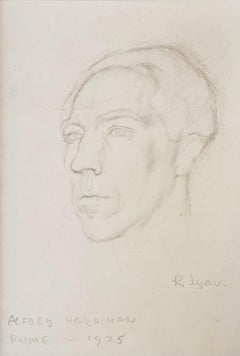
Portrait of Alfred Hardiman, Graphite Sketch, Signed and Dated 1925

Portrait of Alfred Hardiman, Graphite Sketch, Signed and Dated 1925

Located in London, GB

Graphite on paper, signed and dated Image size: 18 x 12 1/2 inches (46 x 32 cm) Mounted and framed The sitter for this portrait, Alfred Hardiman, was an English sculptor. Hardiman and Lyon were friends and met when they both attended the British School at Rome in the early 1920s. Hardiman won a London County Council Scholarship to the Royal College of Art in 1912, and three years later joined the Royal Academy School. After a period as an engineer's draughtsman in the Royal Flying Corps during the First World War, Hardiman resumed his studies and in 1920 was awarded the British Prix de Rome scholarship, spending two years at the British School at Rome. There he developed his style, a blend of naturalism and classicism influenced by Roman and Etruscan art and early fifth century Greek sculpture. Hardiman's best-known (but also most controversial) work is the Earl Haig Memorial on Whitehall in London. More universally admired are the heraldic lions flanking the main entrance to the City Hall, Norwich, a work which fully epitomises his style. He was appointed consultant sculptor to the building, having worked with one of the architects, Stephen Rowland Pierce, on the Haig Memorial. Hardiman also carved three large stone figures for the outside of the council chamber, and worked with other sculptors on the project including James Woodford and Eric Aumonier. Hardiman was elected Associate of the Royal Academy in 1936 and a full Academician in 1944. He became a fellow of the Royal Society of British Sculptors in 1938 and the following year received their silver medal for his statue of Haig. In 1946 he won a gold medal for his bronze fountain figure for the New Council House, College Green, Bristol, which however was never erected. In 1918 he married Violet, daughter of Herbert Clifton White, of London, and had two daughters. He died at Stoke Poges on 17th April 1949. Robert Lyon...

Category

1920s Modern Portrait Drawings and Watercolors

Materials

Paper, Graphite