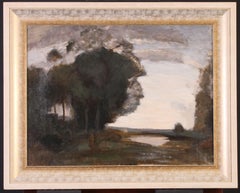
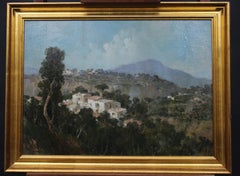
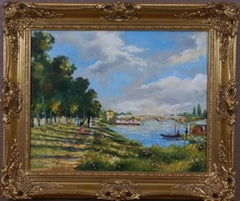
Ronald Ossory Dunlop R.A. 1894-1973, was an Irish painter in landscape, portrait seascape and still life studies, he was also a writer. Dunlop was born in Dublin and lived most of his artistic life in England, travelling back to Ireland regularly to paint, he studied at the Manchester School of Art and the Wimbledon College of Art, he also studied in Paris. Dunlop was serial exhibitor with the Royal Academy, the Leicester Galleries, the Redfern Gallery, the New English Art Club and many others. He joined the London Group of artists and became a member of the Royal Academy in 1950, his works are held in a number of important Institutions including the Tate Gallery and the National Portrait Gallery, both in London. This work is a typical example of Dunlop's style of loose brushwork and heavy impasto, the subjects which painted were as he generally described them as being least important factor in the scale of his art and the method being the most significant aspect of his output. This subject is a few of French farm buildings which may have been an area Dunlop knew well but which has proven to be particularly difficult to identify, however he lived in Barnham, West Sussex, England and at one point within close proximity to the Stopham Bridge, another subject and painting also on sale which with a little artists License one could see the comparison, especially where the land encroaches on the River Avon and is well displayed in the painting.
This painting is signed DUNLOP , lower right.
I have included a short biography of the painter for your interest.
Ronald Ossory Dunlop RA (28 June 1894 – 18 May 1973) was an influential Irish-born author and painter celebrated for his expressive landscapes, seascapes, portraits, and still lifes. He painted extensively in France, a country that served as a major catalyst for his career. Dunlop was born in Dublin, Ireland, into a highly creative Quaker family. His mother, Eleanor Fitzpatrick, was a watercolourist, and his father, Daniel Nicol Dunlop, was a Scottish entrepreneur and prominent theosophist. Growing up, he was surrounded by influential figures of the Irish Literary Renaissance, including W.B. Yeats and James Stephens. During World War I, Dunlop’s Quaker beliefs led him to become a conscientious objector. He spent his service working on farms with the Friends’ Ambulance Unit. After a brief stint working in an advertising agency, he formally pursued art, studying at the Manchester School of Art and the Wimbledon College of Art. In 1923, he co-founded the Emotionist Group, an association of writers and artists that championed raw feeling over rigid academic rules. France played a pivotal role in Dunlop’s artistic evolution, transforming him from a part-time commercial artist into a full-time professional painter. Dunlop traveled to Paris to complete his training, taking informal life drawing classes at an art academy in the historic creative district of Montpasse. Following his successful breakthrough solo exhibition at London's Redfern Gallery in 1928, Dunlop used his profits to finance a seven-week immersion trip to Paris. There, he deeply studied French Impressionism, developing an intense admiration for Camille Pissarro and Alfred Sisley. A second sell-out exhibition in 1929 funded a two-month painting tour across southeastern France. He captured sun-drenched landscapes and coastal vistas in regions such as Cagnes-sur-Mer (1931), Martigues (1939), and later Saint-Tropez (1950s). Dunlop also frequently painted the northern coast of France, producing notable pieces depicting the harbours and coastlines of Honfleur and Normandy.Style and TechniqueDunlop was predominantly an alla prima wet-on-wet painter, executing his vibrant works in single sittings before the paint layer could dry. He was highly regarded for his bold impasto technique, heavily loading his canvas with pure, strong swaths of colour using a palette knife. Later in life, he transitioned to using softer sable brushes to achieve a more fluid, rhythmic line with a thinner texture. He captured himself in his work on numerous occasions, including pieces like Myself in a French Hat. Dunlop became an established fixture of the mid-20th-century British art scene. He joined The London Group in 1931 and was elected a full Royal Academician (RA) in 1950. Alongside painting, Dunlop was a prolific writer, publishing several books including Understanding Pictures (1948) and his autobiography, Struggling with Paint (1956).He spent most of his later life living and working out of a cottage in Barnham, West Sussex, where he died in 1973. Today, his artwork is displayed in world-renowned public collections, including the Tate Gallery in London, the National Portrait Gallery, and the Crawford Art Gallery in Cork.