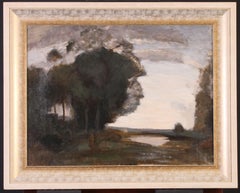
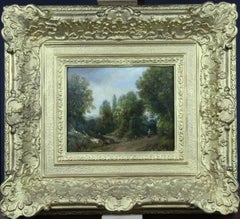
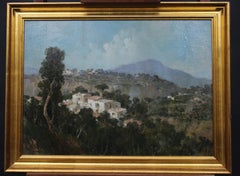
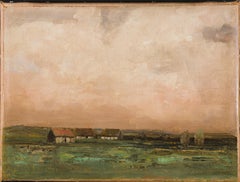
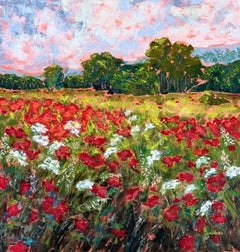
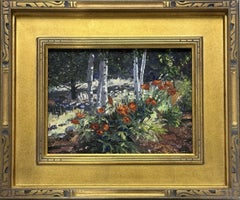
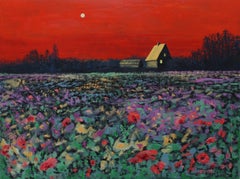
Le Pho 1907 -2001, was a Vietnamese born painter who lived and worked in Paris and was considered to be of the School of Paris. From 1925-1930 he studied art at the Ecole des Beaux Arts in Hanoi, he then travelled to France, Paris , and studied under a companion of Matisse, having finished his studies in Paris he returned to Hanoi to continue teaching until 1937 only to return to Paris continuing his career as a painter. He was much travelled throughout France, Europe and New York. His period and style of his painting in America confirmed his most recognisable style which depicted lush landscapes with elongated Vietnamese women, bright still life subjects, and family settings and portraits. This painting is in the manner of Le Pho and was probably painted by a English artist who was clearly accomplished and was a follower of the now very famous Vietnamese artist. Le Pho continued to paint in a semi realist and surrealist manner throughout his long career, he also continued to refer to Paris , France as his home and yet his fame and fortune was confirmed by his long association with the American Public who consistently and enthusiastically supported him with his luscious landscapes such as this picture. This painting is unsigned but the name of Osman P. Webb was attributed to this work originally, however our researcher could find no confirmation that he was the painter, and consequently we have designated this picture as unsigned.
I have included a further biography for your interest.
Lê Phổ (1907–2001) was a pioneering Vietnamese-French modern master and a leading figure of the École des Beaux-Arts de l'Indochine. His work is celebrated for its poetic synthesis of traditional Vietnamese aesthetics with European Impressionism and Post-Impressionism.
While Lê Phổ is widely recognized for his elegant portraits of women, landscapes serve as the foundational environment of his work, evolving through three distinct stylistic periods:
Early Vietnamese Period (1925–1937): During his formative years in Hanoi, Lê Phổ primarily utilized watercolors on silk. His landscapes from this era, such as L'âge heureux (1930), are characterized by a muted, natural palette and a deep sense of nostalgia. They often depict the misty, serene terrains of Northern Vietnam's Tonkin region.
After settling permanently in Paris, his landscapes shifted under the influence of European Modernism. These works often feature elongated figures in dreamlike, semi-surrealist settings where the natural world becomes a stage for intimate family narratives.
In his later career, Lê Phổ transitioned to oil on canvas, embracing vibrant, "luminous" hues of yellow, green, and blue. His landscapes became lush and impressionistic, often depicting women and families integrated into dense, blooming gardens that evoke a perpetual, idealized spring.
Lê Phổ's landscapes are not mere backgrounds; they are nostalgic "guides to a world that no longer exists," capturing the cultural soul of Vietnam through a refined, international lens. Today, his works are held in major institutions like the Musée d'Art Moderne in Paris and continue to set record prices at international auctions.