Want more images or videos?
Request additional images or videos from the seller.

William Walcot R. E. Hon. R. I. B. A.
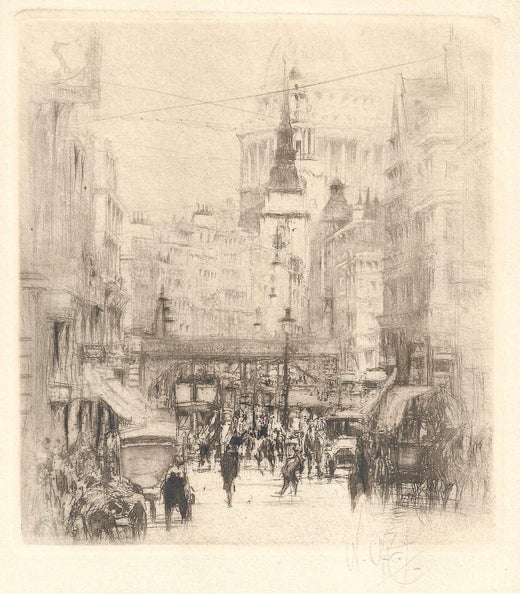
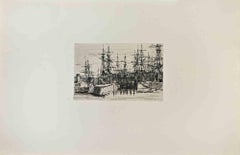
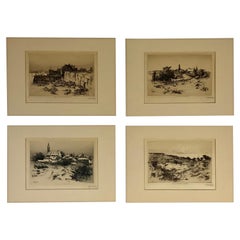
collection of 8 pencil signed etchings of various locations.

Earl 20th Century

$8,791.38
£6,500
€7,936.07
CA$12,536.48
A$12,854.05
CHF 7,323.77
MX$163,621.04
NOK 84,124.47
SEK 87,772.15
DKK 59,323.81

About the Item

William Walcot 1874 - 1943, was one of the most celebrated architectural draughtsmen and printmakers working in England between the two World Wars. Known as "the architects' etcher," his unique style combined exact perspective geometry with a vibrant, impressionistic touch that perfectly captured the grandeur of historic and contemporary cities. Walcot was born at Lustdorf, near Odessa (now Ukraine), to a mixed Scottish-Russian family. He grew up travelling throughout Western Europe and South Africa before returning to Russia at age 17. He studied architecture under Leon Benois at the Imperial Academy of Arts in Saint Petersburg and completed further training at the École des Beaux-Arts in Paris. Before establishing himself in the UK, Walcot spent several years practicing as an architect in Moscow. He became a notable practitioner of the Russian Art Nouveau style (Style Moderne), famously designing the historic Hotel Metropol (completed in 1905). In 1906, Walcot emigrated to England and settled in London. While he rarely returned to actual construction—designing only one London building at 61 St James's Street—he became the most sought-after architectural illustrator of his era. Master architects like Sir Edwin Lutyens, Herbert Baker, and Aston Webb routinely commissioned Walcot to create evocative presentation drawings of their designs. He was elected to the Royal Society of British Artists in 1913, the Royal Society of Painter-Etchers and Engravers in 1920, and was made a Fellow of the Royal Institute of British Architects (RIBA) in 1922. Walcot developed a highly innovative printmaking technique influenced heavily by his mentor and close friend, Frank Brangwyn. Defying traditional British etching customs, Walcot preferred oversized zinc plates over copper and occasionally applied nitric acid directly to the plate to produce dramatic, textured tones. His printmaking fell into two main categories:Classical Antiquity: He was famous for imagined, archeologically informed reconstructions of ancient Rome, Greece, Babylon, and Egypt. He captured the sweeping energy of global hubs, publishing a famous folio titled Architectural Watercolours and Etchings of William Walcot in 1919. London was Walcot’s greatest muse, and his works serve as a vital visual record of the city's changing face leading up to World War II. His London plates are defined by soaring monumental buildings contrasted against blurry, ghostly crowds and early motor cars. Famous examples include: The Strand and Trafalgar Square: Portraying the buzzing movement and architectural layers of the West End. Ludgate Hill (1921): A masterpiece of drypoint and aquatint depicting a bustling street scene with the massive dome of St Paul's Cathedral faintly materialising in the background. Westminster Bridge & Parliament: Highlighting the dramatic gothic silhouettes of the political heart of the empire. The Reconstruction of Piccadilly: Documenting the real-time urban transitions of the 1920s. The modern print market crash following the 1929 Wall Street financial collapse severely damaged Walcot's primary source of income. Though he maintained some business through private patrons, the outbreak of World War II completely devastated his remaining architectural practice. Suffering from poor health and deep depression, Walcot tragically died by suicide after falling from a nursing home window in Hurstpierpoint, Sussex, on 21 May 1943. Today, his works are heavily collected, and his legacy is honored by institutions globally, with his original painting palette preserved at RIBA in London. This group of eight pencil signed etchings contain a variety of views, including, Trafalgar Square, London, Piccadilly Circus, London, Fleet Street, London, etc. also include Florence and Rome. They are offered here as one lot , eight pictures, they have been professionally cleaned and framed sympathetically with non reflective glass to a 1920's styled frame, they all include the original plate marks and pencil signatures of the artist.
More From This Seller

View All
Unknown location .

Unknown location .

By Hercules Brabazon Brabazon

Located in Douglas, Isle of Man

Hercules Brabazon Brabazon 1821-1906, was an English watercolour painter. He was born Hercules Brabazon Sharpe his father was Hercules Sharpe and his father in-law was Sir Anthony Br...

Category

Late 19th Century Landscape Drawings and Watercolors

Materials

Paper, Watercolor, Gouache

Extensive landscape

Extensive landscape

By Thomas Creswick

Located in Douglas, Isle of Man

Thomas Creswick R.A. 1811 - 1869, was an English landscape painter and illustrator. Creswick was one of the leading members of the Birmingham School of landscape painters and exhibit...

Category

1840s Landscape Paintings

Materials

Canvas, Oil

Pond Farm

Pond Farm

Located in Douglas, Isle of Man

Bernard Sleigh 1872-1954, was an English mural and stained glass painter, illustrator, and landscape painter. He was best known for his fairyland pictures and was inspired by Willi...

Category

Early 20th Century Landscape Drawings and Watercolors

Materials

Paper, Watercolor

Sunset

Sunset

By Benjamin Williams Leader

Located in Douglas, Isle of Man

Benjamin Williams Leader 1831-1923, was an English landscape painter, he exhibited at the Royal Academy from the age of 23 and continued every year until 1922. He was a very popular ...

Category

Late 19th Century Landscape Drawings and Watercolors

Materials

Paper, Watercolor

Potts Point Sydney Australia

Potts Point Sydney Australia

Located in Douglas, Isle of Man

Sydney Ure Smith O.B.E. 1887-1949, was an English born Australian Arts publisher and part time painter, but did not exhibit his own works. He studied pencil and ink drawing at the A...

Category

1930s Landscape Drawings and Watercolors

Materials

Paper, Watercolor

You May Also Like

Antique 3 Drawings by a Boston Artist, Signed June 21, 1908, D4

Antique 3 Drawings by a Boston Artist, Signed June 21, 1908, D4

Located in Norton, MA

3 Drawings by a Boston Artist, Signed June 21, 1908, D4 Three drawings of figures, two 7" x 4.5", and one 5" x 4.25", were drawn in the early 20th century, Framed (22.5" x 14.5") und...

Category

Antique 18th Century American Paintings

Materials

Wood, Paper

Set of 4 Rare 19th Century Landscape Etchings by William Goodrich Beal

Set of 4 Rare 19th Century Landscape Etchings by William Goodrich Beal

Located in Bedford Hills, NY

A rare and complete suite of four original 19th-century etchings by renowned American artist William Goodrich Beal. These works capture the serene coastal and village landscapes of l...

Category

Antique 1880s American American Classical Prints

Materials

Paper

Three English engravings - 19th century

Three English engravings - 19th century

Located in Porto, PT

Three English engravings - 19th century. English; 19th century; two views of Porto and one view of Penha d'Águia. Dimensions: (largest) 30x43 cm

Category

Antique 19th Century British Prints

Materials

Paper

Set of 6 19th-century engravings

Set of 6 19th-century engravings

Located in MILL, NL

Set of six 19th-century engravings, dating from around 1860 The images depict classical figures and sculptures from Greco-Roman mythology and antiquity, rendered with fine, detailed...

Category

Antique 19th Century Picture Frames

Materials

Glass, Wood, Paper

J.B. Waring - Antique Prints, Silvermith's Work and Group of Silver Vases

J.B. Waring - Antique Prints, Silvermith's Work and Group of Silver Vases

Located in Savannah, GA

J.B. Waring Silversmith's Work and Group of Silver Vases Two framed antique chromolithographs published in London in 1863 for Masterpieces of Industrial Art and Sculpture at the Gr...

Category

Antique 1860s English Prints

Materials

Gold Leaf